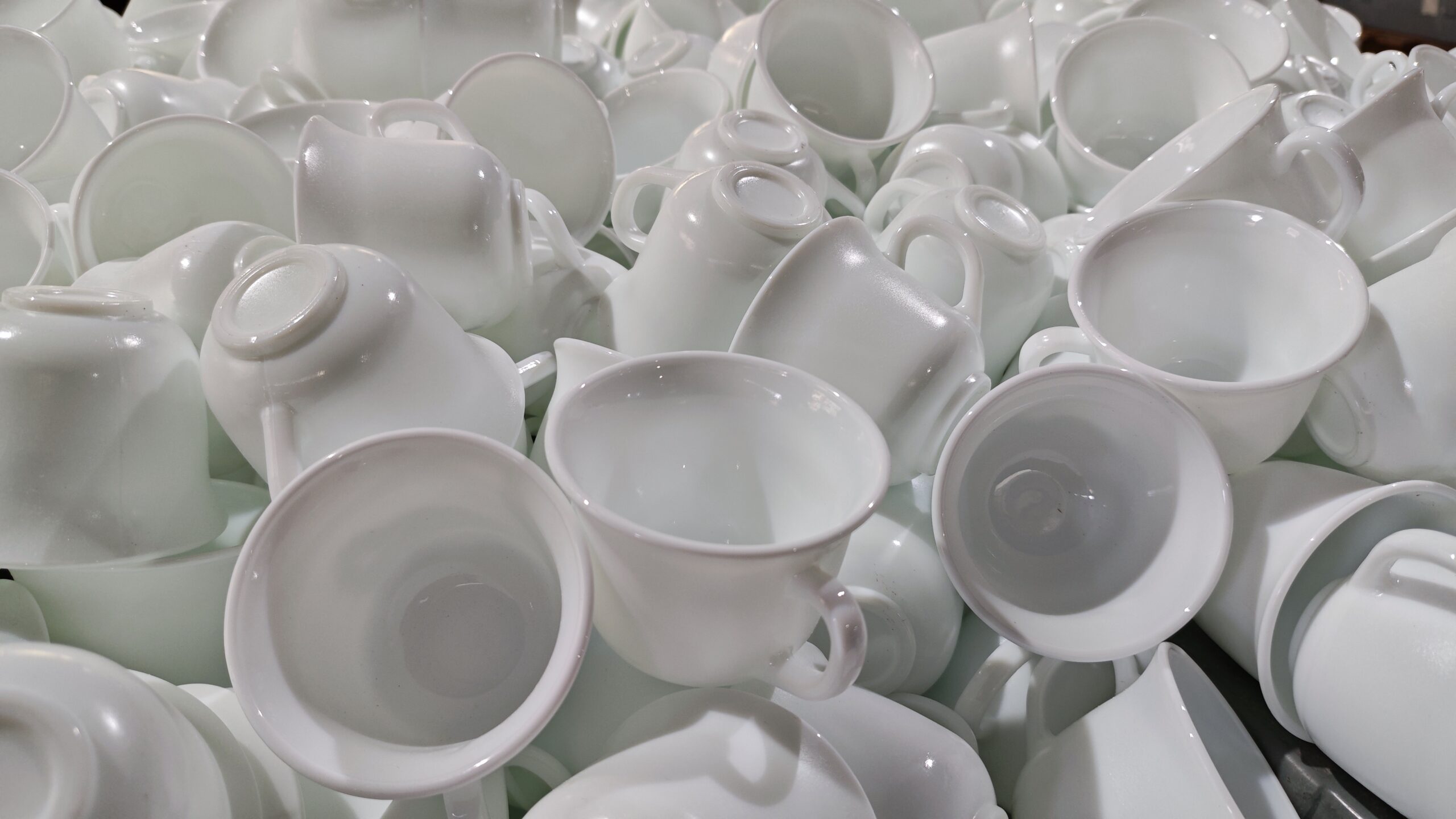
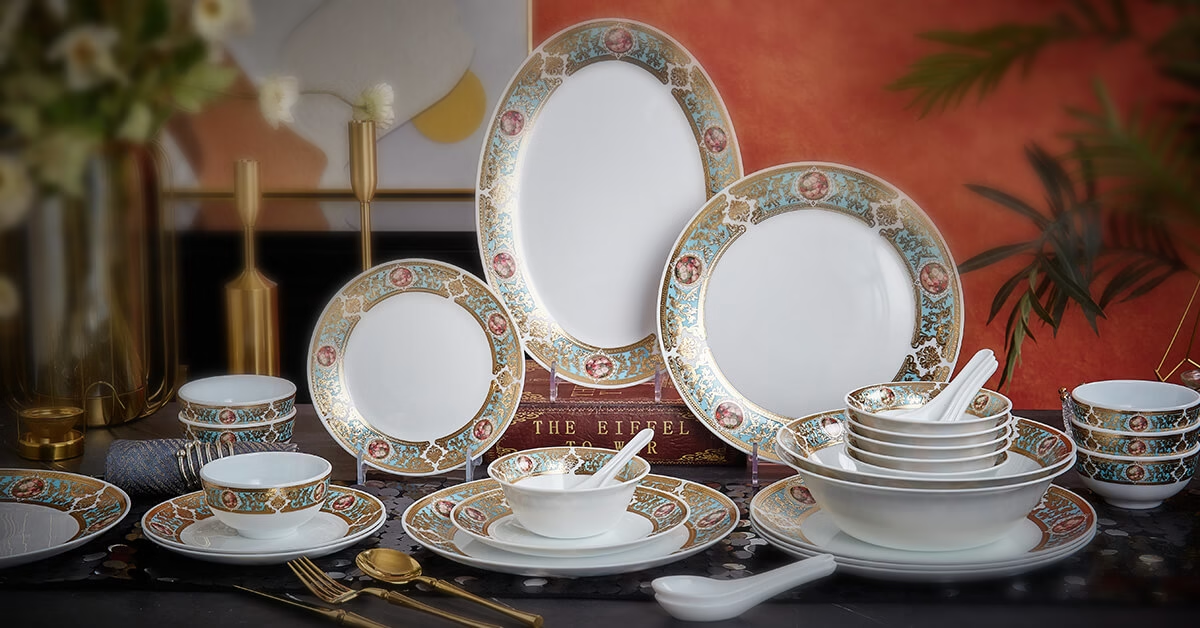
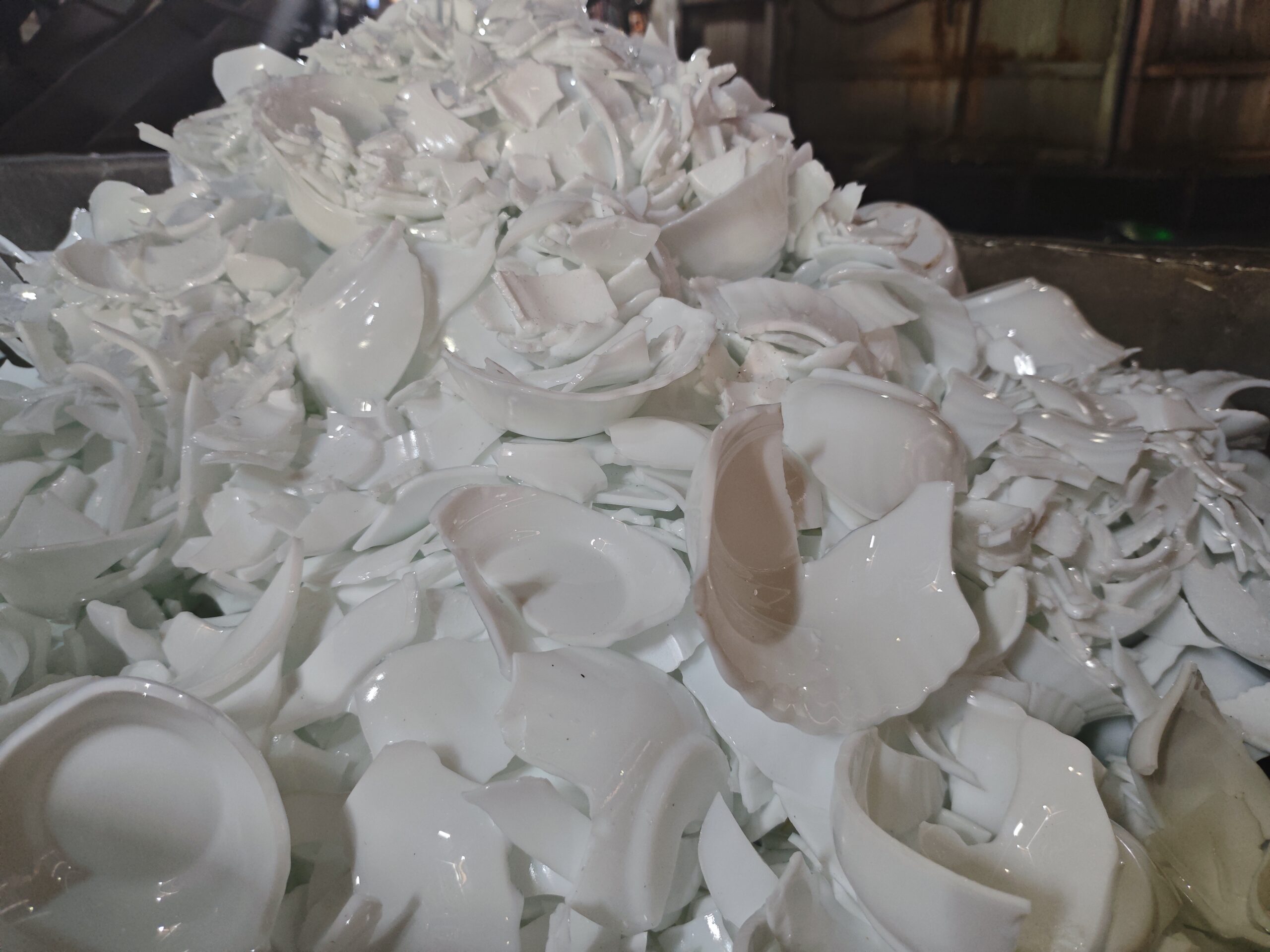
⚡Short note: Opal glass lowers restaurant breakage with edge resilience, lightweight design, easy cleaning & long lifecycle—vs porcelain/melamine.
- Edge durability: Dense crystalline structure disperses impact stress, delaying initial edge gaps in commercial dishwashers—lasting 3–5 times longer than ceramic in high-volume, repeated cleaning cycles.
- Stacking efficiency: Lightweight build reduces total weight and bottom pressure of stacked sets, allowing 33% higher stacking height without frequent realignments, cutting daily transfer times.
- Easy cleaning: Non-porous glass surface prevents residue and pigment from embedding, maintaining consistent post-wash cleanliness and avoiding extra rewashing or touch-ups over time.
- Lifecycle value: Average service life extends from 18 to 30 months, offsetting higher upfront costs by reducing annual replenishment expenses for kitchens handling hundreds of pieces daily.
How Opal Glass Edge Impact Resistance Reduces Loss in Commercial Dishwashers
If you stand in the back kitchen of a restaurant and watch the dishwashers run round after round, you will notice a detail: the key to restaurant dinnerware breakage reduction is often hidden in the continuously running cleaning process backstage—not the bumps on the dining table. It is not the bumps when serving dishes, nor the operations of customers during meals, but the almost continuously running cleaning process in the backstage.
From the perspective of the actual operation of the cleaning process, the damage path of tableware usually shows a similar rhythm: the edges are more likely to be the area of repeated contact: during the loading, unloading and stacking stages, the plate rims often bear more mechanical contact. A single action is usually not enough to show problems: in most cases, the impact strength is limited, and damage will not appear immediately. The number of cleanings gradually widens the material differences: as the cycles accumulate, whether the edge structure is stable begins to affect the rhythm of loss occurrence.
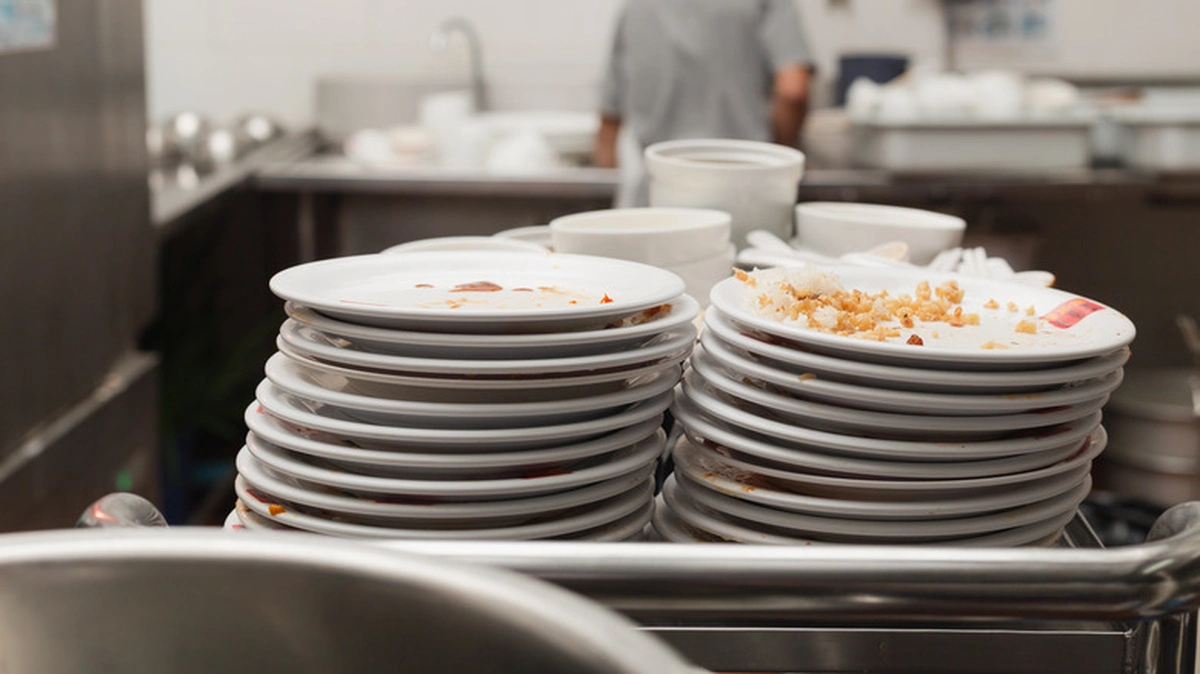
From a long-term use perspective, what really widens the difference in breakage rates is not just “whether it can withstand a single collision”, but whether the material is more likely to be gradually pushed to a state of failure after hundreds or thousands of repeated actions. This is the core of restaurant dinnerware durability – not instantaneous strength, but sustained performance. In such an environment dominated by repetition, the stability of the edge is often closer to the actual use scenario than the instantaneous strength. So, how exactly does the edge impact resistance of opal glass reduce losses in commercial dishwashers? The answer to this question needs to be found from the corresponding relationship between material characteristics and actual loss paths.
First, it changes the starting point of edge failure. In traditional tempered porcelain tableware, edge damage often starts with local peeling of the glaze layer – when the plate rim repeatedly contacts the metal basket bars, tiny cracks appear at a concentrated stress point on the glaze surface. The dense crystalline structure of opal glass prevents impact energy from concentrating on a single point on the surface, but instead disperses it over a larger area. This means that under the same cleaning intensity, the time for initial gaps to appear on the edges is delayed – possibly from the 200th cleaning to the 500th, or even longer.
Second, it slows down the expansion speed of damage. Once a small gap appears on the edge, every subsequent contact during cleaning may become an “expansion point”. Once the glaze layer of tempered porcelain is damaged, the internal ceramic body is exposed and more likely to further crack during friction. Due to the uniform overall material of opal glass, there is no structural difference between the “surface layer – substrate”, so the expansion path of the gap is more dispersed and slower. The actual performance is: the same degree of initial wear may develop into obvious cracks on tempered porcelain within three months, while on opal glass it may take six months or even longer.
Third, it directly reduces the overall scrap rate caused by edge damage. In the actual operation of commercial kitchens, the standard for eliminating tableware is often not “complete breakage”, but “visible gaps or cracks” – even if other parts of the plate are intact, once the edge has obvious defects, it is usually replaced immediately. Therefore, a material with a more durable edge means that a single piece of tableware can complete more cleaning cycles before reaching the scrap standard. If the average service life of a set of tableware is extended from 18 months to 30 months, the difference in annual replenishment costs can be clearly calculated for a commercial kitchen that cleans hundreds of pieces of tableware every day.
Finally, this way of reducing losses is essentially achieved by “delaying the failure rhythm”. It does not make collisions disappear, nor does it change the operation mode of the dishwasher, but allows the material to maintain edge integrity for a longer time in the same mechanical cycle. From a cost control perspective, this is equivalent to using the structural characteristics of the material itself to exchange for a longer effective service time – not avoiding damage in one go, but making the arrival of damage slower and more predictable.
How Opal Glass Lightweight Design Improves Stacking & Storage
In a restaurant, the operational efficiency of tableware often starts to show in those moments that do not require deliberate thinking but are immediately perceived. If you shift your perspective from the dining area back to the back kitchen, you will find that what truly tests restaurant dinnerware durability repeatedly is not “how easy it is to use”, but how easy it is to stack, whether it is easy to place stably, and whether it is smooth to carry. The differences between opal glass, tempered porcelain and commercial melamine are also gradually amplified in these continuous actions.
Weight is usually the first factor to be felt, but it is not always clearly realized at the first time. When holding a single plate in your hand, the difference is not obvious; but once in the back kitchen, they often appear in groups. Stacking, transferring, centralized placement – weight is no longer just a feeling, but an operational burden that gradually manifests with the accumulation of quantity. The more you stack, the more obvious this burden becomes; and any instability is more likely to be amplified at this moment.
This is why in high-frequency operation environments, lightweight is often not a deliberately emphasized feature, but it is more likely to be continuously perceived in actual operation. For procurement decisions and material design, the three indicators of durability, weight and stacking efficiency are often considered simultaneously. In our another article How to Choose the Most Durable Opal Glass Dinnerware Set, we also discussed the purchasing criteria for opal glass tableware from the perspective of practicality and durability, emphasizing that commercial kitchens should pay attention to commercial dishwasher safety ratings and shatter resistance marks to help operators achieve higher comprehensive efficiency in procurement.
The user experience of tempered porcelain is more reflected in another focus. A single piece is thick and has a stable feel, but when this stability is superimposed into multiple pieces, the weight itself begins to become a variable that needs to be paid attention to. People tend to be more cautious when stacking, and subconsciously slow down their movements when transferring.
As for commercial melamine, its light weight is a relatively intuitive advantage, but after long-term high-temperature cleaning and high-frequency use, it is usually necessary to continuously pay attention to whether the shape can remain consistent. For commercial dishwasher safe dinnerware, consistent performance across repeated high-temperature cycles is just as important as initial usability.
In addition to weight, whether the shape is regular is often noticed only in later operation steps. When using a single piece, few people will care about the slight differences in the bottom of the plate; but when a dozen plates are stacked together, these differences start to become concrete – do they align naturally when placed, or do you need to turn the angle slightly? Can you walk away after stacking, or do you subconsciously hold it again?
In this regard, the structural consistency of opal glass tableware is more reflected in the fact that it interferes less with the operation process. The bottom size of the plate is relatively clear, the stacking path is relatively definite, and the stacking process usually does not require additional correction. This smoothness is not conspicuous, but it can make the entire process easier to maintain coherence.
First, how lightweight directly improves the controllability of stacking height. In commercial kitchens, plate stacking is not fixed at a certain standard height – in actual operation, employees will judge “it’s about right to stack here” based on the current feel and stability. Due to the lighter weight of a single opal glass plate, the total weight and bottom pressure generated by stacking at the same height are smaller. What does this mean? It means that under the same sense of safety, opal glass plates can usually be stacked higher – maybe 12 instead of 8, maybe one stack instead of needing to be divided into two. This difference is not noticeable in a single operation, but when hundreds of pieces of tableware need to be processed a day, the higher single stacking amount is directly converted into fewer transfer times and more compact storage space occupation.
Second, how lightweight reduces “correction actions” during stacking. When a plate is placed on an existing stack, the weight itself generates a downward impact. If a single piece is heavy, this impact is more likely to cause slight displacement of the plates below, requiring the operator to stop and readjust the alignment. Due to its lighter weight, opal glass produces less impact when placed down, making the stacking process easier to complete in one go – not that no attention is needed at all, but fewer cases of “needing to stop and straighten again” are triggered. From the perspective of time cost, the cumulative effect of this smoothness is reflected in the improvement of the overall operational rhythm.
Third, how shape regularity forms a synergistic effect with lightweight. Lightweight itself does not automatically bring a better stacking experience – if the bottom size of the plate is inconsistent and the edges are not regular enough, even if it is light, it may not stack stably. The production process of opal glass (high-temperature melting integrated molding) makes the bottom diameter and edge curve of each plate maintain high consistency. When this regularity is combined with lightweight, the stacking path becomes clearer: it can be aligned naturally when placed down, without needing to rotate the angle to find a fitting point; the overall stacked structure is less likely to lose balance due to the deviation of a single piece. This “structural coordination” allows the advantages of lightweight to be more fully exerted.
Fourth, how to reduce space waste and safety hazards in the storage link. Storage is not just “putting on the shelf”, but also involves space utilization and access safety. Since opal glass plates can be stacked higher and more stably, the number of storage shelf layers required for the same number of tableware is fewer, or more stacking groups can be accommodated on the same layer. For back kitchens with tight space, this is directly converted into more flexible layout possibilities. At the same time, the lighter weight also means that employees bear less burden on their arms when taking a stack of plates from high shelves, and are less likely to drop them because “it’s heavier than expected” – in an environment with frequent access, this is an easily overlooked factor that actually affects safety, especially for shatter resistant restaurant dinnerware that needs to maintain integrity during handling.
Finally, the essence of this improvement is to reduce the “friction coefficient” in the operation process through material design. Lightweight and regularity do not change the basic actions of stacking and storage, but make these actions encounter less resistance when executed: less need for extra effort, less need for mid-course adjustments, less need to allocate attention to “handle with care”. From the perspective of operational efficiency, this is equivalent to using the characteristics of the material itself to exchange for higher certainty and coherence in the operation process – not making employees feel “this tableware is really light”, but allowing them to not need to slow down the rhythm or add steps because of the tableware itself in daily work.
How Opal Glass Easy-Clean Surface Beats Other Dinnerware
In the daily operation of a restaurant, few people will specifically discuss “how easy it is to clean the tableware”. More often, this issue is perceived at a specific moment – for example, just after the peak period, the dishwasher runs continuously, the tableware is pushed out in batches and stacked on the operating table, the lights are turned on, some plates look ready to be served directly, while others make people subconsciously take a second look. It’s not that they haven’t been cleaned, but there are certain differences in the state after cleaning. Water marks, dark shadows, slight residues, which do not affect use sometimes, but will slow down the rhythm when busy. It is in these repeatedly appearing details that the differences between tableware materials are gradually perceived, a key aspect of opal glass vs porcelain vs melamine restaurant performance comparisons.
From a material perspective, the cleaning performance of opal glass does not rely on additional surface treatment, but mostly comes from its own structure. Unlike tempered porcelain, which forms a smooth surface through a glaze layer, the surface of opal glass is directly composed of a glass matrix, making it more uniform and continuous overall. Regarding this point, there is a very intuitive description in the description of the material characteristics of opal glass:
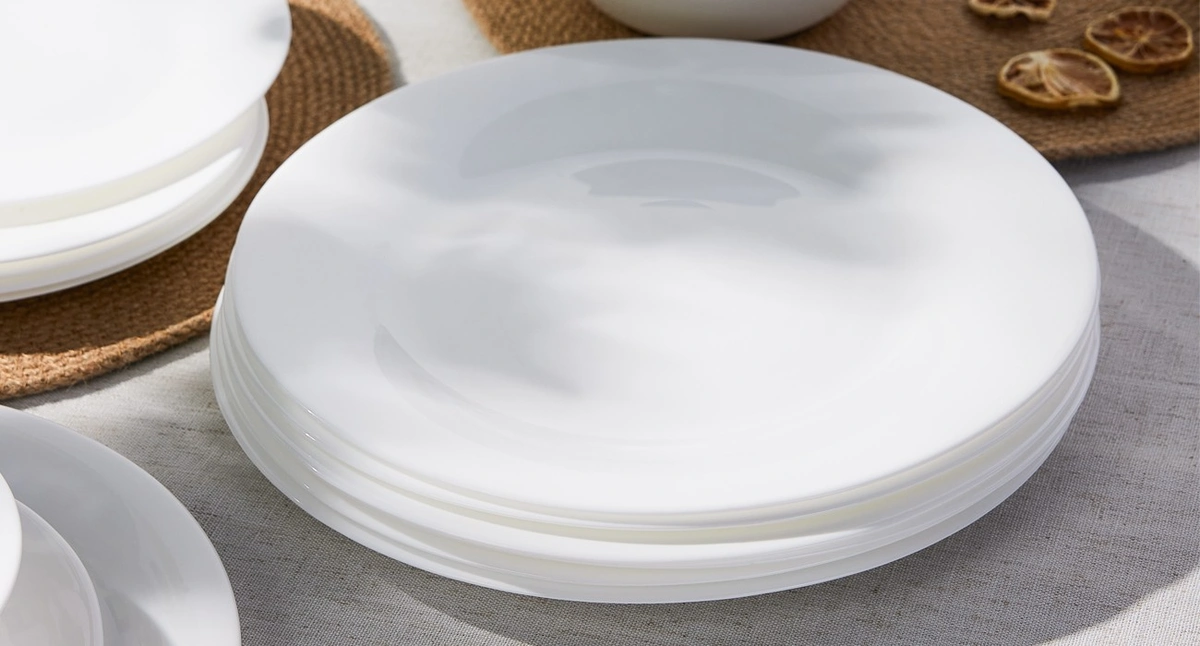
“Hard, ideally even coating practically has no pores, therefore there is no dirt on it, it is very easy to clean.”
What is really worth paying attention to here is not the literal “there is no dirt”, but “practically has no pores”. In other words, stains are relatively less likely to embed into the surface structure, and mostly only stay on the surface layer – and this often affects whether repeated treatment is needed during cleaning.
In actual use, the differences between different tableware in the cleaning link are usually not fully visible in one time, but gradually widen with the passage of use time: Opal glass: the surface is relatively flat, and oil and sauce are easier to be washed away during cleaning. Regarding such long-term use feedback and easy-cleaning experience, you can find more real users’ dynamic feedback articles in What Do Long-Term Users Say About Opal Glass Dinnerware?, which summarizes the specific performance of easy cleaning, low wear and long-term maintenance of appearance from the perspective of long-term household and commercial scenarios, which is highly consistent with the discussion of “post-cleaning state” and “cleaning stability” in this section.
Tempered porcelain: the glaze surface is bright when first used, but after repeated stacking and scrubbing, tiny scratches may gradually appear, and these marks are easy to amplify the sense of presence of water marks and stains.
Commercial melamine: light and labor-saving in the early stage, but with the increase of use times, surface wear and pigment residue are more likely to accumulate, and often need additional inspection or wiping.
It should be noted that opal glass is not tableware that “does not need to be cleaned”. Its difference is that under the same cleaning process, it is less likely to amplify those unavoidable small residues. When the dishwashing steps remain unchanged, but there is less hesitation about “whether this piece needs to be washed again”, the overall rhythm often becomes smoother.
This change is difficult to be clearly pointed out in a single comparison, nor is it necessarily reflected in numbers immediately. But in an environment with high-frequency table turnover and continuous cleaning, whether rewashing is needed, whether manual repeated confirmation is required, whether it is temporarily shelved due to appearance problems, these details will keep repeating.
First, its performance in the “clean after washing” link is more stable. When a batch of tableware comes out of the dishwasher, the difference often appears at this moment: some need a second look, some need to wipe off water marks with a cloth, and some can be returned to their positions directly. Due to the extremely low surface porosity (“practically has no pores”) of opal glass, stains mostly stay on the surface layer rather than embedding into the structure, which makes oil, sauce and food residues easier to be completely washed away by high-pressure water flow under standard cleaning processes. The actual performance is: under the same dishwasher program, the “one-time pass rate” of opal glass tableware from unloading to shelving is usually higher – no need for rewashing, no need for additional wiping, directly entering the next process. This stability is particularly critical during peak hours: when the back kitchen needs to quickly turn over tableware, fewer “need for reprocessing” means a more coherent overall rhythm.
Second, it can still maintain a good clean appearance after long-term use. Tempered porcelain usually has a smooth surface in the early stage of use, but with the accumulation of repeated stacking, metal tableware scratching and high-temperature cleaning, the glaze layer will gradually appear tiny scratches. These scratches themselves do not affect the function, but will produce irregular reflections under light, amplifying the visual presence of water marks and tiny residues – even if it is actually clean, it still looks like “not washed thoroughly”. Due to the uniform overall material of opal glass and the surface directly composed of glass matrix, wear is relatively slower and more uniform. This means that after six months or a year of use, it is less likely to have the visual trouble of “looking old” or “always feeling not clean”. For restaurants that need to set tables in open or strong light environments, this continuous clean appearance directly affects customers’ perception of the restaurant’s overall hygiene level.
Third, its advantage in resisting pigment accumulation is more obvious. In commercial kitchens, tableware will repeatedly come into contact with ingredients with high pigment content such as curry, tomato sauce, soy sauce and coffee. The “yellowing” or local staining that often appears on commercial melamine tableware after a period of use is precisely because the surface structure is not dense enough, and pigment molecules gradually penetrate into micropores or scratches after multiple contacts. The non-porous glass surface of opal glass makes pigment molecules lack a microstructure to attach to – not that there is no residue at all, but under the same cleaning conditions, it is easier to be completely removed. The actual effect is: after several months of use, the color of opal glass tableware is closer to the initial state, and there is no need to replace it in advance because “it looks old”. This stain resistance, combined with strong structural stability, enhances overall restaurant dinnerware durability.
Finally, this “outperformance” is reflected in specific savings in operational links. The actual value of an easy-clean surface is not just “looking cleaner”, but reducing uncertainty and additional processing in the cleaning process. When employees take tableware out of the dishwasher, they need to stop less to judge “whether this piece needs to be washed again”; when tableware is stacked on the operating table, fewer are temporarily shelved due to water marks or residues; when rapid turnover is needed during peak hours, fewer tableware disrupt the rhythm because of “unsatisfactory state”. These details seem insignificant in a single time, but accumulate into a perceptible difference in efficiency when repeated hundreds of times a day. From a cost perspective, this is equivalent to using the surface characteristics of the material itself to exchange for time savings in manual inspection and secondary processing – not making cleaning unimportant, but making the results of cleaning more predictable, stable and less in need of remediation.
Restaurant Dinnerware Guide: How to Choose and Save Money by Type
If starting from actual operation, we will find a very realistic situation: different types of restaurants consume tableware in different ways. Some restaurants have concentrated consumption during peak operation hours, some occur during cleaning and stacking processes, and others are reflected in the overall state changes after long-term use.
Restaurants with high table turnover and tight rhythm: In a fast-paced environment, tableware has almost no rest time. Recycling, centralized stacking, cleaning, and serving again – each link will continuously amplify material differences. If a certain type of tableware is more likely to have problems in edge bumps or high-temperature cleaning, replacement will gradually become the norm. Industry data also mentions that in high-intensity commercial scenarios, “Commercial kitchens report 3–5 times longer lifespan with opal glass tableware compared to ceramic alternatives, making it the smart choice for high-volume operations where replacement costs directly impact profitability.” Such feedback does not mean that there is an absolute superiority or inferiority between materials, but under high-frequency use conditions, choices with longer service life are often easier to control the replacement rhythm, a key goal of restaurant dinnerware breakage reduction.
Restaurants with continuous high frequency but relatively stable rhythm: Family-style or local chain restaurants usually need to cope with a stable frequency of use and also maintain the basic appearance of the tabletop. Tempered porcelain is not uncommon in this scenario, but edge bumps or surface changes tend to appear earlier over time. Some restaurants only realize in the later stage that what really brings pressure is not a single damage, but “whether it is necessary to replace the whole set in advance”. In contrast, opal glass does not rely on the glaze layer to maintain its state, so changes after long-term use are slower. This difference is not obvious in the early stage, but will be gradually perceived in the later stage.
Usage places emphasizing stacking efficiency and safety management: In buffets, group meals or staff canteens, tableware is more managed quickly rather than displayed. Commercial melamine has practical advantages in light weight and shatter resistance, but aging and surface wear will also affect the overall replacement rhythm after long-term use. In contrast, the state change of opal glass is more controllable under high-frequency cleaning and repeated use, which is often more acceptable in scenarios emphasizing long-term stability. As commercial dishwasher safe dinnerware, it maintains consistency across hundreds of cleaning cycles.
Returning to the procurement decision itself, what really needs to be clarified is not “which material is better”, but where the tableware is mainly consumed.
Step 1: Identify where the tableware is mainly consumed in your restaurant. The concentration points of tableware loss vary in different restaurants. Tableware in fast-food restaurants may be mainly lost in the links of rapid recycling and stacking; high-end restaurants may replace tableware in advance more because of appearance changes; buffets may gradually accumulate damage in high-frequency cleaning. The method to identify this is straightforward: review the tableware eliminated in the past three months – were they eliminated due to edge chipping, surface wear, color aging, or overall breakage? Where the loss is concentrated, priority should be given to materials with more stable performance in that link. For example, if you find that most plates are eliminated because “small gaps appear on the edges after dishwashing”, then edge impact resistance should be a key indicator in selection; if more are replaced because “they look old and have scratches”, then surface wear resistance and stain resistance are more worthy of attention.
Step 2: Calculate the “total life cycle cost” rather than the one-time procurement price. The real cost of tableware should be “procurement unit price ÷ service life”. A plate that costs 20 yuan and can be used for 3 years has an actual annual cost of 6.67 yuan; a plate that costs 12 yuan and can only be used for 1 year has an annual cost of 12 yuan instead. This calculation seems simple, but it is often ignored in actual procurement – because at the time of procurement, only the former is “8 yuan more expensive” is seen, but it is not foreseen that the latter needs to be replaced twice in the next two years. The specific operation method is: record the average cycle of the currently used tableware from procurement to scrapping (which can be inferred from the inventory consumption speed), then use “total procurement cost ÷ average number of months of use” to get the monthly average cost, and then compare it with the new plan. If the unit price of opal glass is 1.3 times that of tempered porcelain, but the service life is 3 times (as mentioned earlier “3–5 times longer lifespan”), then from the perspective of the total life cycle, its cost is actually lower.
Step 3: Match material priorities according to restaurant types. Different types of restaurants have different core needs for tableware, and limited budgets should be invested in the most critical performances:
- High-turnover fast food/chain restaurants: Prioritize edge impact resistance and high-temperature cleaning stability. Tableware in such restaurants may undergo 5-8 cleaning cycles every day, and loss mainly comes from the mechanical repetition of cleaning-stacking-recleaning. Opal glass has the most obvious advantages in this scenario because its overall structural stability can withstand high-frequency mechanical cycles without rapid failure.
- Family-style/local restaurants: Prioritize long-term appearance stability and stain resistance. Although the table turnover frequency of such restaurants is not as high as that of fast-food restaurants, the service life is often longer (2-3 years), and customers are more sensitive to the appearance of tableware. In this scenario, tempered porcelain performs well in the early stage, but the advantage of opal glass in maintaining a good state after 1-2 years will gradually appear.
- Buffets/group meals/canteens: Prioritize lightweight and stacking efficiency, while taking durability into account. In such scenarios, the management attribute of tableware is stronger than the display attribute, and rapid turnover and safety are core demands. If the budget is limited and the replacement cycle is acceptable, commercial melamine is a reasonable choice; if you want to reduce the long-term replacement frequency, the lightweight + durable combination of opal glass is more advantageous.
Step 4: Test in batches instead of replacing all at once. Even if calculations show that a certain material has a cost advantage, it is recommended to test in small batches first – for example, buy 50-100 pieces of new material tableware, mix them with existing tableware for 3-6 months, and then compare the actual loss rate, cleaning effect, employee feedback and customer perception. This “incremental verification” method can verify material differences in your own operating environment, rather than relying entirely on theoretical data or supplier statements. During the test, you can focus on observing: whether the new tableware is damaged more slowly under the same use intensity, whether the state after cleaning is more stable, and whether employees find it more convenient to operate. If the test results meet expectations, then gradually expand the procurement proportion; if it is found to be inconsistent with expectations, the loss is also controlled within an acceptable range.
Finally, the essence of saving money is to align procurement decisions with actual loss paths. Tableware procurement should not be a simple choice of “buying cheap” or “buying expensive”, but “buying the one that wears slower and has a more stable state in your own operating environment”. When you clearly know where the tableware is mainly consumed, what the consumption rhythm is, and which performances are most critical to extending the service life, the procurement decision is no longer a gamble, but a cost control link that can be calculated and optimized. Opal glass vs porcelain vs melamine restaurant selections depend on matching operational needs, and each has its applicable scenarios; the key is to find the one that best matches your operational rhythm, loss mode and budget structure – this is the real meaning of “saving money”.
Technical Comparison of Opal Glass, Tempered Porcelain and Commercial Melamine
| Performance Indicator | Opal Glass | Tempered Porcelain | Commercial Melamine |
|---|---|---|---|
| Edge Impact Resistance | High (stress dispersion via dense crystalline structure; slow gap expansion) | Medium (relies on glaze layer; gaps expand fast after glaze damage) | Low to Medium (lightweight but prone to edge deformation after long-term use) |
| Lightweight & Stacking Efficiency | High (lightweight with high structural consistency; stable stacking) | Low (heavy single piece; stacking requires more caution) | Very High (ultra-lightweight but shape irregularity may occur over time) |
| Easy-Clean Surface | High (non-porous surface; low pigment accumulation; stable post-cleaning state) | Medium (smooth initial glaze; scratches amplify residue visibility over time) | Medium (easy to clean initially; pigment residue accumulates with use) |
| Service Lifespan (Commercial Scenarios) | 24-36 months | 6-18 months | 12-24 months |
| Annual Cost (Based on Unit Price & Lifespan) | Low (higher unit price offset by longer lifespan) | Medium to High (low unit price but frequent replacement) | Medium (low unit price; moderate replacement frequency) |
Frequently Asked Questions (FAQ)
1. How does opal glass perform compared to tempered porcelain in terms of long-term edge durability in commercial dishwashers?
Opal glass outperforms tempered porcelain significantly in long-term edge durability. Tempered porcelain relies on a glaze layer for edge protection; once the glaze is chipped (often from repeated contact with metal dishwasher baskets), the underlying ceramic body is prone to rapid cracking and gap expansion. In contrast, opal glass’s dense crystalline structure disperses impact stress across a larger area, delaying the formation of initial edge gaps (from ~200 to 500+ cleaning cycles) and slowing gap expansion—initial wear that leads to visible cracks in 3 months on porcelain may take 6+ months on opal glass. This translates to a 3–5 times longer lifespan for opal glass tableware in high-frequency commercial dishwasher use.
2. Is opal glass more cost-effective than commercial melamine for buffet-style restaurants focusing on stacking efficiency?
It depends on the restaurant’s priority: short-term vs long-term cost. Commercial melamine is ultra-lightweight (excellent for stacking efficiency) and has a lower upfront cost, making it cost-effective for short-term use (12–24 months). However, melamine develops shape irregularity and pigment accumulation over time, requiring more frequent replacement. Opal glass, while having a higher upfront price, offers lightweight design combined with structural consistency (stable stacking without frequent correction) and a longer lifespan (24–36 months). For buffets aiming to reduce long-term replacement costs and maintain stacking stability over time, opal glass is more cost-effective due to its lower annualized cost (total procurement cost divided by lifespan) and reduced operational friction from consistent stacking and cleaning performance.