
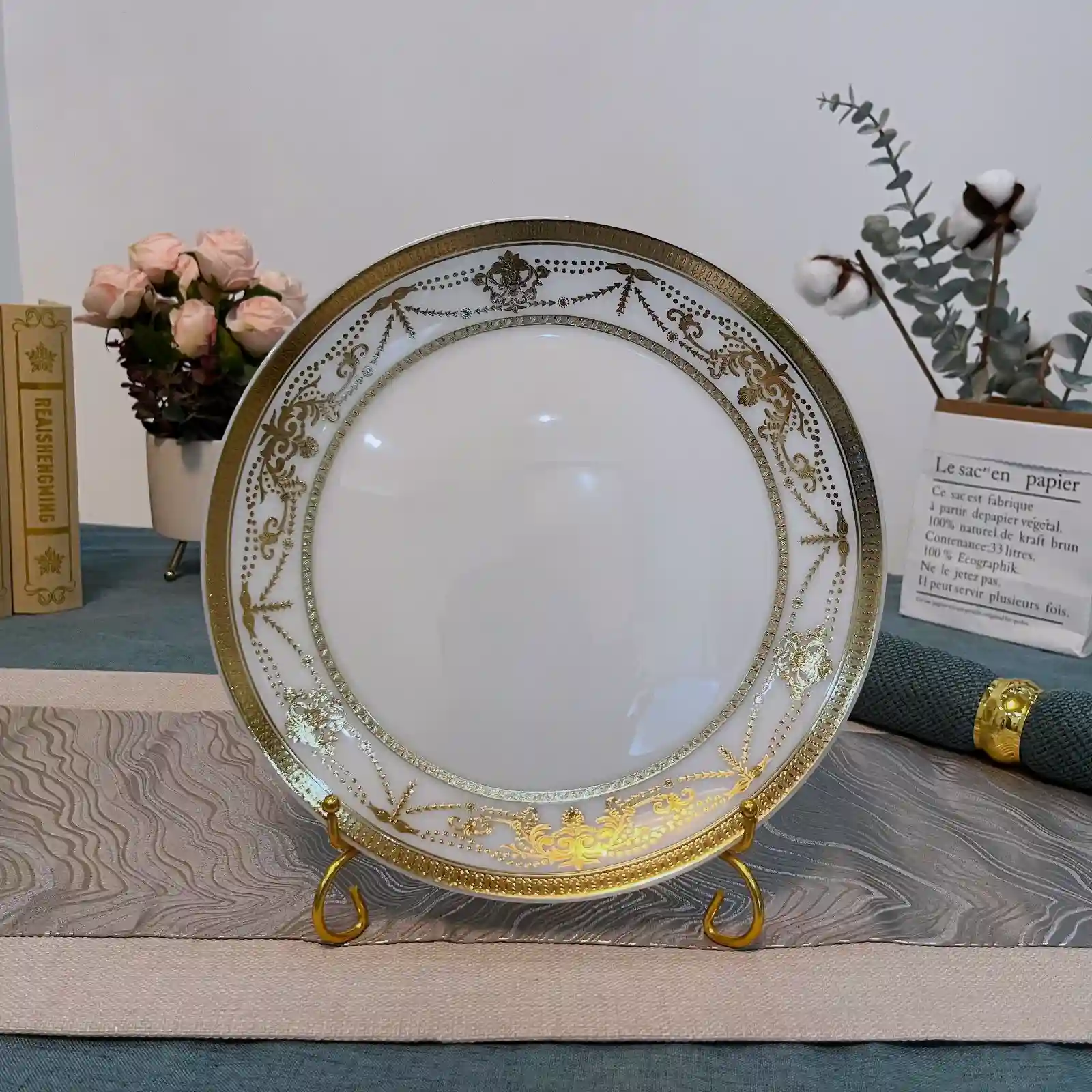
Opal Glass Plate for Airline Catering | Lightweight

FeatureDescription
Lightweight MaterialLighter than ceramic, safer than melamine—opal glass plates cut onboard weight and meet airline food-contact safety standards.
Impact ResistanceImpact-resistant microcrystalline structure survives turbulence, galley cart stacking, and repeated ground-handling cycles.
Thermal StabilityThermal range of -20°C to 130°C supports direct cold-storage-to-reheat transfers without cracking during inflight service.

Video and What We Can Customize for you

Size Customization

Available in 7.5″/8″/8.5″/9″/9.5″/10″/10.5″/11″/12″ to fit standard ATLAS and ACE airline tray dimensions across cabin classes.

Produced in white, black, jade green, topaz yellow, and white jade to match airline livery or cabin interior themes.

Supports decal printing and low-temperature embossing for airline logos or route-specific branding without weakening plate structure.

Round, oval, square, and coupe profiles available to suit varied inflight meal plating and tray layout requirements.

Custom branded packaging with protective inserts for airfreight, or portion-configured kits based on client logistics needs.

Four Best-Selling Decal Designs

The four designs on the right are the best-selling in this series so far, and here are the top 5 countries that have been inquiring the most:

  1. UAE – Arabic mezze and grilled lamb portions for Gulf carriers.
  2. Singapore – rice dishes and laksa servings on Asian airlines.
  3. Germany – cold cuts, bread, and salad plates for European routes.
  4. USA – pasta, protein mains, and dessert courses on domestic flights.
  5. Japan – sushi and bento-style meal presentations.

FAQs

Contact Person Icon

Commernts Question People Often Curious

It gathers the five most frequently asked questions by users regarding this product. If you are also interested, you can click to have a look.

Why do airlines use opal glass plates instead of ceramic?
Ceramic is heavy and fragile. Every extra gram across hundreds of daily flights raises fuel costs significantly—Qantas reported 535,000 kg annual fuel savings just from lighter tableware. Opal glass plates weigh far less while offering 2–3x the impact resistance, eliminating breakage waste and reducing replacement cycles in high-frequency airline catering operations.
Melamine releases harmful compounds above 70°C. Airline galleys reheat meals well beyond that temperature. Opal glass is chemically inert—nothing leaches during heating or contact with acidic foods. It meets FDA, EU EC 1935/2004, and LFGB food-contact standards, making it the compliant choice for carriers that reheat meals onboard.
Yes. The microcrystalline internal structure disperses impact energy across the plate rather than concentrating it at one point. This allows plates to survive repeated jolts inside galley trolleys during turbulence, rough landings, and daily loading. Drop resistance is rated at 2–3x that of standard glass or ceramic dinnerware.
Industry benchmarks show each kilogram removed per aircraft saves USD 42–100 in annual fuel per route. An opal glass plate is significantly lighter than ceramic at the same size. Scaled across full cabin service on hundreds of daily flights, the cumulative reduction translates into measurable fuel and carbon savings fleet-wide.
We offer full-color decal printing for logos and route-themed artwork, plus low-temperature embossing for tactile branding. Both methods withstand industrial dishwasher cycles used in flight kitchens. Airlines can apply different designs by cabin class or season without ordering separate plate lines.
Scroll to Top

Contact us

Connect with us for tailored solutions, partnership opportunities, or product inquiries — we’re ready to support your vision.

learn More​

Please let us know the products or service you want to know  and we will contact you as soon as possible.