
Opal glass dinnerware has been showing up more and more in restaurants and kitchens around the world. But most buyers and everyday users have the same first question when they pick up this milky-white material: is opal glass safe to use?
This article skips over “what is opal glass” and “is it worth buying.” We only answer one thing — is it safe. From what’s actually in the material, to how it holds up against hot food and acidic drinks, to how you can spot lead and cadmium risks, we walk through each layer of the safety question.
Is Opal Glass Toxic? What Makes It White and Is That Safe
The first thing you notice about opal glass is that milky-white look. It’s opaque — doesn’t look like regular glass, doesn’t look like ceramic either. So the natural question is: is opal glass toxic because of whatever makes it white?
Fair question. To answer it, you need to know where that white colour actually comes from.
Where Does the Milky-White Colour Come From
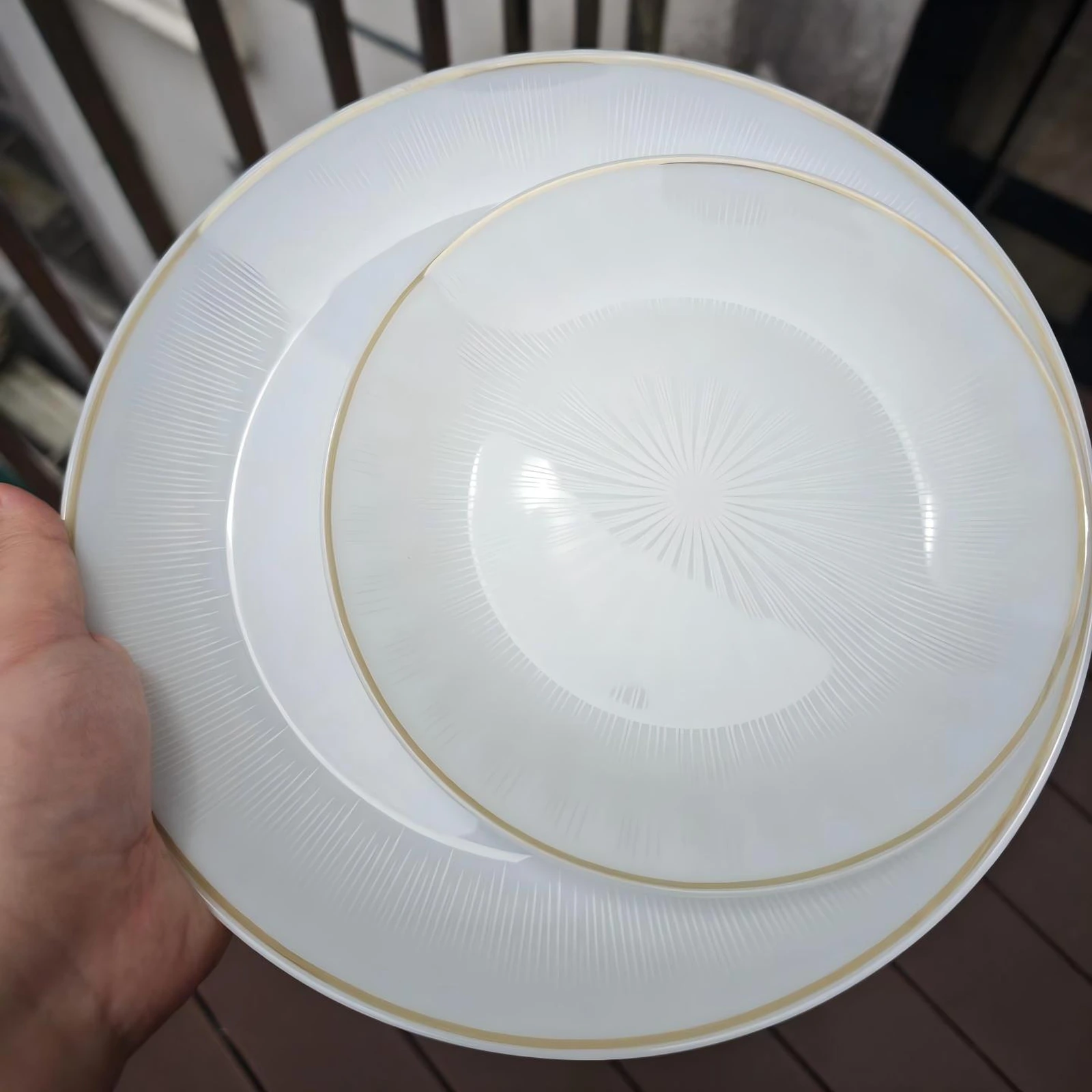
The base ingredients of opal glass are the same as ordinary glass — silicon dioxide (the main stuff in sand), soda ash, and limestone. The difference is that during production, a small amount of opacifier gets added. Usually that’s calcium fluoride (CaF₂) or phosphate compounds.
At melting temperatures above 1,500 °C, these opacifiers spread evenly through the glass and form masses of tiny crystalline particles. When light hits the glass, those particles scatter it. That’s what gives opal glass its soft, milky appearance.
Put simply, the white colour is an optical effect — not a chemical dye. No pigment. No coating. No surface paint.
This is a completely different mechanism from ceramic colouring. Ceramic colours usually come from metal oxides in the glaze — lead, cadmium, cobalt can all show up in glaze formulas. Opal glass gets its white from the physical structure inside the material, with no metallic colouring agents involved. So from a colouring standpoint, there is no route for heavy metals to enter through the colour itself.
Can These Additives Leach Into Food
The opacifiers are inside the glass — that’s a fact. The real question is: can they get out?
They can’t. Here’s why.
At melting temperatures above 1,500 °C, calcium fluoride and phosphate compounds chemically react with silicon dioxide. They form stable covalent bonds and become permanently locked into the glass network. This isn’t just mixing or embedding — it’s fusion at the molecular level.
A simple analogy: dissolve salt in water, and you can evaporate the water and get the salt back. But if that salt reacts with another substance at extreme heat and becomes a new compound, it won’t separate on its own. The opacifiers in opal glass are that second case.
On top of that, opal glass is a single-layer, one-piece structure. Ceramics have two layers — a body and a glaze — and the glaze can crack, chip, or peel over time, exposing the body underneath. Opal glass is the same material from surface to core. There’s simply no coating to delaminate and no hidden layer to release anything.
The European Container Glass Federation (FEVE) points out that glass is the only widely used packaging material classified by the U.S. FDA as “GRAS” (Generally Recognized as Safe).
Is Opal Glass Safe With Hot Food and Acidic Drinks?
Once you know the material itself is non-toxic, the next question is practical — what happens during actual use? Hot soup, freshly cooked dishes, lemon water, vinegar-dressed salads. These are everyday scenarios. Temperature and acidity are the two variables that matter most when testing whether dinnerware is opal glass safe for food contact.
Does Heat Change the Chemical Structure of Opal Glass
Opal glass is an inorganic, non-metallic material. Its chemical bonds are mainly silicon–oxygen bonds (Si–O) — and those bonds are extremely stable at everyday temperatures.
Lab data shows that opal glass stays chemically unchanged below 300 °C. No gas release, no decomposition, no leaching. Meanwhile, the hottest things your dinnerware encounters in daily life — microwave heating, freshly plated food, a dishwasher’s hot rinse — rarely go above 200 °C.
For comparison, some plastic containers can start releasing BPA or plasticizers at just 70–80 °C. Opal glass doesn’t budge below 300 °C. That’s the margin you’re working with when you use it for hot food.
One thing to keep straight, though: thermal safety and thermal shock are not the same thing. Opal glass won’t release harmful substances at high temperatures. But if you pull it from the freezer and put it straight into the microwave, the sudden temperature swing can cause it to crack. That’s a physical risk — the material hasn’t degraded, the temperature gap just created stress fracture.
If children’s dinnerware is your focus — including how opal glass compares with plastic and melamine under heating — this breakdown covers it in more detail: Opal Glass Kids Dinnerware Safety Comparison.
Will Vinegar, Lemon Juice, or Ketchup Cause Leaching Over Time
This is the concern that sits in the back of most people’s minds. And it’s not unfounded — there is a widely cited PubMed study (Sinha, 2007) that detected lead and cadmium migration from certain glass dinnerware after soaking in five types of food acids.
Those findings are real. But the test conditions tell an important part of the story.
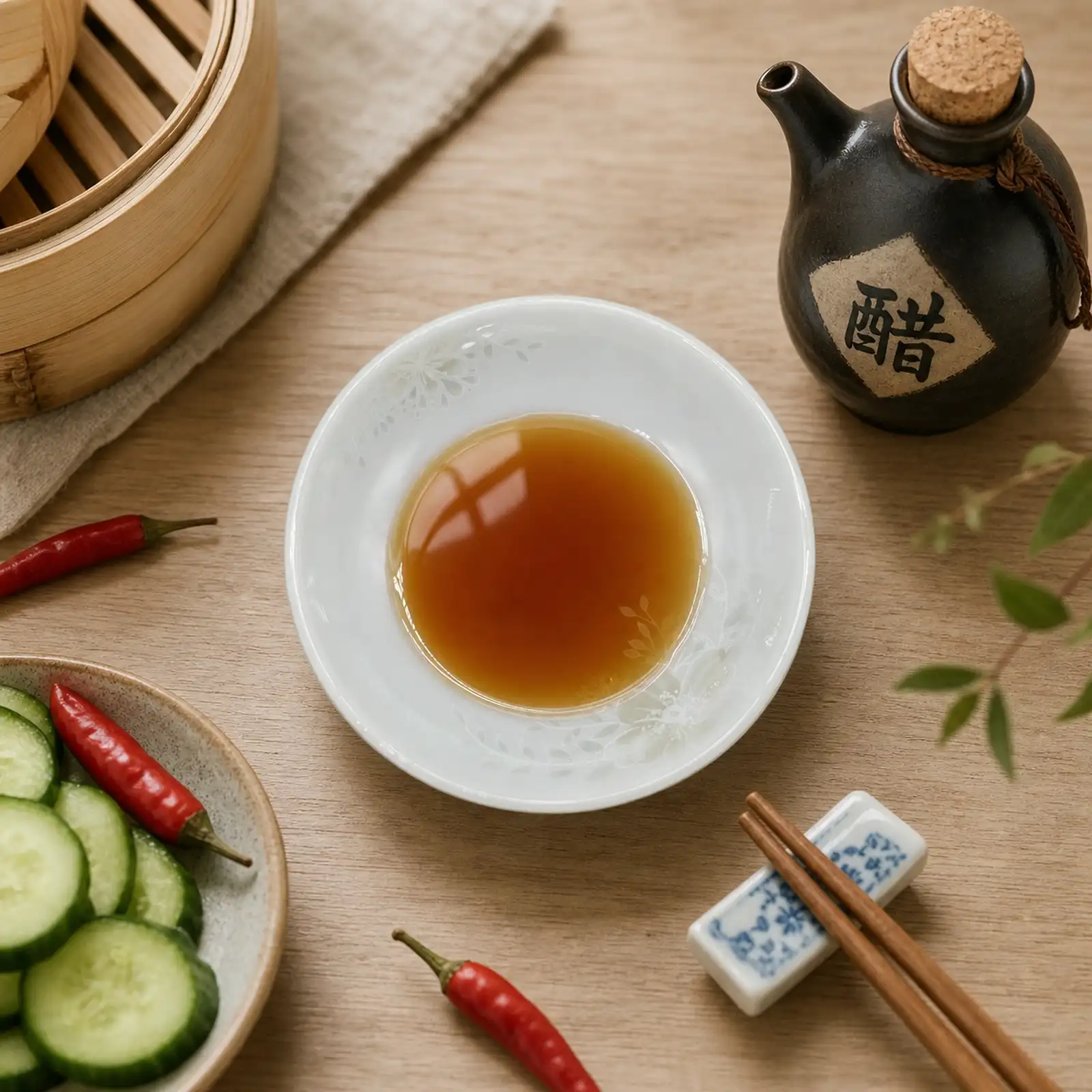
Standard food-contact safety tests use 4 % acetic acid at 22 °C for 24 hours. That’s deliberately extreme — it’s like soaking your plate in undiluted vinegar for a full day. In a real meal, vinegar touches your plate for maybe 30 minutes, at a fraction of that concentration.
Compliant opal glass, even under those harsh test conditions, shows lead and cadmium migration well below international limits. The EU sets the lead limit for flat dinnerware at 0.8 mg/dm² and cadmium at 0.07 mg/dm². The FDA limit for flatware is 3.0 μg/mL for lead.
Everyday acid exposure is far milder than what happens in the lab. As long as the product comes from properly controlled production, using it with ketchup, lemon water, or vinegar dressing leaves plenty of safety margin.
But that depends on one thing — the opal glass being compliant in the first place. And not all of it is. Which brings us to the next section.
Not All Opal Glass Is Equal — How to Tell If Yours Is Truly Safe
So far we’ve established that the material composition of opal glass is non-toxic and that its chemistry holds up under normal temperatures and acidity.
But material safety and product safety are not the same thing. The real question for buyers is whether the specific batch in front of you — from a specific factory, with its own raw materials and processes — is opal glass dinnerware safe enough to trust.
That comes down to production quality control. This is where buyers need to pay the closest attention.
Why Some Opal Glass Dinnerware Tests Positive for Lead and Cadmium
The standard opal glass formula contains no lead or cadmium. So is opal glass lead free by design? Yes. But “by design” and “in every factory” are two different things.
Lead and cadmium typically sneak in through two channels:
First, sloppy raw-material sourcing. Some low-cost suppliers use ingredients that carry heavy-metal impurities. Natural minerals like limestone and soda ash, without strict screening and testing, can bring trace amounts of lead and cadmium into the glass.
Second, decorative processes. This one gets overlooked a lot. The opal glass body itself may be clean. But add decals, silk-screen patterns, or metallic rims, and if those decorative materials contain lead-based pigments or cadmium powders, heavy metals migrate from the decoration into food. The risk jumps when the decoration sits on the inner surface — the side touching your food.
We saw this firsthand on JOINTION’s production line. A customer brought decorated samples from another supplier for comparison testing. The plain, undecorated samples showed near-zero lead and cadmium migration. The samples with decals on the inner wall came back with lead levels over the limit in a 4 % acetic acid soak. The glass wasn’t the problem — the decal was.
So to judge whether a piece of opal glass is safe, asking “is it opal glass?” isn’t enough. You need to look at where the raw materials come from, what decorative process was used, and how tightly that specific production run was controlled.
How to Tell Whether a Batch Meets Safety Standards
Different markets set different rules for food-contact materials. The U.S. and Europe require third-party test reports for customs clearance. Many Southeast Asian markets don’t. But whether your target market mandates testing or not, knowing the standard benchmarks helps you size up a supplier fast.
Here are the lead and cadmium migration limits under the world’s main standards:
| Test Parameter | FDA Standard (U.S.) | EU Standard | What Passing Means |
|---|---|---|---|
| Lead migration (flatware) | ≤ 3.0 μg/mL | ≤ 0.8 mg/dm² | No excessive lead release during daily food contact |
| Lead migration (hollowware) | ≤ 2.0 μg/mL (small) / ≤ 1.0 μg/mL (large) | ≤ 4.0 mg/L | Lead stays within safe range when holding liquid food |
| Lead migration (mugs/cups) | ≤ 0.5 μg/mL | Separate lip-rim test standard | Cups have a much stricter limit because your lips touch the rim directly |
| Cadmium migration (flatware) | ≤ 0.5 μg/mL | ≤ 0.07 mg/dm² | Cadmium migration stays within safe range |
A few things worth knowing. Limits vary a lot by product type. The FDA’s lead limit for cups (0.5 μg/mL) is one-sixth that of plates (3.0 μg/mL), because your lips touch the cup rim directly. If your product line includes both plates and cups, you can’t measure them against the same number.
Plain products and decorated products are different risk categories. A bare white plate that passes doesn’t guarantee the same plate with a decal still passes.
FDA and EU tests use different methods. Different soak concentrations, temperatures, and durations — results don’t translate across standards. If you export to both the U.S. and Europe, you need separate evaluations.
Even if your market doesn’t require test reports, these numbers still tell you a lot about whether a supplier is genuinely managing quality. A supplier who knows these thresholds and one who can’t explain them are almost certainly not operating at the same level.
What Do the Common Safety Marks Actually Mean
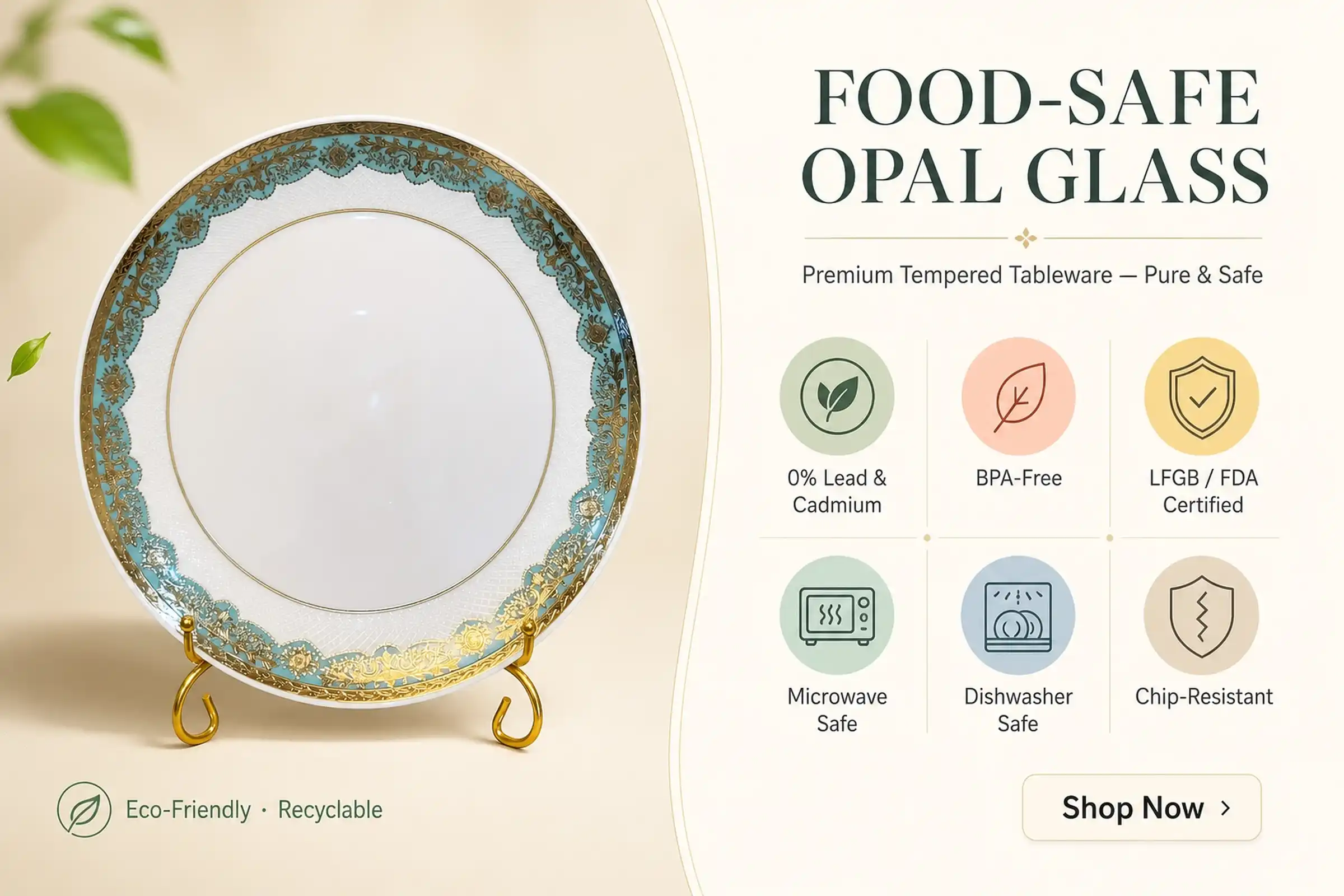
You’ve probably seen safety marks on dinnerware packaging or stamped on the bottom of products. They don’t all mean the same thing, and they aren’t equally strict. Here’s a quick overview:
| Safety Mark | Region | What It Tests | How Strict |
|---|---|---|---|
| FDA compliant | United States | Lead and cadmium migration, tiered by product type | Industry baseline — most reputable factories pass |
| EU 1935/2004 + knife-and-fork symbol | European Union | General food-contact safety framework; materials must not migrate harmful substances into food | Framework regulation; enforced alongside specific ceramic/glass migration directives |
| LFGB | Germany (widely recognised across the EU) | Migration testing plus sensory tests — does the material give food an off-taste or odour | More thorough than FDA; covers smell and taste dimensions |
| California Prop 65 | California, U.S. | Whether consumer exposure to lead, cadmium, etc. exceeds safe-harbour levels | Much stricter than FDA. Passing FDA does not mean passing Prop 65 |
Some of these are mandatory regulations (EU 1935/2004, Prop 65). Others are testing standards (LFGB). But they share one thing — compliance has to be backed by actual test data, not just a symbol printed on a box.
Even if you’re shipping to a market with no mandatory certification, these standards give you a proven framework for evaluating safety. Knowing what these benchmarks are lets you ask sharper questions when vetting suppliers.
So, Is Opal Glass Safe to Use? The Bottom Line
Back to the original question: is opal glass safe to use?
Yes — when produced to proper standards, opal glass is a safe food-contact material.
Its ingredients are non-toxic. The milky-white colour is a physical light-scattering effect, not chemical dyeing. Under everyday temperatures and acidity, its chemistry stays stable — nothing migrates into your food. A standard formula free of lead and cadmium, combined with a glaze-free one-piece structure, removes the source of heavy-metal risk at the material level. Properly manufactured opal glass is food safe by every major international benchmark.
But there’s a condition: the raw materials have to be clean, the decorations can’t contain heavy metals, and quality control has to be consistent throughout production. Not every opal glass product meets all three. Choosing the right supplier matters just as much as choosing the right material.
If you want to see the full production process — from raw materials to finished product — JOINTION’s factory is in Chaozhou, Guangdong, running full in-house production since 2008. Melting, press forming, annealing, and final inspection all happen on the same line. We welcome buyers to visit the factory floor and check raw-material sourcing, process controls, and finished quality firsthand.
You can start by browsing JOINTION’s product range to see the full catalogue and specifications, then decide if you’d like to take the conversation further.