⚡Short note: Opal & regular glass differ in materials, heat resistance, feel—here’s key facts.
- Material Composition: Opal adds CaF₂/BaF₂ to soda-lime base; melts at 1550–1600°C, regular at ~1500°C.
- Thermal Shock Resistance: Opal withstands 50–60°C sudden changes, regular sensitive over 30–40°C.
- Hand Feel: Opal has balanced center of gravity (edge 2–3mm), regular is bottom-heavy (bottom 6–8mm).
- Optical Trait: Opal is milky (crystal light scattering), regular is transparent with direct light transmission.
Are Opal Glass Dinnerware and Regular Glass Made from the Same Materials?
To clarify the difference between opal glass and ordinary glass dinnerware, we first need to compare their core compositions. When discussing the differences between opal glass and ordinary glass tableware, “whether the compositions are the same” is often the first question that comes to users’ minds — after all, they are both called “glass”, and in daily cognition, isn’t glass a unified material? But it is precisely this point that hides a key distinction that is easy to be overlooked.
Most ordinary glass tableware uses the soda-lime glass system. With silica as the core, soda ash and lime are added to lower the melting temperature and improve molding efficiency. The goal is clear: to pursue transparency, control costs and ensure basic firmness. During production, it is melted at about 1500℃ and then simply annealed, with a highly homogeneous internal structure, just like a “clean” glass phase — this is the fundamental reason why it can transmit light clearly and intuitively show the color of food. Precisely because of the simple process, it has become the most common and cost-effective type of glass tableware on the market.
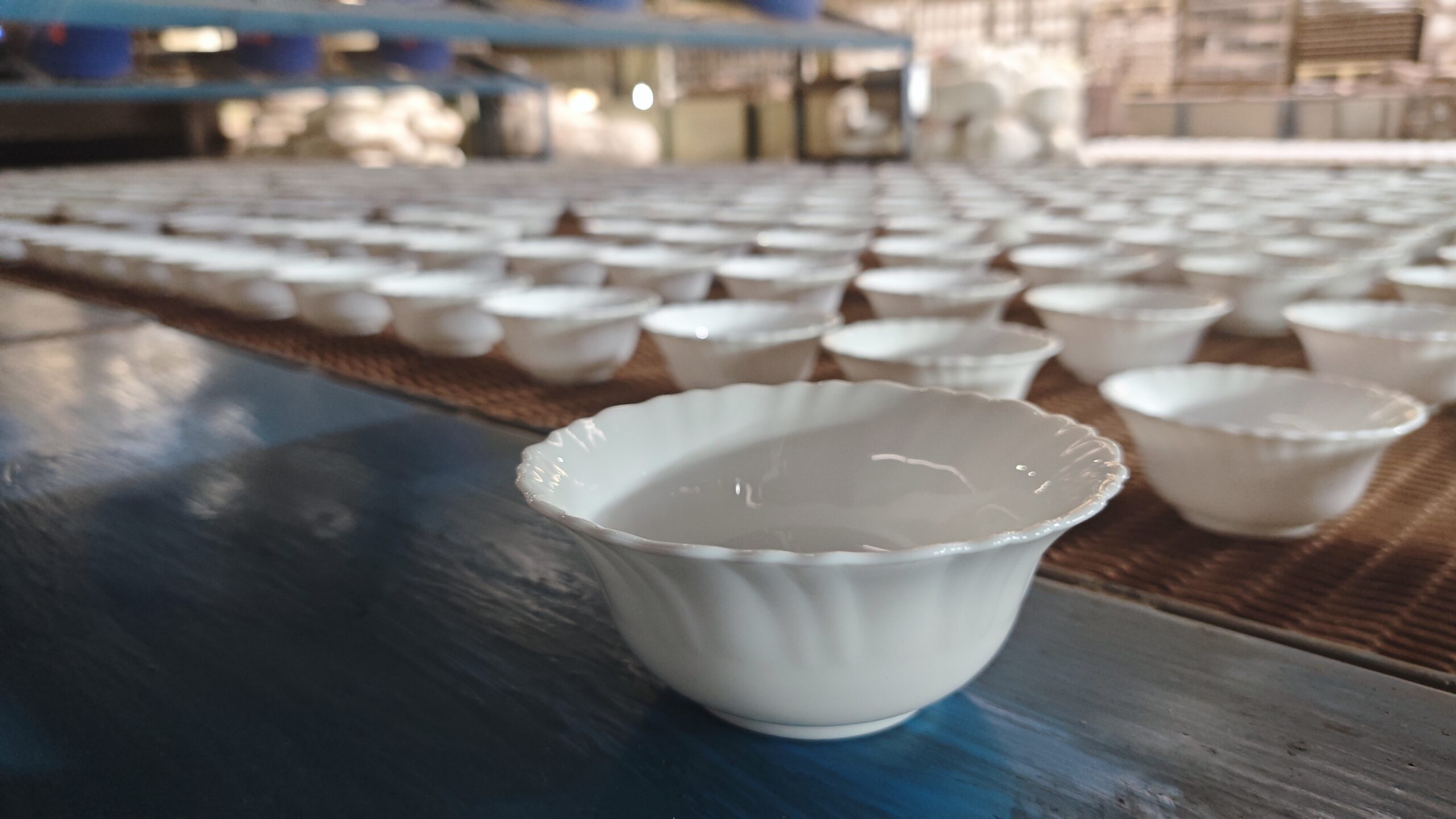
To understand opal glass dinnerware material, we need to look at its unique formulation and processing. Opal glass, however, has taken a different path from the very beginning. It does not become milky white by coating or dyeing ordinary glass after it is made, but “modifies” the formula at the formulation stage: on the basis of soda-lime glass, opacifying components such as calcium fluoride (CaF₂) and barium fluoride (BaF₂) are added, and some also add a small amount of alumina to enhance stability. Then it is melted at a high temperature of 1550-1600℃, and then through gradient cooling, these added components are turned into tiny crystals, which are uniformly dispersed in the glass matrix. This step not only changes the internal microstructure, but also draws a clear line from ordinary glass at the root — ordinary glass is a single amorphous state, while opal glass is a composite structure of “glass matrix + crystalline phase particles”. The opal glass dinnerware material’s composite structure is the foundation of its superior stability. It is this structural difference that gradually widens the gap between the two in thermal shock resistance, usage stability and long-term experience. When it comes to opal glass vs soda lime glass, their structural differences directly affect their practical performance. If you are interested in the specific performance of such structural differences in actual use, you can also see a more intuitive comparative analysis in our another special article Difference Between Opal Glass and Ordinary Glass.
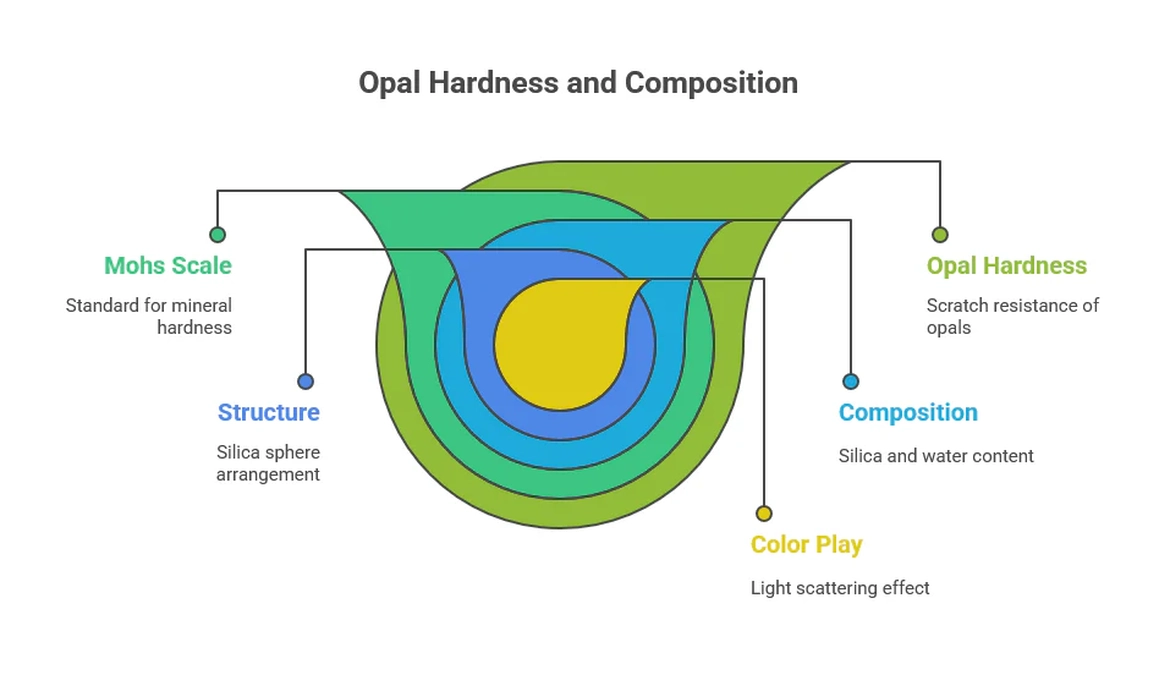
Want to quickly get the core differences between the two? An objective technical comparison table can clearly present these differences hidden in the materials —
| Comparison Dimension | Opal Glass | Ordinary Glass (Soda-Lime Glass) |
|---|---|---|
| Core Composition | Silica as the base, added with opacifying/crystalline components such as CaF₂ and BaF₂, some containing alumina | Silica as the base, only added with soda ash and lime to adjust melting properties, no functional crystalline phase components |
| Microstructure | Multi-phase structure (glass matrix + nano/micron-scale crystalline phase particles uniformly dispersed) | Single amorphous glass phase with homogeneous internal structure |
| Optical Formation Mechanism | Crystalline phase particles scatter light in all directions, presenting a stable milky white appearance with no light transmittance | The material itself is transparent, allowing light to pass directly through and clearly showing the color of food |
| Composition Stability Principle | Crystalline phase components are locked in the glass matrix, and structural stability comes from multi-phase synergy | Stability comes from the overall homogeneous structure, with no internal components to disperse stress |
| Core Design Goal | Adapt to long-term and high-frequency tableware use, balancing appearance stability and durability | Meet basic holding needs, focusing on transparency and cost control |
| Melting and Molding Temperature | Melting temperature of 1550-1600℃, requiring gradient cooling to solidify crystalline phases | Melting temperature of about 1500℃, can be formed by simple annealing |
| Thermal Shock Resistance (Core Heat Resistance Index) | Crystalline phase particles disperse temperature difference stress, can withstand sudden temperature changes of 50-60℃, and are not easy to crack during frequent cold and hot switching | Sensitive to temperature differences, prone to cracking due to stress concentration when sudden temperature changes exceed 30-40℃ |
| Hand Feel and Center of Gravity Design | Center of gravity shifts to the center, edge thickness 2-3mm, center thickness 4-5mm, strong balance, stable to hold with one hand | Bottom-heavy (thickness 6-8mm), edge thickness 3-4mm, center of gravity tends to shift to the edge after holding food |
| Edge Process Characteristics | Fine chamfering and polishing, transition arc between edge and plate surface 1-2mm, continuous and non-irritating touch | Post-molding processing is relatively simple, prone to sudden thickness changes or step feeling, which can be perceived as irritating to the hand after long-term use |
| Knocking Sound Feedback | Short, low “clicking” sound, lasting 0.1-0.2 seconds, high recognition | Crisp, sustained “jingle” sound, lasting 0.3-0.5 seconds, more obvious sound |
| Long-Term Use Stability | Milky white appearance does not turn yellow or fade, and spontaneous cracks rarely occur without external force | Light transmittance may slightly decrease after long-term use, and hidden cracks are easily caused by temperature differences or tiny scratches |
These differences in composition and structure are not just theoretical. Studies have been conducted on opal crystallized glass, and a special research article clearly points out that specific fluoride elements are introduced on the basis of soda-lime glass — and researchers have identified the existence of multiple crystalline phases in its structure:
The investigations on the pristine glass evidenced the nature of CaF₂, BaF₂, and NaF crystalline phases.
The key to this finding is not a specific formula, but the scientific confirmation that Opal Glass is not “ordinary glass with a different color”, but a glass material with significantly different composition and structure. Such formulation adjustments make opal glass vs soda lime glass two distinct material systems. Precisely because of this difference, it mostly does not turn yellow or crack easily during long-term use, and can maintain relatively stable performance. These technical details further highlight the difference between opal glass and ordinary glass dinnerware in material and performance. Regarding the structural stability, appearance changes and actual durability feedback under such long-term use, Opal Glass Dinnerware Durability Guide has also made a more complete collation of related phenomena.
So, going back to the original question: are opal tableware and ordinary glass tableware made of the same composition? The answer is clear — they belong to the same glass category, but to different composition and structure systems. Understanding this, when you compare the durability and usage experience of the two later, you will not judge only by “transparency”, but can see through the differences in the materials themselves.
Is Opal Glass Dinnerware Naturally Heat-Resistant, and Why Does It Handle Sudden Temperature Changes?
One of the most notable advantages of opal glass is its thermal shock resistance opal glass, which addresses the common problem of glass tableware cracking due to sudden temperature changes. When distinguishing opal glass from ordinary glass, “heat resistance” is often a point that is easy to be misread — do you also think that heat resistance means being able to withstand high temperatures and be used in microwaves and ovens? But people who have actually used glass tableware know that the time when glass is prone to problems is usually not at high temperatures, but at the moment of sudden temperature changes.
For example, taking it out of a 60℃ dishwasher and placing it on a 10℃ countertop immediately; pouring 5℃ cold water into it right after holding 90℃ hot soup — the temperature difference impact in these scenarios is often the main cause of glass breakage. Therefore, “being able to withstand sudden cold and hot” is far closer to the real needs of household use than “the maximum temperature it can withstand”.
This is not the promotional rhetoric of a certain brand, but a consensus in the material industry. The American Ceramic Society once clearly stated in a popular science article: thermal damage to glass has little to do with the maximum temperature the glass is exposed to, and the real key is the amplitude and speed of temperature change.
“…less to do with the maximum temperature the glass experiences and more to do with the total temperature change the glass experiences.”
This sentence actually redefines “heat resistance”: it is not a static number, but a dynamic ability to cope with temperature differences.
Why is “temperature difference impact” so common? Because the daily life of a home kitchen is never extreme high temperatures, but high-frequency cold and hot switching:
- It is the dinner plate taken out of a 70-80℃ microwave oven, hitting the 20℃ room temperature air in an instant;
- It is the tableware being placed in a well-ventilated place to cool down quickly after high-temperature cleaning at 65-70℃ in the dishwasher;
- It is 90℃ hot soup poured into the tableware, but the bottom is attached to a 15℃ ceramic placemat —
In these scenarios, the temperature change is fast and concentrated, the expansion and contraction speeds of different areas inside the glass are different, and the stress will be amplified. Once the stress is concentrated on the edge, bottom or places with tiny scratches, cracks may appear, or even break without warning. This is why many people encounter: the tableware was just used well, but suddenly cracked after being placed for a while — in fact, it is not “sudden”, but the stress caused by temperature difference has accumulated to the critical point.
People who have used it all have such feelings:
- No need to deliberately wait for the tableware to cool down, it can be put into the microwave as soon as it is taken out of the cabinet;
- When putting it into the dishwasher, there is no need to be anxious “whether it will crack this time”;
- Rarely there is a situation of “fine lines without being dropped or bumped” —
This is not because opal glass is completely unaffected by temperature differences, but because the crystalline phase particles inside are “helping”: when the temperature changes, the thermal expansion coefficient of the crystalline phase particles is slightly different from that of the glass matrix, which can form a “buffer” to disperse concentrated stress, so it is not easy to crack naturally. This is exactly how thermal shock resistance opal glass achieves reliable performance in daily cold and hot switching scenarios.
However, it should be noted that this stability is not absolutely safe. If the tableware is too thin, the edge is not chamfered, the annealing is insufficient, or the surface has severe scratches, even opal glass may break under temperature difference impact; if it is directly heated on an open flame, it will be damaged no matter how durable it is.
But when we understand “heat resistance” as “whether it can remain stable in the face of daily cold and hot switching”, the difference between opal glass and ordinary glass is very clear: ordinary glass requires you to pay more attention to avoiding temperature differences, while opal glass allows you to use it more at ease — no need to deliberately prevent it, and the probability of accidents can also be reduced.
So, “Is the heat resistance of opal glass innate?” The answer is clear: it is not a property added later, but determined by the structure of the material itself — this stable ability to cope with temperature differences has been inherent since the moment of formula design. Regarding whether this stability is sufficient to support long-term and safe use in daily life, Is Opal Glass Safe to Use? has also made a more systematic explanation from the perspective of material inertness and risk boundaries in this article.
How Opal Glass Feels and Sounds Different from Ordinary Glass—and How to Spot the Difference
To understand the difference between opal glass and ordinary glass, hand feel and sound are the easiest dimensions that do not require “thinking too much” — no need to look at the ingredient list, no need to remember process terms, the moment you pick it up and the sound when you tap it gently, you can feel the difference. These details are hidden in every daily picking, cleaning and storage, and gradually become a profound memory point.
Hand Feel Difference: Not Just Lightness or Heaviness, but “Balance” in Use
Most people who pick up opal glass tableware for the first time have a common feeling: light, but not empty — this hand feel is not just a reduction in weight, but the balance hidden in the structure, isn’t it? Taking a 25cm dinner plate as an example, the weight of opal glass is about 400-450g, and that of ordinary glass is 450-500g, with a gap of only 10%-15%. The real difference lies in the center of gravity design: the edge of opal glass is only 2-3mm thick, and the central area is 4-5mm, so the center of gravity just falls between the palm and finger pads. Even if it holds 200g of hot soup, it will not shift to the edge, and the wrist does not need to exert extra force when holding it with one hand.
This sense of balance will be continuously amplified in high-frequency use: during family dinners, holding dinner plates, soup bowls and small dishes at the same time, movements can be smoother, without slowing down for fear of slipping or falling; during breakfast preparation, quickly picking and placing multiple sets of tableware, there is no need to adjust the posture repeatedly. Especially for families with the elderly or children, this feature of “easy to hold and not wobbly” is more practical — the elderly do not need to grip hard, and children can also hold their small dinner plates relatively easily.
In contrast, ordinary glass tableware has a different hand feel. Most of them are bottom-heavy, with a thickness of 6-8mm at the bottom, but only 3-4mm at the edge. It is okay when empty, but once food is held, the center of gravity tends to run to the edge. When holding it with one hand, you either have to clamp the edge hard, or bend your wrist to offset the shift, and the wrist will inevitably feel sore after a long time. This does not mean that ordinary glass cannot be used, but in the high-frequency use of three meals a day, it always makes people feel “heavy” and “not easy to use”.
Tactile Feedback: Long-Term Feel Brought by Edge and Surface Details
In addition to the center of gravity, the details touched by fingers are also crucial. The edge of opal glass will be finely chamfered and polished, with a transition arc of 1-2mm between the edge and the plate surface. When fingers slide over it, there will be no abrupt thickness changes or irritating edges and corners. This consistency will make people feel “hands not tired” after long-term use: no need to avoid sharp edges when cleaning, no scratching of fingers when stacking, and no excessive worry about scratches even if children grasp it.
Ordinary glass is different. Due to molding methods and cost constraints, sudden thickness changes are more likely to occur at the edge or bottom — for example, the edge suddenly rises from 3mm to 5mm, and there is an obvious step feeling at the junction of the bottom and the side wall. It feels nothing when used for a short time, but after repeated cleaning, stacking and taking, these details will become obvious: fingers always touch the steps when cleaning, tableware is easy to tilt when stacking, and gradually people will feel “uncomfortable to use”. This is why many people pay more attention to “the feeling of holding it in the hand” rather than just the appearance when changing tableware.
Sound Difference: Quick Identification Clues When Tapping and Stacking
If hand feel takes several uses to judge, sound is a practical clue for “identifying the material in one second”. Tapping the dinner plate lightly with nails or knuckles, the feedback of the two kinds of glass is completely different — have you tried it?
Media reviews have mentioned the sound characteristics of opal glass: “Tapping your nails against them, they give off the signature tinny sound…” This sound is not the sustained reverberating “jingle” of ordinary glass, but a short, low “clicking” sound, lasting only 0.1-0.2 seconds, with particularly high recognition. Every time you pick, place and stack, this sound will repeat, and gradually become your “auditory memory” — even without looking at the label, you can roughly judge which one is opal glass by tapping it when opening the cabinet.
Ordinary glass has a distinct sound difference. When tapped, it emits a crisp, sustained “jingle” sound, which can last for 0.3-0.5 seconds, especially on empty cabinets or hard countertops, the sound is usually more obvious. This is not a quality problem in itself, but in a quiet home, it will inevitably seem abrupt and easier to attract attention.
From Perception to Judgment: Intuitive Identification Methods in Daily Use
Combining hand feel and sound, you can gradually figure out the rules without reading any instructions:
- When picking it up, does the center of gravity fit the palm? Do you need to exert force deliberately to stabilize it?
- When touching the edge, is the transition natural? Are there sudden thickness changes?
- When tapping it, is the sound short and low, or crisp and long?
These details may not be noticed for the first use, but they will be repeatedly strengthened in the daily dining, cleaning and storage. It is these perceptions from real life that constitute the core and most memorable differences between the two.
How to Avoid Confusing Opal Glass with Ordinary Glass When Making a Purchase
For consumers, how to identify opal glass dinnerware from ordinary glass is crucial to avoid purchasing mistakes. The easiest pitfall when buying tableware is to mistake ordinary glass for opal glass — it is not a wrong aesthetic choice, but being confused by appearance and marketing rhetoric. After all, some ordinary glass can also present a milky white effect by adding white pigment; some are labeled “heat-resistant” and “strengthened”, with a smooth surface that looks not much different from opal glass under the light. If you only choose by feeling or price, it is easy to go wrong from the beginning.
You must first understand a core fact: opal glass and ordinary glass are not “different appearances of the same system”. As some data say: “Opal glass takes that basic recipe and adds a game-changer: opacifiers… Instead of letting light pass through, these particles scatter it—creating that soft, milky white look…” Simply put, the milky white of opal glass is formed by the scattering of light by internal crystalline phase particles; while the “white” of ordinary glass is either dyed or surface-treated, and there are usually no scattering particles inside.
This difference is easy to verify when purchasing: place the tableware under strong light, ordinary white glass will transmit light, and light can be seen passing through thin areas; while opal glass only shows uniform diffuse reflection, and will not transmit light no matter how thin it is.
Knowing this, your attention when purchasing will shift from “good-looking” to “authentic material”:
Does the product clearly mark “Opal Glass”? Does it explain the origin of the milky white appearance? If it only says “white glass” and “heat-resistant tableware” but cannot explain “why it is white”, it is probably ordinary glass.
Experienced consumers also use a “three-step” method to judge, which is simple and reliable:
Step 1: Check material information: does the detail page and outer packaging clearly state the material name? Does it explain the formation reason of the milky white appearance? Do not be fooled by general terms such as “white glass” and “strengthened glass”.
Step 2: Look at product positioning: is it a set of tableware designed for high-frequency daily use (such as including dinner plates, soup bowls, rice bowls, marked “dishwasher/microwave applicable”), or a single piece only suitable for decoration and occasional use? Opal glass is rarely made into a single decorative style, and most are designed in groups.
Step 3: Observe the consistency of the series: are the thickness and proportion of different models in the same series unified? Opal glass usually does not make up for structural defects by “thick bottom and thin edge”, while ordinary glass is more prone to such unbalanced design.
Following these steps makes how to identify opal glass dinnerware a straightforward process even for first-time buyers. If you choose according to this logic, you will not be led by marketing rhetoric, and you can also avoid the pit of “similar appearance but different materials”. After all, the core of purchasing is not “choosing the good-looking one”, but “choosing the one suitable for your daily use” — only when you buy the right material can the subsequent hand feel, durability and usage experience really meet your expectations.
In the end, a wise choice is not to make a quick decision among many similar products, but to figure out before buying: what do I need to distinguish? Why do I need to distinguish? When you figure out this problem, the boundary between opal glass and ordinary glass will naturally become clear — this is also the most valuable embodiment of the difference between the two in the consumption scenario.
Frequently Asked Questions (FAQ)
Q1: Can opal glass dinnerware be used in the microwave and dishwasher?
A1: Yes, opal glass dinnerware is designed to adapt to high-frequency daily use and can be safely used in microwaves and dishwashers. Its multi-phase structure (glass matrix + crystalline phase particles) disperses thermal stress caused by temperature changes, making it less prone to cracking during frequent cold and hot switching. However, it should not be directly heated on an open flame, and damaged or severely scratched opal glassware may still break under temperature shock.
Q2: Why does opal glass have a milky white appearance while ordinary glass is transparent?
A2: Opal glass has a multi-phase structure with nano/micron-scale crystalline phase particles (such as CaF₂, BaF₂) uniformly dispersed in the glass matrix. These particles scatter light in all directions, resulting in a stable milky white appearance with no light transmittance. Ordinary soda-lime glass has a single amorphous glass phase with a homogeneous internal structure, allowing light to pass directly through, thus presenting a transparent appearance that can clearly show the color of food.
Q3: How to quickly distinguish opal glass from ordinary glass when purchasing dinnerware?
A3: First, check the material information: confirm whether the product is clearly labeled “Opal Glass” and explains the origin of the milky white appearance (caused by internal crystalline particles scattering light). Second, observe light transmission: place the tableware under strong light—ordinary white glass is light-transmissive (light can pass through thin areas), while opal glass only shows uniform diffuse reflection and does not transmit light. Third, check the hand feel and sound: opal glass has a balanced center of gravity (fits the palm), short and low “clicking” sound when tapped (lasting 0.1-0.2 seconds); ordinary glass has a bottom-heavy design, and a crisp, sustained “jingle” sound (lasting 0.3-0.5 seconds).