⚡Short note: Is opal glass dinnerware safe for daily long-term use? Key facts from real scenarios and tests.
- Thermal Stability: Annealed opal glass handles daily temperature changes well, with low stress risk under 75℃ in typical household serving and cleaning scenarios.
- Chemical Inertness: Its dense structure doesn’t release substances when touch food, even acidic ones below 100℃ during routine contact in everyday dining use.
- Microwave Compatibility: Metal-free opal glass works safely in microwaves, with minimal bowl heating during use when used according to standard household instructions.
- Dishwasher Safety: It withstands 60–75℃ dishwasher cycles, show no scratches after repeated household use over long-term domestic washing and handling routines.
Thermal Stability of Opal Glass: Does It Crack with Heat and Cold?
“Will opal glass dinnerware crack when exposed to heat and cold?” This is almost a question that all users will repeatedly ask. This concern is never because the name “opal glass” is unfamiliar, but stems from people’s inherent impression of glass — it looks hard, but seems to be particularly sensitive to temperature changes. However, what we really should care about is not the result of a single extreme test, but: in real life, after repeated heating, cooling, cleaning, and reheating, will it have structural risks due to accumulated temperature differences?
How “sudden” can temperature changes be in daily use? In the morning, pouring hot milk, the bowl body slowly absorbs heat from room temperature; at noon, holding freshly cooked hot dishes, heat slowly conducts from the food to the bowl wall; in the evening, cleaning, first rinsing oil stains with warm water, then rinsing with cold water — in these scenarios, the temperature does not change suddenly, but diffuses slowly to the entire utensil. This is why heat resistant opal glass dinnerware for everyday use is popular among families, as the thermal expansion and contraction inside the material can be synchronized, and the probability of stress concentration is naturally low.
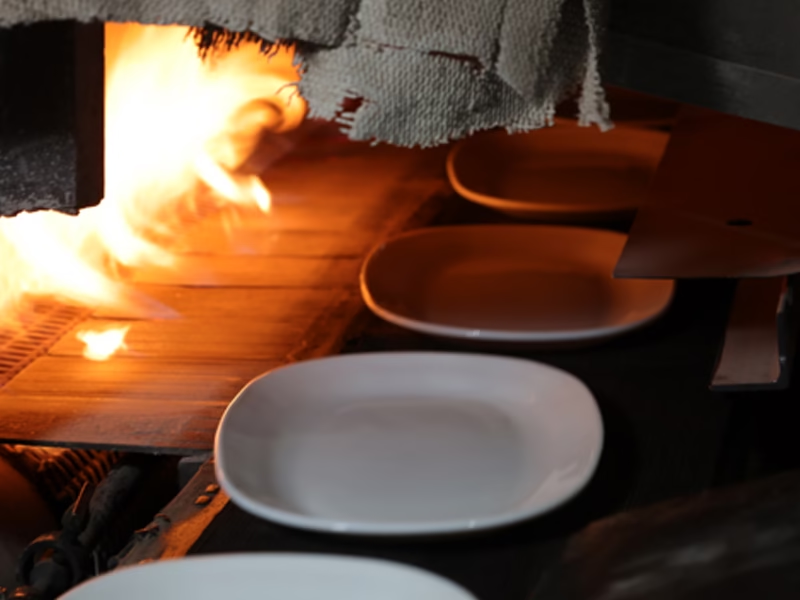
More importantly, opal glass undergoes annealing treatment during production — slow cooling to eliminate residual internal stress. Because of this, it is less likely to have structural risks due to stress superposition in the daily rhythm of repeated heating and cooling.
In long-term use scenarios, this stability is not reflected in “whether it can withstand one extreme test”, but in whether it still maintains a complete structure without microcracks after years of repeated use. Regarding this point, we have a more detailed breakdown in the systematic analysis of the durability of opal glass dinnerware, for example, you can read the Opal Glass Dinnerware Durability Guide for an explanation on this aspect.
For this reason, it is more resistant to temperature differences than ordinary glass that has not been fully annealed, making it a reliable thermal shock resistant glass dinnerware option. To understand “whether it will crack”, we must first understand a concept in materials science: thermal shock. Its definition by Iowa State University Extension is particularly clear:
“Under the right circumstances, glass bakeware will shatter, crack, split and even explode when exposed to thermal shock.”
“Thermal shock is when an object abruptly goes through a drastic temperature change…”
You see, the key is not the “glass” itself, but the two words “abruptly” and “drastic” — if the temperature change does not meet these two conditions, glass is usually not easy to crack, right?
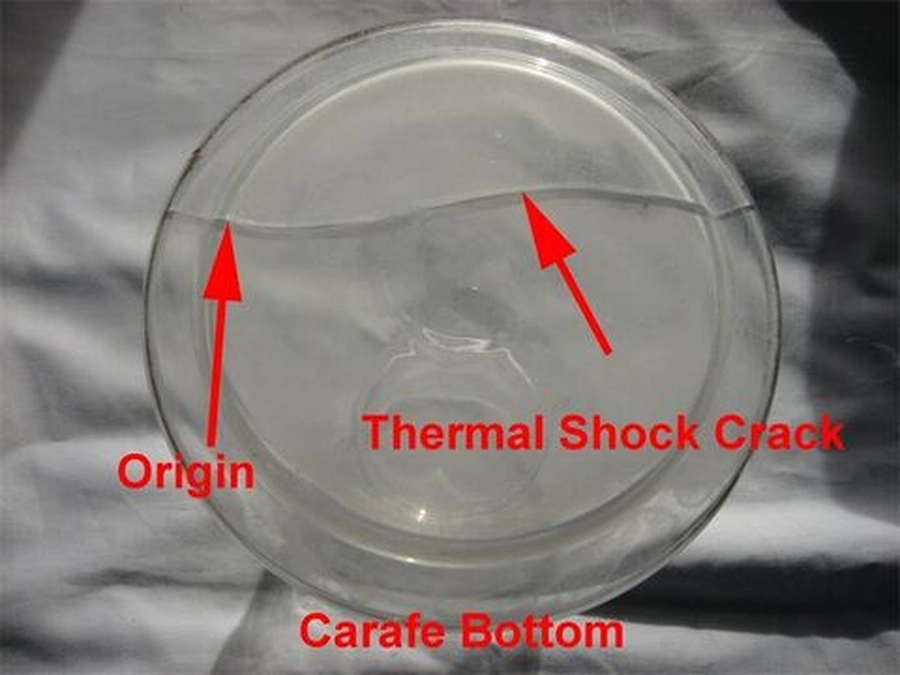
Compared with the family environment, most usage scenarios do not meet the requirements of “thermal shock”. The heat source is food or microwave, not open flame; cooling is natural cooling or gradual washing, not forced rapid cooling. Therefore, during normal use, the temperature change is more like “continuous heat exchange” rather than typical thermal shock.
It is necessary to distinguish clearly here: “Extreme situations where accidents may occur” are completely different from “daily high-frequency scenarios”. What really needs to be vigilant about is mainly concentrated in these operations:
- Large temperature changes in a very short time, such as pouring boiling water into a bowl just taken out of the freezer;
- Temperature acting only on local areas, such as the edge of the bowl touching a high-temperature stove while the rest is at room temperature;
- Forced cooling at high temperature, such as putting a bowl that has just held boiling water into ice water immediately.
The reason why these situations are emphasized is not because they are common, but precisely because they deviate from daily habits. For this reason, people who use opal glass dinnerware for a long time are more likely to say “stable in daily use” and “no problem with hot and cold alternation” rather than “always cracking”, as heat resistant opal glass dinnerware for everyday use adapts well to daily heating and cooling cycles.
Material Inertness of Opal Glass: Does It Release Harmful Chemicals?
“Will long-term use of opal glass dinnerware release harmful chemicals?” This question is even more concerning than “whether it will break”. After all, it has to come into repeated contact with hot food, oil, acidic and salty food. If it quietly affects the food, it is no small matter.
Does this risk really exist? In fact, it has little to do with the number of uses, and the core lies in the chemical inertness of the material — after all, if the material is stable and does not react, it is usually more suitable for long-term repeated contact with food, isn’t it? The so-called chemical inertness means that when the tableware comes into contact with food, it can remain stable, not participate in reactions, and will not leach its components into the food. For household users, this point is more important than “whether it has passed a certain test”, because it directly determines the safety boundary during long-term high-frequency contact with food. Regarding the overall judgment, common misunderstandings and real risk boundaries of opal glass in terms of food contact safety, we have previously given a concentrated answer from the perspective of frequently asked questions by users, such as the article: Is Opal Glass Safe to Use?
In terms of material, opal glass is still a type of glass. As long as no additional coatings or chemical treatment layers are added, its chemical performance is similar to other glass tableware. After glass is formed by high-temperature melting, its internal structure becomes stable: dense, non-porous, and non-adsorptive — the network structure formed by silica, the main component, is particularly tight, with molecular gaps so small that food components cannot enter, and its own molecules basically do not migrate out. To put it simply, the contact between food and the bowl is only physical, without molecular-level exchange.
This is not an empty statement. In the suggestions on safe food storage containers by Iowa State University Extension, it is clearly stated:
“These materials are sturdy and heat-tolerant and do not release chemicals or toxins into food.”
“Further, they are inert and do not react with natural chemicals or dyes found in food.”
The key points of this passage are clear: first, glass does not release harmful substances, and second, it does not react with food components. This stability is usually not dependent on an additional “isolation layer”, but determined by the material’s own structure.
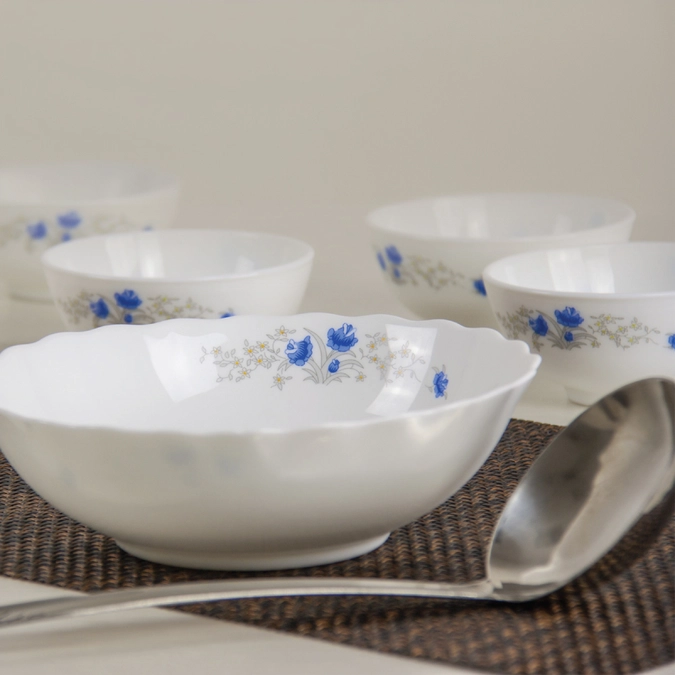
The “high temperature”, “long-term contact”, and “repeated use” that people worry about are usually not enough to break through the stable boundary of glass in a family environment. For example, using an opal glass lunch box to hold tomato juice (acidic), heating it in the microwave every day for several months; or holding olive oil for a long time at room temperature; or holding salty broth and repeatedly heating and cooling it — in these scenarios, the temperature (not exceeding 100℃), heating duration (1-5 minutes), and cleaning water temperature are all within the range that glass can withstand, and chemical migration is generally not triggered.
How can ordinary users judge? You don’t have to wait for laboratory data; daily details can tell:
- After holding curry for a long time, does the smell remain after washing?
- After repeatedly heating milk, does the taste become fishy and astringent?
- After using for half a year, are there yellowing, stickiness, or small holes on the surface?
Although these observations are not strict chemical tests, they are the most intuitive proof of safety. If there are no such abnormalities, it often indicates that the tableware has maintained relative stability in terms of food contact.
In the end, “whether harmful substances are released” is essentially to confirm the long-term stable boundary of the tableware. Understanding this point, you will no longer be troubled by vague “potential risks” — this is why people always ask online, but few people really encounter problems in reality.
Is Opal Glass Microwave- and Dishwasher-Safe? A Look at Appliance Compatibility
“Can opal glass be put into microwaves and dishwashers?” This is probably the most frequently asked question of all. Modern family tableware is no longer just for “holding food” — it needs to be integrated into the electrical processes of heating and cleaning. If it’s not safe in these high-frequency scenarios, the risk comes from daily use, not extreme situations.
To determine if tableware can be used in the microwave, don’t just look at “how thick it is” or “whether it’s labeled heat-resistant” — the key is whether the material will “conflict” with microwaves. The heating principle of microwaves is to excite water molecules in food to generate heat, not to directly heat the container. Therefore, materials that are metal-free, non-magnetic, and have a stable structure are mostly safe to use; on the contrary, even if they are thick, problems may arise.
Glass is widely verified as a “safe option” in this regard. Consumer Reports clearly states in its explanation of microwave-safe materials:
“The ‘play it safe’ category: Glass, ceramics, and stoneware are materials that are usually microwave-safe…”
This passage does not “endorse” a specific type of tableware, but clarifies the material positioning of glass in microwave environments. So microwave safe opal glass plates are widely trusted in modern kitchens, as opal glass, being a type of glass, its compatibility with microwaves is mostly based on this general classification, not a single test.
Compared with microwaves, dishwashers test tableware more for long-term stability. A dishwasher has 60–75℃ hot water circulation, plus detergent, water pressure flushing, and repeated hot and cold changes — the key here is not whether it can withstand a single use, but whether problems will arise with long-term use.
The performance of opal glass in dishwashers mainly lies in “easy to clean and stable state”, proving it’s a high-quality dishwasher safe opal glass dinnerware. Its dense surface does not absorb oil, so even if it holds fried food, hot water and detergent under the standard cleaning procedure can usually clean it without additional hand washing; even if you choose a 75℃ intensive wash and wash it repeatedly for several months, there will be no scratches, fading, or loss of luster on the surface.
This characteristic of “ready to use after washing” is why many families use it as their main daily tableware, and dishwasher safe opal glass dinnerware meets the daily cleaning needs of most households.
It should be noted that appliance compatibility is not “absolutely safe”, but depends on usage conditions. As long as microwaves and dishwashers operate according to conventional household parameters, the performance of opal glass is stable and predictable; but if it exceeds household scenarios — such as running the microwave empty, or using industrial-grade highly corrosive detergent in the dishwasher — any glass tableware may have problems.
People repeatedly ask “can it be put into microwaves and dishwashers”, not for “theoretically absolute safety”, but to know: in daily use, do you need to deliberately avoid it, pay extra attention, or replace the tableware frequently? For this reason, the stability of opal glass in terms of appliance compatibility has often become a more practically valuable point in judging “whether it is safe”.
Comparison Table of Core Characteristics Between Opal Glass and Common Tableware Materials
| Characteristic Dimension | Opal Glass | Ordinary Soda-Lime Glass | Ceramic Tableware (Uncolored Glaze) |
|---|---|---|---|
| Thermal Stability | Good (supported by annealing process, no obvious stress risk in daily hot and cold alternation) | General (prone to microcracks due to rapid cooling and heating) | Good (but slightly inferior to opal glass in thermal shock resistance) |
| Chemical Inertness | Excellent (non-porous and dense structure, no reaction with acid, alkali and oil) | Excellent (same as opal glass, but inferior products may have structural defects) | Good (surface is easy to adsorb a small amount of food pigments) |
| Microwave Compatibility | Excellent (no metal components, no abnormal temperature rise of the body) | Good (some thin models are prone to local temperature rise) | Excellent (but thick-walled models heat up slightly slower) |
| Dishwasher Compatibility | Excellent (surface resistant to scouring, not easy to leave stains) | General (prone to fine scratches caused by high-pressure water flow) | Good (glaze wear may occur after long-term use) |
How to Objectively Choose a Safe Opal Glass Dinnerware Set
“Peace of mind” is never an abstract slogan, but a result that can be repeatedly verified in long-term use. When choosing opal glass dinnerware, instead of trusting a one-time commitment, it is better to observe and recheck by yourself — after all, seeing it with your own eyes and using it without problems for a long time can often make people more at ease.
Truly valuable judgment criteria all have one thing in common: the longer the time and the more frequent the use, the more reliable they can be verified, and they will not fail easily. Based on this, you can follow these logics when choosing:
First, check the overall stability of the material, don’t just focus on the words “opal glass”. Mature opal glass dinnerware has uniform color, soft light transmission, and consistent color tone between the main body and the edge. You can put it in natural light by the window and turn it slowly to see: if there is local yellowing, graying, or inconsistent transparency, it is likely that the raw material ratio or firing process is not well controlled. Although this observation cannot replace professional testing, it can help you first eliminate products with obvious problems and reduce subsequent risks.
Then check the processing details of the surface and edges — minor defects may be amplified after long-term use. Touch it with your hand: is the surface too rough? Are there visible pinholes or sand spots? Are the edges smooth, with no sharp or abrupt corners? These details may seem small, but they have a significant impact: a rough surface is easy to stick to oil stains and difficult to clean; defects on the edges may lead to cracking after repeated use. For household users, these details are more referenceable than “how thick it is” or “how sturdy it looks”.
Also, combine your family’s usage habits to clarify the use boundary — there is no need to pursue “universal use in all scenarios”. If your family is used to taking tableware out of the freezer and putting it directly into the microwave, you must confirm whether the product is marked “suitable for both freezing and microwave use”; if you often hold high-salt and high-acid food and wash it in the dishwasher every day, prioritize styles with uniform thickness and reinforced edges. A set of tableware is truly “assuring” only if it performs stably in your family’s high-frequency scenarios — clarifying the boundary is itself an important way to reduce risks.
Finally, verify through long-term rechecking: pay more attention to changes after using it for a period of time. For example, after using it for 1 month, check if the surface color has changed, and if it becomes dark or mottled after washing; after 3 months, touch the feel and weigh the weight to see if there is local thinning or brittleness; after 6 months, check if there are tiny cracks on the edges. These changes can be found with the naked eye and by touch without professional tools, but they can truly reflect the stability of the material and craftsmanship. Compared with a one-time test report, this long-term verification is more in line with the family’s expectation of “peace of mind”.
Tableware safety has always been a concern. The mainstream media Consumer Reports mentioned in the report on heavy metal risks in tableware:
“The Food and Drug Administration has regulated lead levels in ceramic dishware since 1971.”
This sentence does not draw a conclusion on a certain material, but reminds us that the material and processing stability of tableware always need to be valued. For this reason, more and more people, when choosing opal glass dinnerware, will take the initiative to observe and recheck by themselves, and establish their own screening criteria based on material performance, processing details and long-term use experience.
In the end, there is no absolute answer to is opal glass dinnerware safe that is divorced from scenarios and judgment methods. A truly rational choice is, after understanding people’s common concerns, to use a set of clear and operable purchase logic to control uncertainty within a perceptible and verifiable range. And this judgment method of “observing by yourself and rechecking for a long time” is itself an important part of “using it with peace of mind”.
Frequently Asked Questions (FAQ)
- Q: Will opal glass release harmful substances when used to hold acidic foods like lemon juice for a long time?
A: No, opal glass has excellent chemical inertness with a dense and non-porous structure. In household use scenarios (temperature not exceeding 100℃), it will not react with acidic foods such as lemon juice, nor will it release harmful substances into the food. Long-term holding of acidic foods in opal glass dinnerware will not cause chemical migration as long as it is used normally. - Q: Is it safe to put opal glass dinnerware in the dishwasher with high-temperature and strong cleaning mode every day?
A: It is generally safe. Opal glass has good dishwasher compatibility, and its dense surface is resistant to scouring by high-temperature (60–75℃) water flow and detergent. Using the high-temperature and strong cleaning mode of household dishwashers every day will not cause scratches, fading or structural damage to the opal glass dinnerware. However, industrial-grade highly corrosive detergents should be avoided, as they may damage the glass surface.