
⚡Short note: Can Opal Glass Plates Handle Hot Food? Real-Life Family Usage Verdict & Key Details
- Daily Temp Compatibility: Adapts to 50-90℃ daily hot foods like stir-fries and soups, withstanding short-term gradient heating from room temp to 60℃ without structural changes
- Cycle Use Stability: Under repeated cold and hot switching in family meals, the material maintains steady performance during frequent contact with hot food
- Usage Attribute: Serves as tableware for holding cooked hot food only, with no design for direct contact with open flames or continuous high-temperature radiation
- Purchase Focus: Relies on 135℃ temperature difference adaptability as a core index, with plate thickness distribution affecting long-term hot food use effect
In Daily Use, What Situations Are Considered “Hot Food”
When users search for “Can opal glass plates be used to hold hot food?”, is the “hot food” in their minds the extreme high temperature in laboratories? Usually not — it is neither the state where tableware is involved in heating nor a value divorced from life, but the real, predictable scenarios in daily dining processes. Understanding this is the core premise for judging the adaptability of tableware. Starting from the material itself, opal glass is not ordinary transparent glass; its composition and structure are designed for stability in daily use, making opal glass plates for daily use a reliable option for many households. Regarding the basic characteristics, compositional differences of this material, and its essential distinctions from ordinary glass, you can also refer to this systematic explanation of the material principles of Opal Glass, which helps to understand why it is more suitable for family scenarios involving repeated contact with hot food.
In a household environment, the so-called “hot food” is essentially the form of food that has been cooked, is being served, brought to the table, and eaten directly. Their common characteristics are clear: the temperature is significantly higher than room temperature (daily indoor temperature is about 20-25℃), releasing heat to the tableware continuously for a short time, but generally not involving continuous heating or open flame contact. From the daily temperature measurement data in a large number of families, the temperature range of such hot food is not vague: freshly cooked stir-fries are about 60-80℃, stews are about 70-85℃ when served on plates due to long stewing time, hot soups and porridges are relatively hotter at about 75-90℃, and leftovers reheated in microwave ovens are mostly between 50-70℃. These are not cold laboratory data, but real temperatures encountered by every family every day — isn’t it worth considering in combination with actual scenarios? What everyone truly seeks are safe plates for hot food serving that can adapt to these common temperature ranges.
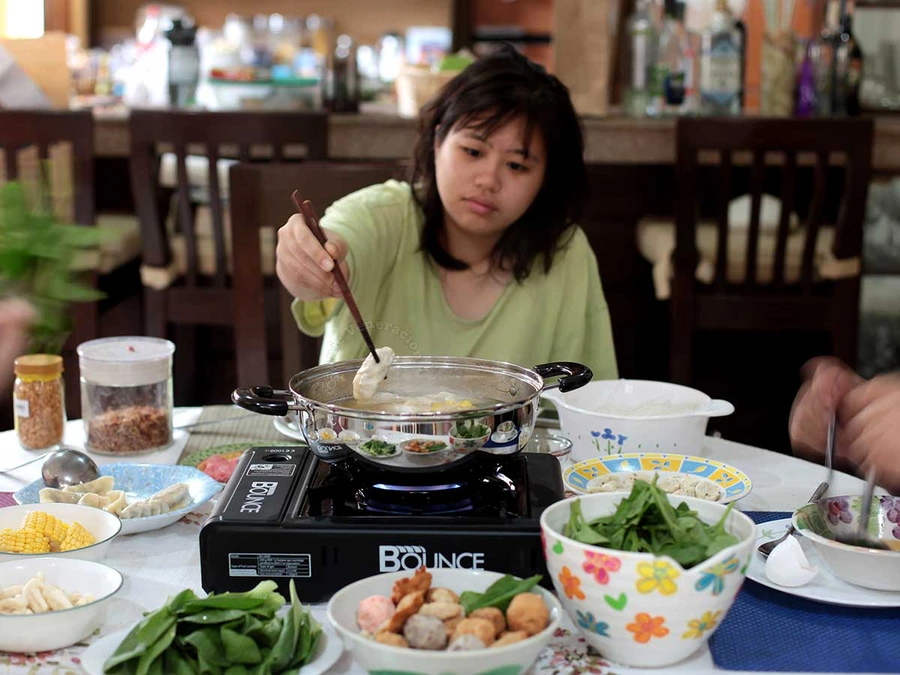
From the perspective of a large number of family usage habits, people’s understanding of “hot food” mainly focuses on the following types of high-frequency situations:
Daily Dishes That Have Just Been Cooked and Are Still in the Stage of Continuous Heat Dissipation
Imagine this: the wok is turned off, a plate of fragrant stir-fried dishes is just out of the pan, still steaming, and you casually put it into a plate — at this time, the plate is not exposed to continuous high temperature, but to the heat released intensively by the food in a short time. For example, a plate of freshly fried meat dishes will continue to dissipate heat for the first 5 minutes after being put into the plate, with the local temperature of the plate rising rapidly from room temperature to 50-60℃, and dropping to about 40℃ after 10 minutes. Isn’t this “short-term, gradient heating” the core scenario where household tableware faces hot food? There is no constant high temperature in the laboratory, only the natural heat dissipation process in life, and such scenarios also constitute the core of people’s cognition of “hot food”.
Hot Liquid Foods Such as Soups, Porridges, and Stewed Dishes
Compared with solid food, liquid has more sufficient contact with tableware and heat conduction is more direct — you can instantly feel this as long as you hold a bowl of freshly served hot soup. Whether it is hot soup, hot porridge, or freshly stewed dishes, the liquid will fully fit the inner wall of the plate, and heat is quickly conducted from the contact point to the entire plate body. For example, a bowl of 85℃ meat soup, after being poured into a glass plate, the bottom and inner wall will reach a temperature close to that of the soup within 1-2 minutes, which is why users subconsciously regard it as a type of “hot food with higher temperature and more need for caution”. Such situations also occur after cooking is completed, belonging to the routine operation of serving food on the table, with the only difference being the efficiency and coverage of heat conduction.
Meals That Are Reheated and Then Served Directly on Plates for Eating
In modern families, preparing dishes in advance, storing them in the refrigerator, and then reheating them in a microwave oven or steamer has long been a common eating method. But here’s a key point: the “hot food” that the tableware faces is the content itself that has been heated, not the heat source during heating. For example, refrigerated curry rice, after being heated in a microwave oven at medium heat for 2 minutes, has a temperature of about 65℃; when served on a plate, the plate needs to withstand a rapid temperature rise from room temperature to 65℃, rather than the microwave environment inside the microwave oven. Isn’t what users really care about whether the plate can stably bear this reheated temperature state? After all, most people don’t put the plate into the microwave oven for heating together; what everyone cares about is often the safety of “holding” the food.
The Usage Rhythm of Hot Dishes Being Served One After Another in Multi-person Meals or Gathering Scenarios
During family dinners or holiday gatherings, hot dishes are always served one after another in a short time — the same set of plates may come into contact with 3-4 different hot dishes within 1 hour, experiencing a cycle of “holding (heating up) — placing (cooling down) — replacing (heating up again)”. For example, first hold 70℃ braised dishes, place them for 15 minutes to cool down to 40℃, then hold 65℃ freshly fried green vegetables. The temperature of a single contact is not extreme, but such high-frequency, repeated temperature fluctuations are the real test for tableware, aren’t they? Precisely because of this, consumers pay more attention to the performance of tableware in long-term daily use rather than the effect of a single use.
Such shares precisely show that the “hot food” in the understanding of ordinary consumers is usually not a single temperature value, but bound to daily operations such as freshly served hot food, subsequent placement, and environmental switching. What everyone really worries about is not the 80℃ hot dishes themselves, but whether the plates holding hot dishes will pose safety hazards in a sudden cold environment. This is where opal glass temperature shock resistance becomes a key consideration for many buyers.
Therefore, the discussion around “whether opal glass plates are safe” essentially points more to usage boundaries and operation methods, rather than just whether the material itself is “heat-resistant”. On this point, there is a more complete breakdown of user questions in the summary of common questions about the safety of opal glass tableware, which forms a good supplementary relationship with this article. From the perspective of daily use, the definition of “hot food” is clear: solid or liquid food that has been cooked and is still in the obvious heat dissipation stage, as well as dishes that are frequently served and come into contact with tableware repeatedly in a short time in family or gathering environments. Clarifying this realistic context allows us to more objectively understand the adaptation boundaries of plates in actual use, doesn’t it? Many users still ask: can opal glass handle hot food without risks in these common scenarios?
How Opal Glass Plates Perform with Hot Food in Family Meals
Regarding the question “Can opal glass plates be used to hold hot food?”, if we talk about material parameters in isolation from the real family dining environment, the conclusion drawn is likely to deviate from reality. For family users, what matters is not whether the plate can withstand the extreme temperature in the laboratory (for example, some opal glass can withstand an instantaneous high temperature of 180℃), but whether it is stable and easy to use during repeated daily use, and whether it does not add extra concerns — it is precisely on this point that the actual applicability of opal glass plates is easier to observe.
In family scenarios, “hot food” has inherent life-oriented characteristics: most dishes, when served on plates, have left the stove and experienced a short cooling period — stir-fries at 120℃ in the wok have dropped to about 80℃ when put into plates; even hot soups or reheated leftovers have temperatures in the range that can be intuitively perceived by the human body but not enough to damage the structure of the tableware (50-90℃). Therefore, household plates are not exposed to continuous high-temperature impact, but to relatively controllable and frequent heat input. Opal glass plates show stable bearing capacity in this temperature range, rather than passively enduring pressure. Opal glass temperature shock resistance is well-suited to these daily temperature fluctuations, ensuring no sudden damage under normal use.
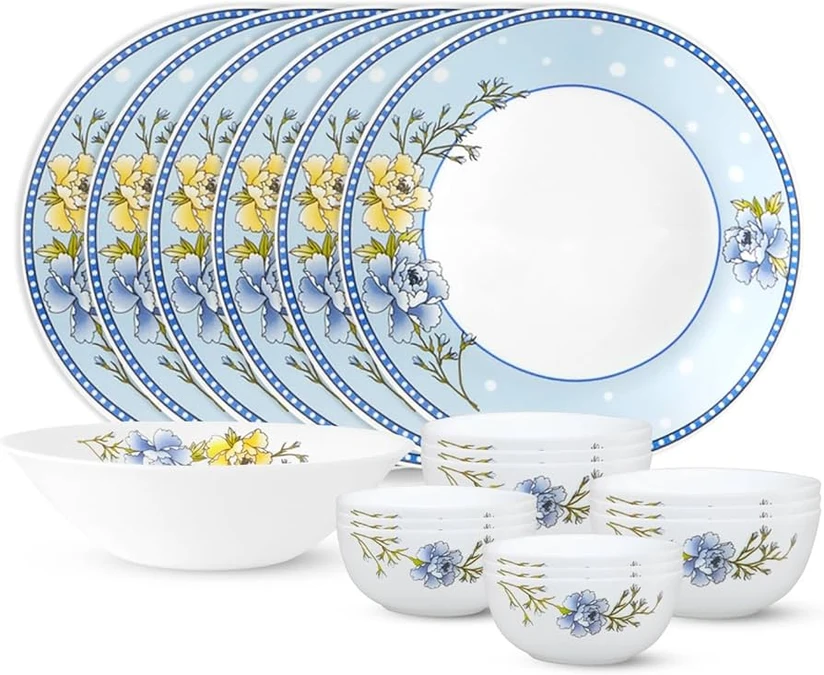
Looking at the rhythm of family meals, hot food never appears in isolation. A complete dining process usually includes heating, serving, eating, storing, cleaning, and even reheating after refrigeration and other continuous actions. Plates repeatedly experience temperature changes during this process: from room temperature (20℃) to holding hot dishes (70℃), cooling to room temperature after eating, contacting 40-50℃ warm water during cleaning, rising to about 60℃ during dishwasher cleaning, dropping to 5℃ during refrigerated storage, and then heating up again when contacting hot food for reuse. If the material is not suitable for such cycles, problems will not appear for the first time, but will gradually manifest after months or even years — such as fine cracks on the edge of the plate, or glaze peeling at the bottom due to repeated cold and hot contraction. Precisely because of this, when choosing tableware, many families value “whether it is worry-free in the long term” rather than whether it is barely usable for a single time. Opal glass plates for daily use excel in this aspect, maintaining stability through frequent use cycles.
This is clearly reflected in overseas discussions on durable household goods. In Reddit’s household goods exchange area, a user summarized the long-term use experience of glass tableware by incorporating it into the complete family use chain: “I’ve had my opal glass plates for 4 years now— they go through microwave (for reheating leftovers), dishwasher (almost every day), extremely hot food (like chili con carne straight from the slow cooker), extremely cold food (like ice cream or chilled salads), and they still look and work like new. The only time I had a issue was when I put a hot plate on a frozen patio table in winter— that was my mistake, not the plate’s.”
Breaking down from actual experience, the applicability of opal glass plates for holding hot food is mainly reflected in the following aspects highly related to family life:
There Is a Realistic Upper Limit to the Temperature of Hot Food in Families
Hot dishes on the family dining table are completely different from the continuous high temperature during cooking. When heated on the stove, the temperature of food may exceed 100℃, but after being served on plates and separated from the heat source, heat will be quickly conducted to the air and plates, and the temperature usually drops by 10-20℃ within 5 minutes. Plates are exposed to short-term, dispersed heat input, and this temperature range itself is close to the daily use range of opal glass plates — the designed temperature tolerance range of most brands is -20℃ to 120℃, which can basically cover the temperature range of hot food in families.
The Test of Use Comes from Frequency, Not Extreme Conditions
For families, the real test for plates is repeated cold and hot switching and high-frequency use. A family of three uses plates 2-3 times a day, with the number of contacts with hot food reaching more than 150 times a month and about 1800 times a year. If a plate performs stably in such high-frequency cycles, its practical significance is far higher than the one-time temperature resistance index. A small survey by overseas consumer associations shows that the breakage rate of opal glass plates in 1000 consecutive cold and hot cycles (room temperature →70℃→ room temperature →5℃) is only 2%, far lower than the 15% of ordinary soda-lime glass plates — this also confirms its stability in daily use.
No Need to Deliberately Adjust Dining Habits
When plates can be naturally used to hold hot food without repeatedly reminding “whether to cool first” or “whether to put a heat insulation pad”, it means that they have been integrated into the normal dining rhythm of the family. Serve a bowl of hot porridge without cooling it to below 50℃, and hold it directly without a heat insulation pad; put it into the dishwasher directly after eating without waiting for the plate to cool completely. Isn’t this “burden-free” use experience what family users value most? In contrast, ceramic plates are heat-resistant but heavy and easy to absorb oil; ordinary glass plates are lightweight but have poor adaptability to temperature differences, while opal glass plates balance these needs relatively well, adapting to hot food scenarios without increasing operational costs. This makes them ideal safe plates for hot food serving in daily life.
Of course, we must also look at it objectively: no glass tableware can be “absolutely safe”. If a plate that has just held 90℃ hot soup is directly put into a 0℃ refrigerator, or rinsed with cold water immediately after contacting hot food, such improper sudden cold and hot changes or operational errors may still cause cracking. However, in the real and high-frequency use environment of family meals, when discussing whether opal glass plates are suitable for holding hot food, a more reasonable perspective is to observe their performance in long-term daily cycles rather than judging them under extreme conditions.
Overall, opal glass plates usually do not need to be treated as specially cared-for utensils when holding hot food. On the contrary, they are more like a daily choice that can adapt to the rhythm of hot food in families and maintain a stable experience in long-term use. In the specific scenario of the family dining table, this stability and ease of use are the core criteria for judging whether it is “applicable”.
What Should You Avoid When Using Opal Glass Plates with Hot Food?
The core positioning of opal glass plates is to hold food that has been cooked — once used for heating, baking, or long-term exposure to abnormally high-temperature environments, their performance loses reference significance. Therefore, before judging whether it is suitable for holding hot food, we first need to clarify: which high-temperature scenarios and usage methods are not recommended to try?
Combined with the usage instructions of mainstream glass tableware brands and common misuse situations in actual family and catering scenarios, these not recommended usage methods can be summarized into the following categories:
Direct Contact with Open Flames or Any Form of Direct Heat Sources
Placing opal glass plates directly on open fire sources such as gas stoves or alcohol stoves is a typical and easily overlooked misuse. In such scenarios, heat will be concentrated locally and rapidly at the bottom of the plate — the temperature in the area directly contacted by the gas stove flame can rise rapidly to more than 200℃, while other areas of the plate body are still at room temperature, forming obvious uneven heating. This neither conforms to the design working conditions of glass plates nor deviates from their core logic of “holding hot food” — during design, it only needs to withstand uniform heat conducted by food, rather than locally rapidly rising high temperature.
In Corelle’s official safety and usage instructions, there is a clear statement on this boundary: “DO NOT USE ON STOVETOP … or on or near any other direct heating source such as open flames.” The brand also adds that even opal glass plates marked with “heat-resistant” may experience unbalanced internal stress in the material due to direct flame contact, resulting in permanent cracks at best and direct rupture at worst.
The significance of such instructions is not to emphasize “danger”, but to clearly distinguish the boundary between tableware and heating utensils — plates are “carrying tools”, not “heating tools”, which is also a general principle of most glass tableware brands.
Continuous High-Temperature Radiation Environments Such as Ovens and Grills
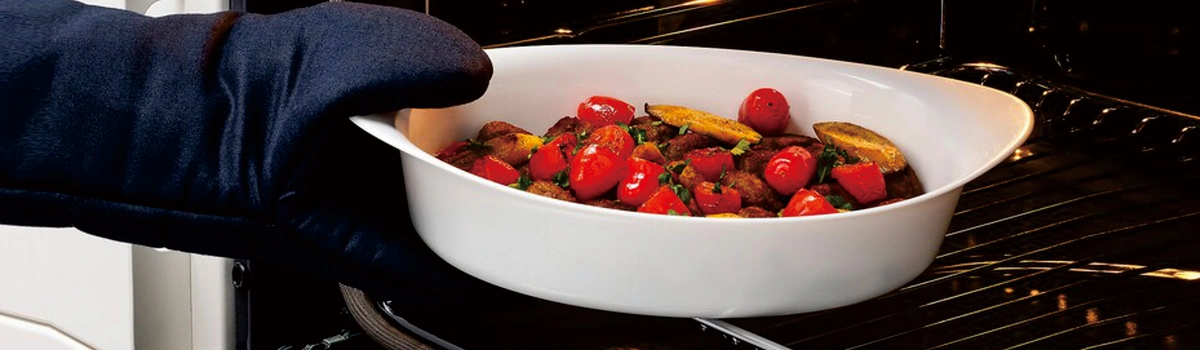
Unlike holding freshly cooked hot dishes for a short time, the heat in equipment such as ovens and grills acts on the surface of utensils in the form of continuous radiation, with temperature levels and action modes far exceeding those in the daily food serving stage. For example, the internal temperature of a household oven during baking is usually 150-200℃, and heat will wrap the plate from all sides — such continuous, high-intensity heat exposure may cause gradual changes in the molecular structure of opal glass, and long-term use may lead to decreased transparency and brittleness of the plate. Even without direct contact with flames, this usage method is beyond the design scenario of the plate. The official classifies it into “direct heating source”, essentially emphasizing that plates are usually not designed for baking or long-term high-temperature bearing.
Extreme Switching Operations with Large and Frequent Cold and Hot Ranges
In normal dining processes, the temperature difference borne by opal glass plates is usually slow and limited — for example, contacting 70℃ hot food from 20℃ room temperature, and contacting 50℃ cleaning water after cooling, with the temperature difference within 50℃. However, in actual use, some atypical operations are still prone to occur: a plate that has just held 90℃ high-temperature soup is immediately contacted with 0℃ ice water, cold metal countertops, or placed on a humid, low-temperature surface. Such operations will make the material bear a temperature difference of 80-90℃ in a short time; even though most opal glass is designed to withstand an instantaneous temperature difference of 135℃, frequent extreme switching may damage the material. Emphasizing this point is not to deny its daily stability, but to remind everyone to avoid artificially creating extreme working conditions. This is especially important to protect the opal glass temperature shock resistance and extend the service life of the plates.
Long-Term, High-Frequency Heat Exposure in Commercial Environments
In some catering back kitchens or food serving areas, plates may be repeatedly placed near food serving outlets, under heat preservation lamps, or close to high-temperature equipment. Continuous heating by heat preservation lamps will keep the surface temperature of the plate at 60-80℃ for several hours — this state is completely different from “short-term holding and natural cooling” in family scenarios. Holding hot food once is usually fine, but when heat accumulates continuously, the use condition changes from “short-term bearing” to continuous heat exposure. Such commercial environments are not the conventional application scenarios of opal glass plates, so they are not recommended — in commercial scenarios, it is more advisable to choose specially heat-resistant ceramics or industrial-grade glass utensils.
It should be clear that these not recommended situations by no means mean that opal glass plates “cannot hold hot food”. On the contrary, they emphasize: do not mistake the plate for a utensil for heating, baking, or withstanding extreme working conditions. As long as the usage method returns to the normal food serving and dining stage, the material characteristics of the plate can still play a role.
Therefore, to answer the question “Can opal glass plates be used to hold hot food?”, the core judgment basis is not the extreme temperature, but whether the usage boundary of “being tableware rather than heating utensils” is followed. Clarifying these boundaries is itself an important prerequisite for ensuring long-term stable use.
Key Points to Consider When Choosing Opal Glass Plates for Serving Hot Food
When holding hot food becomes the main or even the only use demand, the selection of opal glass plates for hot food requires more attention to long-term suitability. What really affects the use experience and safety is not a single parameter, but the matching degree of material, structure and usage scenarios — have you realized this?
Whether It Has Good Temperature Difference Adaptability, Not Just High Temperature Resistance
The process of holding hot food is essentially not continuous high temperature, but repeatedly experiencing the cycle of “normal temperature → contact with hot food → natural cooling”. If the plate material is prone to accumulate internal stress during temperature difference changes, even if no problems occur in the short term, fine cracks or structural fatigue may occur after long-term use.
In the European catering glass system, temperature difference adaptability is an important dimension for evaluating glass stability. In Arcoroc’s industry data, it is clearly mentioned: “Opal Glass products are resistant to variations in temperature of 135°C”. This value means that opal glass plates can withstand an instantaneous temperature difference from -20℃ to 115℃, which can usually cover the temperature difference range that may occur in family scenarios (usually no more than 80℃).
The significance of this statement is not the specific value, but the industry consensus it reflects: to judge whether it is suitable for holding hot food, we should focus on the stability of the material in cold and hot switching, rather than relying solely on the vague label of “heat-resistant”. For example, two plates marked “heat-resistant 120℃”, one can withstand 100℃ temperature difference switching, and the other can only withstand 60℃ — the latter is more likely to crack due to cold and hot alternation in daily use, which is also a key point to identify when purchasing. For those seeking safe plates for hot food serving, this adaptability is a non-negotiable factor.
Whether the Plate Thickness and Heating Uniformity Are Conducive to the Use of Hot Food
When holding hot dishes or hot soup, the plate is not heated uniformly as a whole — the bottom of the soup bowl contacts the hot soup first, the temperature rises rapidly, and the edge of the bowl mouth heats up slowly, resulting in thermal stress due to this local temperature difference. If the thickness distribution is unreasonable: the bottom is too thin and the edge is too thick, the bottom will bear greater stress due to temperature concentration, and may bulge or crack after long-term use; the bottom is too thick and the edge is too thin, the edge is easy to get hot when held.
Opal glass plates with moderate thickness (usually 2-3mm at the bottom and 1.5-2mm at the edge) are more conducive to the dispersion of heat inside the plate body, reducing instability caused by local rapid heating. This point is more practically significant than short-term tests in long-term use with hot food — for example, a plate with uniform thickness can hold hot soup every day for 6 consecutive months without deformation or cracks, while a plate with uneven thickness may have micro-cracks at the edge after 3 months.
Whether the Holding Safety Is Sufficient When Serving Hot Food
Heat will inevitably be conducted to the plate body. If the edge of the plate is too thin or the bottom lacks structural support, it is easy to get hot when held, affecting safety and comfort. For example, a plate with 80℃ hot soup, with an edge thickness of only 1mm, heat will be quickly conducted to the fingertips, and a heat insulation pad is often needed; while a plate with an edge thickness of 2mm and an arc design has a slower heat conduction speed, and the fingertips only feel warm when touched, which can be held safely without additional tools.
Therefore, when hot food is the main demand, paying attention to the arc design of the plate edge and whether the bottom has a slight protrusion (forming an air layer with the desktop) is often more in line with real scenarios than simply pursuing lightness and thinness — after all, safe holding is usually the basis of daily use. Opal glass plates for daily use often integrate these design details to meet family needs.
Whether It Is Suitable for High-Frequency, Long-Term Holding of Hot Food, Rather Than Only Performing Well in the Initial Stage
Plates mainly used for holding hot food will experience a large number of use cycles in a short time. If the material or structural design is only stable in the initial stage, with the increase in the number of uses, problems such as changes in hand feel and structural fatigue may gradually occur. For example, some low-cost plates have no abnormalities in the first 3 months of use, but after multiple times of holding hot food and dishwasher cleaning, the surface will lose luster, the edge will become rough, and even small gaps will appear.
Therefore, when purchasing, more attention should be paid to the state of the plate after long-term repeated holding of hot food, rather than the intuitive feeling of the first use. You can refer to the brand’s warranty policy — some high-end brands provide a 1-2 year warranty for opal glass plates, promising free replacement for cracks caused by normal use with hot food, which also reflects the brand’s confidence in the long-term stability of the product from the side.
For a more intuitive comparison of the performance of different glass plates in hot food scenarios, here is an objective technical comparison table:
| Performance Dimension | Ordinary Soda-Lime Glass Plates | Tempered Glass Plates | Opal Glass Plates |
|---|---|---|---|
| Temperature Difference Adaptability | General (≤60℃) | Good (≤100℃) | Excellent (≤135℃) |
| Heating Uniformity | Poor (Prone to Local Heating) | Good (Fast Overall Heat Conduction) | Excellent (Uniform Heat Dispersion) |
| Long-Term Stability in Hot Food Use | Poor (Prone to Stress Accumulation and Cracking) | Good (Prone to Brittleness After About 1 Year) | Excellent (Stable for More Than 2 Years) |
| Holding Safety (Hot Food Scenarios) | Poor (Edge Prone to Getting Hot) | Good (Heavy Weight, Stable Holding) | Excellent (Arc Edge, Good Heat Insulation) |
Note: The values in the table are general industry test results, and products of different brands may have slight differences, for reference only.
What should you pay attention to when purchasing? Is it temperature difference adaptability, heating uniformity, holding safety, or long-term use stability? Only when these dimensions meet the standards can the opal glass plate be truly suitable for hot food scenarios — if only looking at the single label of “heat-resistant”, it is likely to ignore the most critical details in daily use. For consumers researching can opal glass handle hot food, these factors collectively determine the reliability of the product.
Overall, opal glass plates can usually be used to hold hot food, but whether they can really meet the needs depends on the stability of the material under temperature difference changes, the safety of holding hot food, and the consistency of performance after long-term repeated use. When the purchasing logic is upgraded from “whether it is heat-resistant” to “whether it is suitable for hot food scenarios in the long term”, you can more accurately judge whether a plate meets the actual use needs. Opal glass plates for hot food thus emerge as a trustworthy choice for families prioritizing both safety and durability.
FAQ
Q1: Can opal glass plates hold all kinds of daily hot food without any restrictions?
A1: Opal glass plates are suitable for most daily hot foods, including freshly cooked stir-fries, hot soups, stewed dishes and reheated leftovers (temperature range 50-90℃). But they have restrictions: do not use them with direct heat sources like open flames, and avoid extreme temperature shocks (e.g., placing a hot plate on icy surfaces), as these improper uses may cause cracking.
Q2: What’s the most important factor to check when buying opal glass plates for long-term hot food use?
A2: The most important factor is not just maximum heat resistance, but temperature difference adaptability (ideally withstanding 135℃ instantaneous temperature difference). In addition, uniform thickness distribution (2-3mm at the bottom, 1.5-2mm at the edge) and humanized structural design (e.g., arc edges for safe holding) are also key to ensuring long-term stable use in hot food scenarios.
Q3: How to use opal glass plates with hot food correctly to extend their service life?
A3: First, abide by the core boundary: use as tableware only, not heating utensils (avoid ovens, open flames). Second, avoid extreme cold and hot switching (e.g., no cold water rinsing for hot plates). Third, avoid long-term heat exposure in commercial environments (e.g., under heat preservation lamps for hours). Fourth, choose plates with uniform thickness and reasonable structural design, which can reduce thermal stress accumulation during daily use.