News For Reading

Opal Glass Dinnerware: Why It Wins in Shatter Resistance & Safety – Durability Comparison

⚡Short note: Opal glass dinnerware shines in shatter resistance, safety, scratch resistance & versatility for daily use.

  • Shatter resistance: Spreads impact stress effectively, shows predictable failure without sharp or tiny fragments.
  • Safety performance: Avoids hidden structural damage, failure state is easy to identify for timely replacement.
  • Surface stability: Resists scratches and yellowing as surface is integral to material, no layered deterioration.
  • Usage versatility: Transitions smoothly from fridge to microwave without extra steps or temperature adaptation.

When Dropped: Why Opal Glass Is Safer Than Melamine & Tougher Than Stoneware

Many families have experienced similar moments: a freshly washed dinner plate stacked by the sink slips from your hand and crashes to the floor with a “pop”; or during a meal, a child stands up too quickly, bumps the edge of the table, and the plate tumbles off the corner. These scenarios are hardly “accidents”, but they are real, frequent, and often difficult to completely avoid in daily life—making opal glass dinnerware durability a key consideration for practical use.

It is in these moments that people gradually realize – the durability of tableware is not exactly the same as its ultimate strength tested in a laboratory. What truly impacts the user experience is how the material reacts when an accident occurs, and whether it poses additional usage risks after failure. This is where opal glass shatter resistance stands out in real-world settings.

Let’s first look at stoneware.

Its first impression is often “thick, hard, and sturdy”, but in drop scenarios, its material properties also bring certain limitations. Stoneware belongs to the high-density ceramic system; when an impact occurs, force is more likely to concentrate on the impact point or edge area, and once a crack appears, it may be difficult to buffer effectively. As a result, in actual use, common situations include edge chipping or overall fracture.
Therefore, some users find that stoneware does not necessarily break on the first drop, but may show obvious failure after a seemingly minor collision.

Now let’s turn to melamine.

Melamine does exhibit good drop resistance in daily use, which is quite intuitive in many household scenarios. However, as usage time extends, some changes may not be so noticeable: for example, small nicks on the edges, imperceptible damage to the surface, or structural fatigue after repeated drops. These situations may not immediately affect use, but they can make subsequent safety judgments less clear – it is sometimes not easy to determine whether the plate is still suitable for continued use.

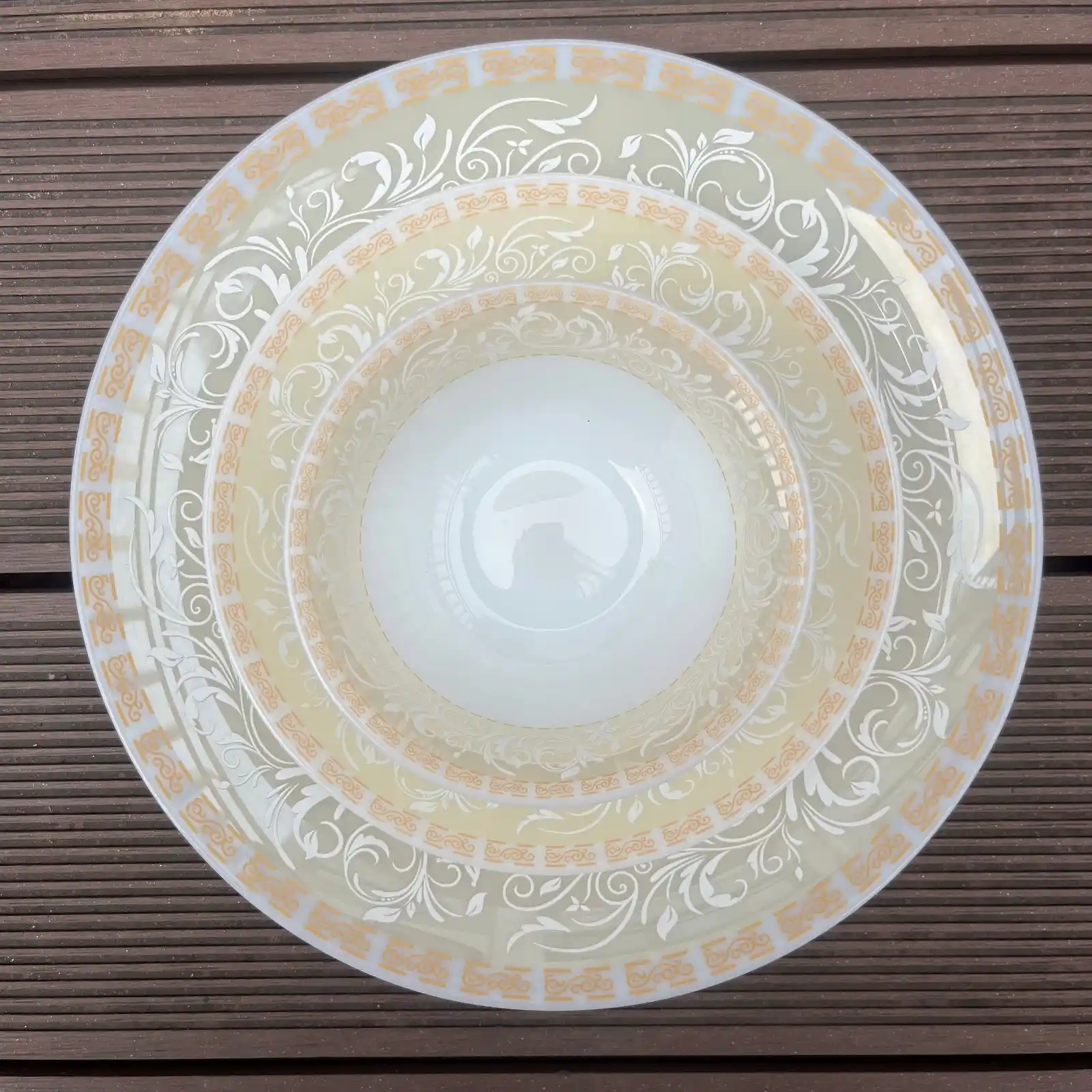
Opal Glass Dinnerware

In contrast, opal glass performs in a relatively balanced state in drop scenarios, a key aspect of opal glass vs melamine stoneware durability. In other words, when subjected to the same drop:

  1. Melamine usually does not shatter immediately, but may develop imperceptible structural damage after repeated drops;
  2. Stoneware seems sturdy, but may suddenly break in a single impact, forming sharp fractures;
  3. Opal glass, however, strikes a more practical balance between impact resistance and failure safety – it is neither like melamine, which “appears intact but has hard-to-judge hidden risks”, nor like stoneware, which “fails suddenly with sharp fragments”.

This is the core meaning of “safer than melamine & tougher than stoneware”: it is not simply a competition of hardness or number of drop resistances, but rather, when accidents are inevitable in real family use, which material can provide a more predictable and controllable failure performance.

Some opal glass adopts a glass-ceramic structure, introducing uniformly distributed microcrystalline phases into the glass matrix. Regarding the formation mechanism and material composition of this structure itself, we have a more systematic explanation in the article What Is Opal Glass?. When an impact occurs, stress is relatively less likely to concentrate on a single location, but is dispersed over a larger structural range. This does not mean it will not break, but under the same conditions, it usually helps delay the formation and propagation of cracks, making the failure process less sudden.

At the same time, when the load threshold is exceeded, the failure state of opal glass is often easier to identify.
Compared with the situation where “the surface still looks intact, but the internal state is difficult to judge”, this relatively clear failure performance makes it easier for users to determine whether to stop using it. From the perspective of household use, this judgeability itself has certain safety significance.

Regarding this structural difference, it has also been directly mentioned in real usage discussions. In a discussion on durable tableware on Reddit, a user described the structural characteristics of opal glass as follows:

“The sheet’s core layer is white opal glass sandwiched between a transparent top and bottom skin. The layers provide superior strength and is highly resistant to breaking or chipping.”

Such discussions are not performance tests, but descriptions of intuitive feelings after long-term use: when tableware undergoes repeated drops and collisions, the structural design will affect its failure mode and usage expectations to a certain extent.

Let’s return to the result after dropping.

In an inevitably severe drop, stoneware often forms sharp fractures, and melamine may have irregular chipped edges; under reasonable structural and thickness conditions, opal glass is more likely to separate into blocks. Of course, the fragmentation pattern is still affected by the drop height and contact surface, which is not an absolute rule, but a relatively common failure trend in actual household use.

Why Opal Glass Resists Scratches & Yellowing Better Than Glazed Ceramic

If you think back to the dinner plates commonly used in restaurants, you may notice a detail: some plates do not experience obvious drops or severe collisions, but after continuous use for a period of time, certain usage marks gradually appear on the surface – fine scratches left by knives and forks, friction marks from stacking, often concentrated in fixed areas. They are not very eye-catching, but are often hard to ignore. For those seeking scratch resistant opal glass dinnerware, this long-term surface stability is a notable trait.

The problem usually does not arise from a single use, but more from those daily operations that are almost never deliberately noticed: dinner plates are repeatedly stacked for storage, tableware moves frequently on the surface, and dishwashers go through round after round of cleaning cycles. It is these seemingly mild but long-term repeated processes that gradually widen the gap in usage status between opal glass and glazed ceramic.

Structurally, opal glass does not have a layered relationship of “surface glaze – internal body”. Its surface is not an attached covering, but part of the material itself – color, density, and structure show a relatively continuous distribution. This means that when slight friction occurs during the use of tableware, changes always occur within the same material system, and are less likely to be significantly amplified due to structural switching.

The situation with glazed ceramic is relatively different. Its initial smoothness and luster depend to a certain extent on the surface glaze layer. When this glaze layer is repeatedly scratched and gradually weakened during long-term use, the relatively rough structure of the underlying ceramic body may start to participate in subsequent wear. The same friction behavior yields completely different results under different structures – usage marks are relatively more likely to appear concentratedly.

This difference is not simply a subjective feeling. The Canadian Conservation Institute pointed out in its guidelines for material preservation that ceramic products are particularly vulnerable to physical forces such as abrasion and impact (“Ceramics are particularly vulnerable to physical forces such as abrasion and impact”).
This statement itself does not make a value judgment on specific tableware materials, but provides an objective background for understanding the possible surface changes of glazed ceramic during long-term use.

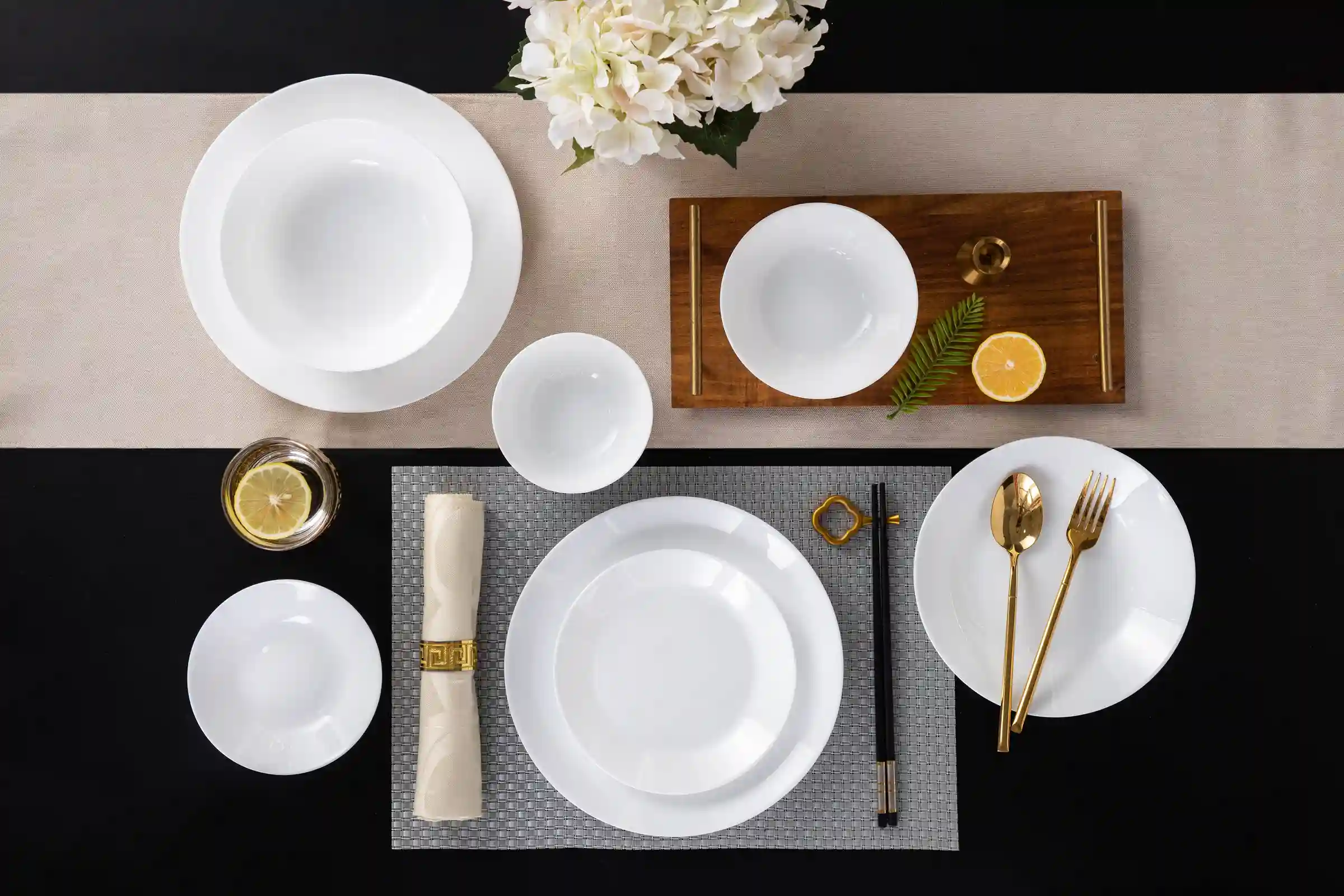
Opal Glass Dinnerware

As for the phenomenon of “yellowing”, it also rarely occurs suddenly in a short time.
In restaurant environments, a more common situation is: with increased cleaning frequency, more contact with oily foods, and repeated high-temperature treatment, the color of dinner plates gradually shows a certain degree of uneven change. Such changes do not entirely depend on cleaning methods, but are related to the evolution of the material’s surface state during long-term use.

The U.S. National Institutes of Health (NIH) mentioned in a systematic review that surface finishing and roughness significantly influence color stability over time (“Surface finishing and roughness significantly influence color stability over time”). In other words, whether the color can remain relatively stable is not just a matter of sufficient cleaning, but also related to whether the surface structure is prone to micro changes during continuous use. You can refer to the article A systematic review and meta-analysis.

Putting these factors back into the actual use scenarios of restaurants, the differences are easier to understand. That is, when facing the same long-term use wear:

  1. Glazed ceramic relies on the surface glaze layer to maintain smoothness and color; once the glaze layer is weakened by repeated scratches, the rough underlying ceramic body is exposed, and scratches and yellowing will appear concentratedly;
  2. The surface of opal glass itself is part of the material body, and its color comes from the internal structure rather than a surface covering layer. Therefore, during the same friction and cleaning processes, it will not suddenly accelerate deterioration due to “surface layer failure”;
  3. This is the core meaning of “resists scratches & yellowing better” in the title: it does not mean that no usage marks are produced at all, but in the high-frequency use environment of restaurants, opal glass can maintain a relatively consistent surface state for a longer time, avoiding accelerated deterioration caused by structural stratification.

The color of opal glass comes from its internal material structure, not from a surface covering layer. Therefore, during repeated cleaning and daily friction, its overall appearance is relatively less prone to obvious local changes. In contrast, glazed ceramic is relatively more dependent on the state of the surface layer; once the surface changes, usage marks are often more likely to appear concentratedly.

If we look back from a time dimension, the performance paths of the two materials in restaurant use environments can be roughly summarized as

Opal glass: The surface is the material itself, changes occur within the same structural system, and usage marks are relatively less likely to be amplified.

Glazed ceramic: Relies on the glaze layer to maintain surface state; as the surface layer gradually weakens, appearance changes are relatively more likely to appear concentratedly.

As the service cycle lengthens: The impact of surface treatment methods on scratch resistance and color stability will gradually accumulate, rather than appearing all at once in a short time.

Therefore, when discussing the shatter resistance and safety of restaurant tableware, the advantages of opal glass do not come from a single extreme test result, but are more reflected in the long-term, repeated use process – in frequent friction, cleaning, and stacking, it is relatively less likely to leave irreversible surface changes. This stability is closer to the actual use status of restaurant tableware in real operating environments, reinforcing opal glass dinnerware durability in daily settings.

Fridge to Microwave: How Opal Glass Beats Stoneware & Melamine in Versatility

More often than not, problems with restaurant tableware do not arise in deliberate tests or extreme conditions. They are more likely to occur in a very common state – fast-paced, continuous operation, and not necessarily stopping to confirm repeatedly at each step.

For example, imagine this scene: in a restaurant’s preparation room, there are still some pre-prepared dishes in the refrigerator. A staff member takes out a dinner plate and turns to walk towards the microwave or heating equipment. The process itself is not complicated, but whether it is necessary to stop and change containers midway often affects the overall rhythm. It is in these details that are not individually emphasized that the differences between opal glass, stoneware, and melamine gradually emerge – especially for microwave safe opal glass dinnerware, which supports seamless heating transitions.

The step from fridge to microwave reflects more on the smoothness of the process. In actual restaurant operations, few people repeatedly check the material instructions before each heating.
More often, it is halfway through the process that one realizes: the currently used tableware is not suitable for direct heating.

In this link, melamine tableware usually needs to be treated with caution. The U.S. Food and Drug Administration (FDA) stated in its public explanation:

“Foods and drinks should not be heated on melamine-based dinnerware in microwave ovens.”

This means that in actual restaurant use, the heating step may require additional process splitting: temporarily putting down the tableware, changing containers, re-handling, and then heating. These actions are not complicated in themselves, but in a high-frequency, continuous operating environment, additional transfer steps usually increase the probability of collisions or scalds. On the premise of being marked as microwave-safe, microwave safe opal glass dinnerware often does not significantly interrupt the operation rhythm in this process, but can complete the transition relatively smoothly.

The limitation of stoneware is closer to “needing more careful handling”.

Stoneware and ceramic are also common in restaurants, and they can also be used in heating scenarios.
However, between cold and hot temperatures, they usually rely more on the user’s control of the operation rhythm.

Some ceramic brands remind against direct cold-to-hot switching in their usage instructions, for example: “Never put a plate from the fridge or freezer into the oven or microwave.”

Such reminders are more operational suggestions based on material properties.
In actual restaurant environments, this means that the use of stoneware often requires additional attention to process connection, rather than relying entirely on the material’s own adaptability.

When operations need to repeatedly rely on human memory and norms, the continuity of the process may be affected to a certain extent.

The so-called all-around convenience is more reflected in the “reduced” links in the process. When the same food needs to be moved from refrigeration to heating:

  1. Melamine tableware usually cannot be directly heated in the microwave and requires container replacement midway – this means additional transfer steps and also increases the risk of collisions or scalds;
  2. Although stoneware can be heated, it is often not recommended to put it directly into the microwave or oven after taking it out of the fridge – it requires the operator to remember and follow the temperature transition rules, which relies on human judgment and is easy to be ignored in a fast-paced environment;
  3. Opal glass (on the premise of being marked as microwave-safe) can complete the entire transition from refrigeration to heating relatively smoothly, without the need to change containers midway or deliberately wait for temperature adaptation.

It is not simply a competition of heat resistance temperature or material hardness, but in the real operation process of restaurants, opal glass can reduce interruptions caused by material limitations – the more coherent the process, the lower the probability of human error, and safety is naturally reflected in this smoothness. This versatility further complements opal glass vs melamine stoneware durability by addressing practical usage needs.

From the perspective of shatter resistance and safety, the advantage of opal glass does not lie in a single indicator, but in the fact that it introduces fewer additional interruption points in the actual process. Its consistent performance across drop resistance, surface stability, and heating adaptability underscores opal glass shatter resistance as a key part of its overall reliability.

Everyday Drops, Long-Term Peace of Mind: Choosing Durable Dinnerware for Families

Few people sit down to “rationally analyze” whether tableware is durable at the very beginning. More often, problems emerge on their own at a specific moment.

For example, such a scene – dinner has just ended, the table has not been cleaned up yet, and a child reaches for fruit while talking. The dinner plate is pushed and slides towards the edge of the table. It is not a slow-motion thrilling moment, just a “click” as it falls to the floor. You stop instinctively, and the first thought in your mind is often not “how expensive is the plate”, but: will there be broken pieces all over the floor? It is in these moments that require no deliberate thinking that the safety issue of household tableware becomes very specific.

Opal Glass Tableware

For families with children, what really makes people nervous is often not “whether it will fall”, but – what it will become after falling. Is it broken into small pieces? Will it splash? Do you have to repeatedly check for missed small fragments when cleaning? These problems are usually difficult to solve through instruction manuals, but they recur in life.

In a public video demonstration, the publisher directly showed the damage state of a glass dinner plate after exceeding its bearing limit, and pointed out the possible risks of the result with one sentence:

“when a Corelle plate exceeds its ‘shock proof’ limit… the plate will explode into thousands of pieces!”

This demonstration discusses the performance of a specific dinner plate after exceeding its bearing range. It is not telling families which material to choose, but intuitively reminding: sometimes, what is really troublesome is not just “breaking”, but “how it breaks”. When damage means a large number of small fragments, the problem often continues from the moment of falling to cleaning, inspection, and even subsequent safety concerns.

Thus, a more daily selection idea has gradually emerged. In inevitable minor collisions and occasional drops, many families have begun to favor tableware types that – do not promise “absolute unbreakability”, but are less likely to result in highly fragmented consequences under common mistakes. Opal glass is frequently mentioned in such household discussion contexts: what is focused on is not its extreme test results, but whether the outcome is more acceptable under the expected usage intensity of most families. Scratch resistant opal glass dinnerware also aligns with this demand by maintaining its appearance through daily wear.

This feeling is often more obvious in families with high-frequency use. When tableware is taken, placed, cleaned, and stacked multiple times a day, the risks that gradually accumulate are usually not from a single accident, but from small changes during long-term use – repeated cold and hot alternations, edge contact, and storage friction. Regarding “whether cold and hot switching will amplify usage risks”, if you are interested in the topic of heat resistance, you can learn more in our article Can Opal Glass Handle Hot Food in Daily Use?, which discusses daily heating and usage boundaries separately. If a type of tableware can maintain a relatively predictable performance in an environment with frequent cold and hot changes, its safety is often more acceptable to families.

For families leaning towards a simple lifestyle, durability has another meaning. It is not “looking as good as new all the time”, but not being frequently replaced due to concerns. A set of tableware, if it still makes people feel at ease to use and looks pleasing after several years of use, is more likely to stay in daily life naturally, rather than being eliminated prematurely due to hidden risks.

Putting these scattered life experiences together, a relatively intuitive judgment sequence can be formed:

  1. For families with kids: The real concern is not “whether it will fall”, but “whether it will break into small pieces all over the floor” – opal glass is relatively less likely to result in highly fragmented consequences in common drop scenarios, which reduces cleaning burdens and subsequent safety hazards;
  2. For busy households: Tableware undergoes multiple pick-ups, placements, cleanings, and cold-hot alternations every day, and accumulated risks often come from small changes in long-term use – opal glass can maintain relatively stable performance in repeated use and is not prone to sudden failure due to hidden damage;
  3. For families pursuing simple living: Durability is not “looking as good as new”, but “using with peace of mind and not needing frequent replacement” – opal glass maintains a stable state after several years of use, making it more likely to stay in daily life naturally rather than being eliminated prematurely due to concerns.

These three household scenarios essentially point to the same core need: in the repeated use of real life, control the consequences of accidents within an acceptable range.

First, look at the household environment itself – whether there are children, whether it is frequently moved and dropped; then, look at the result after an accident – whether it is easy to fragment, whether it increases cleaning burdens; finally, look at the state of long-term use – whether it remains stable after high-frequency cleaning and stacking.

Looking back along this sequence, it is found that opal glass is often considered to have more advantages in shatter resistance and safety not because it “never has problems”, but because in most real household scenarios, it is more likely to control problems within a less stressful range. This is not an absolute conclusion, but rather a choice result gradually formed by many families after repeated use.

Frequently Asked Questions (FAQ)

Q1: Is opal glass completely unbreakable when dropped?

A1: No, opal glass is not completely unbreakable. However, compared to melamine (which may have hidden structural damage after repeated drops) and stoneware (which may suddenly break into sharp fragments), opal glass strikes a balance: it is less likely to shatter into tiny, scattered pieces in common drop scenarios, and its failure state is more predictable and easier to identify, reducing safety risks and cleaning burdens.

Q2: Why does opal glass resist scratches and yellowing better than glazed ceramic in restaurant use?

A2: Unlike glazed ceramic, which relies on a surface glaze layer for smoothness and color, opal glass’s surface is an integral part of the material itself, with color derived from its internal structure rather than a surface coating. In high-frequency restaurant use (repeated friction, cleaning, and stacking), opal glass avoids accelerated deterioration caused by glaze layer wear, so scratches and yellowing are less likely to appear concentratedly and irreversibly.

Q3: Can opal glass be directly used to heat food from the fridge in the microwave?

A3: On the premise that it is marked as microwave-safe, opal glass can smoothly transition from fridge to microwave without the need for container replacement or waiting for temperature adaptation. In contrast, melamine tableware is not suitable for microwave heating (requiring extra transfer steps), and stoneware is not recommended for direct cold-to-hot switching (relying on human judgment and easy to be ignored in fast-paced environments), making opal glass more versatile in restaurant and household heating scenarios.


Scroll to Top

Contact us

Connect with us for tailored solutions, partnership opportunities, or product inquiries — we’re ready to support your vision.