
⚡short note: Jade dinnerware “yellowing”? It’s from usage habits, light, material, and residues.
- Visual impressions: Most “yellowing” feelings stem from surface residues, lighting contrasts, or memory gaps, not the dinnerware’s inherent color.
- Structural stability: Around 60% of consistent jade hues come from internal material structure, resisting fading from daily heat or cleaners.
- Dishwasher impact: Regular high-temperature cycles slightly reduce transparency, creating duller visual cues over extended use.
- Residue buildup: Oily food leftovers and delayed cleaning form thin layers, heightening perceptions of color shifts.
When many people first come into contact with jade-colored dinnerware, they are attracted by its texture close to white jade: the color is soft, not harsh to the eyes, looks clean, and is also very pleasing to the eye over time. However, what really makes people hesitate is often not the immediate visual appeal, but a more practical daily life issue — can this color stand the test of time and frequent use? Many people quietly ask, “does jade dinnerware turn yellow” as they imagine long-term use, and this doubt lingers in daily scenarios.
This worry is not a conclusion drawn from rational analysis, but a very natural intuitive reaction. Jade color is not cold white; it inherently has a slight warm tone. When the color is light enough and restrained enough, the human eye is instead more sensitive to changes. Even if the difference is very subtle, as long as it forms a contrast with “how it looked when first bought”, it is easily perceived as a color change.
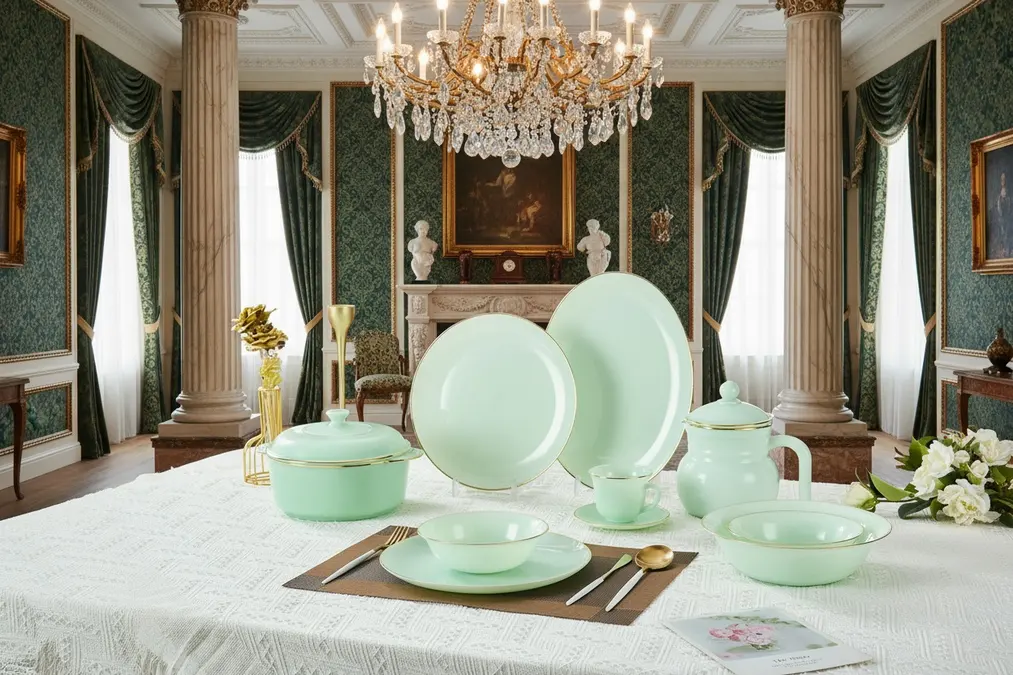
This judgment usually does not occur on the day of purchase, but is gradually amplified during use. You may not explicitly see a moment when it “yellows”, but suddenly realize at an inadvertent moment: it doesn’t look exactly the same as in your memory. Then doubts start to arise, and once they do, they are hard to completely ignore.
What Situations Lead to This Concern?
The real driver of this worry is not a single reason, but a series of highly daily scenarios stacked together.
- When new and old dinnerware are placed together, the old one appears darker in color by contrast
- Right after the dishwasher finishes, the surface of the dinnerware is covered with moisture, resulting in reduced transparency and looking less “white and clean” than when dry
- After eating foods with high oil content or strong colors, even after cleaning, there is a subconscious suspicion of residual residues
- When observed under warm lighting or natural light in the evening, the inherent warm tone of jade color is further amplified
When these situations occur individually, they often do not attract much attention, but when they recur in daily life, they will slowly reinforce an impression: jade color seems to “change easily”.
In addition to the immediate usage experience, many people’s judgments are also influenced by past experiences. Plastic dinnerware, some melamine products, or ceramics with insufficient glaze stability that have been used in the past may indeed experience a deepening of the overall tone after long-term use. These experiences may not be recalled consciously, but they automatically surface when seeing a similar color.
Thus, an imprecise but highly intuitive judgment logic is formed: light-colored dinnerware, as long as used every day, will inevitably yellow over time. When this experience is applied to jade color, which is inherently warm, the worry is naturally further amplified.
In social discussions, “yellowing” is often understood as a surface change. In some overseas daily discussions, when people talk about dinnerware “looking yellow”, they tend not to rush to conclusions, but first start with usage marks. For example, in a Reddit discussion on dinnerware cleaning, a user mentioned when analyzing color changes in old dinnerware: If it is brown/yellow-ish it could be oil or grease.
The Essence of Worry: Uncertainty About the Source of Change
Taking these factors together, many people worry that jade color “yellows more with use” not because they have seen a clear, irreversible change, but because they cannot immediately judge: Is the difference in front of them due to the color itself, or the superposition of usage state, light, contrast, and memory? Does jade dinnerware turn yellow due to inherent flaws, or is it a result of external factors? This uncertainty fuels the persistent concern.
When this sense of uncertainty recurs, it will gradually evolve into a persistent doubt. Understanding this is actually laying the foundation for subsequent discussions on color stability — first figuring out why people have this worry, so that we can more rationally distinguish the difference between “appearing to have changed” and “actually changing”.
Common Causes That Actually Lead to Color Changes in Jade Dinnerware
Understanding jade dinnerware yellowing causes requires looking at material, cleaning, and usage factors that accumulate over time. Many people really start to doubt whether jade-colored dinnerware “is going to yellow” not when they first bring it home, but at a very daily moment. It may be after washing a stack of bowls and preparing to put them into the cabinet, suddenly feeling that some of them are not as transparent as before; or it may be after serving spicy oil, curry several times, cleaning them thoroughly, but always feeling that the color is a bit off. This feeling is often indescribable, but hard to ignore.
If we connect these details in use, we will find a fact that conforms to common sense of life: color changes in jade dinnerware almost never happen suddenly, nor are they caused by a single reason. It is more like the result of the material continuously “responding” to the environment during long-term use.
- Color changes in jade dinnerware are usually the result of long-term accumulation, not sudden occurrence in a short time
- The real decisive factor is whether the material itself is stable
- Cleaning methods, food types, and heating habits will continuously amplify the differences
- Situations that look like yellowing are not necessarily due to actual color changes of the dinnerware itself
Material Stability
Jade dinnerware color stability hinges on whether the hue comes from the material’s inherent structure or external additives. In daily use, many people easily overlook a reality: dinnerware that looks the same jade color on the outside may be made of completely different materials. At the beginning of use, they are almost indistinguishable, but as time goes by, their states may slowly diverge.
This is why some people use jade dinnerware for many years without noticing obvious changes, while others quickly get the intuitive feeling of “aging” and “yellowing”.
Dishwashers, Oil, and Cleaning Habits
From the perspective of life experience, dishwashers are just tools for convenience, but from the material science, they are actually a continuous, high-frequency test environment. High-temperature water repeatedly sprays, cleaning agents long-term contact, plus temperature differences during the drying process, all will imperceptibly affect the appearance of the dinnerware. This phenomenon is often referred to as jade dinnerware dishwasher haze, which is not permanent with proper care.
When the material itself is stable enough, these processes only complete cleaning, and the appearance hardly changes; but if the material has general tolerance to heat or chemical environments, the surface may gradually lose its original delicacy and smoothness. When light no longer reflects evenly, the human eye will naturally feel “not as white as before”, thus making a judgment of yellowing.
Similar situations also often occur after serving foods with heavy oil and strong colors. Spicy oil, curry, and sauces themselves are not problems; the key is whether the material is easily affected by oil and pigments. Dinnerware with a dense surface often returns to its original state after cleaning; while materials with a relatively loose structure, even if they look clean, tend to accumulate a feeling of “aging” over time.
Heating Methods and Surface Changes
There are also some color changes that are actually amplified in advance during the heating process. During microwave heating, heat is often concentrated in local areas, and reheating leftovers will subject the dinnerware to uneven temperature changes. If the heat resistance of the material is limited, this pressure will easily manifest first at the edges, bottom, and other positions, forming uneven appearance changes.
At the same time, as usage time increases, fine scratches on the surface will inevitably multiply, and the luster will gradually change from clear to soft. When the originally slightly cold white jade color loses a bit of transparency, the human eye will easily interpret this change as “the color has yellowed”. But in essence, what changes in many cases is the surface state, not the color itself.
From the perspective of real usage scenarios, whether jade dinnerware will yellow is not a simple yes-or-no question. It often depends on whether the material itself is stable, and whether it can withstand the repeated impacts of cleaning, oil, and heating methods during long-term use. When the material is stable enough, these daily operations will not significantly change the appearance of the jade color; while when the material’s tolerance is limited, changes will slowly appear inadvertently.
Understanding these reasons, and then looking back at the color changes of jade dinnerware, it is easier to judge where the problem lies, and also closer to the real usage experience.
Does Jade Glass Yellow Naturally or Is It Just Visual Perception?
When many people first feel that jade-colored dinnerware “seems different”, it is often not due to obvious damage, but at an inadvertent moment of daily comparison: among the same set of dinnerware, some still look clear and transparent, while others appear slightly darker. At this point, the question naturally arises: “Has the color changed?” But if we refocus on the usage process itself, we will find that what appears to be “yellowing” is not actual color change of the dinnerware—instead, different usage habits simply create such a visual perception.
Color Changes Depend on “How It’s Used” Rather Than “How Long It’s Used”
From the perspective of life experience, if the material itself really undergoes a color change, it will usually shift as a whole and evenly; while the situation seen in most families is more like a kind of “state difference”. This is exactly the trace left by usage habits after long-term effect.
- Hand-washing-dominant usage habits: Color changes are often not obvious, and the overall state remains uniform. Even after years of use, the dinnerware mostly has a slight change in luster, but the jade white tone itself is basically stable.
- High-frequency dishwasher usage habits: The probability of “appearing to have color changes” is higher, manifested as reduced transparency, a slightly foggy surface, and looking less clean under lighting. Jade dinnerware dishwasher haze is more likely to occur in this scenario without proper program adjustment.
- Usage habits with frequent changes in cleaning environment: When the type of cleaning agent, water quality, or washing procedure is adjusted multiple times, it is easier to have subtle color differences between the same set of dinnerware.
Understanding these differences helps to break down the intuitive feeling of “yellowing” into more specific manifestations.
Color Presents Differently Under Different Cleaning Methods
In families where hand washing is the main method, jade-colored dinnerware usually shows a relatively stable appearance. Because the cleaning action is immediate and controllable, the surface of the dinnerware is rarely in a high-temperature or chemical residue environment for a long time. In this case, even with long-term use, the color is more just “a bit old” rather than a shift towards an obvious tone change.
When the dishwasher becomes the main cleaning method, the manifestation of color changes will shift. The dishwasher does not directly change the color of jade-colored dinnerware, but it makes the surface state more likely to be altered. After long-term superposition of high-temperature programs, the dinnerware may overall look less transparent, and the color appears a bit duller. This change is not uniform and is often more obvious at certain angles or under specific lighting conditions.
In social discussions about dishwasher cleaning effects, such phenomena are not uncommon. Consumer Reports mentioned when analyzing the appearance changes of dinnerware after cleaning: Dishwasher detergent additives… can get rid of that white haze
This also explains why some dinnerware “looks like it has changed color”, but can restore its original visual state after adjusting the cleaning method.
Usage Environment Differences Amplify or Mask Color Changes
In addition to cleaning methods, the usage environment itself also affects the manifestation of color changes. In environments with high mineral content in water quality, fine residues are more likely to form on the surface of dinnerware, making the color look less pure; while in environments with relatively stable water quality, color changes are less obvious under the same service life.
High temperatures do not make jade-colored dinnerware “yellow”, but they make existing residues more likely to fix on the surface. When this state persists, the color gives people a feeling of shifting from “clear and transparent” to “darkened”, which is misunderstood as unstable color. Jade dinnerware color stability can be better maintained in consistent, mild environments.
Returning to the Core Judgment of “Different Habits”
Therefore, when observing color changes in jade-colored dinnerware, a more effective judgment method is not to simply ask “will it yellow”, but to look at the specific appearance of the changes: whether it is consistent as a whole or has local differences; whether it appears gradually or synchronously with adjustments in usage methods.
How to Maintain the Original Jade Color in Daily Use
For those concerned about preserving their tableware’s appearance, how to keep jade dinnerware from yellowing boils down to consistent, gentle use and care. When many people start using jade-colored dinnerware, they are attracted by its soft, clean, jade-like visual perception. But when it really enters daily life, doubts often follow: used and washed every day, can this color be maintained all the time? Here we need to clarify one point first — whether the original jade color can be maintained in daily use depends not on “avoiding use”, but on “how to use it”. Jade color is not a fragile color, but it is very honest about usage methods; ultimately, the visual result left corresponds to the habits adopted.
- The core is not material change, but whether daily usage methods are stable
- The focus is on “how to make it less likely to appear discolored”
- Methods are derived from real life rhythms, not idealized operations
- The goal is to keep the jade color fresh, uniform, and pleasing to the eye for a long time
Pay Attention to Daily Usage and Cleaning Rhythms — the First Step to Maintaining Jade Color
In most families, the real test for jade-colored dinnerware is not a single meal with heavy-flavored food, but the day-to-day usage rhythm. For example, after a meal, bowls and plates with residual soup and oil are temporarily placed by the sink; moisture in the air and pigments in food will slowly adhere to the surface during this period. Even after cleaning later, the transparency of the jade color may be a little weaker than when it was first used.
From the perspective of “how to maintain”, the key is not to wash with great effort, but to shorten the time that residues exist. If conditions permit, cleaning as soon as possible after meals is ideal; if not, you can also simply rinse off the oil with clean water first to avoid natural drying and hardening of food residues on the surface. Such operations will not increase the burden of use, but can significantly slow down the visual changes caused by color superposition. This is a key part of how to keep jade dinnerware from yellowing in daily life.
During the cleaning process, there is also no need to deliberately pursue strong stain removal. For jade color, a mild, stable, and not excessive cleaning method is more conducive to maintaining the original color state for a long time. Many cases of “looking darkened” are not due to incomplete cleaning, but the result of repeated effects of cleaning agents or oil films.
Pay Attention to the Selection of Usage Tools and Methods
The emergence of dishwashers has made tableware cleaning easy, but on the issue of “how to maintain jade color”, it is more like a tool that needs to be used with discretion. Jade-colored dinnerware can usually be safely used in dishwashers; what really needs attention is whether cleaning intensity exceeding actual needs is used for a long time.
If high-temperature, long-duration, and strong-cleaning modes are selected for each cycle, it looks very clean in the short term, but in repeated cycles, oil is more likely to be re-spread, and cleaning agent residues are more difficult to detect. Over time, the jade color will appear less transparent, but it is hard to say what is wrong. This change often makes people mistakenly think that “it has started to yellow”.
A more common approach is to flexibly adjust according to usage conditions: use standard programs for ordinary meals, increase intensity when there is heavy oil contamination, and clean the dishwasher regularly. The purpose of doing this is to ensure that cleaning consistently maintains the jade finish, rather than unconsciously adding to the visual burden. For a more comprehensive understanding of these series, you can also refer to our Jade Dinnerware Full Guide article.
Pay Attention to Scenarios and Storage Habits
In daily life, jade-colored dinnerware is easily used as a “convenient container”: making tea, holding soup, temporarily storing food. From the perspective of convenience, this is understandable, but if done for a long time, it will keep the jade color in a high-humidity, high-pigment environment, slowly losing its original freshness.
From the perspective of “how to maintain as much as possible”, a more ideal state is: jade-colored dinnerware is used for serving meals on the spot, and after use, it is cleaned, dried, and stored in a timely manner. This rhythm itself continuously pulls the color back to a stable state, rather than allowing it to accumulate changes during long-term placement.
The storage stage is also not to be ignored. If dinnerware is stacked before being completely dry, water marks and trace residues will form uneven marks on the surface. It is not obvious in a single time, but in long-term repetition, it is easy to make the color look uneven in depth. Maintaining a dry, ventilated, and orderly storage method, although simple, is an important prerequisite for jade color to remain pleasing to the eye for a long time.
Returning to the question of “how to maintain the original jade color as much as possible”, the stability of jade color depends on timely use, restrained cleaning, reasonable scenarios, and dry storage. When these links conform to the natural logic of daily life, jade-colored dinnerware can still maintain a visual perception close to the original after long-term use, without the need to deliberately worry about the changes themselves.
Technical Comparison of Jade Dinnerware Materials
| Material Type | Color Stability | Dishwasher Resistance | Oil & Pigment Resistance | Heat Resistance |
|---|---|---|---|---|
| Jade Color from Inherent Material Structure | High (no active color change over time) | Excellent (no surface damage under regular dishwasher use) | High (dense surface prevents oil/pigment penetration) | Excellent (withstands uneven heating in microwaves) |
| Jade Color from Formulas/Fillers/Color Powders | Low (color fades/yellows due to material aging) | Poor (surface loses smoothness under repeated high-temperature cleaning) | Low (loose structure allows oil/pigment accumulation) | Poor (prone to uneven appearance changes under heating) |
Frequently Asked Questions (FAQ)
Q: Does genuine jade-textured dinnerware actually yellow over time with regular use?
A: Genuine jade-textured dinnerware with color inherent to its material structure does not actively yellow over time. The perception of yellowing often stems from accumulated usage conditions (e.g., residual grease, lighting effects, surface scratches), rather than actual color change of the material itself. Only jade dinnerware relying on formulas or color powders for its hue may show yellowing due to material aging after long-term use.
Q: Can I safely clean jade dinnerware in a dishwasher every day?
A: Jade dinnerware can generally be cleaned in a dishwasher daily, but it is not recommended to use high-temperature, long-duration, or strong-cleaning modes excessively. Adjust the dishwasher program according to the level of oil contamination (standard mode for regular meals, enhanced mode for heavy grease) and clean the dishwasher regularly to avoid reduced transparency of the dinnerware due to residual detergents or re-spread oil. This approach ensures the jade color remains stable without unnecessary damage.