
⚡Short note: Jade dinnerware colors vary by shade, light and setting—3 main hues, 4 green types, photo-real differences explained
- Core Hues: Jade green plates feature three steady tonal types, all widely seen in physical and online tableware retail channels
- Light Effect: Jade tones shift under 2700K-3000K warm, 4000K-5000K cold and natural light, each source changing its visual display
- Green Variations: Four distinct green tableware tones have unique undertones, showing clear visual gaps in direct side-by-side comparisons
- Photo vs Reality: Jade dinnerware in product shots is bright and uniform, with softer, natural color layering on actual dining tables
Jade Green Plates Explained: The 3 Real Shades You Will Actually See in Stores
Many first-time buyers asking “what color is jade dinnerware” encounter a practical problem: why do jade plates labeled the same look slightly different in different stores? Some see rich emerald green in online pictures but find the plates much lighter in physical stores; others pick up a plate in the tableware section that looks white from a distance but has a faint green tint under the light. First-time tableware shoppers often wonder: among these seemingly different colors, which one is the real jade green? In fact, the colors of jade green tableware in most stores do not vary infinitely but usually fall into several stable visual tones. As long as you understand these common colors, buyers can quickly determine which type a plate belongs to when seeing it in the store, without feeling confused by the difference between pictures and physical products. Many people browsing slowly in tableware stores will find that a row of jade green plates looks like three different shades of green—some dark, some light, and some almost white—which is the most common color variation of jade green tableware.
If you observe for a while in a tableware store or browse products from different brands on e-commerce pages, most jade green plates can actually be categorized into three real and stable color types. This breakdown covers the full jade green plates color range you’ll encounter in most retail settings:
- Deep Jade Green
- Soft Jade Green
- Translucent Jade White-Green
The reason many novice buyers struggle to distinguish jade green in stores is not that the colors are too complex, but that the differences between different shades of green are subtle. When several plates are placed together, the color variations become obvious: some have a higher concentration of green, some have a lighter green, and others are almost white with a hint of green. After understanding these three most common tones, you can usually quickly identify which category a jade green plate belongs to in the store, without repeatedly comparing pictures or guessing if the color is correct. When many people first come into contact with this type of tableware, they are not only concerned about the color but also curious about what material this jade-toned glass tableware is made of and why it presents such a soft green color. For a comprehensive understanding of the material and design background of this type of tableware, you can read the article opal glass jade dinnerware.
Deep Jade Green
In many tableware stores, the most noticeable type is often deep jade green. This shade of green is relatively rich, resembling natural emerald or dark green ore, so it usually stands out more on the shelves. When a stack of dark green plates is placed under light, the surface luster makes the color appear more full, which is why many people feel the color is darker in physical stores than in web pictures. Deep jade green plates have a very distinct visual presence and are easier to create color contrast when placed on the dining table—for example, on a wooden dining table or a dark tablecloth, the dark green stands out clearly. Therefore, many jade dinnerware collections retain this classic color. In the impression of many consumers, when mentioning jade green tableware, they first think of this dark green because it is very close to people’s intuitive impression of “jade color”. When walking into a tableware store, if you see a row of plates with rich, emerald-like colors, they most likely belong to the deep jade green category.

Soft Jade Green
Compared with deep jade green, soft jade green is significantly lighter. It is not as rich as a gemstone but is closer to pale jade or mint green, resulting in a softer overall visual effect. On tableware display shelves, these soft jade green plates tend to look brighter and are easier to integrate into different dining table settings. For example, in a bright kitchen or a dining table near a window, when natural light shines on the surface of the plates, this green usually appears more transparent, like polished light-colored jade. Many people, when seeing this color in a store for the first time, find it lighter than traditional jade green and more suitable for daily use because the color is not too strong. Many modern jade dinnerware collections offer this soft green version, allowing the tableware to retain the characteristics of jade green while adapting to a more relaxed dining atmosphere. When several plates are placed side by side, soft jade green is brighter than deep jade green but still maintains a distinct green layer, making it very easy to identify in stores.
Translucent Jade White-Green
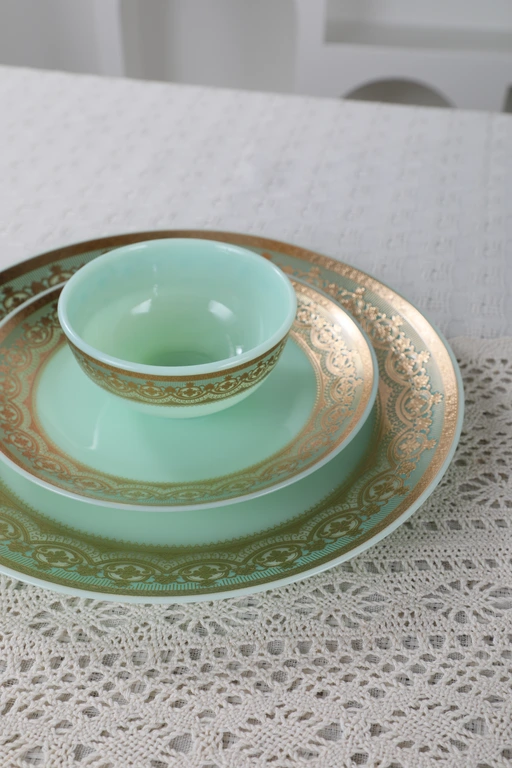
The third color is often the easiest to misidentify when first seen, because from a distance it almost looks like ordinary white tableware, but upon close inspection, you will find a very faint green tint in the plate. This color is usually called translucent jade white-green and is also a common visual effect in many opal glass jade dinnerware. This subtle tonal quality is key to understanding jadeite dishes color explained in tableware retail guides. Under store lighting, if you tilt the plate slightly, you may sometimes see a slight translucent effect at the edges, which is one of the characteristics of this color. Unlike the previous two shades of green, the green in these jade white-green plates is very restrained, looking more like white with a hint of jade tone, so the overall visual effect is very clean and soft. When placed with ordinary white plates, the difference may not be noticed immediately, but when light shines on the surface of the plates, the faint green gradually appears, resembling the natural luster of light-colored jade. Precisely because this color retains the characteristics of jade green without being too prominent, it is also very common in many jade dinnerware collections, and this jade white-green tableware can often be seen on store shelves alongside other jade green plates.

How the same set looks completely different under warm bulbs, cold light, and sunlight
Many first-time buyers of Jade dinnerware encounter a very intuitive situation: the same set of tableware looks like different colors under different light environments. Some find it warm under restaurant lighting, some see a more transparent green under kitchen lighting, and near a window during the day, they see a more natural jade green. The tableware itself has not changed; what really alters the visual effect is the type of light. These light-induced changes highlight the natural variation in jade colored tableware shades across daily use scenarios.
Light directly affects how the human eye perceives color. Different light sources have different color temperatures: warm light has more yellow components, cold light has more blue components, and natural light is closer to a complete spectrum. When these different lights shine on the same set of Jade tableware, the way green is displayed changes accordingly. Many people, when taking tableware from the dining table to the kitchen or from the kitchen to the window for the first time, clearly feel that the color “has changed”—this change is the visual difference caused by light.
- Warm bulbs: The green is softened by warm light, appearing more like cream green or pale jade, with a warmer overall feel.
- Cold light: The green appears more transparent and leans towards turquoise, with a more obvious visual contrast.
- Sunlight: The color is closest to the real Jade green, without obvious yellow or blue tint.
After understanding this, you will find that the color change of tableware is actually very normal. When many users see different visual effects in different rooms, it is not because the tableware has color difference, but because the light source changes the way the color is presented.
Jade Dinnerware Color Under Warm Dining Room Lights
When turning on the dining room chandelier at dinner time, most households use warm light bulbs of 2700K–3000K. This light source itself has more yellow components, so when the light shines on the surface of Jade tableware, the green naturally shifts towards warm tones. The tableware looks softer, and the green often leans slightly towards cream green or pale jade.
This visual effect is particularly obvious on family dining tables. Wooden dining tables, warm lighting, and the dinner environment make the tableware look more gentle and moist. Many people, when setting the table under restaurant lighting for the first time, find the color softer than what they saw during the day. This feeling is not an illusion but because warm light reduces the cool tone of green, making the color look milder.
If the same set of tableware is taken from the dining table to the kitchen, the color change is often noticed immediately. The warm green that appeared gentle under restaurant lighting may become clearer under another type of light—this is the result of differences in light sources.
How Jade Plates Look Under Bright Kitchen Lighting
Kitchen environments usually use cool white LED lights of 4000K–5000K. This type of light has a higher blue component, making the green appear clearer. When Jade tableware is placed on the kitchen countertop or next to the sink, the color often looks more transparent.
Under this light, the green usually shifts slightly towards turquoise, and the overall visual effect is brighter. White countertops, stainless steel sinks, and strong ceiling lighting enhance the glass texture of the tableware. Many people, when washing dishes or organizing tableware, suddenly notice that the tableware looks more “green” than on the dining table—this is actually because cold light improves the clarity of the color.
This change is very common in modern kitchen environments. Strong lighting and light-colored countertops strengthen color contrast, so Jade tableware usually presents a cleaner, more transparent visual effect in this environment.
Jade Color Appearance in Natural Daylight
During the day, when placing tableware by the window, the color often changes again. Natural light has a more complete spectrum, so it can more truly present the color of the tableware material itself. In this environment, Jade tableware usually presents a balanced jade green.
Natural light does not obviously enhance yellow or blue, so the green looks neither warm nor cold. The translucent texture of the tableware is also more obvious under this light, looking closer to the soft effect of jade. Many product photos are taken near windows to more accurately present this real color.
Jade vs Sage Green vs Celadon vs Mint Green Dishes: What Is the Actual Difference
Many people encounter the same problem when buying green tableware for the first time: product pages state green tableware, but different products are labeled as Jade, Sage Green, Celadon, Mint Green. They all look green, but when pictures are placed side by side, the color differences are obvious. Some people browsing products wonder: why do some greens look soft, some grayish, and some with a hint of blue?
This situation is actually very common because the tableware industry does not describe all colors with a single “green” but uses different names to distinguish different tonal systems of green. When users judge colors only through product pictures, they are likely to misjudge the real color if they do not understand the tonal directions behind these names. For example, some users think they are buying Jade color but find it closer to Sage or Celadon after receiving it—this is mostly because they do not understand the differences between different greens.
When browsing tableware products, many consumers just want to quickly figure out one question: what are the actual differences between these green names? As long as you understand the basic visual directions of the four greens, it will be easier to judge the real color when looking at product pictures.
- Jade Green (jade-colored tableware): The green is soft and balanced, resembling the color of natural jade—neither too dull nor too bright, with an overall gentle and natural feel.
- Sage Green (sage green tableware): The green has an obvious gray tone, making the color more low-key and calm, resembling the color of natural plant leaves.
- Celadon (celadon-colored tableware): The green has a blue tint, making the overall effect more transparent, and often presents a pale blue-green effect.
- Mint Green (mint green tableware): The brightest shade of green—light and fresh, looking more lively and brisk.
After understanding this, it will be much easier to look at tableware pictures, because these four colors actually represent four different green styles. When several types of green tableware are compared on the same dining table, this difference becomes more obvious.
| Green Tone | Color Characteristics | Underlying Color Undertones | Light Response | Typical Material Compatibility |
|---|---|---|---|---|
| Jade Green | Soft, balanced, natural jade-like hue | Neutral (no obvious warm/cool undertones) | Stable; softens under warm light, clarifies under cold light | Opal glass (most common), ceramic |
| Sage Green | Dull, calm, plant-like hue with gray tint | Warm gray undertones | Gray tone intensifies under low light; muted in bright light | Ceramic, stoneware |
| Celadon | Transparent, cool-toned with blue tint | Cool blue undertones | Bluer under cold light; greener under natural light | Porcelain, celadon ceramic |
| Mint Green | Bright, fresh, lively light green | Cool slight blue undertones | Maintains brightness across all light types; more vivid in sunlight | Opal glass, glazed ceramic |
Jade vs Sage Green Dinnerware Color Difference
In real dining table environments, Jade and Sage Green are often the two most easily confused colors because they both belong to relatively soft greens. But upon close inspection, the difference is actually obvious. Jade green is cleaner and more balanced, resembling the color of polished jade, so it has a more transparent visual feel. Sage Green has an obvious gray tone, making its green softer and calmer, just like the color of plant leaves in a natural environment.
When the two types of tableware are placed together, Jade tends to have a stronger “green feel”, while Sage Green leans more towards natural plant tones. Many people, when browsing product pictures, if they feel the green has a slight gray tint, it is most likely Sage Green rather than Jade.
Celadon and Jade Dinnerware Color Comparison
The difference between Celadon and Jade usually comes from the addition of a blue tint. The celadon vs jade color difference stems primarily from the blue undertone in celadon, which jade green lacks entirely. Jade green is relatively pure, while Celadon green has a hint of blue, making the overall visual effect more transparent and cooler. In some tableware pictures, Celadon may even look like pale blue-green.
This blue-green color may also have subtle changes under different lights. In natural light, Celadon may be closer to green; in cold light, it may appear bluer. This is why many people, when seeing Celadon tableware for the first time, find it different from ordinary green tableware.
Mint Green Compared With Other Green Dish Colors
Mint Green is the easiest to identify among the four colors because its brightness is significantly higher. Compared with Jade, Mint Green is lighter; compared with Sage, it is brighter green; and compared with Celadon, it is fresher and brisker.
In terms of dining table visual effects, Mint Green often makes the overall environment brighter. This green is as fresh as mint leaves, so it is also common in many modern dining table designs. When several types of green tableware appear at the same time, Mint Green is usually the brightest color and is easy to identify visually.
After understanding the real differences between Jade, Sage Green, Celadon, and Mint Green, it is easier to judge colors when browsing tableware product pages and to find green tableware that truly matches your dining table style.
What solid color dinnerware in jade looks like in real life vs product photos
Many first-time buyers of jade dinnerware (jade-colored tableware) have a very direct question when browsing product pages: why does the color look so clean and uniform in pictures, but the tableware on the real dining table looks a bit softer? This feeling is actually very common. It is not that the color has changed, but that product photos and real usage environments display colors in different ways. For those asking “what color is jade dinnerware”, this photo-real discrepancy is one of the most common pain points.
On e-commerce pages, solid color jade dinnerware is usually photographed in a standard product photography environment. Photography lights, white backgrounds, and stable exposure result in a very uniform visual effect of the color. In real dining table environments, however, the tableware is simultaneously affected by natural light, indoor lighting, and tabletop backgrounds, so the green appears more natural and closer to the visual experience in daily life.
Many users find this in actual use: the same set of tableware looks slightly different in the kitchen, restaurant, or on a table near the window, but the overall tone remains a stable jade color.
- 1. Jade color in product photos is usually brighter and more uniform
E-commerce pictures are taken in a professional lighting environment, with light shining on the tableware from multiple angles, so the color of the center and edges of the plate is almost the same, looking very stable. - 2. Jade color on real dining tables is usually softer
In daily environments, light is not as uniform as photography lights, so jade color presents a more natural layered effect instead of a completely uniform color. - 3. Natural light makes jade color look more transparent
When tableware is placed on a dining table near a window, natural light makes the green more transparent and closer to pale jade. - 4. Indoor lighting makes the color slightly warmer
Under warm restaurant lighting, the green usually looks softer and milder.
Jade Dinnerware Color in Product Photography
On most e-commerce product pages, jade dinnerware presents a very clean and stable light green. This effect comes from the standardized product photography process. Soft lights are usually used during photography, paired with white or light-colored backgrounds, so that the color of the tableware surface is not affected by the surrounding environment.
This shooting method has an obvious characteristic: the color looks very uniform. There is almost no obvious color difference between the central area, edges, and the overall surface of the plate. The green is also usually slightly brighter, so that consumers can more easily identify the tableware color when browsing product lists.
Visually, product pictures are closer to a “standard display”. Their goal is to reduce environmental factors and present jade color in the most stable state. This is why in many product pictures, the tableware looks like a piece of clean light green.
Jade Dinnerware Color on a Real Dining Table
When jade dinnerware is placed in a real dining table environment, the color usually looks softer. Many people notice a detail during daily meals: the same plate looks slightly different at different times of the day.
For example, in the morning, when natural light shines into the restaurant through the window, jade-colored plates tend to look more transparent and the green is brighter. In the evening, if the restaurant uses warm lighting, the color looks softer. The tabletop background also has an impact—for example, a wooden tabletop makes the green look milder, while a white tablecloth makes the color look clearer.
In a family dining table environment, this change is actually very natural. When light green tableware is placed on the table, the color presents different subtle layers as the light changes throughout the day, but the overall tone remains a stable jade color. This is why many people, after actual use, find that jade dinnerware looks softer and more natural than in product photos.
The Soft Look of Jade Dinnerware in Everyday Use
Many jade dinnerware items are made of opal glass (opal tempered glass). Compared with ordinary ceramic tableware, this material has an obvious characteristic: it has a slightly translucent structure. When light shines on the surface of the tableware, part of the light diffuses inside the material, so the color does not look very heavy but presents a soft layered effect.
This material structure causes slight changes in jade color under different lights. For example, in a bright environment, a slight translucent effect may appear at the edges of the plate—this effect is not necessarily obvious in product photos but is relatively easy to observe in real dining table environments.
Precisely because of this material characteristic, solid color jade dinnerware usually presents a more natural jade-colored visual effect in daily use. Compared with the standardized color displayed on e-commerce pages, jade dinnerware in real environments looks softer and more lifelike, while still maintaining a stable green tone. This difference is the most direct visual distinction between solid color jade dinnerware in real dining table environments and product photos.
Frequently Asked Questions (FAQ)
Q1: What material is most commonly used for jade dinnerware, and how does it affect the color?
A1: Jade dinnerware is most commonly crafted from opal glass (also known as opal tempered glass). This material features a slightly translucent microstructure that causes light to diffuse internally rather than reflect directly, resulting in the soft, natural jade-like green hue characteristic of this tableware. Unlike ceramic dinnerware (which has an opaque structure and more solid color), opal glass jade dinnerware exhibits subtle color variations under different light conditions due to its translucency, enhancing its natural jade-like appearance. A small portion of jade dinnerware is also made from ceramic with jade-toned glazes, but these tend to have a more solid green color with less light-induced variation.
Q2: How can I minimize the color discrepancy between product photos and real-life jade dinnerware?
A2: To reduce color mismatch, first, prioritize product listings that include photos taken in natural daylight (these are closest to the real color of the dinnerware). Second, check if the seller provides images of the dinnerware in different light environments (e.g., warm indoor light, cold kitchen light) to understand its color performance in various settings. If possible, visit a physical store to examine the dinnerware under the same lighting conditions as your home (e.g., bring a sample of your home’s light bulb to compare). Additionally, avoid relying solely on mobile phone product photos (which may have screen color calibration issues) and instead view products on a calibrated computer monitor for more accurate color perception.