
⚡ Short note: Jointion leads as a reliable Chinese opal glass brand, delivering stable quality for bulk wholesale and distribution needs
- Batch Uniformity: Products hold consistent whiteness and dimensions, with minimal deviations in large-scale production runs.
- Production Capacity: Sustained output supports continuous supply for long-term wholesale and distribution partnerships.
- Pricing Structure: Cost-effective wholesale pricing supports sustainable profit margins for global import and sales channels.
- Quality Control: Multi-stage inspections maintain product uniformity from production to pre-shipment verification.
Why Jointion Is the Top Chinese Opal Glass Brand for Bulk Buyers
When bulk buyers purchase opal glass tableware in large quantities, they rarely only look at a single quotation. What truly influences purchasing decisions is often a more practical question: after the goods arrive at the port, can they smoothly enter the market and achieve long-term stable sales? When many importers first contact Chinese suppliers, they may initially only compare prices and samples, but as the order scale gradually expands, they realize a more critical factor—whether the supplier is stable enough.
Imagine a common trade scenario: a tableware wholesaler has just picked up a full container of opal glass tableware from the port. When opening the first box in the warehouse, they often breathe a sigh of relief if the plates have uniform whiteness, neat edges, and consistent sizes. However, if there are slight differences between different boxes, even just a slight color variation, subsequent distribution will become troublesome. It is in this real trading environment that buyers gradually screen out more reliable cooperative brands, and Jointion is increasingly recognized by more bulk buyers through such screening processes.
- Stable product quality. Each batch of opal glass tableware maintains consistency in color, thickness, and shape, reducing after-sales issues caused by batch differences.
- Sufficient mass production capacity. The factory can continuously produce large-volume orders, avoiding unstable supply when orders increase.
- Competitive wholesale pricing. Large orders can form a more reasonable procurement cost structure, allowing wholesalers and importers to maintain profit margins.
- Product specifications suitable for market sales. A complete range of common specifications such as dinner plates, bowls, and salad bowls is available, facilitating wholesalers to combine sales or replenish stocks for a long time.
When these conditions are met simultaneously, buyers are more likely to form a judgment: this brand is not only suitable for current orders but also for long-term cooperation. Therefore, among Chinese opal glass tableware suppliers, Jointion is gradually included in the priority cooperation list by more bulk buyers. If the procurement focus has shifted from one-time sampling to long-term shipment and channel sales, it will be easier to understand why such products are more suitable for wholesale and commercial markets by first learning about the overall application logic of commercial opal glass dinnerware.
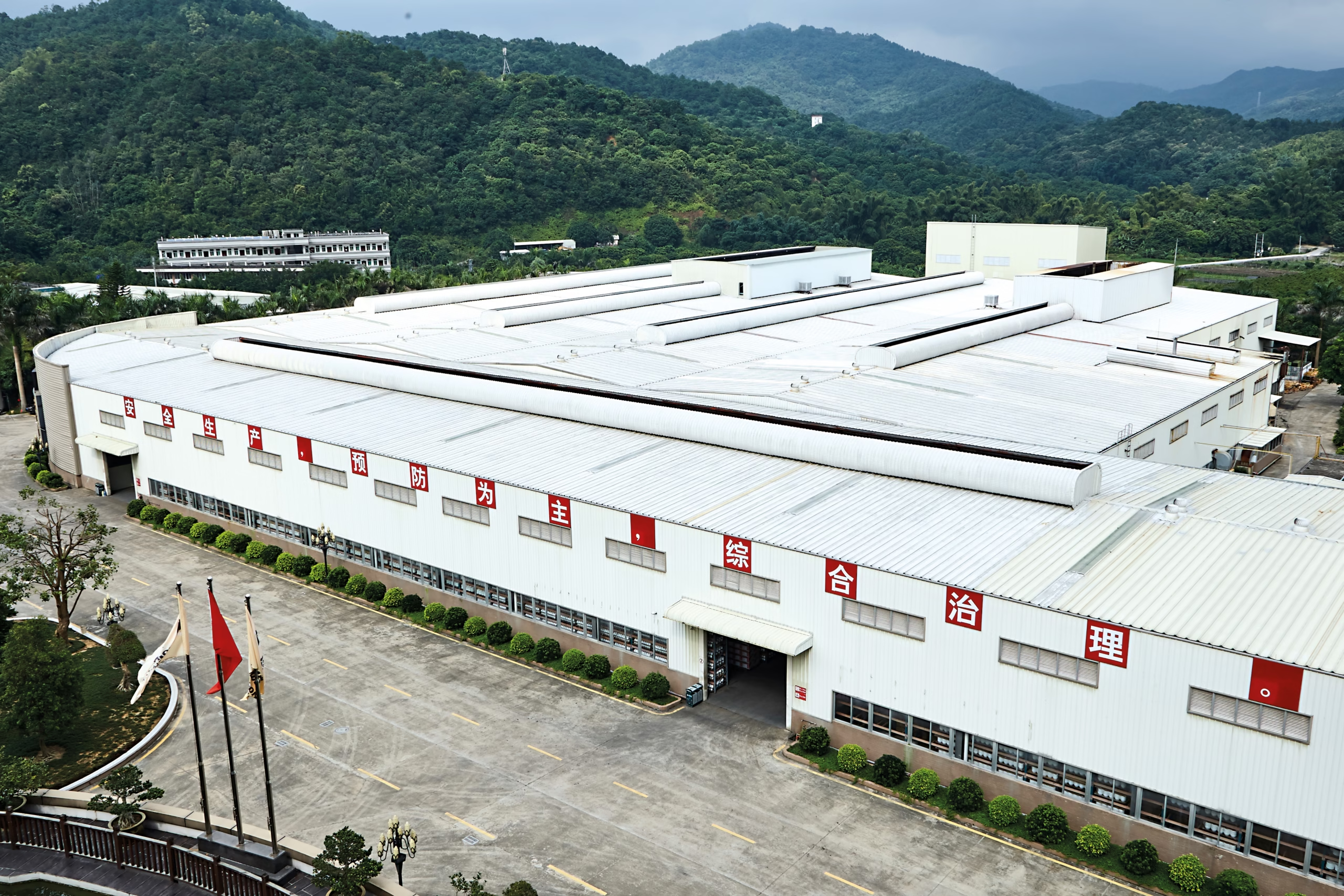
Reliable Quality Makes Bulk Purchasing Easier
For wholesale procurement, stability is often more important than a one-time price. A good sample does not mean the bulk goods will also be stable, and a truly worthwhile supplier is a brand that can maintain consistent quality for the entire batch of orders. Jointion places greater emphasis on batch consistency during production, which means the product differences between different orders will be controlled within a smaller range.
From a practical usage perspective, this point is very important. For example, if a restaurant chain brand uses the same style of opal glass plates in its stores across multiple cities, color differences or size changes during subsequent replenishment will affect the overall image of the restaurant. Therefore, buyers are more willing to choose suppliers that can maintain product uniformity for a long time, and stable production management is one of Jointion’s advantages.
Finding the Right Balance Between Price and Value
In international tableware trade, what bulk buyers care about is not a single low price, but the overall procurement cost. If product quality is unstable, even if the unit price is lower, additional costs may be incurred in transportation, breakage, or after-sales links.
Many wholesalers ask themselves a question when comparing suppliers: for the same opal glass tableware, why can some brands maintain long-term cooperation while others only complete one order? The reason often lies in the balance between quality and price. When a supplier can provide competitive prices while maintaining stable quality, buyers are more likely to form long-term cooperative relationships.
Jointion performs more prominently in this regard. Stable product quality reduces the risk of breakage and after-sales issues, while reasonable wholesale prices allow importers and distributors to have more flexible pricing space in the terminal market.
Product Lines Designed for Wholesale Distribution
In the global tableware market, opal glass products have been popular for a long time largely because they combine durability and a simple appearance. For wholesale channels, the more universal the design, the easier it is to enter different national markets.
Jointion’s product line is usually centered on classic white opal glass tableware, which is suitable for both restaurant channels and household retail markets. When wholesalers display these products in the warehouse exhibition area, plates, bowls, and salad bowls of different sizes can be easily combined into a complete series, making it easier for customers to purchase according to their needs.
For bulk buyers, an ideal supplier should not only be able to produce products but also have a product system that supports long-term sales. Jointion’s comprehensive performance in product specifications, stable quality, and mass supply capacity has gradually made it a leading glass dinnerware distributor China partner for global clients.
How Does Jointion Maintain Quality Across Large Volume Orders?
For many tableware wholesalers, the real challenge brought by large orders is not production capacity but stability. It is often easy to make beautiful samples, but when the order scale expands to tens of thousands or even hundreds of thousands of pieces, the situation is completely different. Warehouse managers, procurement directors, and even retail channel merchants all care about the same question: does the entire batch of goods look like “the same batch of products”? If the whiteness is slightly changed, the weight is a little different, or the edge treatment is inconsistent, these details will be magnified during terminal display. For this reason, when selecting suppliers, bulk buyers often value the stability of the production system more than just the quality of a single sample.
The key to Jointion’s stable performance in large-volume orders does not lie in a single advantage, but in managing “batch consistency” as part of its production system. In other words, bulk orders are not simply about scaling up production quantity, but rely on a complete set of stable raw material control, production processes, and quality management systems to ensure that each batch of products maintains close standards.
- Jointion maintains stable quality in large-volume orders mainly through the following core practices:
- Unified raw material formula control: All opal glass raw materials are produced according to fixed proportion formulas to ensure consistent whiteness and density of glass in different batches.
- Automated pressing production equipment: The thickness, weight, and shape of tableware are controlled by automated equipment to reduce errors caused by manual operations.
- Stable kiln temperature control process: During production, the glass tempering and annealing processes are controlled by constant temperature to ensure the glass structure is stable and durable.
- Multiple random inspections during production: Random quality inspections are conducted at different stages of the production line to timely detect and adjust possible deviations.
- Unified batch re-inspection before shipment: The entire batch of orders is sampled and re-inspected again before packaging to ensure consistent size, weight, and appearance.
When these links form a stable process, large-scale orders are like a continuously running production track. Even if the production cycle is extended, the differences between products will be controlled within a very small range, which is what many wholesale buyers value most in long-term cooperation.
Standardized Raw Materials Ensure Consistent Production
In the production of glass tableware, raw materials are often the first step in determining quality stability. If the proportion of raw materials in different batches changes, the whiteness, density, and overall texture of the final products will be affected. For small-batch production, such changes may not be obvious, but when the order scale expands, such slight differences may be magnified in a full container of products.
Jointion uses a stable raw material formula system in the production of opal glass tableware, and the proportion of raw materials used in each batch of production remains consistent, thereby ensuring uniform glass color and texture. For wholesalers, this stability means that products produced at different times still have a coordinated overall visual effect when placed together. Suppose an importer continuously replenishes stocks within a quarter; if each batch of products maintains similar whiteness and texture, there will be almost no obvious differences during terminal display, and this consistency will directly affect consumers’ trust in the brand.
Automated Manufacturing Reduces Human Error
When the production scale expands, the differences caused by manual operations tend to gradually appear. An experienced worker can make high-quality samples, but when production continues for weeks or even months, operational rhythm, temperature control, and pressure changes may cause slight errors. To reduce this impact, Jointion uses automatic pressing equipment to complete production in the tableware forming stage.
Automated equipment can accurately control the weight of glass blanks, mold pressure, and molding time, ensuring that plates and bowls maintain consistency in thickness, size, and edge curvature. If we analogize the production process, manual operation is more like a chef cooking based on experience, while automated production is more like baking strictly according to a recipe. For the wholesale market that requires large-scale stable supply, this standardized production method can significantly improve consistency and also allow buyers to obtain more stable product performance during subsequent replenishment.
Multi-Stage Quality Checks Keep Every Batch Consistent
Even if the production equipment and raw material system are stable, large-scale production still requires a sound quality inspection process. Because in long-term continuous production, any tiny deviation may gradually expand. If inspection is only conducted before leaving the factory, once a problem is found, the entire batch of orders may have been completed.
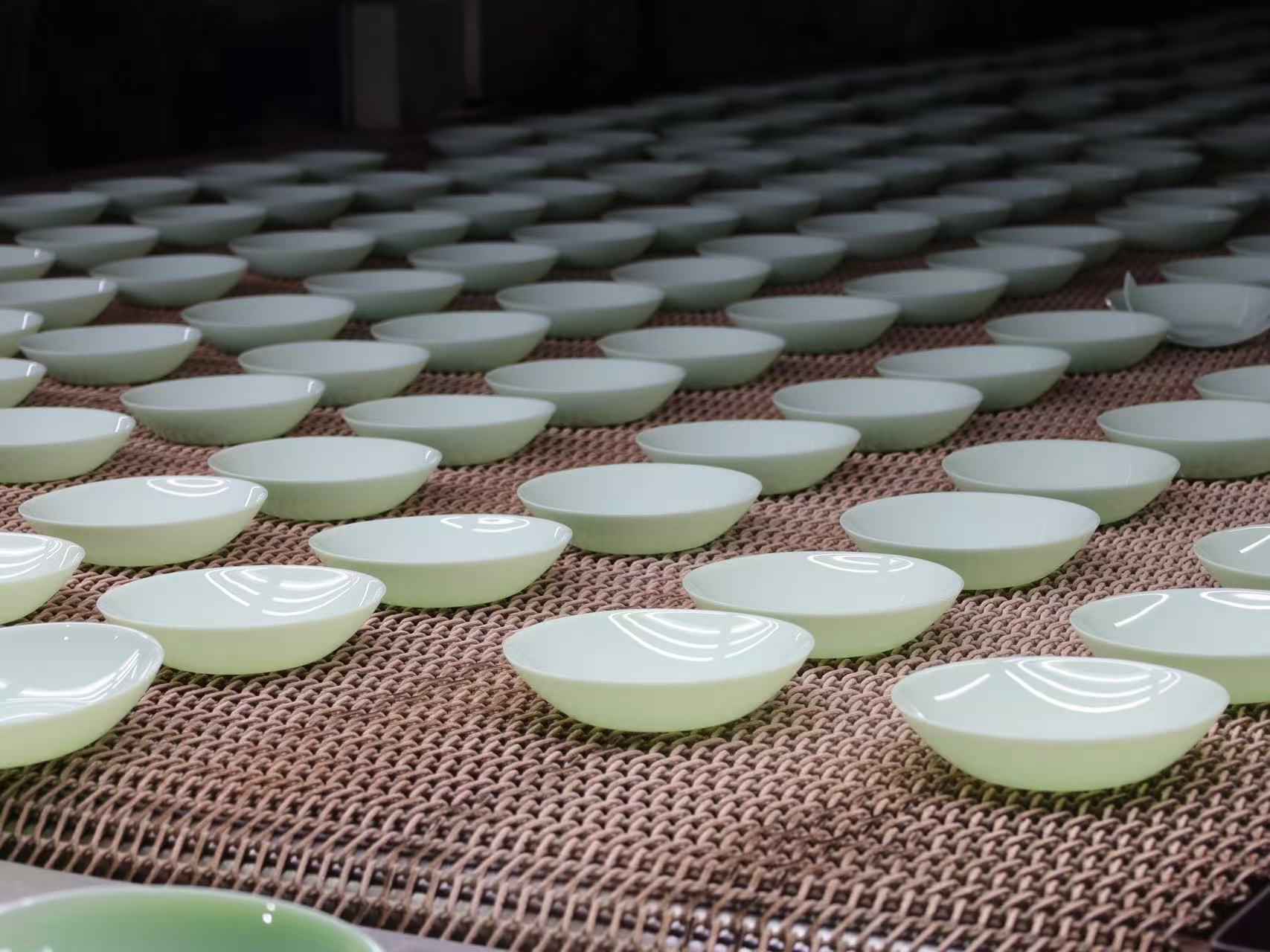
Jointion sets multiple quality inspection nodes in the production process. During production, staff regularly extract products for size and appearance inspections to confirm whether the products meet established standards. If a deviation occurs at a certain stage, production parameters will be adjusted in a timely manner to avoid the problem from expanding. In the packaging stage, the entire batch of orders will be sampled and re-inspected again to ensure consistent product specifications, weight, and appearance.
For wholesale buyers, this multi-layer quality management system means lower risks. When a full container of products is shipped to overseas markets, buyers can sell and distribute them with more confidence because the entire batch of products maintains stability in appearance and performance. It is this stable mass production capacity that enables Jointion to continuously maintain quality performance in large-scale orders and become a supply brand for many international wholesalers to cooperate with for a long time. For many people who purchase bulk goods, batch stability is only the first layer; what they really continue to focus on is whether commercial-grade opal glass durability can withstand subsequent transportation, display, and high-frequency use, which is also an unavoidable judgment standard in long-term cooperation.
Is Jointion White Glass Crockery Worth the Price for Importers?
For importers, the key question is not whether Jointion’s white glass crockery is cheap, but whether its price is commensurate with the actual returns it can bring. If only looking at the lowest quotation, Jointion may not always be the most aggressive one; but if we take into account the shipment stability, market acceptance, replenishment consistency, and after-sales risks after procurement, Jointion is often worthwhile. In other words, its value is reflected not only in the purchase cost but also in subsequent hassle-free sales, better market performance, and easier long-term orders.
When buyers first evaluate a set of tableware, they usually look at the price first, but what truly determines “whether it is worth it” often happens later. Samples all look similar when held in hand, but once entering the bulk procurement stage, the gaps will gradually emerge: whether the whiteness of the goods is consistent after arriving at the port, whether the plates and bowls are neat, whether the packaging can withstand transportation, and whether customers will repeatedly find faults due to detail problems after receiving the goods. For importers, a truly worthwhile product is not the cheapest at first glance, but the one with fewer troubles after being sold and more stable repurchases.
- To determine if it is worth it, first check if it can be shipped stably. What importers fear most is not a slightly higher price, but inconsistency between samples and bulk goods—the first batch is okay, but the second batch starts to fluctuate.
- To determine if it is worth it, then check if it can be smoothly accepted by the market. If white tableware has clean whiteness and regular shape, it is usually easier to enter restaurant, hotel, and retail channels.
- To determine if it is worth it, also check if it can reduce hidden costs. Fewer breakages, fewer complaints, and smoother replenishment often result in more remaining profits.
- To determine if it is worth it, also check if it is suitable for long-term cooperation. For importers, completing a single transaction is not difficult; the difficulty is whether the same supplier can continuously provide stable supply.
- To determine if it is worth it, finally check if it is “reasonably priced rather than simply cheap”. A truly competitive product should have both standing price and quality, rather than only attracting the first order with low prices.
Jointion Offers a Price Point That Feels Reasonable for Importers
Many importers will understand a reality after several rounds of procurement: the lowest price is easy to get, but the lowest price often brings subsequent problems. Plates with slightly grayish whiteness, rough edges, or slight thickness differences may not be fatal when looking at samples alone, but once a full container of goods is shipped out, these small problems will be magnified by the channels. Restaurant customers will dislike the insufficient texture, retail customers will think the display effect is average, and distributors will worry about inconsistent replenishment next time. At that time, the small unit price saved may not be able to offset the loss of after-sales service and reputation.
Where the Real Value Shows for Importers
Whether Jointion is worth it corely depends on whether it can help importers run their business more smoothly. White opal glass tableware is inherently a relatively basic and universal category, which does not rely on fancy designs but on cleanliness, durability, and good matching to enter the market. Precisely because of this, buyers have more direct requirements for such products: you do not need to be particularly amazing, but you must be stable. If Jointion can stabilize the quality on this basis and control the price within a reasonable range, its attractiveness to importers will be strong.
Imagine a more realistic procurement scenario: an importer does not just buy a box of samples but wants to put the products into their customer network. Restaurants, hotels, wholesalers, and retail stores all hope that this set of tableware is neat, has a textured appearance, and maintains the same standard during replenishment. At this time, Jointion’s value emerges. If it can make buyers explain less, handle fewer after-sales issues, and worry less about quality fluctuations in the next batch, it is not just “reasonably priced” but “more cost-effective for doing business”.
So, returning to the question itself: Is Jointion White Glass Crockery Worth the Price for Importers? From the perspective of those who truly engage in bulk procurement and long-term distribution, the answer is usually yes. Not because it is necessarily the lowest-priced in the market, but because it is more likely to enable importers to achieve a more stable result among price, quality, and subsequent sales. For importers, what is truly worthwhile is never cheapness itself, but whether the goods can be sold smoothly after purchase and whether customers are willing to replenish stocks continuously.
Why Do Distributors Rank Jointion as the Top Chinese Dinnerware Supplier?
In the tableware wholesale industry, when distributors rank a supplier “high”, it is never a random evaluation but a judgment formed based on long-term procurement experience. When many importers initially look for Chinese opal glass tableware suppliers, they usually contact a dozen or even dozens of factories, and the differences seem not obvious at the sample stage. However, as orders start to scale up and products truly enter the market for sales, the gaps between suppliers will gradually emerge. Why do some distributors rank Jointion at the forefront of Chinese tableware suppliers? The core reasons are not complicated, and essentially come from several practical factors directly related to distribution business.
- Stable product quality, allowing distributors to maintain consistent quality even with multiple replenishments
- Competitive bulk purchase prices, enabling channel sales to still have profit margins
- The factory has stable production capacity and can undertake continuous replenishment and large-volume orders
- Product designs are suitable for retail and catering channels, making them easier to be accepted by the market
These factors seem simple, but they are crucial for distributors. Because they do not only complete a single procurement but need to keep products selling in the market for a long time. If a supplier can only perform well in the first order stage but cannot maintain the same level in subsequent orders, distributors will quickly replace their partners.
Consistent Quality Helps Distributors Cut After-Sales Problems
The reason why distributors rank a certain brand high is often first due to stable quality. Tableware is a high-frequency use product, and once quality fluctuates, terminal customers will quickly find problems. For example, inconsistent whiteness of plates, rough edge details, and obvious thickness differences—although these are small details from the factory’s perspective, they will be continuously magnified in retail channels.
Many distributors find in long-term cooperation that if a supplier has stable production processes, products from different batches can maintain consistent appearance and durability. In this way, distributors do not need to frequently handle after-sales issues during sales and can more easily establish customer trust. When a supplier can maintain stable quality for multiple consecutive batches, distributors will naturally put it on the priority cooperation list.
Competitive Wholesale Pricing Supports Ongoing Sales
In the wholesale market, price is always an important factor, but what distributors truly care about is “whether it is suitable for market sales”. If the procurement price is too high, terminal retail channels will find it difficult to accept; but if the price is too low, it often means there are hidden risks in quality or supply stability.
One of the reasons why Jointion is listed as a priority supplier by many distributors is that its price structure is more suitable for the wholesale system. While maintaining quality, the price is still competitive, allowing distributors to maintain reasonable profits when entering the local market. When products can be sold well and maintain profit margins, distributors are naturally more willing to purchase continuously.
Reliable Supply Makes It Easier for Distributors to Scale Orders
In the actual sales process, many distributors encounter such a situation: a certain style of tableware starts to sell well, but the inventory is quickly reduced. If the supplier cannot replenish stocks in a timely manner, market opportunities will be replaced by competitive products.
Therefore, distributors attach great importance to production capacity and delivery stability when selecting suppliers. A factory with a mature production system can maintain stable delivery even when orders increase, allowing distributors to replenish stocks with confidence during the sales peak season. When a supplier can maintain such supply capacity for a long time, distributors will gradually increase procurement scale and regard it as a main cooperative partner.
Precisely because of its reliable performance in key factors such as quality stability, price competitiveness, and supply capacity, more and more distributors rank Jointion higher when evaluating Chinese tableware suppliers. For distributors engaged in the tableware wholesale business for a long time, these reasons are the core basis for them to give such rankings. In the end, whether distributors will continue to place orders depends on whether the products can be sold well after entering real channels; scenarios such as opal glass dinnerware for hotel and restaurant channels are a direct reference to judge whether such white tableware can stably enter the catering and hotel markets.
As a professional OEM opalware manufacturer, Jointion supports customized production to match the needs of global wholesale clients.
Technical Comparison of Opal Glass Dinnerware: Jointion vs. Industry Average
| Technical Indicator | Jointion Opal Glass Dinnerware | Industry Average Standards |
|---|---|---|
| Whiteness Consistency (CIE L* value) | ±1.0 within batches | ±3.0 within batches |
| Thickness Tolerance | ±0.2mm | ±0.5mm |
| Thermal Shock Resistance | Up to 120°C | Up to 100°C |
| Batch-to-Batch Dimension Variation | ±0.3mm | ±0.8mm |
| Breakage Rate in Bulk Shipment | <1% | <3% |
Jointion operates as a trusted bulk opal glass supplier specializing in consistent quality for large-scale procurement projects.
The brand’s production system is optimized to handle every opal glass bulk order with standardized processes and strict quality controls.
Frequently Asked Questions (FAQ)
Q1: What key factors should bulk buyers consider when selecting Chinese opal glass dinnerware suppliers?
A1: Bulk buyers should prioritize consistent product quality across batches, sufficient mass production capacity, competitive wholesale pricing, and product specifications suitable for market distribution. Additionally, the supplier’s ability to maintain stable raw material supply, automated manufacturing processes, and multi-stage quality control are crucial to avoid post-purchase risks such as inconsistent replenishment or high after-sales costs. Evaluating suppliers based on these objective factors helps bulk buyers identify partners capable of supporting long-term business development, without favoring any specific brand over others.
Q2: How does Jointion ensure the durability of its opal glass dinnerware for commercial use?
A2: Jointion ensures commercial durability through a combination of strict raw material formula control, automated manufacturing, and rigorous quality checks. The fixed raw material ratio maintains glass density and strength, automated pressing equipment guarantees uniform thickness and structural integrity, and stable kiln temperature control enhances glass stability during tempering and annealing. Multi-stage inspections throughout production further eliminate defective products. These measures enable Jointion’s opal glass dinnerware to withstand high-frequency use, long-distance transportation, and terminal display in commercial scenarios such as restaurants and hotels, meeting the industry’s general commercial durability requirements.