
Table of Contents
Impact and Scratch Resistance: Is Opal Glass or Jadeite More Resistant to Daily Wear?
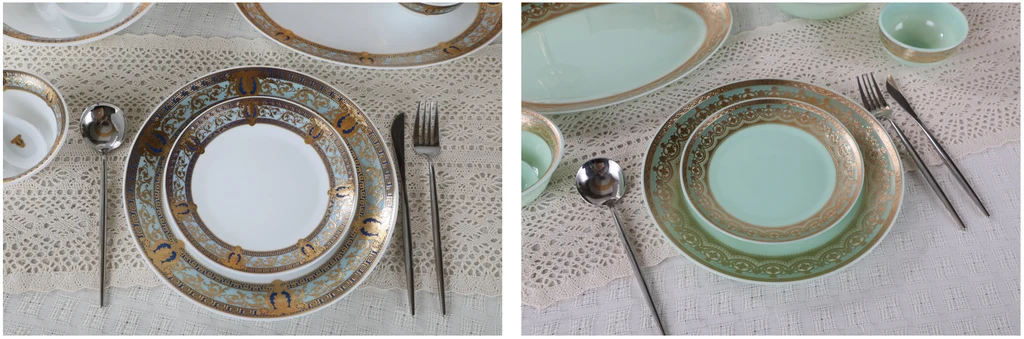
When weighing opal glass vs jadeite glass durability, real-world dining settings are the true proving ground — not a single lab test. Tableware endures countless everyday collisions, scratches, and abrasions: forks scraping across plate surfaces, rims knocking together when stacked, and repeated friction during dishwasher cycles. It is precisely in this dimension that the performance differences between Opal Glass and Jadeite Glass deserve a point-by-point comparison.
In short: across the two core dimensions of daily impact resistance and scratch resistance, Opal Glass is overall superior to Jadeite Glass. Here’s why:
Scratch Resistance
Both materials have similar Mohs hardness values — Opal Glass sits at approximately 5.5–6, and Jadeite Glass, as a soda-lime glass system, falls within the same 5.5–6 range. One common misconception worth addressing: many people see the name “Jadeite” and assume it shares the hardness of jadeite mineral, which does reach 6.5–7 on the Mohs scale. However, Jadeite Glass tableware is made of glass, not mineral stone — the two should not be confused.
In terms of hardness values alone, Opal Glass and Jadeite Glass show no meaningful difference; everyday cutlery contact is unlikely to leave noticeable marks on either. What truly sets them apart is the homogeneity of their surface structure. Opal Glass gets its milky-white appearance from opacifying agents — such as tin oxide or zirconium oxide — uniformly distributed throughout the material. The surface is an integral part of the material itself, so every scratch occurs within the same material system, eliminating any risk of “surface layer spalling leading to accelerated degradation.” Jadeite Glass, under modern mass-production standards, has not widely adopted an equivalent level of glass-ceramic strengthening. After prolonged high-frequency use — frequent dishwasher cycles, repeated stacking — the surface is more prone to accumulating subtle matte scratches. Once surface deterioration begins, subsequent wear tends to concentrate and become increasingly visible.
Impact Resistance
This is the dimension where the gap between the two is most pronounced. When examining milk glass break resistance, modern Opal Glass typically employs either thermal tempering or a glass-ceramic composite structure. The core principle of this design is that when an impact occurs, internal stress does not concentrate at a single contact point but instead disperses across a broader structural area, thereby delaying crack formation and propagation.
The practical result: under equivalent drop conditions, Opal Glass may not shatter immediately. Even when it does exceed its stress threshold, the fracture pattern tends to be more predictable — it is less likely to explode into numerous sharp, fine fragments, making cleanup safer for the user.
Jadeite Glass belongs to the standard soda-lime glass system. When subjected to significant impact, stress concentration is comparatively more pronounced and crack propagation speeds are higher. Once a critical threshold is exceeded, complete fracture typically occurs, and the resulting fragment pattern is harder to predict than that of glass-ceramic-strengthened materials. Users on the Reddit community r/BuyItForLife have described the structural advantage of Opal Glass this way: “The sheet’s core layer is white opal glass sandwiched between a transparent top and bottom skin. The layers provide superior strength and is highly resistant to breaking or chipping.” — This multi-layer construction is precisely what Jadeite Glass lacks.
It is worth noting that soda-lime glass is more impact-tough than borosilicate glass and is less likely to shatter instantly. However, in real household drop scenarios outside of laboratory conditions, its overall impact resistance still falls short of structurally strengthened Opal Glass.
| Comparison Dimension | Opal Glass | Jadeite Glass |
|---|---|---|
| Mohs Hardness | Approx. 5.5–6 | Approx. 5.5–6 |
| Surface Structure | Homogeneous material body; no surface spalling risk | Standard soda-lime glass; no glass-ceramic strengthening |
| Impact Resistance Design | Thermally strengthened / glass-ceramic composite; stress dispersed | Standard soda-lime glass system; stress concentrates more easily |
| Fracture Pattern on Drop | Relatively predictable; larger fragment pieces | Prone to complete fracture; fragment pattern harder to predict |
| Scratch Visibility | White surface; scratches less visually apparent | Deep green surface; scratches create greater visual contrast |
As the comparison above shows, Opal Glass holds a systematic structural advantage in both impact resistance and scratch resistance — which is also the fundamental reason it is widely procured for commercial settings such as restaurants and hotels. If you are selecting Opal Glass tableware for a commercial environment, the material selection logic differs from household scenarios and requires comprehensive consideration of bulk usage intensity, washing frequency, and procurement cost. For a complete analysis of this topic, see: Opal Glass Tableware Commercial Guide.
Thermal Shock and Chemical Resistance: Which Glass Lasts Longer Under Heat and Corrosion?
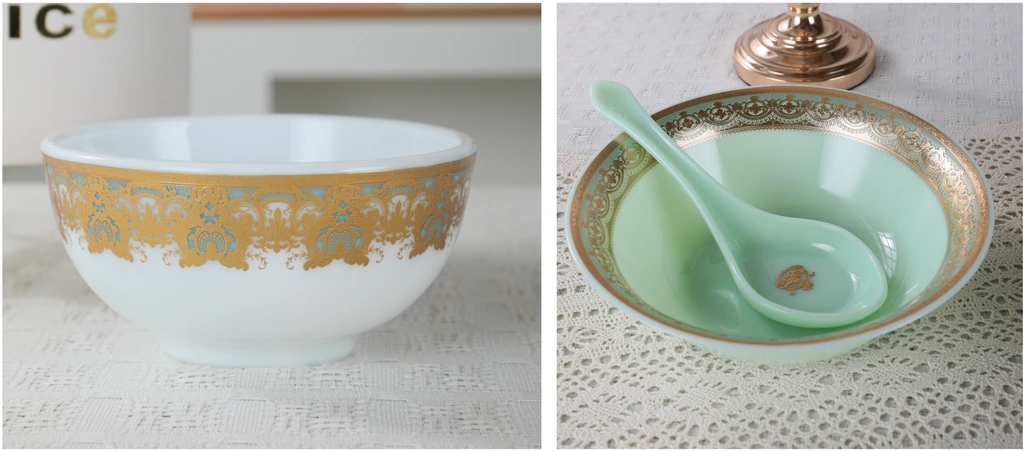
In everyday dining use, tableware is exposed daily to challenges such as going straight from the refrigerator into the microwave, being rinsed with cold water after holding scalding soup, and repeatedly coming into contact with highly acidic foods like tomato sauce and lemon juice. These two performance properties — thermal shock resistance and chemical corrosion resistance — are often the decisive factors behind a set of tableware’s true service life, far more so than appearance or brand recognition.
In short: Opal Glass and Jadeite Glass each excel in different usage scenarios when it comes to heat and corrosion resistance, as reflected in the following key points:
① Thermal Shock Resistance: Suited to Different Heating Habits
During production, Opal Glass tableware incorporates fluorides or phosphates as opacifying agents, which are uniformly dispersed throughout the glass matrix. This structural approach effectively controls the thermal expansion coefficient at the material level. According to technical records in US Patent US3275492A, Opal Glass optimized for tableware can achieve a thermal expansion coefficient as low as 25–50 × 10⁻⁷/K. Empirical test data indicates it can withstand instantaneous temperature differentials of 50–60°C without cracking — comfortably handling high-frequency everyday operations such as going directly from refrigerator to microwave.
Furthermore, Opal Glass undergoes annealing treatment after forming — a process of slow cooling over several hours in an annealing oven — which further releases residual internal thermal stress and delivers even more stable, consistent thermal shock resistance. This annealing step is a key reason why tempered opal glass service life consistently outperforms standard glass alternatives in high-frequency use environments.
The governing relationship is expressed as:
ΔL = α · L₀ · ΔT
Thermal expansion (ΔL) is directly proportional to the thermal expansion coefficient (α). The lower the α value, the smaller the destructive internal stress generated by any given temperature differential — this is the materials science foundation that allows Opal Glass to handle sudden temperature changes with ease.
Jadeite Glass also possesses a proven track record of heat resistance. The most representative example is Fire-King Jadeite: Anchor Hocking positioned it as “Heatproof Oven-Safe” kitchenware from the 1940s through the 1970s, a product that could be placed directly in the oven and served in high-intensity restaurant kitchen environments for decades without failure.
This generationally validated thermal stability remains one of Jadeite Glass’s most important practical qualities today. The Takeout has also noted that because Jadeite is made from heatproof milk glass, it remains fully capable of meeting the demands of modern kitchens. Jadeite Glass is best suited to regular, paced heating habits — for example, allowing food to come to room temperature before heating, or pre-warming dishes with warm water. Under such usage patterns, its thermal performance is entirely reliable.
② Resistance to Acidic Food Corrosion: High-Frequency Use vs. Everyday Home Cooking
Opal Glass features a dense, non-porous glass surface structure, preventing food pigments, odors, and acidic chemical compounds from penetrating the interior of the vessel. Research literature has reported that Opal Glass with phosphate opacifiers maintains structural integrity in hydrochloric acid corrosion tests, demonstrating strong chemical stability.
For usage scenarios requiring frequent contact with highly acidic content — tomato sauce, lemon juice, pickled foods — Opal Glass’s chemical stability provides more sustained appearance retention over time.
Jadeite Glass is equally stable and reliable in the acidic food contact scenarios typical of everyday home cooking. Its body color is formed by colorants fused into the glass matrix, not a surface coating, so acidic foods will not cause color fading or leaching of harmful substances. For everyday home dishes — whether stir-fried tomato and eggs, sweet-and-sour spare ribs, or fruit juice — Jadeite Glass handles them all without any food safety concerns.
Its distinctive jade-green opaline quality also lends food a uniquely appealing visual presentation, which remains one of the key reasons it continues to be beloved on everyday dining tables.
| Comparison Dimension | Opal Glass | Jadeite Glass |
|---|---|---|
| Thermal Expansion Coefficient | 25–50 × 10⁻⁷/K | Closer to standard soda-lime glass range |
| Tolerable Instantaneous Temperature Differential | 50–60°C; suited for sudden cold-to-hot transitions | Better suited for regular, gradual heating patterns |
| Resistance to Acidic Foods | Excellent; ideal for high-frequency acidic food use | Good; well-suited for everyday home cooking scenarios |
Overall Durability Verdict: Opalware or Jadeite — Which Has the Longer Service Life?
In this long-running durability comparison between opalware and jadeite glass, both materials are celebrated as “stronger than ordinary glass” and each has a devoted following. Yet when we truly focus the question on “which one lasts longer in daily use,” the gap between the two gradually reveals itself through real-world usage trajectories.
This is not a question that can be settled by a single drop test or laboratory hardness data. It requires a holistic assessment across three dimensions: material structure, everyday usage context, and long-term surface stability.
How Long Does Opalware Last Under Daily High-Frequency Use?
Under conditions of daily use combined with 3–4 dishwasher cycles per week, chip resistant opalware can deliver stable, consistent performance for 5–8 years without requiring replacement due to structural damage or appearance degradation.
This service life expectation stems from its glass-ceramic-strengthened structure — the material distributes stress evenly when absorbing everyday impacts, making premature localized failure unlikely. The wear rate across an entire set remains consistent, eliminating the scenario where some pieces fail prematurely and force early retirement of the whole set. For households seeking worry-free, long-term reliable use, this is a service life cycle they can depend on with confidence.
What Is the Service Life Ceiling for Jadeite Glass?
Understanding jadeite glassware longevity requires acknowledging how closely it is tied to its care routine. With strict hand-washing maintenance, many users report that carefully tended jadeite pieces remain in excellent condition after years of use — a service life that is equally impressive.
However, once routine dishwasher use is introduced, the repeated action of high-temperature water jets and detergents accelerates surface deterioration, meaningfully shortening usable life compared to hand-washed conditions. This means jadeite glass has a wider range of actual service life outcomes — fully capable of standing the test of time when properly cared for, but less predictably durable than opalware in high-frequency, daily-use households where hand-washing cannot be consistently maintained.
How Does Material Structure Directly Affect Service Life?
Opalware uses a strengthened glass-ceramic structure. The uniform micro-crystalline phase distributed throughout the material makes it far less likely to develop latent internal micro-cracks from localized stress concentration over prolonged use. The overall service life degradation curve is relatively gradual and flat.
Jadeite glass is fundamentally an opaque milk glass colored with metallic oxide pigments. Its durability relies more on the passive cushioning provided by physical wall thickness than on active stress dispersion at the structural level. While the thick-walled design of vintage pieces does confer considerable impact resistance, this thickness advantage is not consistently replicated across modern reproduction lines — meaning service life performance can vary between production batches.
| Service Life Dimension | Opalware | Jadeite Glass |
|---|---|---|
| Expected Service Life Under Daily High-Frequency Use | 5–8 years (including regular dishwasher use) | As durable as opalware with hand-washing care; notably shorter under dishwasher routine |
| Service Life Consistency | High; gradual wear curve; consistent across the whole set | Variable; care routine directly determines actual service life |
| Structural Support for Service Life | Glass-ceramic strengthening; active stress dispersion; slow degradation | Relies on wall thickness for passive cushioning; performance varies between batches |
Conclusion
When the full picture of opal glass vs jadeite glass durability is laid out — from impact resistance and scratch stability to thermal shock tolerance and long-term service life — opalware emerges as the more structurally reliable choice for high-frequency, dishwasher-dependent households. Jadeite glass, by contrast, rewards careful ownership: treated well, it can last just as long and brings a warmth of character that opalware does not replicate. The right choice ultimately comes down to how you actually use and care for your tableware day to day, not which material wins on paper.
FAQ
Q: I only hand-wash my dishes and want a set that feels vintage and special — is opalware still the better option for me?
Probably not. If hand-washing is your consistent habit and you value the visual warmth and collectible character of jadeite glass, the durability gap between the two materials narrows considerably. Opalware’s structural advantages are most meaningful under dishwasher-heavy routines. For a hand-wash-only household that prioritizes aesthetics and is willing to handle pieces with care, jadeite glass is a fully reasonable — and arguably more rewarding — long-term investment.
Q: I’m outfitting a small café and need tableware that survives a commercial dishwasher multiple times a day — does jadeite glass hold up?
This is exactly the scenario where jadeite glass tends to underperform relative to expectations. The repeated exposure to high-temperature jets, industrial detergents, and rapid drying cycles in commercial dishwashers accelerates surface wear on standard soda-lime glass systems. For commercial settings with machine-wash cycles running several times daily, opalware’s glass-ceramic-strengthened construction is the more practical specification. Jadeite glass is better reserved for lower-volume or display-oriented settings where it can be handled more gently.