
This guide is about one thing: how to use tempering process parameters to judge whether a batch of opal glass dinnerware will actually hold up in real-world use — before you commit to a purchase order. We start with the physics of the opal glass tempering process, then connect factory numbers like surface compressive stress and opal glass thermal shock resistance directly to the daily abuse dinnerware faces in hotels, airlines, and chain restaurants. By the end, you will have a clear path from “use scenario → performance indicators → product specifications” — so you can talk to any bulk opalware supplier in technical language and lock down the right product range before pricing even starts.
How Tempered Opal Glass Dinnerware Is Made in the Factory
The Complete Tempering Process: From Heating to Quenching
After forming and annealing, an opal glass blank has its shape — but that is all it has. Strength comes from the next step: tempering. The whole process boils down to three actions in a fixed sequence — heating, soaking, quenching. No skipping. No reversing.
1. Heating
The blank rides conveyor rollers into the tempering furnace. Chamber temperature sits around 620°C. At entry, the glass is cool and the furnace is hot, so heat absorption is fast. As the blank warms up, the temperature gap shrinks and absorption slows. The heating curve is not a straight line — it flattens out toward the end, like a hill that levels off near the top.
For the wall thicknesses typical of opal glass dinnerware, this stage takes several minutes. It is done when the entire blank reaches close to the furnace set point.
2. Soaking
A hot surface does not mean a hot core. This step has one job: shrink the temperature gap between the outer wall and the inner center to as close to zero as possible. If that gap is still large when the blank exits the furnace, different parts shrink at different rates during cooling. The result is warping — or cracking.
On our tempering lines, operators adjust soaking time based on each batch’s thickness and shape. Thin pieces need less time. Thick pieces get held longer. The rule is simple: nothing leaves the furnace until it is heated all the way through.
3. Quenching
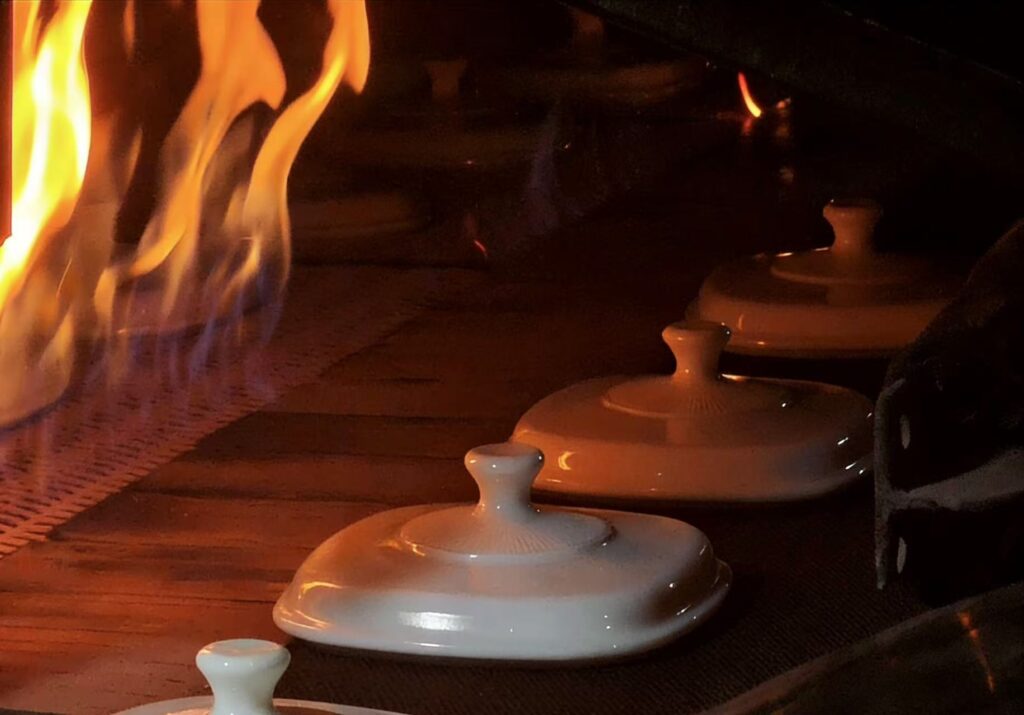
The moment soaking ends, rollers move the blank to the air-grid station. The setup is straightforward — two arrays of nozzles, one above and one below, aimed at the blank’s surfaces. They blast high-pressure cold air simultaneously. In a matter of seconds, the surface temperature drops from above 600°C to well below the glass strain point. That brief window locks a specific stress pattern inside the glass. Tempering strength is born right here.
All three steps happen in strict order. At last year’s Canton Fair, a South American buyer asked us point-blank: “What makes your tempering different?” We pulled up a video from the air-grid station on the production line. The key detail: transfer time from furnace exit to quench start was held to just a few seconds. Stretch that gap even slightly, and the surface cools by a few extra dozen degrees before quenching begins. That alone is enough to leave the finished product measurably short on compressive stress.
No spec sheet captures this. It is the kind of timing that only comes from running high-volume production day after day at an opal glassware factory wholesale scale.
Tempering is one link in a longer chain. Raw material formulation, melting, forming, annealing — every upstream step shapes the blank’s condition before it ever enters the tempering furnace, and that condition affects final strength. For the full picture of what happens before tempering, see this walkthrough: Complete Opal Glass Dinnerware Manufacturing Process.
Why Quenching Makes Glass Stronger
So the process is clear. Now the bigger question: why does a few seconds of cold air make glass four to five times stronger?
It comes down to one thing — the speed gap between how fast the outside and inside cool.
High-pressure air hits the surface. The surface cools first, hardens first, shrinks first. The core? Still hot. Still soft. At this stage the core behaves like putty — it stretches to match whatever the outer layer does. No resistance, no stress buildup. The surface is already “shorter” than the core, but the core can still deform to keep up.
The turning point comes when the core temperature keeps falling, crosses the strain point, and turns rigid. Now the core wants to shrink too — but the outer shell hardened long ago. It will not budge. The core is stuck. It cannot contract freely, so it stays stretched. That internal tension pushes back against the outer layer, squeezing the surface into permanent compression.
This compressive layer is the armor. Any external force that wants to crack the glass has to cancel out all that compression first, before the surface can even enter tension — which is the only state where micro-cracks propagate. More compression means a thicker shield. Thicker shield means harder to break.
Here is a side-by-side look at what changes before and after quenching:
| Comparison | Before Quenching (Annealed Blank) | After Quenching (Tempered Product) |
|---|---|---|
| Surface Stress | Nearly zero residual stress | Permanent compressive stress — surface stays squeezed |
| Core Stress | Nearly zero residual stress | Tensile stress — core locked in stretch by the rigid outer layer |
| How Cracks Start | Any external force can send micro-cracks running | Force must first overcome the compressive layer before cracks can even begin |
| Overall Strength | Low impact and bending resistance | Impact and bending resistance up roughly 4–5× |
| How It Breaks | Large, sharp shards | Small, blunt-edged granules — much safer |
The takeaway is simple. Tempering does not change the chemistry of opal glass at all. It does one thing only: pre-load the surface with a massive layer of compression. As long as that layer holds, the glass does not crack. Whether the air pressure is even, whether cooling is symmetrical, how fast the blank moves from furnace to air grid — those process details decide the drop resistance and lifespan of every single piece that ships to a buyer.
How Different Tempering Parameters Affect Dinnerware Performance
Tempering parameters control two things that matter most to buyers: how hard the dinnerware is to break, and how much temperature shock it can take.
At 24–52 MPa surface compressive stress (heat-strengthened), impact resistance is only about 2× that of plain annealed glass, and the tolerable thermal shock sits around 80–100°C. Push that stress to ≥69 MPa (fully tempered), and impact resistance jumps to 4–5× while thermal shock tolerance widens to 120–135°C. This is not a small gap. It is the line between dinnerware that survives commercial kitchens and dinnerware that does not.
Below, we break down how tempering temperature, cooling rate, and compressive stress level each move these two numbers — with parameter ranges and real-world references for each.
Tempering Temperature, Cooling Rate, and Impact Resistance
The principle is short. Tempering presses a permanent layer of compressive stress into the glass surface. To break the glass, an outside force must first cancel out that compression before it can reach the fragile tensile zone inside. More compression = harder to break. And how much compression you get depends on two inputs: furnace temperature and cooling speed.
The opal glass tempering process runs in stages. First, the blank enters an annealing section at 580–600°C, near the softening point. Then it moves to a hotter zone at 620–650°C, where it soaks until the full cross-section is uniformly heated. The critical moment comes right after — the product enters the air-cooling zone immediately. Inlet air pressure is ≥10,000 Pa, adjusted down to 5,000–7,000 Pa at the nozzle depending on product thickness. Both surfaces get hit with cold air at the same time.
Surface temperature drops fast. The core stays hot. Once everything reaches room temperature, the surface is locked in compression and the core is locked in tension. The resulting surface compressive stress number is the direct scorecard for tempering strength — it sets the ceiling on how much impact the dinnerware can take.
ASTM C1048 draws clear lines on the compressive stress scale. The gaps between levels show up clearly in real foodservice use. We first pulled this classification together from the heat-treated glass technical documentation published by the Vitro Glass Education Center (formerly PPG Glass), then cross-checked it against our own production-line measurements. The ranges matched.
1. Heat-Strengthened Level
Surface compressive stress: 24–52 MPa. Mechanical strength is about 2× annealed glass. Everyday minor bumps? Fine. A drop from a kitchen prep counter or a collision inside a dishwasher rack? That is where it starts to struggle. And the breakage pattern is the bigger problem — large, sharp shards, no different from ordinary glass. Serious safety concern.
2. Fully Tempered Level
Surface compressive stress: ≥69 MPa (about 10,000 psi). Impact and bending resistance jump straight to 4–5× annealed glass. But the improvement is not just about being harder to break. When it does break, it crumbles into small blunt granules instead of jagged shards — meeting CPSC 16 CFR 1201 and ANSI Z97.1 safety glass standards. For anyone sourcing commercial opalware dinnerware sets, that means fewer breakages and far less injury risk.
3. High-Standard Fully Tempered (≥90 MPa)
Some markets set the bar higher. European orders, for example, typically require passing the EN 12150 four-point bending test — baseline 90 MPa (about 13,200 psi). Opal glass dinnerware at this level has a meaningfully larger safety margin against drops and stacking pressure than 69 MPa products. Not “a little better.” A different tier.
That said, pushing parameters to extremes is not free. Hotter furnace temps and more aggressive cooling also raise the core tensile stress. Past a certain point, trace nickel sulfide (NiS) inclusions in the raw glass can undergo phase-change expansion — and the piece shatters on its own with zero external force. Spontaneous breakage. It is a known risk across the industry.
We also conducted some comparative tests for our opalware products and ceramic products based on this characteristic, such as drop tests and scratch resistance tests, etc. You can watch the following video content:
When procurement teams from Latin America and the Middle East visit the factory for audits, the tempering furnace section is where they park the longest and dig the deepest — especially on temperature control logic and air pressure settings. The reason is always the same: problems they ran into with previous suppliers almost always traced back to this part of the parameter curve.
Tempering Level and Thermal Shock Resistance
The last section covered mechanical hits — will it break when dropped? This section covers temperature swings — will it crack from hot-cold cycling? The physics behind each type of failure is completely different.
In daily use, thermal cycling happens far more often than drops. A plate goes from a 4°C fridge straight into a microwave. A bowl comes out of a 70°C dishwasher and lands on a room-temperature counter. That can happen several rounds a day. Each sudden temperature swing creates an instant stress gradient through the glass wall — the surface wants to shrink, the core resists. When that tug-of-war exceeds the glass’s strength, a crack starts.
The tempered surface’s compressive layer works as a buffer. Thermal shock generates tensile stress on the surface, but that tension has to eat through the entire compressive layer before it can do any real damage. This is exactly why opal glass thermal shock resistance is one of the most important specs to verify before placing a bulk order.
Higher compressive stress = more thermal shock absorbed = wider safe temperature range. Here is how the numbers break down:
| Tempering Level | Surface Compressive Stress | Tolerable Temp. Swing (Approx.) | What That Means in Practice |
|---|---|---|---|
| Un-tempered Annealed Glass | ≈0 MPa | 40–60°C | Room-temp use only. Any hot-cold shift is a gamble. |
| Heat-Strengthened | 24–52 MPa | 80–100°C | Handles gentle swings. But “fridge → microwave” (≈100°C gap) already pushes the ceiling. Repeat that for a few months and micro-cracks build up. |
| Fully Tempered (≥69 MPa) | 69–100+ MPa | 120–135°C | Fridge to microwave, hot dishwasher to cool counter — all routine cycles handled with room to spare. |
Quick math on the most common scenario. Fridge at 2–5°C, food surface after microwaving at 80–100°C — that is a gap close to 100°C. Heat-strengthened dinnerware might survive once or twice, but it is riding the edge. Months of daily cycling stack up invisible micro-cracks until one day the piece just shatters. The classic end-user complaint — “it cracked out of nowhere” — almost always traces back here.
Fully tempered? Same 100°C swing, and it still has 20–35°C of headroom left over. Dishwasher water at 60–70°C onto a 20–25°C countertop? That is roughly 50°C — not even half the product’s capacity.
This is the part many buyers miss. Tempering parameters do not just set “drop resistance.” They set “thermal resistance” at the same time. Most breakage complaints from end markets are not caused by someone dropping a plate. The real killer is thermal fatigue — cold-hot stress building quietly, day after day, until it releases all at once.
When you evaluate a supplier, ask for impact test reports — but ask for thermal shock data and the matching surface compressive stress readings too. Those two sets of numbers together are the full picture of whether a batch of opal glass dinnerware will survive real use.
How to Choose the Right Specifications for Bulk Purchasing
Picking specs for tempered opal glass dinnerware in bulk comes down to two steps. Step one: start from your end-use scenario (hotel, airline, chain restaurant, etc.) and work backward to the tempering performance numbers you actually need — surface compressive stress in MPa and thermal shock tolerance in °C. Step two: take those numbers and check them against a glass dinnerware manufacturer’s product spec sheet, line by line. Find the series where every parameter lands inside your required range. The rule is not “pick the highest single number.” It is “pick the series where everything passes.”
Below is the full walkthrough of this “scenario → indicators → specs” matching process, with a ready-to-use comparison table at the end.
Reverse-Engineering Performance Indicators from End-Use Scenarios
Do not start by opening a product catalog. Start at your own end-use site. Map out the toughest conditions your dinnerware will face — that is the real starting point. Work backward from there:
Step 1: Find the “Toughest Condition” in Your Scenario
Every use environment has one moment that pushes dinnerware the hardest. Identify it first.
In a hotel all-day restaurant, pressure comes from three directions at once. Commercial dishwashers run 5+ cycles daily at 82–88°C with pH 11–12 detergent. Servers stack 8–12 plates per trip. And dishes go straight from a 4°C fridge to a buffet station above 60°C. That triple load is the hotel’s ceiling condition.
Airline catering is a different game. Temperature swings are not the main enemy. The real stress is sustained static pressure from high-density stacking in storage, plus repeated vibration hits when catering carts roll through turbulence.
Chain fast food? Collisions happen constantly, but each one is light. Temperature swings center on microwave heating (roughly 130–150°C) versus room temp. Cleaning intensity scales with daily meal count. Different scenarios, completely different pressure points. Do not skip this step.
Step 2: Turn Conditions into Numbers
Once you know the conditions, translate them. Break each physical demand into three measurable dimensions: impact resistance (how much collision and stacking force), thermal tolerance (the biggest instantaneous temperature gap in a use cycle), and chemical resistance (cleaning temperature and detergent pH).
Hotel example, translated: needs to handle high-frequency medium-force impacts, tolerate instantaneous temperature gaps over 100°C, and survive 82°C+ alkaline cleaning at pH 11–12. Three lines, and the vague label “hotel use” becomes precise technical language. Whether you are sourcing white tempered glass plates bulk for a hotel group or opaline glass tableware for an airline caterer, this translation step produces the same structured output.
Step 3: Convert Performance Needs into Tempering Parameter Ranges
This is the step that matters most. Physical impact maps to surface compressive stress (MPa). Temperature range maps to thermal shock resistance (°C).
On compressive stress: for tempered opal glass dinnerware in commercial use, 90 MPa is the entry-level threshold for credible impact resistance. High-intensity environments — hotel stacking, airline dense storage — push that target to 100 MPa and above.
On thermal shock: 120°C covers most chain restaurant routines. But hotels running the “fridge-to-hot-station” cycle plus daily commercial dishwasher abuse need 135°C or higher to leave a real safety margin.
These are not just textbook ranges. In an internal test at our factory, we took fully tempered opal glass plates from a 4°C environment and dropped them straight into boiling water. Batches above 100 MPa with thermal shock ratings at 135°C+ survived 30 consecutive cycles — zero cracks. Batches around 90 MPa with 120°C ratings started showing micro-cracks by cycle 15. Same base glass. Different tempering parameters. Night-and-day results. This data is the backbone of every spec recommendation we give to clients.
At this point you have a parameter set written in factory language — something like “surface compressive stress ≥100 MPa, thermal shock ≥135°C, compatible with pH 11–12 alkaline detergent.” That is your technical brief. Bring it to any opaline glass tableware manufacturer and you skip the marketing fog entirely. You are speaking in numbers from the start.
Matching Your Indicators Against Manufacturer Specs
Indicators in hand, the next move is straightforward: put your numbers side by side with a manufacturer’s product spec sheets.
Most producers organize specs by product series. Each series runs on a fixed set of tempering parameters — compressive stress range, thermal shock rating, flexural strength, compatible cleaning conditions. Your job is to check your reverse-engineered numbers against each series and find the one where every data point falls inside your range.
One common trap: do not grab the series with the single highest number. Tempering is a balancing act. If compressive stress is pushed to an extreme, something else may slip. The reliable pick is the series where all indicators clear your minimum at the same time — not the one where one spec looks amazing and the rest barely scrape by.
In practice, comparison gives you one of three results. Complete match: one existing series hits every number. Best case — go straight to sample testing. Partial match: most specs clear, but one or two fall just short. For example, thermal shock at 120°C when you need 135°C. Go back to step one. How often does that extreme condition actually happen? If it is rare, a small concession might be fine — or you can add a brief warm-up step on the usage end to close the gap.
No match: nothing on the shelf hits all your numbers at once. This usually means your requirements are unusually tough or non-standard. At that point, you need to work with a milk glass dinnerware supplier who can adjust temperature curves and cooling rates for a custom run — which typically means a longer timeline and higher MOQ.
Here is the full comparison table — which parameters to watch for each end-use scenario, and what you can expect when you go looking:
| End-Use Scenario | Core Operating Conditions | Target Compressive Stress (MPa) | Target Thermal Shock (°C) | Cleaning Requirements | Typical Matching Result |
|---|---|---|---|---|---|
| Five-Star Hotel All-Day Dining | High-freq stacking + dishwasher 5+/day + fridge to hot station | ≥100 | ≥135 | 82–88°C, pH 11–12 alkaline | Most premium commercial lines can match |
| Airline Catering | Dense stacking static load + turbulence vibration + limited temp. swing | ≥100 | ≥120 | Standard commercial wash | Verify stacking static load data; may need customization |
| Chain Fast Food | Frequent light impacts + microwave temp. swing | ≥90 | ≥120 | Varies by outlet equipment | Most standard commercial lines cover this |
| Contract Catering / Campus Dining | Very high turnover + rough handling + moderate temp. swing | ≥95 | ≥120 | Industrial dishwasher compatible | Standard lines mostly match; check edge impact data |
If your tempering requirement range is already defined, the next step is to screen against what is currently in production. Jointion’s opal glass dinnerware covers plates, bowls, cups, and more — all fully tempered, with the option to customize specs by end-use scenario. Start with the Jointion opal glass dinnerware product catalog, match it against the table above, and zero in on the series closest to what you need before opening a sample conversation.
Common Questions People Ask
Q1: My order is not huge and the end-use scenario is not extreme. Do I really need fully tempered (≥69 MPa)?
Ask one question: will end users put this dinnerware in a microwave or dishwasher? If yes, heat-strengthened products have almost no thermal margin to spare. A few months of daily cycling quietly stacks micro-cracks, and one day a whole batch starts cracking. Even on a small order, the return-and-replace cost from that kind of complaint dwarfs whatever you saved on unit price. Lock in fully tempered at minimum — it blocks the biggest after-sales risk before it starts.
Q2: Suppliers quote similar compressive stress numbers but very different prices. How do I tell whose numbers are real?
Spec sheets alone are not enough. Ask for a third-party lab report and check three things: the testing standard used (EN 12150 or ASTM C1048), the batch that was sampled, and the test date. Then look at one detail most buyers miss: the batch-to-batch fluctuation range. A stable production line reports a tight band. A less reliable supplier only shows the peak value — it looks good on paper, but the low end of that range is what sets your actual breakage rate.
Q3: My customer wants “microwave-safe” opal glass dinnerware. What spec should I focus on?
Skip the generic “microwave-safe” label. Go straight to the thermal shock temperature differential. The real swing depends on the food’s starting temperature and how hot it gets — refrigerated food into a microwave easily creates a 100°C+ gap. Pick products rated at ≥120°C thermal shock. If the end-use involves frozen food going directly into the microwave, move that floor to 135°C or above.