
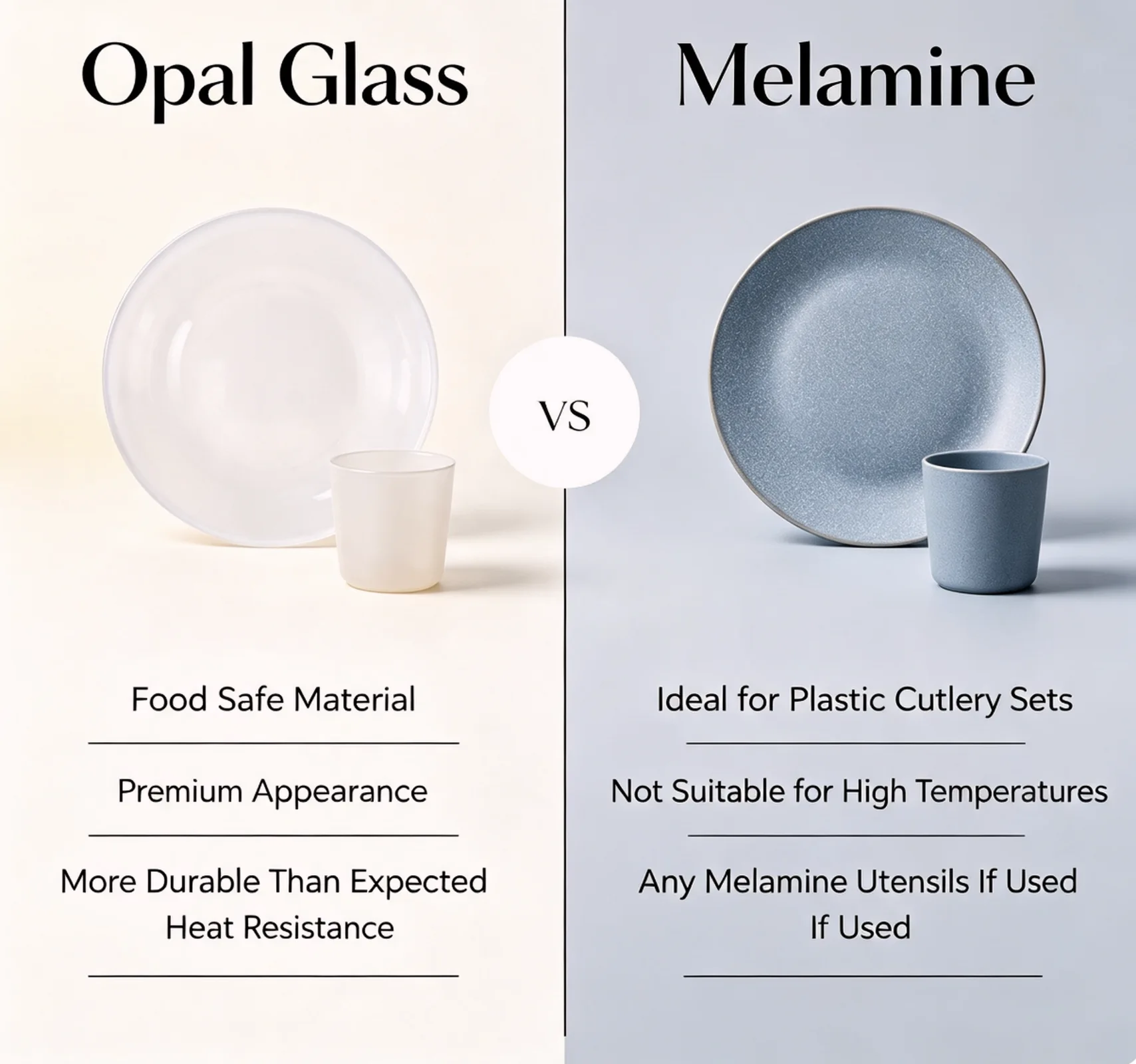
If you run a high-turnover restaurant — fast-casual, quick-service, chain operations flipping tables three or more times a day — you’ve probably been stuck between two imperfect options for a while. Melamine is light and cheap, but the chemical safety questions won’t go away. Ceramics look great on day one, but they chip and crack so fast the replacement bills never stop. This guide looks at both problems honestly — with real data from material science and actual operating costs — and then asks whether tempered opal glass dinnerware is the third option that finally resolves the tradeoff. By the end, you’ll have a clear opal glass vs melamine vs ceramic comparison to decide what actually fits your business.
Where Melamine and Ceramics Fall Short in High-Turnover Restaurants
To be clear upfront: both melamine and ceramics have earned their place in the industry for good reasons. Melamine is virtually unbreakable and extremely light — there’s nothing better for poolside service, outdoor patios, or children’s areas where shattering is the number-one concern. Ceramics, especially high-fired porcelain and bone china, deliver a tactile elegance and warmth of presentation that no other material can match — fine dining depends on it. Neither material is “bad.” The question is narrower than that: when your specific operation involves high table turnover, hot plating temperatures, and aggressive dishwasher cycles day after day, do their respective weak spots start to outweigh their strengths?
For melamine dinnerware safety, the issue comes down to chemical migration. Heat, acidic food, scratched surfaces — three conditions every high-turnover restaurant hits daily — keep pushing formaldehyde and melamine monomers out of the resin and into the food. The older the plate, the worse it gets.
For ceramics, it’s not safety — it’s money. A 50%–150% annual replacement rate is just the opening number. Batch-to-batch color mismatch, mismatched stopgap pieces, glaze erosion from the dishwasher that makes plates look terrible long before they actually break — that’s where the budget really bleeds out. Here’s each one in detail.
The Safety Problem with Melamine Dinnerware
Melamine dinnerware is made from melamine-formaldehyde resin. For cold dishes and fruit at room temperature, every major regulator says it’s fine. No argument there. The problem is that a high-turnover restaurant doesn’t live in “room temperature, non-acidic” territory. Not even close.
A plate of boiled fish in chili oil comes off the wok well above 70 °C. A bowl of hot-and-sour soup? Same story. And 70 °C is exactly the line where trouble starts. A peer-reviewed study in the journal Molecules (Ebner et al., 2020) tested this directly: 3% acetic acid at temperatures above 70 °C caused melamine and formaldehyde release to spike hard. Even worse, release went up — not down — with repeated use. Hot acidic liquid roughens the resin surface over time, and monomers leach out faster through the damage.
Germany’s Federal Institute for Risk Assessment (BfR) didn’t mince words in Opinion No. 046. Their conclusion: melamine-formaldehyde products are “generally not suitable for repeated contact with hot liquid food.” They also recommended cutting the EU’s formaldehyde migration limit from 15 mg/kg to 6 mg/kg.
In a real restaurant kitchen, the triggers break into three categories:
1. High heat — every single service. Plating temperatures routinely blow past 70 °C. Soups, sizzling platters, clay pots — they go much higher. Multiple studies confirm 70 °C as the point where formaldehyde and melamine migration jumps sharply. That’s why the FDA flat-out bans melamine in the microwave.
2. Acidic food — unavoidable on most menus. Vinegar, tomato, lemon juice, pickled vegetables. They’re everywhere in Chinese cuisine and fast-food menus. BfR testing showed that under high heat plus acid, some “bamboo fiber” melamine products released formaldehyde at 30 times the adult Tolerable Daily Intake. Not a freak lab condition — just a normal Tuesday lunch.
3. Wear and tear — and the risk only climbs. Knives scratch the surface. High-pressure rinse jets blast it. Plates knock into each other in the dishwasher rack, dozens of times a day. All those micro-scratches are invisible, but they matter. Studies show that monomer release from melamine goes up with each use-and-wash cycle, not down. That six-month-old plate covered in fine scratches? It’s leaching more than the day you unboxed it.
If children eat at your restaurant, this needs even more caution. Kids weigh less and eat more relative to body weight. At the same leaching level, their actual exposure is many times higher than an adult’s. For the detailed lab data on melamine in children’s dinnerware, see: Opalware vs Melamine Plates: Kids Safety.
The High Breakage Rate of Ceramics
Ceramics in a high-turnover restaurant don’t last nearly as long as the unit price suggests. The restaurant dinnerware breakage rate for ceramics in commercial use runs 50% to 150% per year. Plain English: a restaurant flipping tables three-plus times a day can chew through its entire opening-day plate inventory in six months.
Here’s the math. You have 1,000 ceramic plates at $5 each. Year-one commercial dinnerware replacement cost: $2,500 to $7,500. Over two years: $7,500 to $12,500. That money doesn’t improve your menu. It doesn’t upgrade the guest experience. It just keeps the “break-and-rebuy” loop running.
These aren’t our numbers. GoFoodService, a U.S. foodservice industry publication, cites the same 50%–150% range in a comparative review of restaurant dinnerware materials.
But breakage is just the visible part. What really grinds is everything that follows. Restocking takes time. While you wait, you grab whatever spare styles you have, and suddenly every table looks different. When the reorder does arrive, the new batch almost never matches the old one exactly — glaze whiteness, sheen, subtle texture. New next to old, and guests notice.
For any restaurant that cares about brand consistency or how things look on social media, that “patched-together” vibe is a constant drag. Then stack on the back-of-house hours spent counting stock, placing orders, and chasing deliveries. None of that shows up as a neat line item on the P&L, but it eats operational bandwidth every single week.
This table lays out the full cost picture of ceramics in a high-turnover restaurant:
| Cost Type | What It Looks Like | Actual Impact on the Business |
|---|---|---|
| Direct breakage replacement | Annual replacement rate 50%–150%; for 1,000 plates, $2,500–$7,500/year | Ongoing cash-flow drain with zero revenue conversion |
| Stopgap mix-and-match during restocking | Forced use of mismatched styles while waiting for replacements | Inconsistent table presentation; brand identity weakened |
| Batch-to-batch color variation | Visible differences in whiteness and gloss across production runs | Old-and-new juxtaposition lowers guest perception |
| Inventory management overhead | Repeated stock counts, reorders, delivery tracking | High hidden admin costs; ties up back-of-house labor |
| Dishwasher glaze damage | Alkaline detergent + high-temperature cycles cause glaze erosion, dulling, crazing | “Dead before broken” — actual discard volume far exceeds breakage count |
| Cutlery mark absorption | Roughened glaze attracts grey-black metal scuff marks from knives and forks | Plates look old and dirty; food presentation suffers |
Breakage alone isn’t the full story. Add in hidden write-offs, color mismatch headaches, inventory overhead, and weeks of mix-and-match improvisation — that’s the true cost of ceramics being “not drop-proof” in a high-volume kitchen.
Why Tempered Glass Dinnerware Passes Both the Safety and Durability Tests
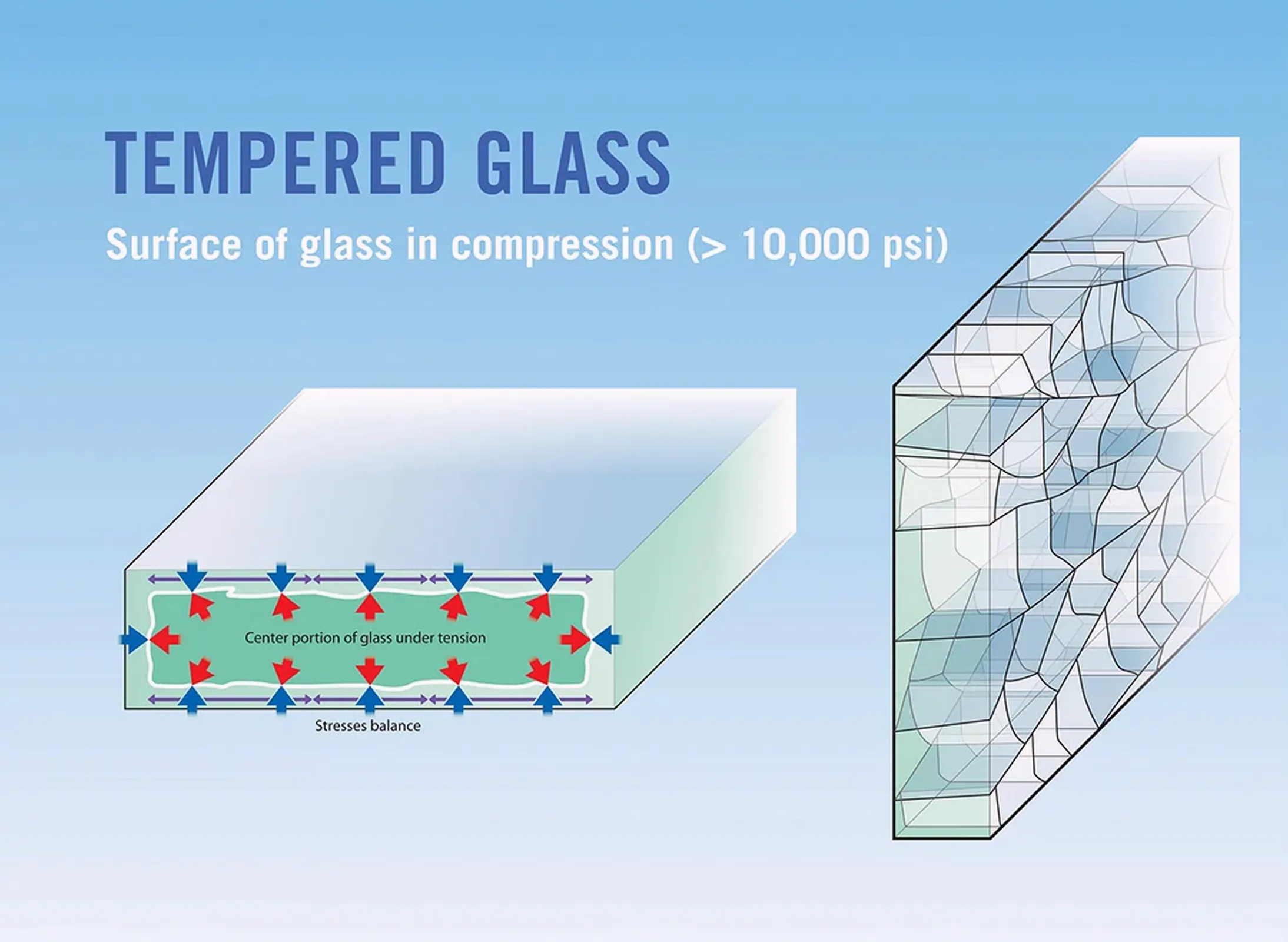
Tempered opal glass solves both problems at once, and the reasons are straightforward. First, the raw materials — silica, soda ash, limestone — are all inorganic minerals. There’s no melamine or formaldehyde in the structure, period. No matter how hot the food or how acidic the sauce, nothing migrates into what your guests eat. Second, tempering at 600 °C+ creates a surface compressive stress layer above 100 MPa, pushing impact resistance to 2–3× that of ordinary ceramics. Real-world annual breakage sits at just 3%–5%, compared to 10%–15% for ceramics under the same conditions.
That dual advantage is why tempered opal glass dinnerware is gaining ground fast as break resistant restaurant plates in high-volume operations. (A note on breakage numbers: the 50%–150% annual replacement rate cited earlier for ceramics comes from industry sources like GoFoodService and includes all forms of attrition — chipping, crazing, glaze damage, and aesthetic write-offs, not just outright fractures. The 10%–15% vs. 3%–5% figures in the table below isolate physical breakage only, to give a cleaner material-to-material comparison.) Here’s the science behind each claim.
Tempered Glass Has Zero Chemical Migration at the Material Level
1. Melamine’s problem is baked into the raw material
The safety issue with melamine isn’t about bad factories or sloppy production. It’s the chemistry. Melamine-formaldehyde resin is an organic polymer, and it always contains leftover unreacted monomers — melamine and formaldehyde. Add heat and acid, and those monomers move into the food. That’s how the material works.
A 2024 consumer advisory from Jiangsu Province’s Consumer Protection Committee spelled it out: no microwave, don’t exceed 120 °C, avoid prolonged contact with vinegar and similar acids. In a busy kitchen, that means every dish leaving the pass needs a mental check — “Can this plate handle this food?” One more thing to think about. One more chance to get it wrong.
2. Opal glass eliminates chemical migration at the source
Tempered opal glass is a completely different material. Silica, soda ash, limestone — inorganic minerals, melted together above 1,500 °C. The finished product contains zero melamine, zero formaldehyde, zero organic monomers of any kind. The precondition for chemical migration doesn’t exist. Food can be as hot or as acidic as you like. The glass stays chemically inert. Testing confirms it: no lead, no cadmium, full compliance with FDA 21 CFR and EU food-contact standards.
3. Non-porous surface, zero usage restrictions
Opal glass is completely non-porous and homogeneous all the way through. It doesn’t absorb odors. It doesn’t harbor bacteria. A normal wash cycle gets it fully clean. It goes in the microwave. It handles 82–88 °C commercial dishwasher cycles without flinching. Every restriction that applies to melamine — “don’t overheat, don’t use with acid, don’t microwave” — simply doesn’t apply here.
That said, opal glass is not the right answer for every situation. It does break when dropped on hard tile — far less often than ceramics, but it’s not shatterproof the way melamine is. For open-air patios with concrete floors, children’s play areas, or poolside buffets where impact on hard ground is almost guaranteed, melamine’s near-zero breakage still wins on pure practicality. And if your concept depends on the handcrafted, tactile warmth of artisan stoneware or the translucent elegance of bone china, opal glass won’t replicate that aesthetic. Its strength is operational — for kitchens where safety, durability, and total cost of ownership matter more than artisanal character.
One of our quick-service chain clients switched 200 workstations from melamine to opal glass restaurant plates last year.
The biggest change he noticed wasn’t breakage — it was training. Before the switch, new hires needed specific instruction on which dishes couldn’t go in which plates. Afterward, one plate works for everything. That rule got deleted from the training manual.
The Swiss non-profit Food Packaging Forum backs this up in its glass packaging factsheet: glass constituents are “strongly retained in the material,” and transfer into food is of low concern (Food Packaging Forum — Glass Factsheet).
Tempering Delivers 2–3× the Impact Resistance of Ordinary Ceramics
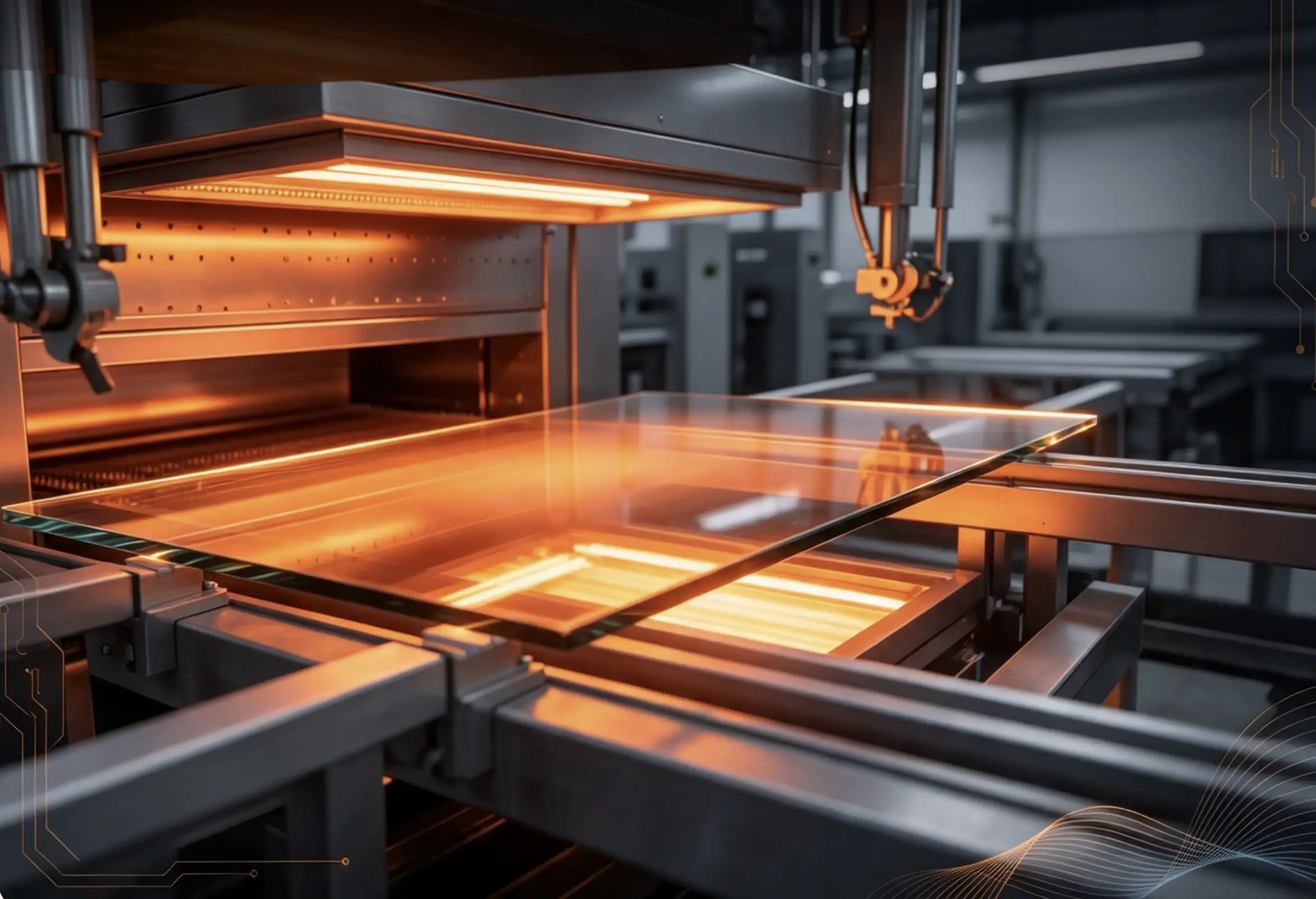
Here’s how the strength gets built. After forming, the glass is heated past 600 °C, then hit with forced air on both sides for rapid cooling. The outer surface locks up first while the inside is still hot and expanding. That tension compresses the surface to over 100 MPa. Before anything can crack the glass, it has to overcome that entire compression layer first. End result: 2–3 times the impact resistance of standard ceramic plates.
But one-off impact strength is only half the picture. What really grinds down plates in a restaurant kitchen isn’t a single dramatic drop. It’s the dishwasher — 82–88 °C wash, rapid cooldown to room temp, three to five times a day, every day.
This is where ceramics have a hidden weak spot. Ceramics are two layers — glaze on top, clay body underneath — and those two layers expand and contract at different rates when heated and cooled. One cycle, no problem. A few hundred cycles later, the glaze starts showing fine network cracks. The industry calls it “crazing.” Once crazing sets in, food pigments seep through the cracks into the porous clay body. They can’t be washed out. The plate is done.
That structural mismatch is a key reason the tempered glass dinnerware vs ceramic comparison favors tempered glass in high-volume kitchens. Opal glass is one material from surface to core — one expansion rate, uniform movement when heated and cooled. Stress has nowhere to concentrate.
In our in-house durability testing (1,500 simulated commercial dishwasher cycles at 82–88 °C wash / ambient cooldown), opal glass samples passed visual, 10× magnified, and stress-polarimeter checks with zero cracks and zero degradation. Structurally identical to day one. Based on these results, a plate washed 2,000 times is expected to perform exactly like one straight out of the box.
| Comparison Dimension | Ordinary Ceramic Dinnerware | Tempered Opal Glass |
|---|---|---|
| Material structure | Dual-layer (glaze + clay body); mismatched thermal expansion | Homogeneous single-material; expands and contracts uniformly |
| Surface compressive stress | No tempering treatment | > 100 MPa |
| Impact resistance (relative) | 1× | 2–3× |
| Annual breakage rate — physical fracture only (3–5 table turns/day) | 10%–15% | 3%–5% |
| After 1,500 dishwasher thermal cycles | Glaze crazing begins around 500–800 cycles; ~11% of samples show crazing or flaking | Zero cracks, zero structural degradation after 1,500 cycles |
| Cumulative micro-crack risk | High — dual-layer interface continuously accumulates thermal stress | Extremely low — homogeneous structure has no stress concentration points |
This comparison zeroes in on impact resistance and thermal cycling — the two things high-turnover restaurants care about most. For a wider side-by-side covering material composition, cost modeling, and use-case fit, see the full Opal Glass vs Ceramic vs Porcelain Complete Comparison Guide.
What Restaurants Gain After Switching from Melamine or Ceramics to Tempered Glass
Restaurants that make the switch see gains in two areas. Cost: opal glass breaks at one-third to one-fifth the rate of ceramics, restocking frequency drops sharply, and 24-month total cost of ownership runs 25%–35% lower. The initial price premium pays for itself in three to four years. Operations: opal glass is lighter than same-size ceramics, so servers carry less strain. It goes straight into the microwave — no container swap like melamine requires. And it runs through commercial dishwashers on normal settings, no extra spacing or temperature babysitting needed.
Here’s each point with numbers and operational detail.
The Annual Savings from a Lower Breakage Rate Are Tangible
1. Fewer Pieces Broken, Period
The real money pit in dinnerware isn’t the first purchase. It’s the restocking that never stops. Ceramics look cheap per unit, but they break constantly — a bump in the dish pit, a slip during plating, too much force stacking at clearing. Two or three broken plates a day is nothing unusual.
A hotel chain we’ve worked with for years tracked their own numbers across properties. On ceramics: 47 pieces broken per month, steady as clockwork. After switching the full inventory to Jointion tempered opal glass — same usage intensity, same staffing — monthly breakage dropped to 5 pieces. Over 24 months, their internal procurement data showed total cost of ownership roughly 25%–35% lower than the ceramic baseline. (These are client-reported figures from a controlled before-and-after comparison, not a lab study.)
2. Lower Restocking Frequency Cuts More Than the Purchase Bill
The upfront price does give some owners pause. Opal glass dinnerware for restaurants runs 30%–60% more per piece than basic ceramics. Two hundred plates means a noticeably bigger first check. But the math flips fast. Ceramics break three to five times more often. That means three restocking rounds a year versus maybe one — or none at all.
Fewer reorders also means fewer hours spent placing purchase orders, inspecting deliveries, and updating inventory logs. Those management costs are easy to overlook, but they shrink right alongside the reorder frequency.
3. Payback Is Faster Than You’d Think
Most restaurant operators tell us the same thing: the extra upfront spend, offset by what they save on restocking, pays itself back within three to four years. High-turnover Chinese restaurants and fast-food shops often hit breakeven sooner. The year-one premium isn’t a cost — it’s an investment that keeps returning value for years.
Serving, Reheating, and Washing All Become Easier in Daily Operations
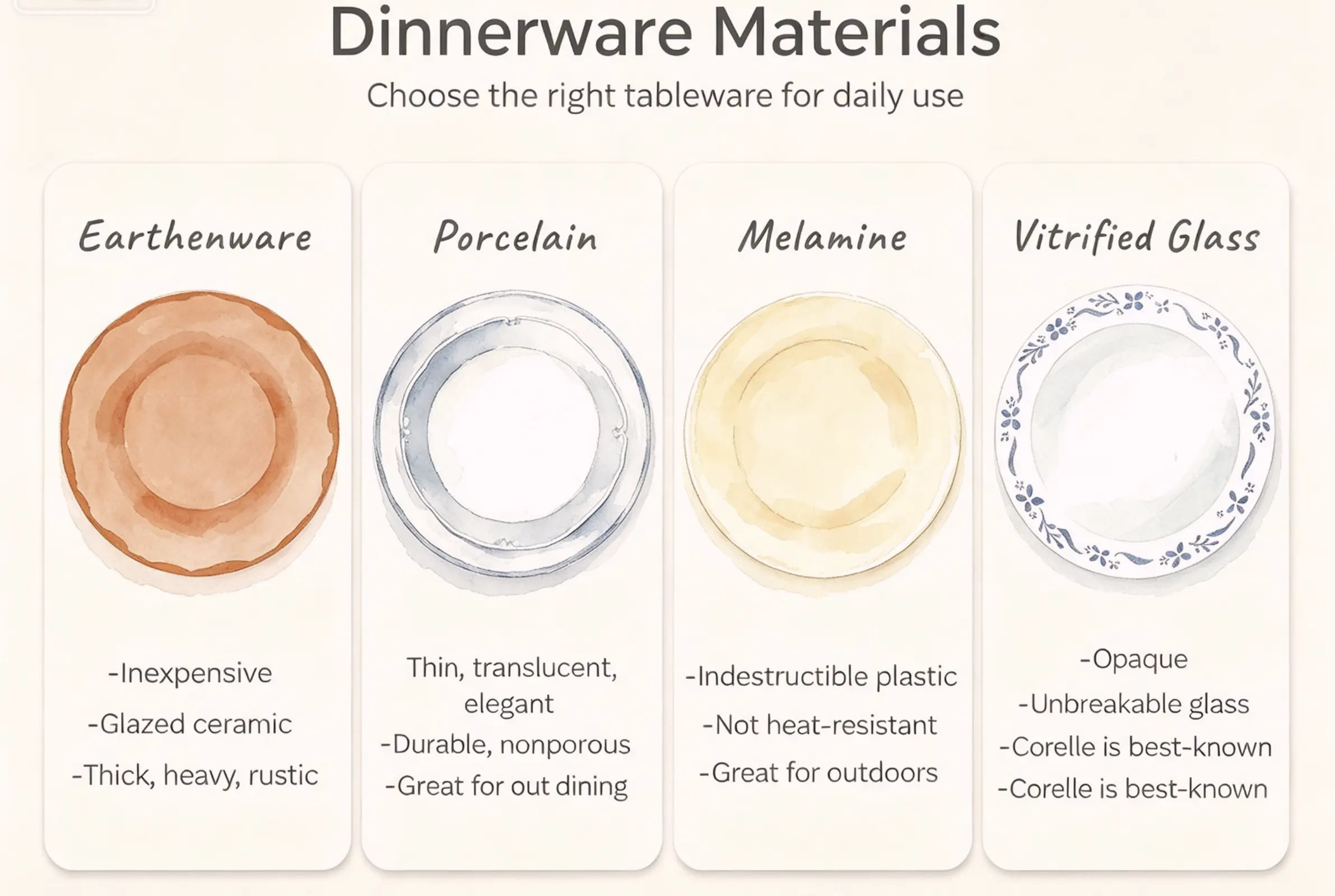
Dollar savings are one thing. What teams actually feel every shift is the change in daily workflow. As a category of tempered glass tableware commercial kitchens can count on, opal glass holds up across every touchpoint. Here’s how the three materials compare in practice:
| Comparison Dimension | Melamine Dinnerware | Ceramic Dinnerware | Tempered Opal Glass |
|---|---|---|---|
| Weight at same size | Lighter | Heavier | Lighter than ceramic; close to melamine |
| Microwave-safe? | No — must transfer to another container | Some — must verify glaze compatibility | Yes — goes straight in the microwave |
| Commercial dishwasher use | Standard cycle is fine | Needs wider spacing and controlled temperature to prevent chipping | Standard cycle is fine; no extra adjustments needed |
| Server load during peak hours | Low | Noticeably heavy | Low; less wrist fatigue over extended shifts |
| Extra handling rules for staff | Fewer | More (handle gently, dedicated storage methods) | Fewer |
| Outdoor / patio suitability | Excellent — won’t shatter on concrete | Risky — high breakage on hard surfaces | Acceptable with care — less breakage than ceramic, but not shatterproof like melamine |
| Premium dining aesthetic | Limited — plastic appearance | Strongest — handcrafted texture, warmth, artisanal character | Clean and modern, but lacks the tactile warmth of fine ceramics |
Serving comes first. Opal glass is noticeably lighter than ceramics. A server carrying two plates per hand or running three dishes on a tray feels the difference immediately — especially after dozens of trips through a lunch or dinner rush. That alone can speed up table turns by a beat.
Then reheating. Opal glass goes straight into the microwave. Melamine can’t — the material won’t allow it. Every time, the kitchen has to swap the food into another container, heat it, then swap it back. A few seconds per plate, but multiply that by dozens of tables at peak and the drag on plating speed adds up fast.
Finally, washing. Opal glass goes into the commercial dishwasher on a standard cycle. Done. No extra spacing, no dialing down the water temperature to avoid chips. The dish crew doesn’t have to baby each piece. Managers don’t have to keep repeating “handle with care.” One fewer step, one fewer worry, one fewer rule to enforce — small things that add up to a noticeable efficiency lift across the whole team, every single day.
If the numbers make sense and you want to explore tempered opal glass further, you can check shapes and specifications on the product page — custom quotes are available.
Common Questions People Ask
Q1: My melamine dinnerware is still in decent shape. Can I reduce the risk and keep using it?
You can lower the risk, but you can’t remove it. Keeping food below 70 °C, cutting back on acidic dishes, and retiring scratched pieces early all help to some extent. But if your menu leans heavy on hot food and sour-spicy flavors, those restrictions basically mean changing how you plate and serve — tough to pull off consistently. Our suggestion: get a third-party migration test done on your current stock. Make the call based on real numbers, not guesswork.
Q2: When tempered glass breaks, does it shatter into dangerous shards?
Fully tempered glass breaks into small, blunt granules — not sharp splinters. Same principle as automotive side-window glass. One important distinction, though: “fully tempered” and “heat-strengthened” are not the same thing. Heat-strengthened glass fractures more like ordinary glass. Always confirm your supplier is providing fully tempered product, and ask for the test report to prove it.
Q3: My average check is low. The 30%–60% upfront premium on tempered glass is a stretch. What do I do?
You don’t have to replace everything at once. A practical approach: start with the items that break the most and turn over the fastest — soup bowls, small sauce dishes. Keep existing ceramics for everything else for now. That way the first batch stays under a third of a full replacement cost, and you get immediate real-world data on how much your restocking frequency drops. Let the numbers tell you whether to keep going.
Q4: A supplier says their melamine is “food-grade” and “zero-formaldehyde.” Can I trust that?
“Food-grade” means the product passes regulatory tests under standard conditions — room temperature, non-acidic food. It does not mean safe in every real-world scenario. “Zero-formaldehyde” is chemically impossible. Melamine-formaldehyde resin synthesis always leaves unreacted monomers; the only variable is how much. The question to ask: can the supplier show you a third-party migration report tested under conditions that match your actual use — high heat plus acidity? A room-temperature compliance certificate alone doesn’t answer that.