
Opal Glass Dinneware Producion process
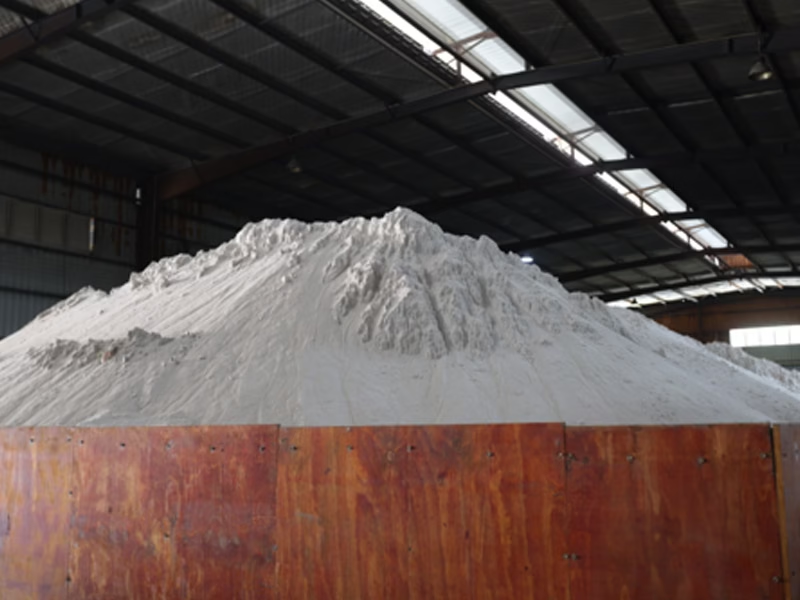
First Step:Raw material preparation
This critical stage establishes quality standards across every production detail:
60-65% Quartz Sand: Defines structural hardness and chemical inertness (safety stability). Creates food-safe, non-reactive framework for heat-resistant glassware.
5-8% Premium Opacifying Agent: Professional-grade opacifiers (not cheap pigments) deliver jade-like milky-white luster with substantial tactile quality (distinctive aesthetics and texture). Superior to standard white glass additives.
Trace Borax Additives: Precision-adjusts glass network’s thermal expansion coefficient. Pre-engineers thermal shock resistance for oven-to-table durability.
Second step:High-temperature smelting
- Pre-melting Zone (1200-1400℃):Batch materials fed via fully-enclosed conveyor system into furnace pre-melting zone,ensures uniform heating and rapid chemical reaction initiation.
- Fining Zone / Homogenization Zone (1500±5℃):Preliminary molten glass flows into furnace’s highest-temperature fining zone with precision temperature control (±5℃ tolerance).
- Conditioning Zone: Extended Homogenization:Glass melt undergoes extended settling (several hours) at constant temperature in fining zone terminus. Natural thermal convection guided by furnace design, supplemented by precision bottom bubbling technology for gentle stirring. Achieves complete chemical and thermal homogeneity.
- Forehearth & Feeder Canal: Fully homogenized glass flows through spout and feeder canal. Multi-stage independent temperature control system reduces temperature along preset curve to ~1100℃
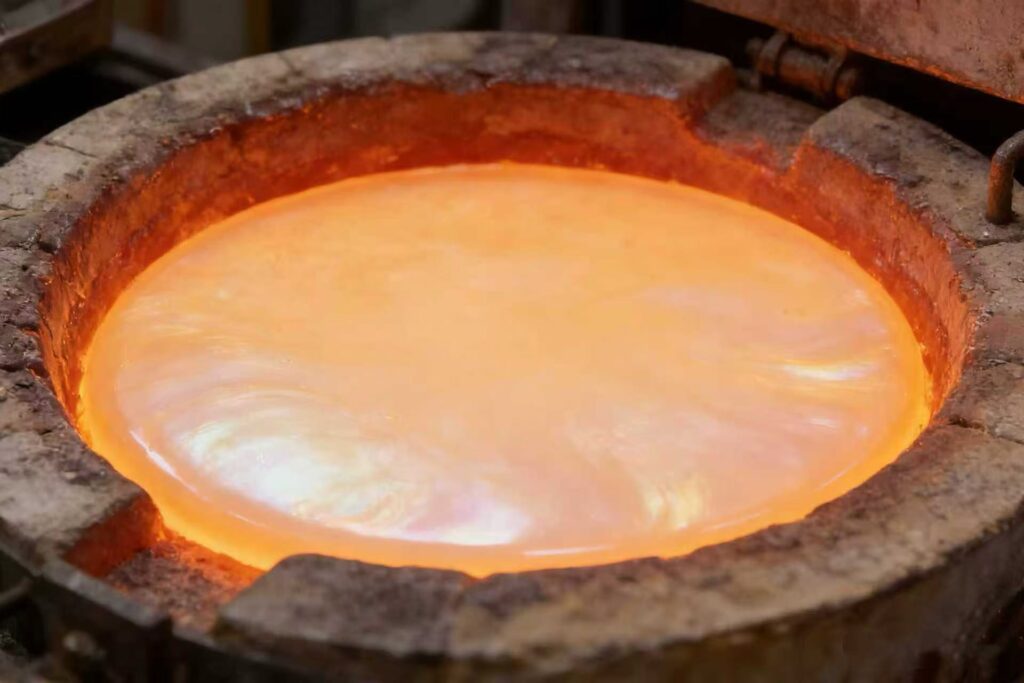

Third step:Fining & Homogenization Zone
- High-Temperature Fining (1500℃, 24-48 Hours):Extended dwell time (exceeding industry standard). Ultra-low viscosity enables fining agents (sodium sulfate) to generate large ascending bubbles—capturing and eliminating micro-bubbles down to nanometer scale before surface rupture.
- Simultaneous Homogenization via Controlled Convection: Deep tank furnace design with platinum bubbling system introduces trace inert gas at melt bottom. Creates uniform vertical convection for thorough chemical and thermal blending.
Our Monitoring Systems:
High-frequency cameras track bubbles | 20+ thermocouples control temperature | Lab analysis verifies composition
Four Step:Opal Glass Tableware Forming Process
- Precision Gob Feeding: Servo shearing system controls glass gob weight within ±1g tolerance, ensuring consistent material input per product.
- Rapid Press Forming: Mold closes and applies pressure in 0.5-1.5 seconds. Pressing force: 50-150 tons (adjusted by product size), instantly fills mold cavity with molten glass.
- Pressure Holding & Setting:Product initially cools and hardens under sustained pressure, maintaining dimensional stability.
- Automated Demolding & Transfer:Robotic arms transfer formed products to annealing lehr conveyor. Zero manual contact throughout process.
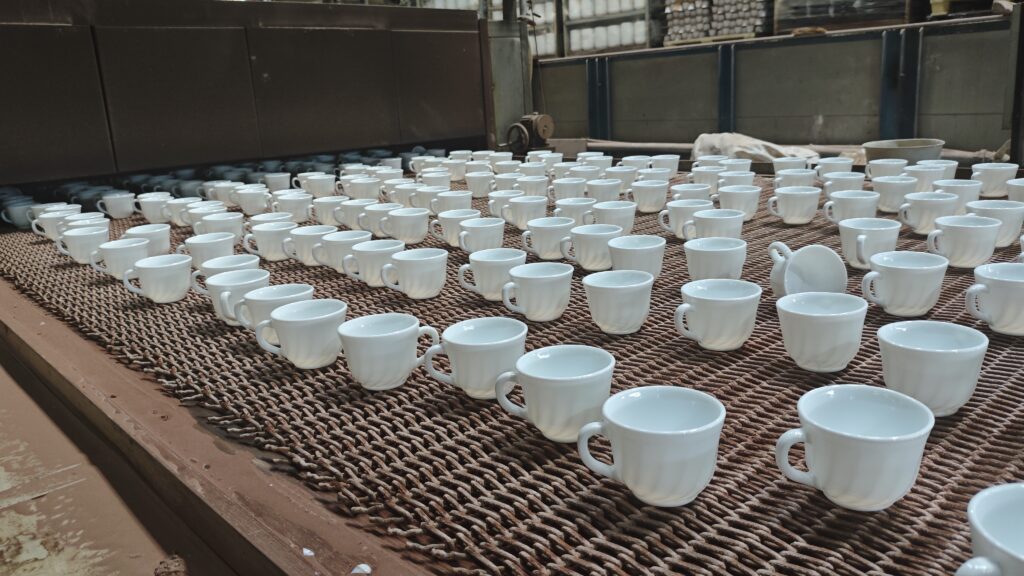
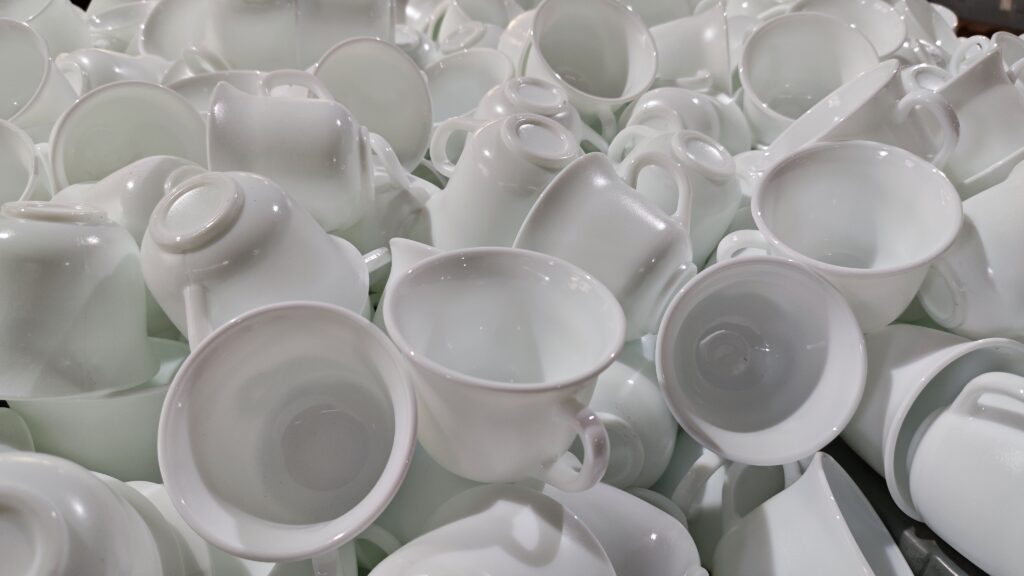
Five step: Annealing & Strengthening
- Precision Annealing (Stress Relief):Formed products immediately enter tunnel annealing lehr. In critical temperature zone (520℃-470℃), ultra-slow cooling rate (<3℃/minute) allows molecular structure relaxation, permanently eliminating internal thermal stress.
- Chemical Strengthening (Premium Series):Post-annealing enhancement: products immersed in molten potassium nitrate salt at 400℃ for 3-6 hours. Ion exchange reaction creates dense compression layer (30-50 microns deep) on surface.
Performance Enhancement: Impact resistance: +300%, Flexural strength: +250%
Six Step:Decoration & Finishing Process
- Embossed & Engraved Patterns: Precision mold embossing or CNC engraving creates permanent three-dimensional textures on product surface. Patterns integrated with body during forming—extremely wear-resistant and lasting.
- Glazing & Decal Application: Food-grade safe glazes applied via high-definition transfer printing technology for complex patterns. All glazes meet strictest FDA and LFGB safety standards—lead-free and cadmium-free certified.
- Hand-applied Precious Metal Decoration:Pure gold and platinum liquid manually applied, then fired at 720-760℃ in dedicated kiln. Metal layer permanently fused with glass—dishwasher safe—imparting unique luxury to each piece.
Seven step: Quality Inspection & Packaging
Quality Testing: 1.Thermal Shock Test:Samples rapidly transferred from 180℃ oven into 20℃ water, verifying resistance to extreme temperature changes. 2.Microwave Safety Test: Ensures safe microwave heating compatibility. 3.Dishwasher Safety Test: Confirms decoration and material integrity after multiple wash cycles.
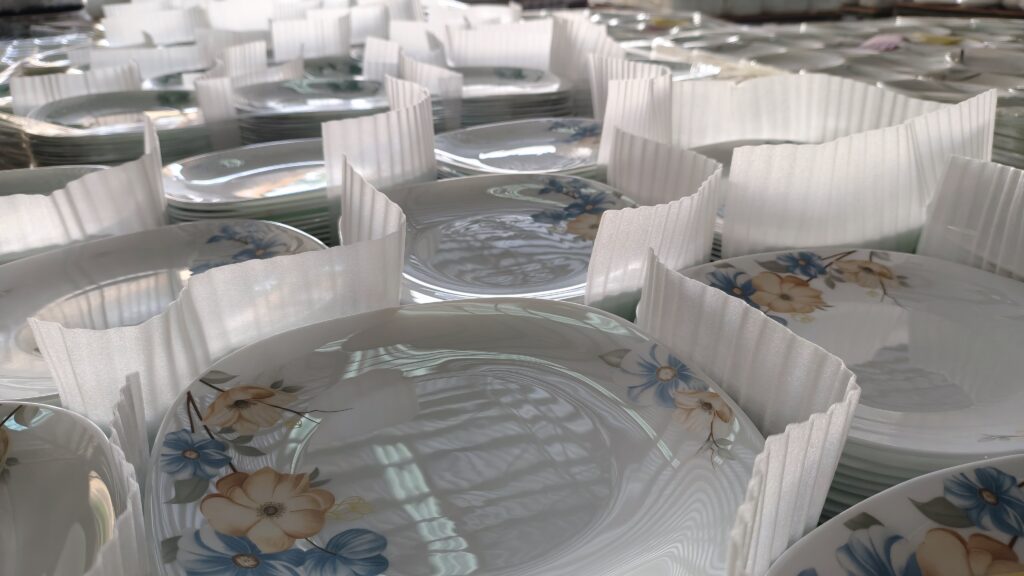
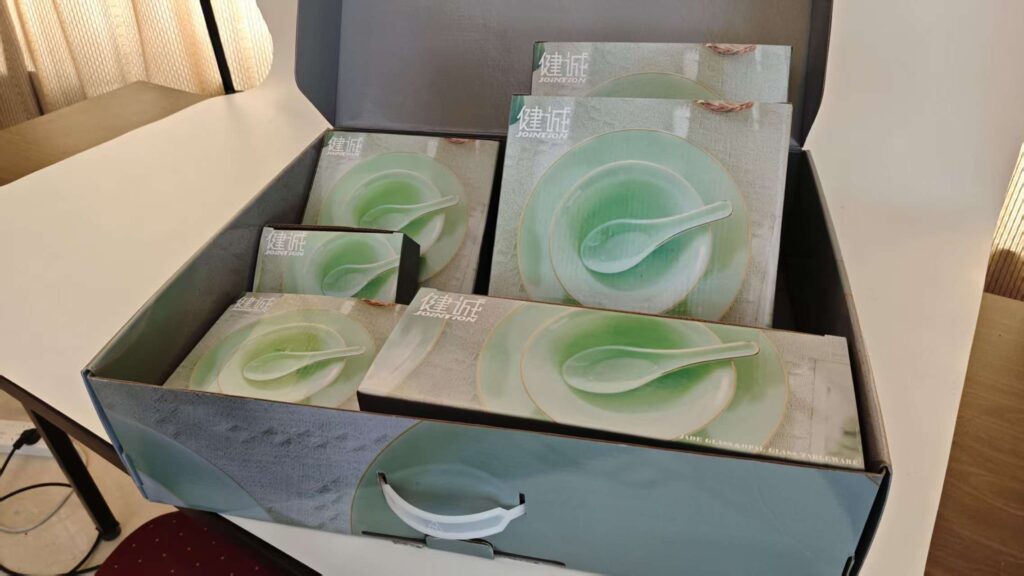
Protective Packaging:1.Cleaning & Drying Final cleaning and drying in dust-free environment.2.Individual Protection Food-grade cardboard or recycled pulp dividers prevent transit damage.3.Eco-friendly Packaging Recyclable kraft or FSC-certified boxes with clear product labeling and environmental certifications.4.Shipping Protection Biodegradable honeycomb paper or air pillows cushion products for safe delivery.