
Opal Glass, Ceramic, Porcelain, and Bone China are the four most common choices in commercial tableware. They all look like “white plates,” but the gaps in raw materials, manufacturing, and daily performance are much bigger than they appear. Pick the wrong one, and you’re not just dealing with plates that “don’t look as nice” — you’re looking at doubled breakage, runaway replacement costs, and a worse guest experience.
This opal glass vs ceramic vs porcelain vs bone china guide puts all four materials side by side — composition, performance, cost, and scenario fit — item by item. One goal: help you pick the right material for your business.
What Are Opal Glass, Ceramic, Porcelain, and Bone China Actually Made Of?
Before comparing performance or price, you need to know what each material actually is. Many buyers mix them up — especially Ceramic and Porcelain. But the opal glass ceramic porcelain bone china difference starts at the raw-material stage. They take completely different paths from day one.
Raw Materials and How They’re Made
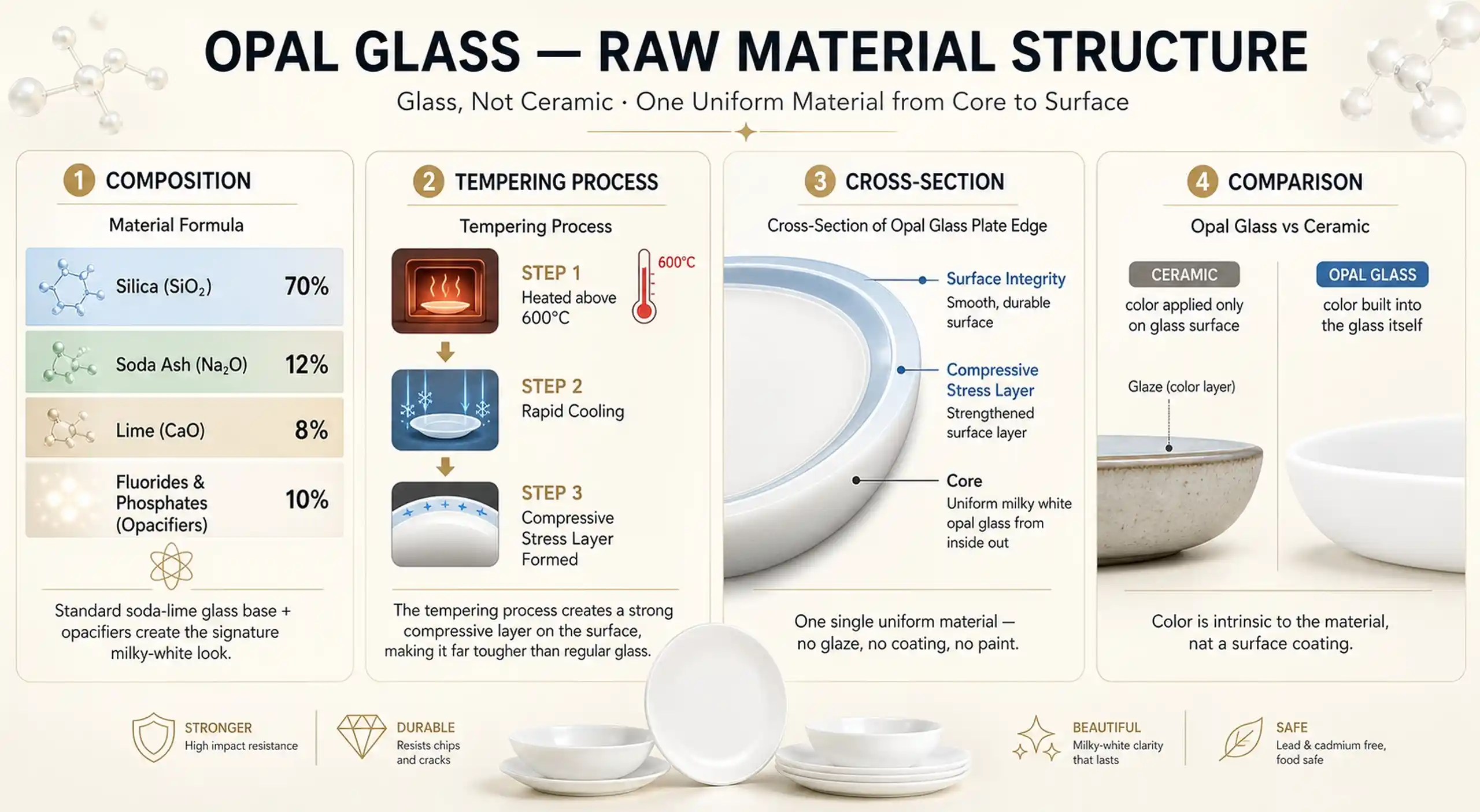
Opal Glass is glass, not ceramic. Its formula adds opacifiers — fluorides, phosphates — to standard soda-lime glass, giving it that even, milky-white look. After shaping, it goes through tempering: heated above 600°C, then rapidly cooled. This creates a compressive stress layer on the surface, making it far tougher than regular glass. The whole piece is one uniform material from core to surface — no glaze, no coating. The color is built into the glass itself.
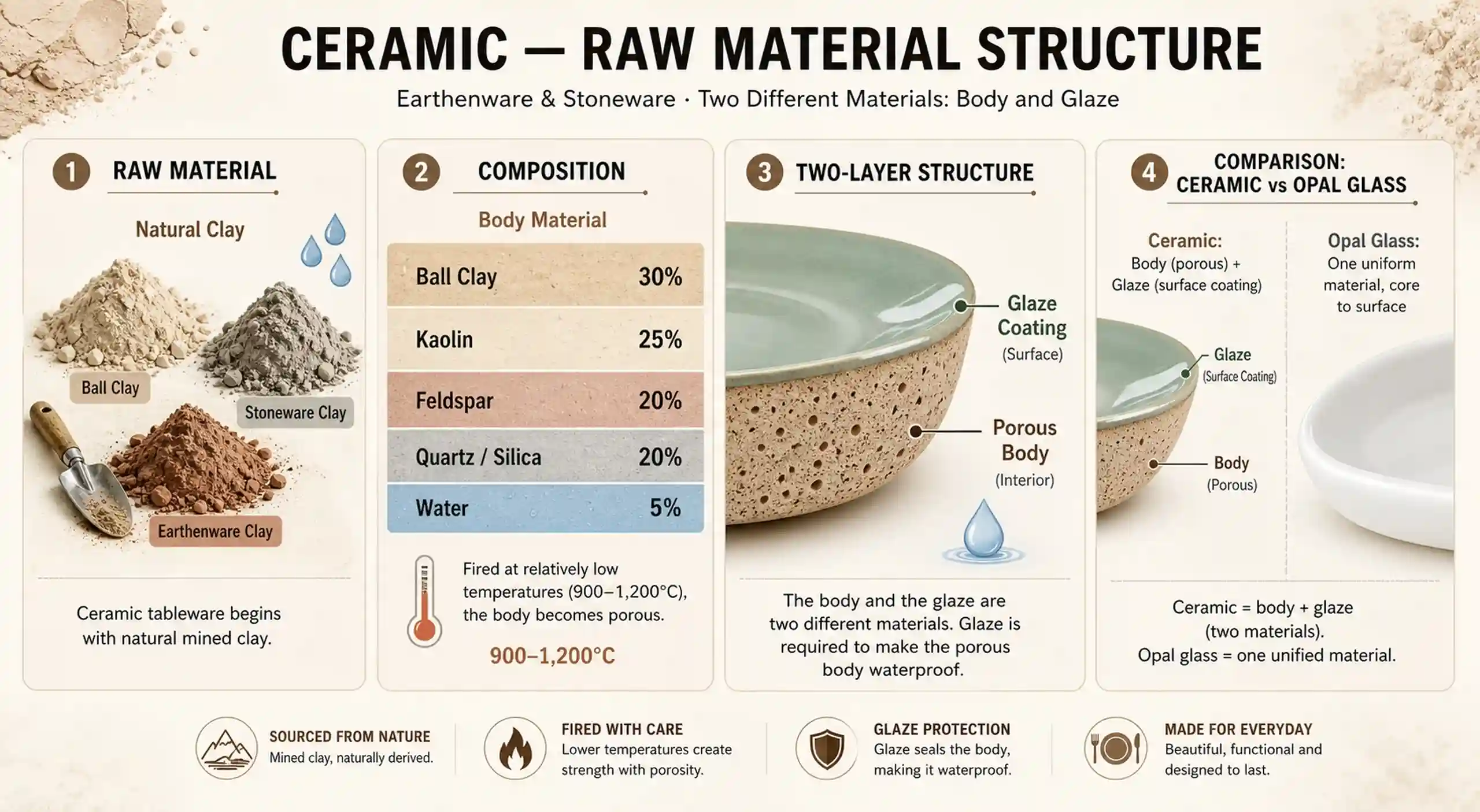
Ceramic is a broad category. In practice, “Ceramic” tableware usually means Earthenware or Stoneware. The raw material is natural clay, fired at relatively low temperatures (900–1,200°C). After firing, the body is porous. It needs a glaze coat to become waterproof. So the “shell” and the “body” are two different materials.
That two-layer structure is also what gives Ceramic its creative edge. Kiln-change effects, gradient glazes, rough hand-thrown textures — these are things the other three materials simply can’t do.
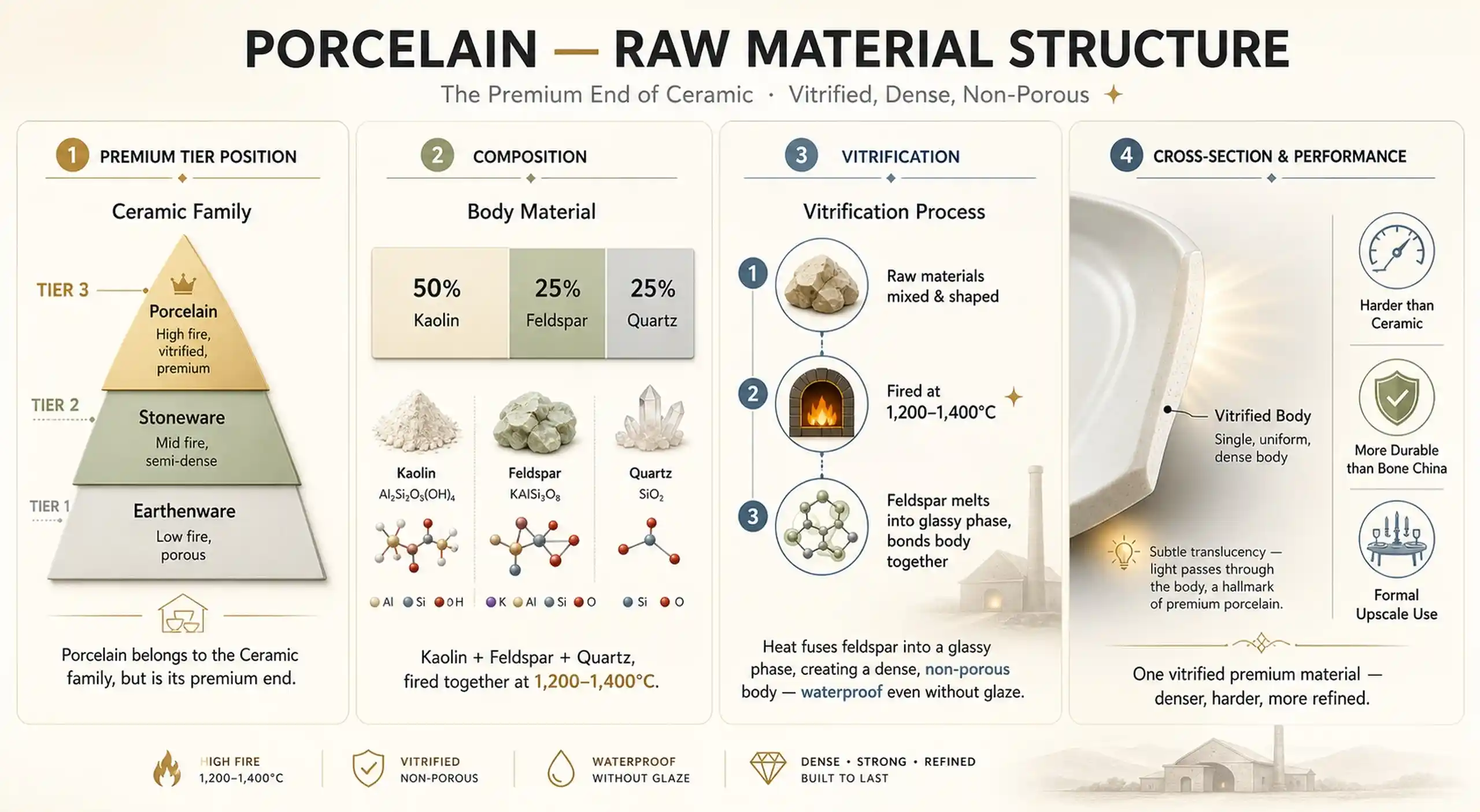
Porcelain belongs to the Ceramic family technically, but it’s the premium end. The raw materials are kaolin, feldspar, and quartz, fired at 1,200–1,400°C. At that heat, feldspar melts into a glassy phase and bonds everything together — a process called vitrification. The result is a body that’s dense and non-porous on its own, waterproof even without glaze. Porcelain balances strength and refinement: harder than Ceramic, more durable than Bone China, and formal enough for upscale tables.
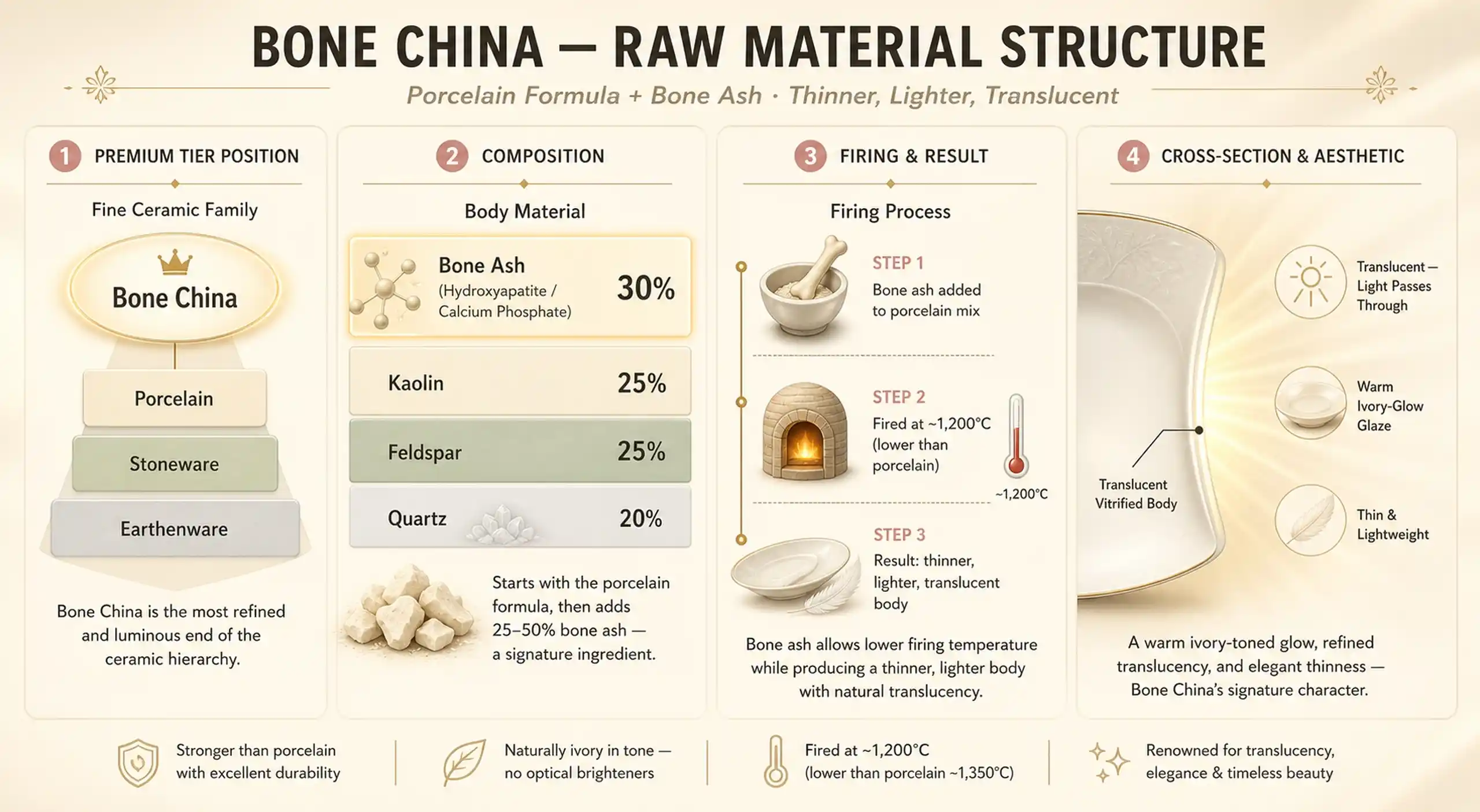
Bone China starts with the Porcelain formula but adds one thing: bone ash, typically 25–50% of the mix. This lets the firing temperature drop slightly (around 1,200°C), yet the finished piece comes out thinner, lighter, and translucent. The glaze has a warm, ivory-toned glow.
Of the four, Bone China delivers the most refined feel — thin enough to let light through, almost weightless in your hand. No other material replicates that. Although it’s technically a Porcelain subcategory, the two differ so much in performance, price, and use case that they need separate evaluation.
Key Parameters at a Glance
| Parameter | Opal Glass | Ceramic | Porcelain | Bone China |
|---|---|---|---|---|
| Primary Raw Materials | Soda-lime glass + opacifiers | Natural clays | Kaolin + feldspar + quartz | Kaolin + feldspar + bone ash |
| Firing Temperature | 1,200–1,500°C | 900–1,200°C | 1,200–1,400°C | ≈1,200°C |
| Density | 2.4–2.6 g/cm³ | 1.8–2.3 g/cm³ | 2.3–2.5 g/cm³ | 2.2–2.4 g/cm³ |
| Porosity | Non-porous | Porous (requires glaze seal) | Non-porous | Non-porous |
| Translucency | Some high-end products are translucent | Opaque | Slightly translucent at thin areas | Noticeably translucent |
| Structure Type | Monolithic, no glaze layer | Body + glaze (dual-layer) | Body + glaze (dual-layer) | Body + glaze (dual-layer) |
One thing worth flagging: both Opal Glass and Porcelain are non-porous, but they get there in completely different ways. Porcelain relies on high-temperature vitrification. Opal Glass relies on being glass. That difference shapes many of the performance results below.
Also note the structure column. Ceramic, Porcelain, and Bone China are all dual-layer — body plus glaze. Opal Glass is a single layer, all the way through. Dual-layer means two materials with different thermal expansion rates, which matters a lot when we get to thermal shock.
Which Material Is the Most Durable, Heat-Resistant, and Long-Lasting?
Now that the “what is it” part is settled, here’s what buyers actually want to know: how does each one hold up in real use? We’ll break it down across four dimensions.
First, I’ll show you three videos for your reference. Then, I’ll explain in detail to you the actual data from the videos. Which Material Is the Most Durable, Heat-Resistant, and Long-Lasting
Impact Resistance — Which Can Take the Most Knocks?
Commercial kitchen tableware doesn’t sit on a shelf. Dishwashers stack plates fast. Servers bump trays against doorframes. Bus carts rattle across tile floors. That’s the daily reality.
Here’s how the four materials handle it:
Opal Glass — Tempering gives it 2–3× the impact strength of regular glass, the highest everyday-knock tolerance of the four. If it does break, it shatters into blunt chunks instead of sharp shards — much safer to clean up in a busy kitchen.
Bone China — Thinner than you’d expect to be tough, but bone ash gives it real resilience. Full-on shattering is rare in daily use. The weak spots are the edges — rims and lip areas chip easily from a single knock. In lower-turnover settings with careful handling, that’s manageable.
Porcelain — Hard, yes. But “hard” and “tough” aren’t the same thing. Porcelain is brittle. Hit it, and cracks spread fast. Rim chipping is the #1 reason Porcelain plates get thrown out in high-volume kitchens. The upside? That hardness means knives and forks barely scratch it — better scratch resistance than Opal Glass or Ceramic.
Ceramic — Huge range here. Stoneware is thick and absorbs impact reasonably well. Earthenware is fragile. If you’re buying Ceramic for commercial use, make sure it’s Stoneware grade.
Impact resistance ranking (strongest to weakest): Opal Glass > Bone China > Porcelain > Ceramic (Stoneware). For a deep dive into how opal glass crystal structure affects durability, the Journal of the American Ceramic Society published a relevant study: Structure and Durability of Opal Crystallized Glass Plates.
Thermal Shock — Which Survives Freezer-to-Microwave Swings?
Here’s a scenario every commercial kitchen deals with: a plate comes out of a 4°C fridge, gets plated, and goes straight into the microwave. Or the reverse — 82–88°C dishwasher water, then room-temperature air. That sudden temperature swing is called thermal shock.
Opal Glass handles this best. It can take roughly a 135°C temperature swing without cracking. Fridge to microwave, no waiting, no buffer step. In a fast kitchen, that’s not just convenience — it speeds up the entire plating line.
Porcelain can handle high heat on its own — it’s fired above 1,200°C, after all. The issue is rapid cycling. The body and glaze expand at different rates. Repeated fast swings build micro-stresses between the two layers. Over months, fine cracks appear in the glaze — a defect called “crazing.” One cycle won’t hurt, but 5+ dishwasher runs a day for a year will leave marks. At lower wash frequencies (home use or Fine Dining), Porcelain holds up just fine.
Bone China is more sensitive. Most manufacturers advise against microwaving it. The thin walls concentrate stress during rapid temperature changes. This isn’t a quality flaw — Bone China was never built for high-frequency heating. In low-turnover, careful-service environments, the limitation barely matters.
Ceramic — Earthenware is the weakest here. Pores in the body trap moisture; heat it fast, and that moisture expands and can crack or shatter the piece. Stoneware is better, but still shouldn’t face extreme swings. On the plus side, Ceramic’s thick body retains heat well — food stays warm longer on the plate, which some dining styles specifically value.
Thermal shock ranking (strongest to weakest): Opal Glass > Porcelain > Bone China > Ceramic
Stain Resistance — Which Still Looks Good After a Year of Heavy Washing?
Every plate looks great on day one. The real question is what it looks like after 6–12 months of commercial dishwasher cycles — 5 to 10 runs daily, detergent pH at 11–13 (strongly alkaline). Under those conditions, materials age at very different speeds.
Opal Glass — No glaze layer to erode. Its color comes from crystal scattering inside the glass itself. Nothing to wash off, nothing for stains to penetrate. Strong alkaline detergent barely touches it. After a year or two, the surface looks essentially the same as new.
Porcelain — Non-porous and strong in the short run. But at 10+ alkaline washes per day, the glaze slowly erodes. After 12–18 months, you may see a slight drop in gloss and a faint grayish tone. At 2–3 washes per day, this process slows way down, and Porcelain can look good for years.
Bone China — Its glaze is the softest of the four (Mohs 5.5–6). High-frequency alkaline washing chips the edges over time, and those micro-chips become entry points for coffee, tea, and curry stains. Once pigment gets under the glaze, it won’t come out. One hotel client in Southeast Asia sent us 9-month-old Bone China samples for evaluation — the surfaces had a permanent yellowish-gray film. But that hotel ran an all-day restaurant with 10+ dishwasher cycles daily. In Fine Dining or private rooms with lighter use, Bone China glazes hold up well for a long time.
Ceramic — Depends entirely on glaze quality. Even, well-applied Stoneware glaze resists staining decently. Uneven spots are where discoloration hits hardest. And since the Ceramic body itself is porous, any crack or chip in the glaze lets moisture and pigment soak in permanently. That said, many brands that choose Ceramic aren’t trying to keep plates looking brand-new — the patina is part of the aesthetic.
Stain resistance ranking under high-frequency washing (strongest to weakest): Opal Glass > Porcelain > Bone China > Ceramic
This ranking assumes 5–10 commercial dishwasher cycles per day. If your operation washes less often, Porcelain and Bone China perform much better, and the gaps shrink. The U.S. FDA has also issued guidance on lead migration from traditional ceramic glazes into food: Questions and Answers on Lead-Glazed Traditional Pottery.
Weight and Stackability — Which Saves Labor and Storage Space?
In retail, weight barely matters. In B2B, it hits three things directly: staff fatigue, shelf space, and shipping costs.
Reference: a standard 10-inch (≈25 cm) dinner plate.
| Material | Weight per Plate (approx.) | Stack Height for 20 (approx.) | Handling |
|---|---|---|---|
| Opal Glass | 350–420 g | Low, tight and uniform | One hand carries a stack of 20 |
| Bone China | 300–380 g | Low, but thin walls risk crushing | Lightest, but tall stacks risk chipping |
| Porcelain | 400–550 g | Medium | Two hands recommended |
| Ceramic (Stoneware) | 500–700 g | Tallest, thick rims | A stack of 20 needs two hands; noticeably heavy |
Opal Glass is about 30–40% lighter than same-sized Ceramic. Its uniform shape stacks tightly, so you fit more per shelf and more per truck. In a kitchen where staff move hundreds of plates daily, that weight gap is felt immediately.
Bone China is the lightest per piece, but thin walls limit how high you can stack. Pile too many, and the bottom plates chip under the weight. Many hotels add paper separators between layers — which eats into storage space and handling time.
Porcelain sits in the middle: moderate weight, stable stacking. A solid all-rounder.
Ceramic is the heaviest and bulkiest. But that heft is part of the appeal for brands going for a “rustic, hearty” feel. Weight isn’t always “lighter = better.” It depends on the experience your brand wants to deliver.
On Reddit’s r/BuyItForLife, users regularly share stories of tempered opal glass dinnerware (Corelle, Luminarc) lasting 10–40 years in great shape: Dinnerware: Corelle or Luminarc?.
How Much Does Each Material Actually Cost Over Time?
Performance is covered. Now the question every buyer has to face: money.
Unit Price Ranges
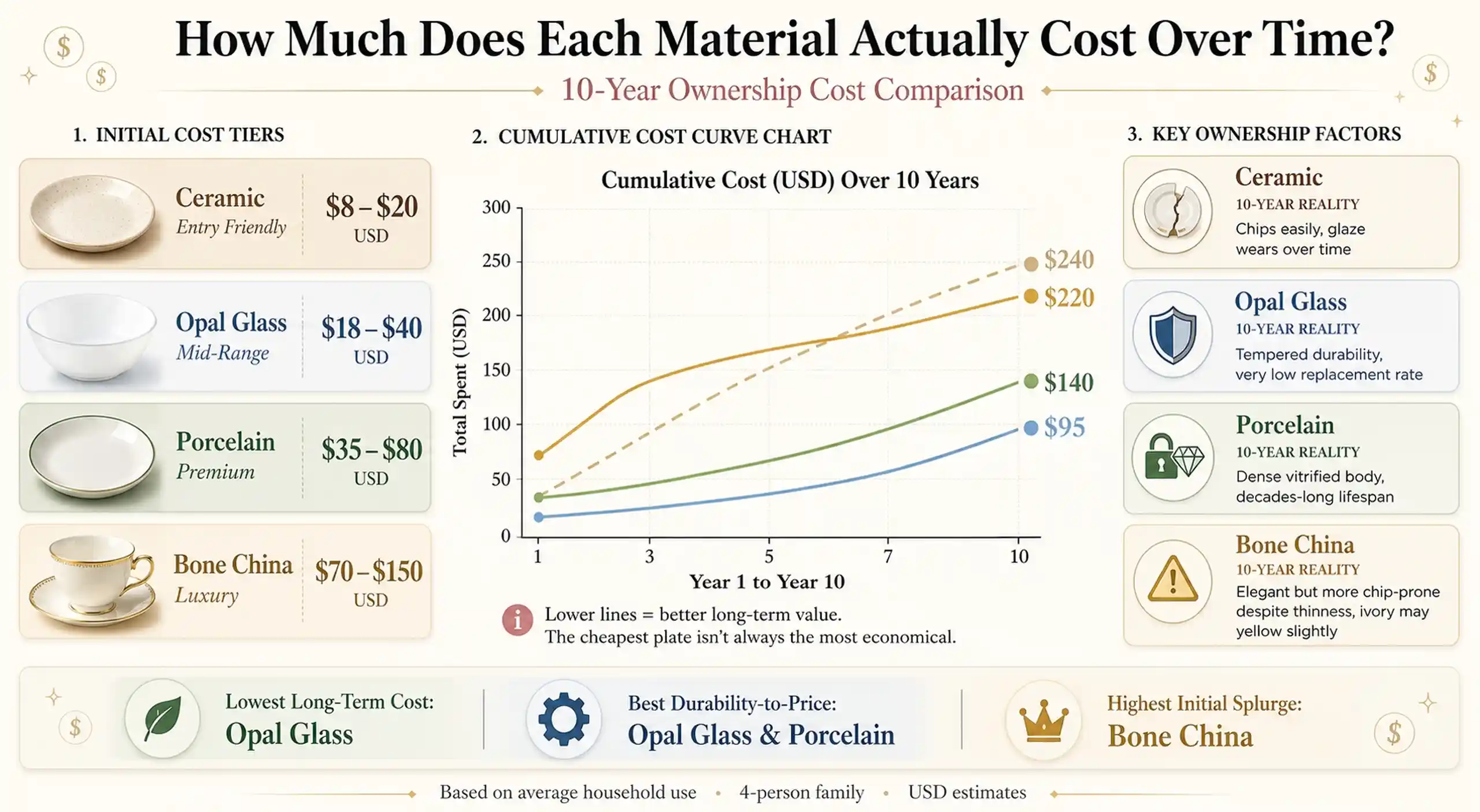
Bottom line first. Approximate unit price from lowest to highest: Ceramic ≤ Opal Glass < Porcelain < Bone China.
That assumes same grade, same specs, and bulk orders. Real quotes shift based on origin (Chinese vs. European Porcelain can differ 3×+), MOQ, customization (plain white is cheapest; custom decals add cost), and dimensions.
Using Opal Glass bulk price as a baseline of “1”:
| Material | Relative Unit Price (Opal Glass = 1) | Key Price Variables |
|---|---|---|
| Ceramic (Stoneware) | 0.8 – 1.2 | Glaze process, origin |
| Opal Glass | 1 (baseline) | Tempering process, opacifier formula |
| Porcelain | 1.2 – 1.8 | Firing temperature, brand premium |
| Bone China | 1.5 – 3.0 | Bone ash content, brand, origin |
Don’t project wholesale costs from retail prices. Retail Bone China and Porcelain carry brand markups of 5–10× over wholesale. Base B2B decisions on actual supplier quotes. If your destination country is adjusting import tariffs, the landed-cost gap between materials widens further. For a specific breakdown, see this analysis of Opal Glass vs Ceramic landed costs under rising tariffs.
The Real Number: Total Cost of Ownership Over Three Years
Unit price is just the first layer. What actually decides your three-year spend is total cost of ownership (TCO):
TCO = Initial Quantity × Unit Price + Annual Replacements × Unit Price × Years
The key variable is annual breakage rate, and it varies enormously across materials:
| Material | Annual Breakage Rate (Commercial Reference) | Notes |
|---|---|---|
| Opal Glass | 3–5% | Tempered, high impact resistance, excellent dishwasher tolerance |
| Bone China | Highly scenario-dependent (5–50%+) | Durable in careful, low-frequency use; deteriorates fast under heavy use |
| Porcelain | 8–12% | Hard but brittle; rim chipping is the main cause of disposal |
| Ceramic | 10–15% | Edge chips and glaze cracks are the main causes |
In practice: buy 1,000 Opal Glass pieces, replace 30–50 in year one. Buy 1,000 Ceramic pieces, replace 100–150. Over three years, Ceramic’s total replacements can approach half the original order. Opal Glass stays around 10–15%.
The cheapest unit price doesn’t always mean the lowest three-year bill. And Bone China, despite having the highest unit price, can keep breakage very low in a gentle Fine Dining environment — making its three-year cost competitive with Ceramic under heavy use.
If you’re considering swapping Bone China for a lower-TCO option, this Bone China alternative tableware guide covers visual-match assessment and bulk cost breakdowns in detail.
The takeaway: TCO depends on the material-scenario combination, not any single number.
Which Material Fits Your Foodservice Scenario?
Performance and cost are covered. The last question: which material belongs in your specific operation?
A high-turnover fast-food chain needs “won’t break, won’t stain, stays cheap.” A five-star private dining room needs “looks and feels premium on the table.” No single material wins everywhere. Whether you’re weighing opal glass vs porcelain for a hotel buffet or porcelain vs bone china vs ceramic for a multi-concept group, the answer always starts with your operating environment.
| Scenario | Recommended Material | Why |
|---|---|---|
| Fast-food chains / Institutional catering | Opal Glass | Impact-resistant, lightweight, uniform look, low breakage, easy to standardize |
| Business hotel buffets | Opal Glass or Porcelain | High wash frequency; needs both durability and a presentable look |
| Luxury hotel private dining / Fine Dining | Bone China or premium Porcelain | Low turnover; texture and brand image come first |
| Specialty / Artisan-style restaurants | Ceramic | Glaze variations and rough textures are part of the brand story |
| Banquet catering / Delivery | Opal Glass | Light weight cuts delivery cost; handles transit bumps |
| Staff canteens / Corporate dining | Opal Glass | High daily volume; needs the lowest possible maintenance cost |
Every material has its best stage. Bone China’s refinement in Fine Dining can’t be faked by another material, just as Ceramic’s kiln-change glazes can’t be replaced in artisan dining. Opal Glass and Porcelain each own high-frequency commercial and mid-to-high-end formal settings respectively. You’re not picking “the best material” — you’re picking the best match for your scenario.
Running multiple scenarios? Mix materials. A hotel with both a buffet and a Chinese fine-dining wing can use Opal Glass in the buffet — high volume, heavy washing, cost-controlled — and Bone China or Porcelain in the private rooms where turnover is low and spend per guest is high. Each material covers its own zone. That’s often the cleanest way to resolve the opal glass vs bone china trade-off.
Three Steps to Lock In the Right Material
Step One: Start with the scenario, not the price tag. How many dishwasher cycles per day? What’s your table turnover? How much do guests notice tableware quality? These answers narrow your shortlist fast. High-frequency, high-intensity? Compare Opal Glass and Porcelain first. Low-frequency, high-refinement? Compare Bone China and premium Porcelain. Need a unique design language? Start with Ceramic. Cut what doesn’t fit, then choose from what’s left.
Step Two: Run the three-year math, not just the unit price. Plug your actual volumes, annual breakage rates, and replacement cycles into a TCO model. An option that’s 10% cheaper per piece often costs 20–30% more over three years. Sometimes the pricier material with near-zero breakage is the better deal. One honest calculation and the choice gets obvious.
Step Three: Test samples in your own kitchen before placing a large order. Spreadsheets only go so far. Get a small sample batch, run it through your dishwasher, let your staff use it for a month. Track breakage, surface changes, and what your team actually thinks. A month of real-world data beats any comparison article. In some markets — particularly India and Southeast Asia — buyers also compare opalware vs ceramic vs porcelain. “Opalware” is simply the local trade name for tempered opal glass, so the same data in this guide applies.
Common Questions People Ask
Q1: I’m using Porcelain now and want to switch to Opal Glass. Can I wash both in the same dishwasher during the transition?
Yes. Water temperature, detergent concentration, and cycle length are fully compatible — no need to separate them in the machine. Just don’t stack them together in storage. Opal Glass has a softer surface than Porcelain, so Porcelain plate bottoms can scratch it when mixed in the same stack.
The most practical transition approach: replace by category, starting with the highest-breakage items (usually flat plates and soup bowls). Keep the lower-attrition Porcelain in service until end of life. The same batch-by-batch logic applies when migrating from opal glass vs ceramic as well.
Q2: Which material is best for custom logo printing? Are there process differences?
All four support logo customization, but the results differ. Porcelain and Bone China handle underglaze, overglaze, and decal decoration — the widest color range and best fit for complex artwork. Opal Glass uses high-temperature decals (fired at 680°C+), which fuse into the glass and survive 2,000+ dishwasher cycles without fading. The trade-off is a narrower color palette than ceramic-based options.
Ceramic offers the most creative freedom in glaze decoration, but low-temperature decals fade fastest under heavy washing. If logo durability is non-negotiable, go with Opal Glass high-temp fired decals or Porcelain underglaze printing.
Q3: My first order is under 500 pieces. How different are the MOQ thresholds?
Very different. Ceramic has the lowest barrier — many factories take 500 pieces or fewer, since their molds and kilns are highly versatile. Opal Glass in standard white usually starts at 500–1,000 pieces; custom patterns push that higher. Porcelain MOQs are similar to Opal Glass, but underglaze customization typically requires 1,000+ pieces.
Bone China has the highest threshold. The bone ash formulation and firing process are more complex, so most factories require 3,000–5,000 pieces minimum. For a first order under 500 pieces, Ceramic and standard white Opal Glass are your most realistic options.