
This article helps you settle a common sourcing question. When you compare colored opal glass tableware side by side, why do some products fade within six months while others hold up? Why do some show obvious color shifts between batches while others stay consistent? It comes down to one thing: whether the color is fused into the glass or sprayed on afterward. We’ll walk through the process differences, show you what each approach actually looks like over time, and give you a practical checklist for colored glass tableware B2B sourcing — so you can tell the difference before placing an order, not after.
What Makes Jade Glass Different from Ordinary Colored Opal Glass?
The Color Is Fused into the Glass, Not Coated On — and “Jade-Toned” Doesn’t Mean Jade-Quality
The core difference between jade glass dinnerware in the Jade Glass series and ordinary colored opal glassware is simple: where does the color come from? Most conventional products get their color sprayed on after the white blank is already formed. Some use crude pigment mixing in the raw materials. Either way, the color sits on or near the surface. It lacks depth. And controlling it from batch to batch is extremely hard.
The Jade Glass series works differently. Mineral coloring agents go into the glass formula at the raw material stage. They’re fused at over 1,400°C. At that temperature, the coloring ions bond directly into the silica network — they become part of the glass itself. The result is a semi-translucent, warm luster that closely resembles natural jade, with color that stays consistent across production batches.
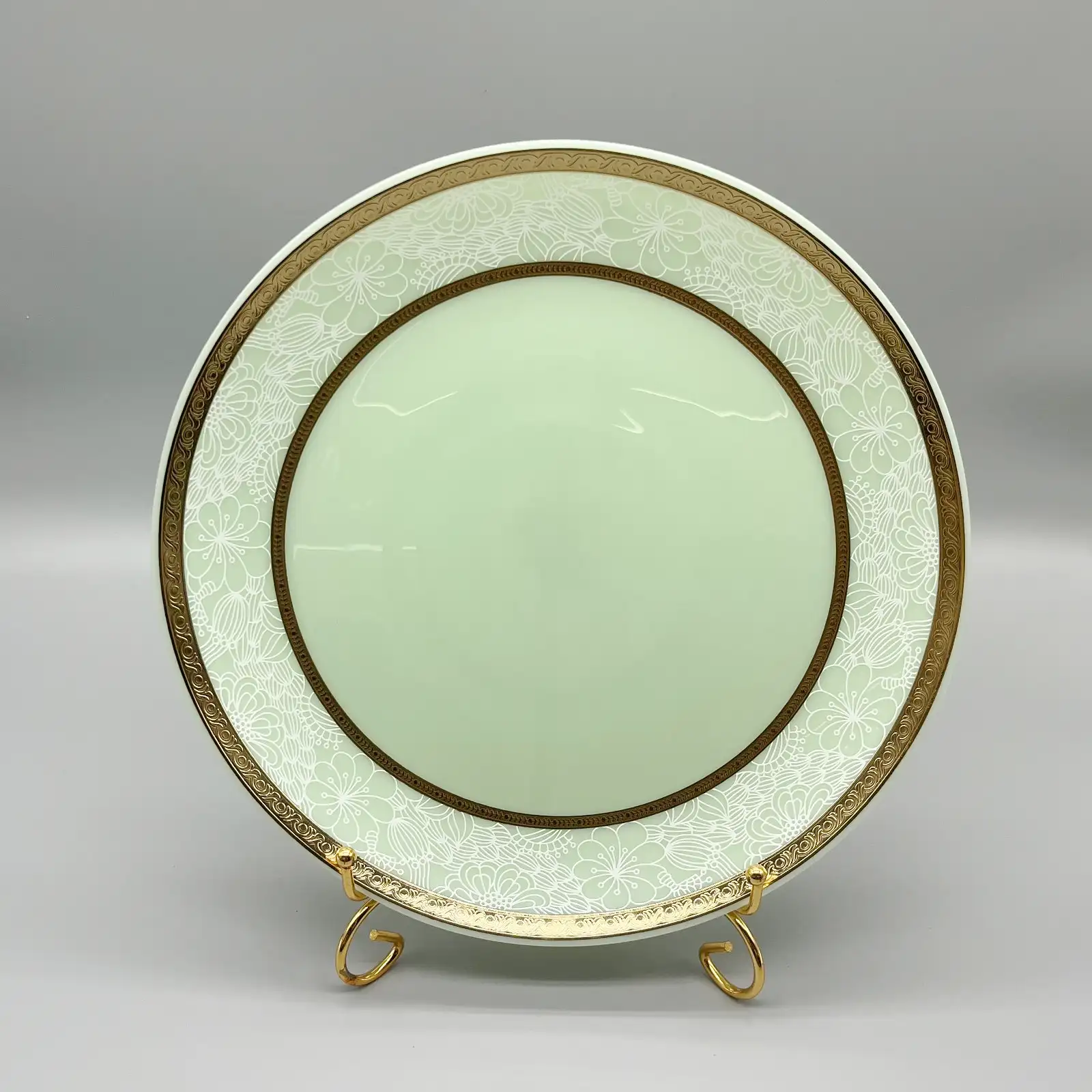
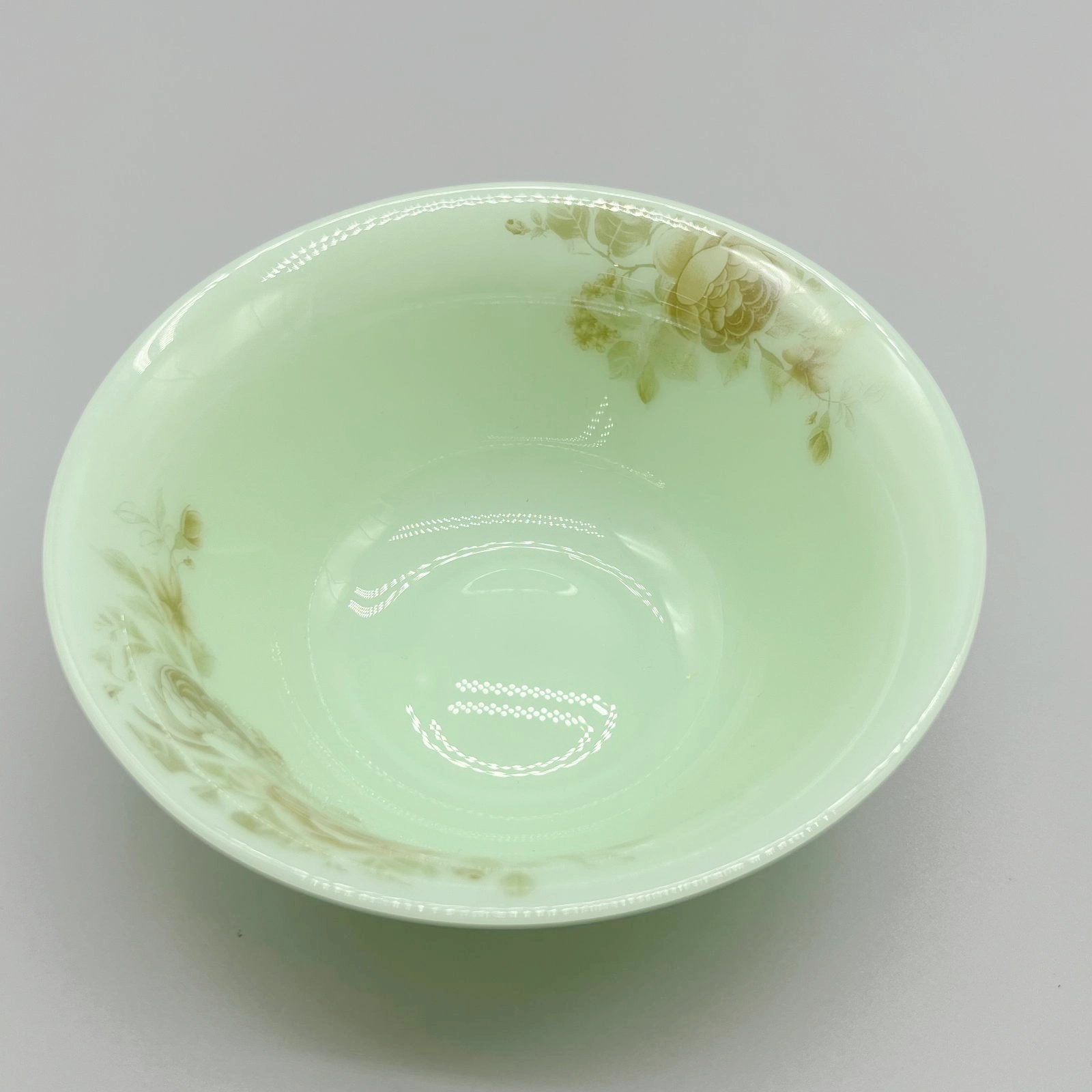
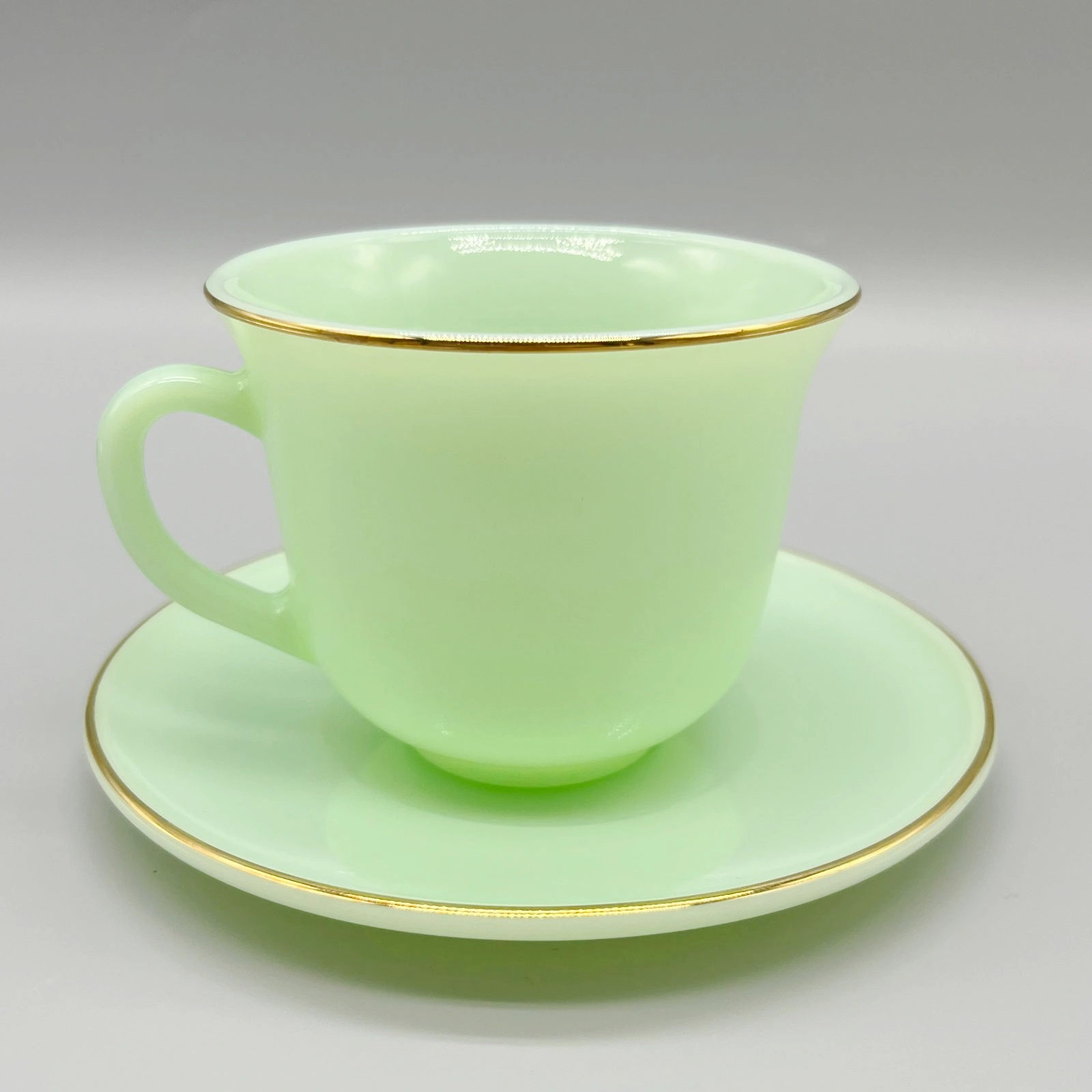
Below, we break this down across two dimensions: how each coloring process actually works, and what that means for batch consistency.
1. Post-forming spray coating — the most common low-cost approach in the industry.
Most ordinary colored opal glass tableware gets its color after forming. The white blank comes out of the mold, and color is applied on top — through spraying or decal transfer. The color layer and the glass body are two separate structures. This isn’t an industry secret. Some manufacturers say so themselves.
Garbo, for example, states in their product description that their colored opal glass involves “spraying color on the basis of white” to keep costs down. They also note that “post-processing color spray products may not be food grade.” Products made this way have limited color adhesion. After repeated use and washing, fading and peeling are common. And there are food safety questions that come with paint-layer contact.
2. Crude pigment mixing or spray-coated jade imitation — harder to spot than pure spray coating.
There’s another category worth watching out for: products sold as “jade-toned” or “jade-imitation.” The colors do look jade-like — pale green, milky white, celadon. But the actual process is either a jade-colored paint sprayed onto ordinary white opal glass, or colorants mixed roughly into the raw materials before quick forming.
Here’s the thing. What makes real jade look beautiful isn’t the color itself. It’s how light passes through the material, scatters inside, and comes back out with a warm, layered glow. Ordinary mixed-formula “jade” tableware can’t do this. The colorant distribution is uneven. The glass body’s optical structure was never tuned for it. So the result is a flat, opaque block of color — there, but lifeless. It looks like a plastic shell wrapped around the surface. No internal light. No depth.
Hold one up. You won’t see that soft glow seeping from inside the material. Just a uniform, flat surface with nothing behind it. That’s why end consumers often say “it looks nothing like the photos” or “this looks like a plastic toy.” The color isn’t wrong. The material just doesn’t have jade’s optical properties.
3. Jade Glass formula-level coloring — the color grows from inside the glass.
Jade Glass takes a fundamentally different approach. Mineral coloring agents — chromium oxide, copper oxide — are added during the raw material formulation stage. During melting at over 1,400°C, these coloring ions fuse with the glass body’s silica network. The color becomes part of the glass at a molecular level. This is the real meaning of the body colored glass vs spray coated distinction, and it shapes every performance difference that follows.
But Jointion goes further than just adding color to the recipe. The glass’s opacity, light transmittance, and refraction are all calibrated at the formula level. The goal isn’t simply “make the glass green.” It’s to let light enter the glass body, scatter through the microcrystalline structure, and come back out soft and layered. The finished color isn’t a film sitting on a surface. It comes from within the material — a semi-translucent texture and warm luster that genuinely resembles natural jade.
Under different angles and lighting, Jade Glass shows subtle shifts in brightness and depth. That’s something jade opal glass plates made with post-spray or crude-mix methods simply can’t replicate.
To see how these tones actually look under different lighting conditions, check out this Jade Dinnerware Color Guide. It breaks down the three main tones — Deep Jade Green, Soft Jade Green, and Translucent Jade White-Green — under warm, cool, and natural light.
Batch-to-Batch Color Consistency Far Surpasses Ordinary Colored Opal Glass — and the “Jade Effect” Doesn’t Vanish with a New Batch
Opal glass production is extremely sensitive to raw material ratios and kiln temperatures. Even white products are hard to keep consistent batch to batch. With colored products, the difficulty multiplies. Visible color differences between batches are common among ordinary manufacturers — and this is the central challenge behind opal glass color consistency.
The problem gets worse with spray-coated “jade” products. Any small fluctuation in coating thickness, uniformity, or curing conditions will shift the tone and gloss. Batch one looks like warm celadon. Batch two comes out grayish and dull — somewhere between jade and plastic. For buyers, this isn’t just cosmetic. Put replenishment stock next to existing inventory and the color gap is obvious. Shelf displays look uneven. Brand image takes a hit.
Jade Glass avoids this because the color comes from the formula itself. Coloring agents are distributed in ionic form throughout the entire glass body during melting. Color and translucency are locked in at the source. There’s no “jade from this angle, plastic from that angle” problem. And there’s no variation within a single piece from uneven coating.
At this year’s Spring Canton Fair (Hall 5.1, Booth D46-48), a buyer focused on Middle Eastern high-end hotel supply chains brought in two batches of “jade-imitation” opal glass from another supplier. Same supplier, same SKU. The two batches side by side showed clear color deviation — one skewed cyan, the other gray. Gloss levels didn’t match at all.
We placed three Jade Glass samples from different production batches next to them. The color and luster across all three were virtually indistinguishable. The buyer later messaged us: “I finally understand what ‘jade’ is supposed to look like — your samples are the first ones that actually match across batches.” That’s not a tagline. It’s what happens when the formula system and production controls are actually dialed in.
Jointion’s 70,000 m² production facility supports this with data-driven controls — from kiln temperature management to annealing curves. The opal glass dinnerware batch consistency that Jade Glass delivers reflects a level of process maturity that most colored opal glass producers haven’t reached. For a fuller picture covering material properties, process background, and selection logic, see this Jade Dinnerware Comprehensive Guide.
The table below shows the core differences between Jade Glass and ordinary colored opal glass on batch consistency:
| Comparison Dimension | Ordinary Colored Opal Glass (Post-Spray / Crude Mixing) | Jade Glass Series (Formula-Level Coloring) |
|---|---|---|
| Coloring Method | Surface spray or decal applied after forming, or crude colorant mixing in raw materials | Coloring ions fused into glass body during melting at 1,400°C+ |
| Color Variation Within a Single Piece | Uneven spray thickness causes localized color shifts; jade-imitation products often look “like jade on one side, like plastic on the other” | Coloring ions distributed uniformly throughout — no localized color deviation |
| Color Variation Across Batches | Large fluctuations in spray conditions or mixing ratios; visible batch-to-batch differences are common | Precise formula control + data-driven kiln management; highly consistent color across batches |
| Gloss Stability | Spray coating degrades and wears over time; “jade effect” fades with use | Gloss comes from the material’s internal optical structure — unaffected by surface wear |
| Replenishment Consistency (Critical B2B Metric) | New and old stock placed together easily reveals color gaps, hurting display and brand image | New and old stock are visually consistent — seamless shelf replenishment |
For buyers, the takeaway is straightforward. With Jade Glass, replenishment stock sits next to existing inventory and looks the same — not just in color, but in luster and texture too. The “jade effect” isn’t a one-batch fluke. It’s what every batch delivers.
How Big Is the Gap in Real Procurement Scenarios?
The gap shows up in two places. First, after six or more months of use, surface-colored opal glass fades and wears visibly. Jade Glass, with color fused into the body, holds up under the same conditions. Second, at replenishment time, surface-colored products often ship with noticeable batch-to-batch color shifts. Mixing new and old stock on shelves drags down the display. Jade Glass, with formula-level color control, delivers far better batch consistency — replenishment orders merge directly into existing inventory.
Let’s look at both scenarios in detail.
After Six Months of Use, the Durability Gap Becomes Unmistakable
At the point of purchase, the two types can look nearly identical. Gloss, saturation, feel — all seem fine. But B2B tableware doesn’t sit in a showroom. It gets used, washed, and stacked hundreds of times a day. Over six months, that adds up to over a thousand commercial dishwasher cycles. That’s when understanding opal glass color fading durability really matters.
Jointion runs comparative durability tests internally. Here’s what we see at each stage:
0–3 months (roughly 500 cycles). Surface-sprayed colored opal glass and Jade Glass look almost the same. Color saturation and gloss are both normal. This is the stage that misleads buyers most — everything looks good, so they pick the cheaper option.
3–6 months (500–1,200 cycles). Surface-colored products start to change. Color thins out in high-contact zones — plate rims, bowl bases. Gloss drops. Some pieces show faint spotting or uneven wear. Jade Glass, with color built into the body, shows no visible change in this period.
6 months and beyond (1,200+ cycles). The gap is obvious and irreversible. Sprayed or decal-coated products show clear fading and localized peeling. A full set starts to look patchy — not suitable for table service or shelf display anymore. Jade Glass remains stable and continues in normal use.
For hotels, restaurant chains, and supermarket private labels — anyone buying in volume for the long term — color durability isn’t a nice-to-have. It directly determines how long each piece actually lasts and what you end up spending overall. The hidden cost of replacing stock six months early usually dwarfs whatever you saved on unit price.
Color Deviation During Replenishment Directly Impacts End-Retail Sales
B2B procurement doesn’t end with the first order. Six months or a year later, you’ll need to reorder. If the new batch doesn’t match the old batch, you’ve got a problem.
On retail shelves, “same set, different colors” kills perceived quality instantly. Shoppers pick up pieces, compare, and hesitate. Conversion drops. In foodservice, if the same plate model shows up in two different shades across tables, the brand impression suffers. Diners may not say anything, but they notice.
The root cause is how controllable the coloring process is. Here’s how the two approaches compare in replenishment scenarios:
| Comparison Dimension | Surface-Colored Opal Glass | Jade Glass (Body-Colored) |
|---|---|---|
| Color Source | Spray layer / decal film on the glass surface | Coloring agents fused into the glass formula, integral to the body |
| Primary Variables for Batch Consistency | Multiple stacking variables: spray thickness, baking temp, ink/coating batch, etc. | Glass formula proportioning — fewer variables, more controllable |
| Effect of Mixing New and Old Batches | Visible color gaps are common; mixing degrades the overall set look | Minimal batch-to-batch difference; new and old stock blend cleanly |
| Typical Risk After Replenishment | Goods arrive but can’t go on shelves due to color mismatch, or are used reluctantly at brand image cost | Merged directly into existing inventory — no extra loss |
One Southeast Asian retail buyer raised this exact issue at our Canton Fair booth. Their previous supplier’s first batch was fine. The second replenishment batch arrived at the warehouse noticeably off — different shade, different feel. The whole shipment ended up being sold at a discount. After switching to the Jade Glass series, three consecutive reorders came through with zero color-deviation complaints.
That kind of loss from replenishment mismatch isn’t unusual. It happens more often — and costs more — than most buyers expect. The higher batch consistency Jade Glass delivers during replenishment isn’t a bonus feature. It prevents a real, recurring loss: stock that arrives but can’t be shelved, or gets forced into use and quietly erodes brand perception. For anyone who cares about display consistency and brand standards at the point of sale, this is the single most important factor in product selection.
How to Use These Differences for Opal Glass Tableware Supplier Selection
Key Dimensions to Verify When Comparing Suppliers
When you’re evaluating suppliers for colored opal glassware wholesale, focus on three things. First, is the coloring process formula-level or surface-level? Ask for a scratch test or a product cross-section photo. Second, how tightly is batch color deviation controlled? Request Delta E values and compare physical samples from different batches. Third, does the supplier have commercial dishwasher durability test data? These three checks separate real capability from sales talk fast.
At the same time, match your own business needs — high-turnover foodservice, chain-store visual standards, retail set displays — against what the supplier can actually deliver. Below, here’s what each checkpoint looks like in practice.
1. Is the coloring process formula-level or surface-level?
Don’t take the supplier’s word for it. Ask for a scratch test, or request an actual cross-section photo of the product. Formula-level coloring shows uniform color all the way through. Surface-level coloring shows clear layering or a visible difference between the inside and outside. This single check is the foundation. Get it right and most other questions answer themselves.
2. What standard is batch color deviation held to?
Ask for written Delta E data. Also get physical samples from at least two different production batches and put them side by side. Some suppliers send beautiful samples from one batch, but go quiet when you ask about cross-batch control. That silence will show up loud and clear when you reorder.
We see this regularly at the Canton Fair. A buyer walks in with two batches of samples from another supplier. Color difference is obvious to the naked eye. They ask that supplier for Delta E data — nothing comes back. That’s when they start looking for a new source. Lock this dimension down during selection. Don’t discover the problem at delivery.
3. Does the supplier have commercial dishwasher durability test data?
This one gets overlooked, but it’s telling. A supplier who hands over a complete test report and one who changes the subject when asked — the gap in quality systems behind them is usually just as wide. These three checks aren’t unreasonable demands. They’re the practical differences covered in this article, repackaged as a verification checklist for your opal glass tableware supplier selection process. Bring it straight to your next supplier meeting.
Which Procurement Pain Points Does the Jade Glass Series Address?
After all the detail on process, color fastness, and batch consistency, let’s bring it back to the most practical question: do these differences match the problems you’re actually dealing with?
If your biggest headaches are products that look tired and faded after six months, new batches that never quite match old ones, or end-customer feedback that quality perception keeps slipping — those are exactly the pain points the Jade Glass series is built to solve. Formula-level body coloring and strict cross-batch color control target these issues directly.
In business scenarios where color longevity and consistency are non-negotiable, these advantages convert straight into sourcing confidence. Here’s a quick way to match your situation:
| Business Scenario | Core Pain Point | Jade Glass Series — How It Helps |
|---|---|---|
| High-Turnover Foodservice | Daily intensive dishwasher cycles degrade color fast | Formula-level body coloring — color isn’t on a surface layer; wash and wear resistance validated through commercial dishwasher testing |
| Chain Store Operations | All locations need a unified look; replenishment color shifts break brand standards | Cross-batch Delta E strictly controlled; color stays consistent across orders placed months apart |
| Retail Full-Set Display | One off-color piece in a shelf set drags down the whole display and hurts conversion | Within-batch deviation is minimal; full sets display cleanly with stable visual impact |
The logic is simple. Check your own situation against the table. If these pain points match what you’re facing, Jade Glass doesn’t just perform “a bit better” in these areas — it resolves them outright.
The bottom line for selecting colored opal glass tableware is one question: is the color fused into the glass at the formula stage, or applied after forming? That answer determines whether your tableware still looks right six months later, and whether replenishment stock blends seamlessly with what’s already on the shelf.
The Jade Glass series chose the higher-cost, higher-certainty route — formula-level body coloring that solves the two most common pitfalls in B2B tableware sourcing: color durability and batch consistency, addressed at the process source. If those are the weak links in your current supply chain, the direction is clear.
Ready to see specific products and specifications? Visit the Jade Glass Tableware Product Page to browse the full range.
Common Questions People Ask
Q1: My order volume is small and I only replenish once or twice a year — does batch consistency really matter for me?
It matters even more. The longer the gap between orders, the more likely the supplier’s raw materials and line conditions will have shifted. Your color deviation risk is actually higher than a large buyer who reorders every month. And with smaller volumes, you have less leverage. If a batch arrives off-color, the time and cost of returns hit harder on a small order than a large one.
Q2: A supplier says their product is also “body-colored” but quotes much less than Jade Glass — is the process basically the same?
“Body-colored” has no standard industry definition. Some suppliers use the term for crude colorant mixing, which is a completely different level of precision from formula-level ionic coloring. Two quick checks will tell you the truth: first, ask for a cross-section photo and see if the color is uniform throughout with no layering. Second, get samples from two different batches and compare them side by side. With genuine formula-level body coloring, the difference — or the consistency — is obvious to the naked eye.