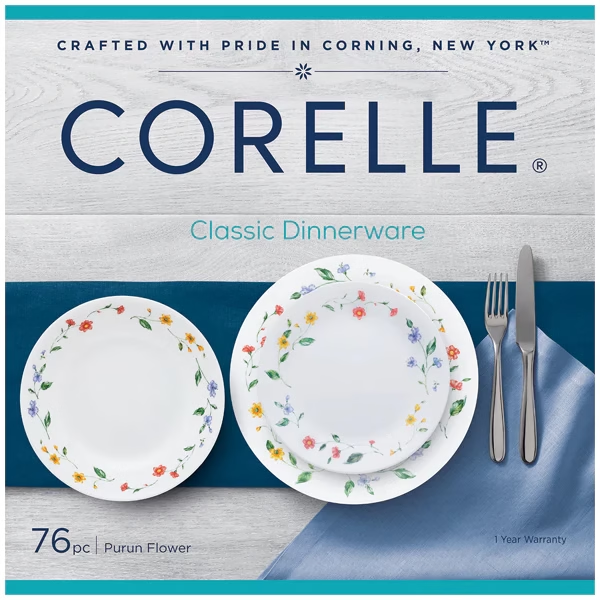
⚡Opening Summary:
- Who this comparison is for: Bulk buyers, importers, and foodservice operators evaluating opal glass tableware options across different price points and supply models.
- The honest short answer: Corelle is a well-established brand with strong consumer recognition, a proven track record, and consistent product quality that has earned wide retail trust. Jointion Opal Glass does not claim to surpass Corelle on brand equity or retail familiarity. Where it offers a genuine case is in wholesale procurement: factory-direct pricing, flexible OEM customization, and large-order supply capacity that suits distributors, importers, and foodservice buyers more than the typical retail channel does.
- How to use this article: Read it as a practical procurement guide, not a ranking. The right choice depends on your channel, order scale, and whether brand recognition matters to your end customer.
Where Corelle Has a Real Advantage
Any honest comparison has to start here. Corelle has been on the market for decades, and its reputation was built on genuine product strengths—not just marketing.
- Brand recognition and consumer trust: Corelle is a household name in many markets, especially North America. Consumers who grew up with it have firsthand confidence in the product. That trust is hard to replicate and genuinely valuable in retail contexts.
- Vitrelle glass technology: Corelle uses its proprietary three-layer laminated glass (Vitrelle), which is notably lightweight and chip-resistant. This specific construction has been refined over many years and is part of what makes the product distinctive.
- Consistent product line: Corelle’s standard patterns and sizes are widely documented, well-reviewed, and easy to replace or match over time. Consumers and small buyers benefit from this predictability.
- Retail channel depth: Corelle is available in major retail chains, department stores, and online platforms globally. For small buyers or individual consumers, accessibility is straightforward.
If your end customer is a retail consumer who recognizes the Corelle name and specifically wants it, there is no substitute. Jointion is not positioned to compete on brand familiarity.
What Jointion Opal Glass Actually Is
Jointion produces tempered opal (milk white) glass tableware—a category that shares basic material characteristics with Corelle’s output: lightweight construction, smooth non-porous surfaces, and resistance to daily temperature changes. The two products belong to the same general tableware category, though their manufacturing processes, glass formulations, and brand specifications differ.
Jointion’s positioning is primarily B2B: it serves distributors, importers, hotel and restaurant procurement teams, and retailers building private-label or unbranded tableware lines. The product is not trying to replicate Corelle’s retail presence—it is built around a different supply model.
For context on how opal glass tableware fits into commercial settings, see the Commercial Guide to Opal Glass Tableware.
Where Jointion Opal Glass Makes a Practical Case
The comparison only becomes relevant when procurement conditions shift away from retail buying. In the following scenarios, Jointion’s structure offers tangible advantages—not because it is “better” than Corelle in absolute terms, but because it is built for different buyer needs.
Bulk Procurement Cost
Corelle’s pricing reflects its brand investment, global distribution infrastructure, and retail channel margins. For buyers purchasing hundreds or thousands of units—restaurants outfitting a new location, importers filling a container, distributors stocking a warehouse—those layers add up in ways that affect landed cost and margin.
Jointion operates factory-direct, which removes intermediary markups. For buyers where opal glass tableware is a functional supply item rather than a branded consumer good, this cost structure can meaningfully improve procurement economics. The tradeoff is that you are buying a less-recognized product, which may require more explanation to end customers unfamiliar with the brand.
OEM and Customization Options
Corelle’s product line is standardized. This is an advantage for consistency, but it means buyers cannot easily adapt patterns, set configurations, or packaging to local market preferences or private-label requirements.
Jointion supports OEM orders: pattern customization, set composition, and packaging design can be adjusted for specific market needs. For distributors serving regional markets or retailers building their own tableware range, this flexibility has real commercial value—provided order volumes meet minimum thresholds.
Large-Order Supply Continuity
For ongoing replenishment buyers—hotels, catering companies, institutional kitchens—supply consistency matters as much as initial price. Jointion’s production model is designed around bulk repeat orders, with dedicated capacity for wholesale clients. Buyers should request lead time commitments and production documentation when evaluating any supplier, including Jointion, to verify actual capacity against their needs.
Distributor Margin Structure
Wholesale distributors building a tableware catalog have to consider the spread between purchase price and viable retail price. Because Jointion’s factory-direct pricing is lower than branded alternatives for comparable opal glass products, distributors typically have more room to price competitively in their market while maintaining margin. This is a structural advantage for the distribution channel, not a claim about product superiority.
A More Honest Side-by-Side
The table below reflects where each product genuinely leads, and where comparisons are more contextual. Buyers are encouraged to verify specific performance claims—microwave safety, dishwasher compatibility, thermal shock ratings—against current product documentation from each supplier, as specifications can vary by product line and market.
| Factor | Corelle | Jointion Opal Glass | Notes for Buyers |
|---|---|---|---|
| Brand recognition | Strong — established household name in multiple markets | Limited — primarily known in B2B / wholesale channels | Matters for retail-facing products; less relevant for institutional or unbranded supply |
| Glass construction | Proprietary Vitrelle three-layer laminated glass; refined over decades | Tempered opal (milk white) glass; standard opalware category | Different constructions; buyers should request samples to assess hand feel and durability for their use case |
| Chip and break resistance | Well-documented; Vitrelle construction has a strong performance record | Designed for daily commercial and household use; performance varies by product line | Request third-party test data or conduct in-house testing for high-turnover environments |
| Microwave / dishwasher safety | Generally rated safe; verify by specific product line | Generally rated safe; verify by specific model and supplier documentation | Always confirm against current product spec sheets regardless of brand |
| Retail availability | Widely available through major retail and online channels | Primarily available through direct wholesale inquiry and B2B channels | Corelle is easier to source for small or retail buyers |
| Bulk / wholesale pricing | Includes brand and channel premiums; higher unit cost at scale | Factory-direct pricing; more competitive unit cost for large orders | Price gap is more significant at high volumes; request formal quotations to compare |
| OEM / customization | Standard product lines; limited customization through retail channels | OEM support available: patterns, sets, packaging, branding | Relevant for private-label buyers; confirm MOQ and lead times before committing |
| Supply lead time | Varies by region, distributor, and order size | Factory-direct; lead times depend on order type and volume | Both require verification; request production schedules for large orders |
Who Should Choose Which
Corelle is likely the better choice if you:
- Are buying for personal or household use and want a proven, widely supported product
- Are a retailer whose customers specifically recognize and ask for the Corelle name
- Prefer a standardized product line with well-documented specs and easy replacement sourcing
- Are buying in smaller quantities where factory-direct minimums are not practical
Jointion Opal Glass is worth evaluating if you:
- Are a distributor, importer, or foodservice buyer purchasing at scale and prioritizing landed cost
- Need OEM or private-label customization that standard retail brands do not offer
- Are building or replenishing an institutional or commercial tableware program where brand name is not the primary factor
- Want factory-direct supply relationships with more direct control over lead times and order specs
Is Jointion a Better Choice for Milk Glass Tableware Wholesale?
For wholesale-specific buyers, the more accurate framing is not “better or worse than Corelle” but “fit for the wholesale channel.” Jointion’s operational structure addresses the practical requirements of bulk tableware procurement in ways that retail-oriented brands are not designed to match.
- Flexible MOQ: Standard and customized orders accommodated from small to full-container volumes, without the fixed minimums common in branded retail supply chains.
- OEM customization: Pattern, set composition, and packaging can be adjusted—important for distributors building region-specific product ranges.
- Repeat order capacity: Production infrastructure designed for ongoing bulk replenishment, which matters for hospitality and institutional buyers managing continuous supply.
- Margin structure: Factory-direct pricing creates more distributor margin room compared to purchasing branded goods at wholesale, where brand premiums are built in.
None of this makes Jointion superior to Corelle as a product. It reflects a different supply model suited to a different buyer type. For a full procurement perspective, see the Buyer’s Guide to Opal Glass Dinnerware.
Frequently Asked Questions (FAQ)
Q1: Is Jointion Opal Glass the same quality as Corelle?
A1: Not a straightforward comparison. Corelle uses its proprietary Vitrelle laminated glass construction, which has a decades-long performance record and strong consumer documentation. Jointion produces standard tempered opal glass in the same general tableware category. Both are designed for daily household and commercial use, but their materials and constructions differ. Buyers assessing quality for specific use cases—high-turnover restaurant environments, for example—are best served by requesting samples and reviewing current product specifications rather than relying on brand-to-brand generalizations.
Q2: Can Jointion Opal Glass dinnerware be used in dishwashers and microwaves?
A2: Jointion Opal Glass is generally designed for compatibility with standard dishwashers and microwaves. However, buyers should verify microwave, dishwasher, and thermal shock specifications by model and current supplier documentation, as performance parameters can vary across product lines. The same applies to Corelle—always confirm against the specific product’s current spec sheet rather than assuming category-wide compatibility.
Q3: Why consider Jointion if Corelle is better known?
A3: Brand recognition matters in retail contexts where the end consumer is making a brand-driven purchase decision. In wholesale, foodservice, and institutional procurement, the decision drivers are different: unit cost at scale, customization flexibility, supply continuity, and distributor margin. In those contexts, a factory-direct supplier like Jointion can offer a more practical fit—not because it is a superior product, but because it is designed around different buyer priorities.