
This guide helps procurement decision-makers figure out which of JOINTION’s three opal glass decoration techniques — decal transfer, embossing, or gold rimming — fits your product positioning and channel needs best. It covers process effects, mass-production quality control, cost, and lead-time parameters. The goal is to give you a ready-to-use framework for supplier comparison and ordering decisions.
What Decoration Techniques Can JOINTION’s Opal Glass Deliver, and How Do They Look?
JOINTION’s opal glass tableware supports three core decoration techniques right now. Decal transfer gives you rich patterns with accurate color reproduction. Low-temperature embossing puts a tactile, three-dimensional texture right on the plate surface. Gold rimming runs a fine gold line along the edge to lift the whole piece a level.
Why do all three opal glassware decoration methods look so good on this material? It comes down to Opal Glass itself — that milky, semi-translucent, jade-like base tone. The warm glow from inside makes decals pop brighter, embossed lines read sharper, and gold sits more evenly. Ordinary glazed tableware just can’t provide that same decorative foundation. Below, we walk through what each technique actually looks like, plus the real differences between Opal Glass and generic “jade-colored tableware” that are easy to miss.
The Actual Effect of Each Decoration Technique
1. Decal Transfer — The widest color range and the most direct visual expression.
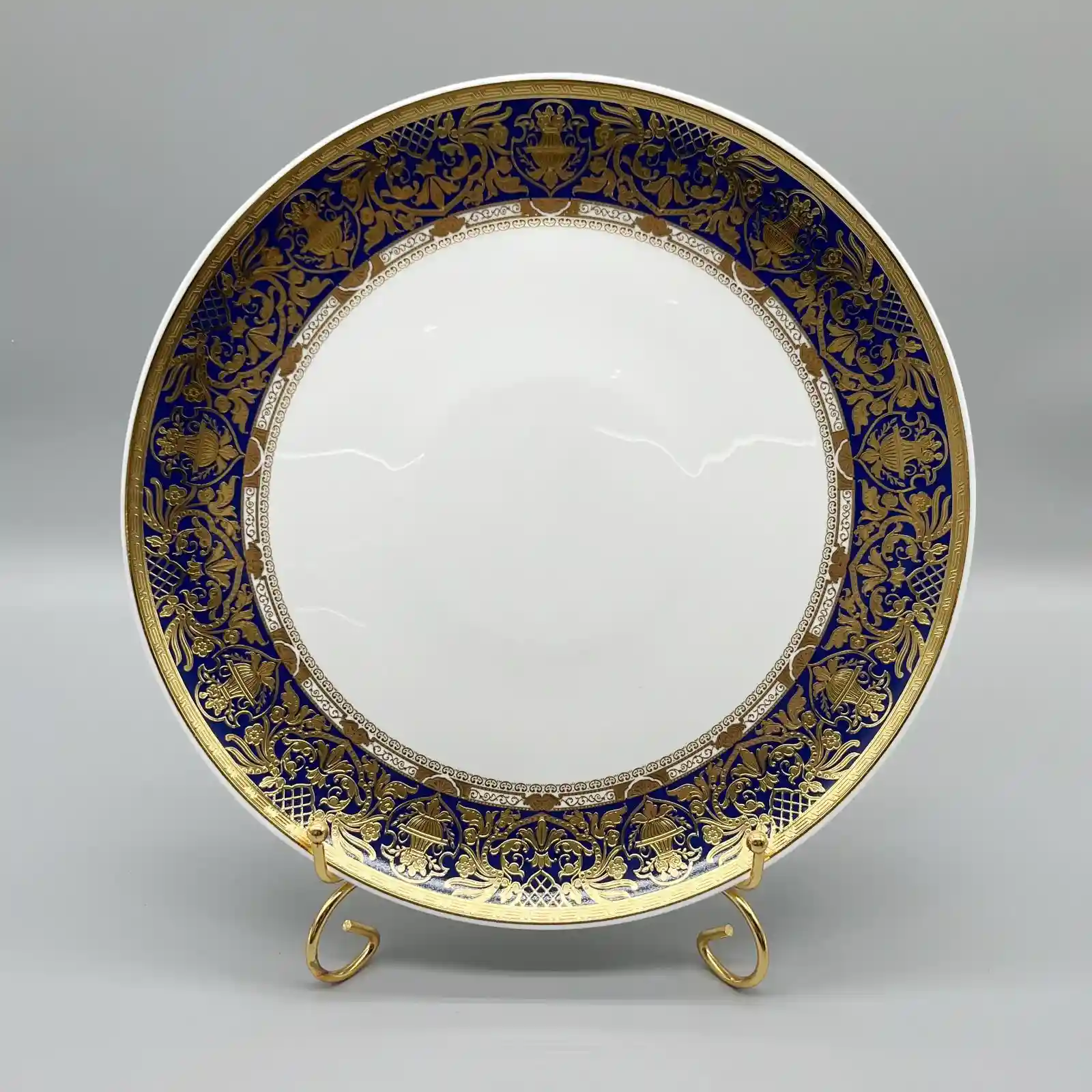
Decal transfer opal glass application is the most versatile of the three. JOINTION can put anything from vintage European florals and geometric line work to marble textures onto the plate surface. Colors come out saturated. Details stay crisp. Even petal-edge gradients and fine leaf veins reproduce faithfully.
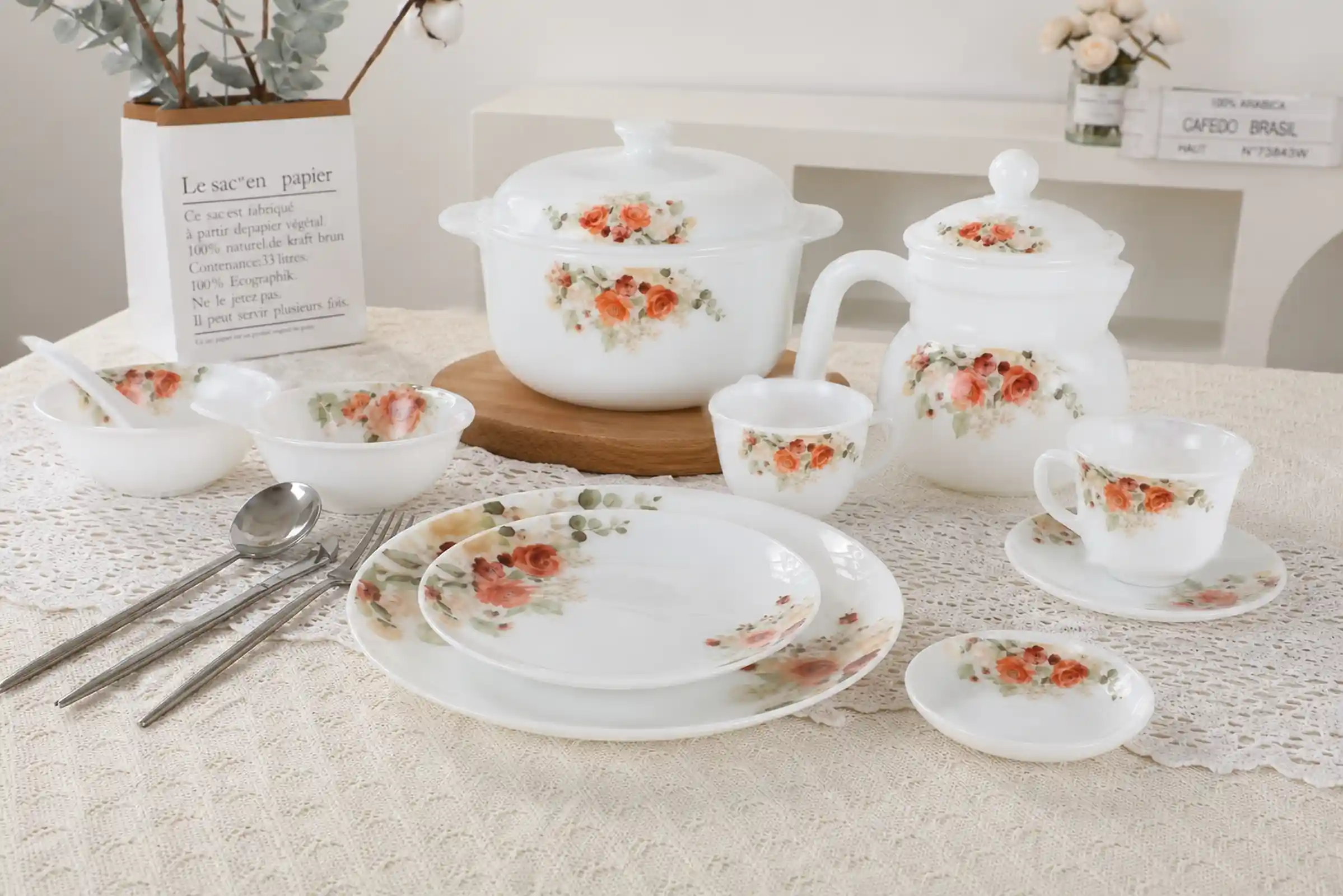
If you need visual differentiation in your product lineup, opal glass decal printing is almost always the broadest and fastest option. Whatever pattern style a client has in mind, there’s usually a matching direction already sitting in the mature decal library.
2. Low-Temperature Embossing — A three-dimensional layer you can see and feel.
Opal glass embossing works nothing like decal. It doesn’t “print” a pattern onto the surface. Instead, the texture physically rises from the plate — a relief you can see with your eyes and trace with your fingertip. A delicate lace border around the rim, a central motif on the plate — the result carries real depth, not an illusion of it.
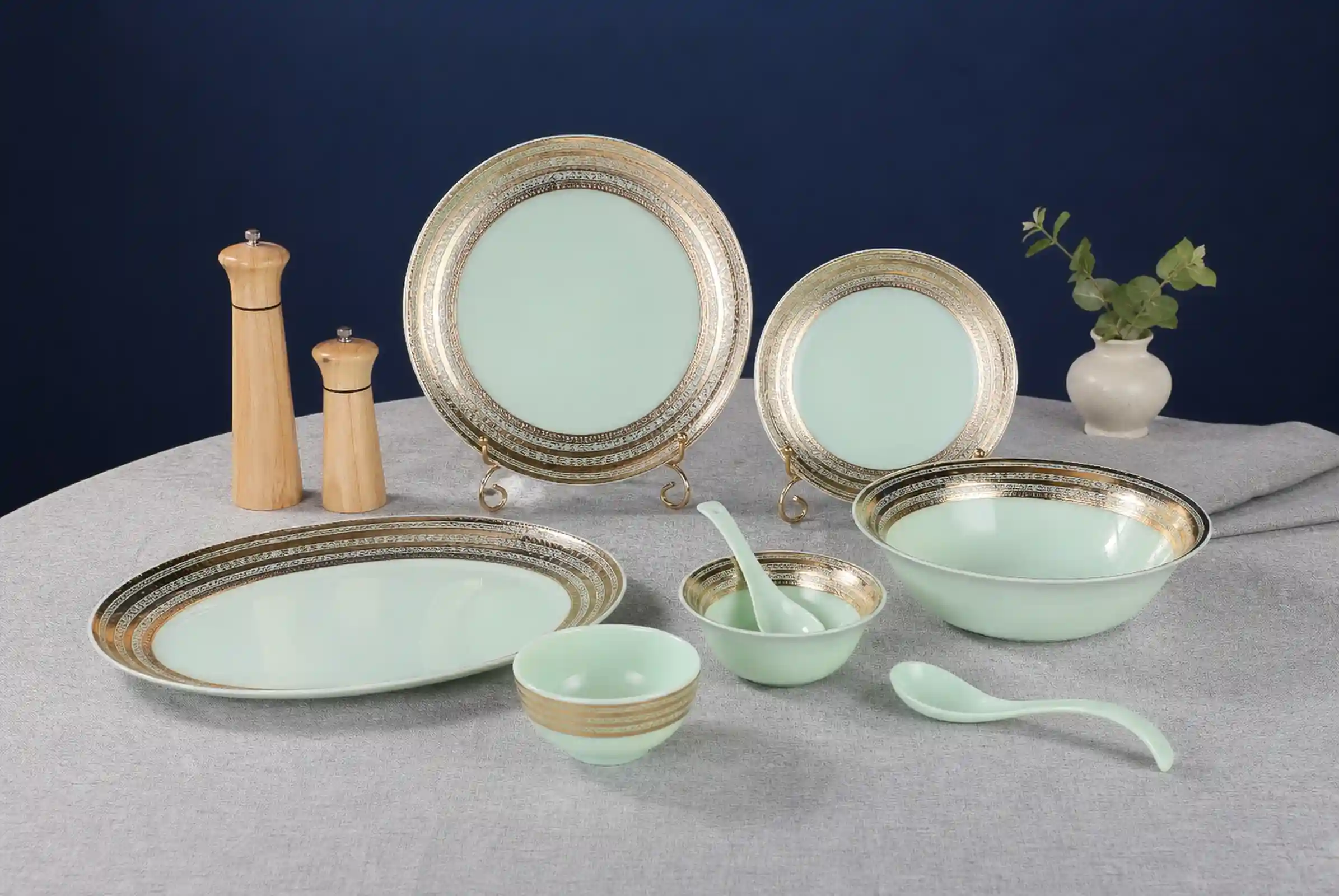
When light hits those raised contours, subtle shadows shift across the surface. The plate stops looking flat. It starts looking like a sculpted piece of craft. At last year’s Autumn Canton Fair (Hall 5.1, Booth D46–48), we watched this play out over and over: nearly every buyer who picked up an embossed sample ran their fingers along the relief edge before flipping it to check the backstamp and price. That reflex — “pick it up and want to touch it” — says more than any spec sheet could.
3. Gold Rimming — The finishing touch that elevates an entire piece.
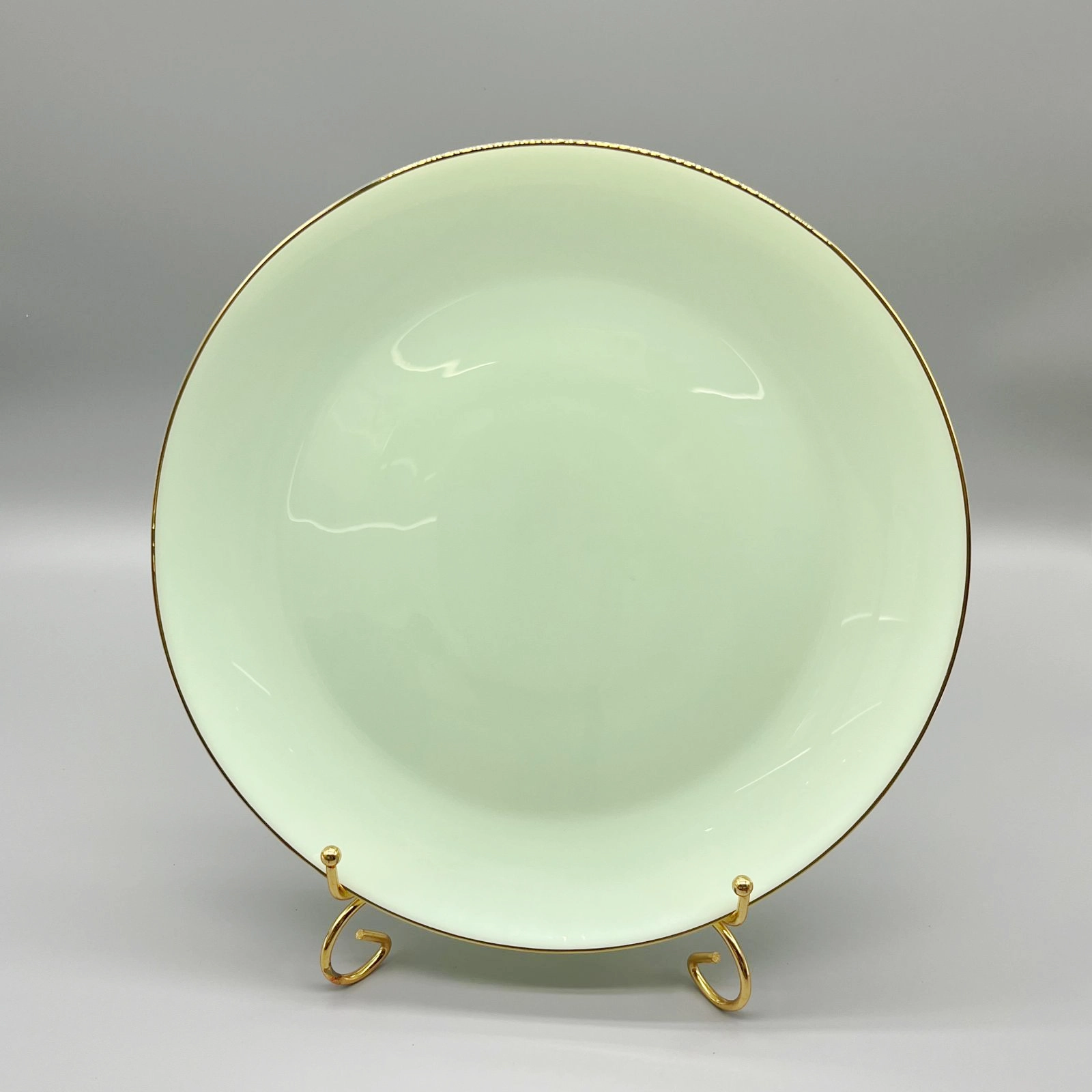
Gold rimming glassware puts a gold line along the plate rim, bowl lip, or pattern outline. It doesn’t compete with the main design. But once that line is there, the whole product feels noticeably more refined. Pair it with plain white Opal Glass or layer it over a decal or embossed design — either way, it works as the finishing stroke that moves a piece from everyday tableware into banquet service, gift set, and wedding favor territory.
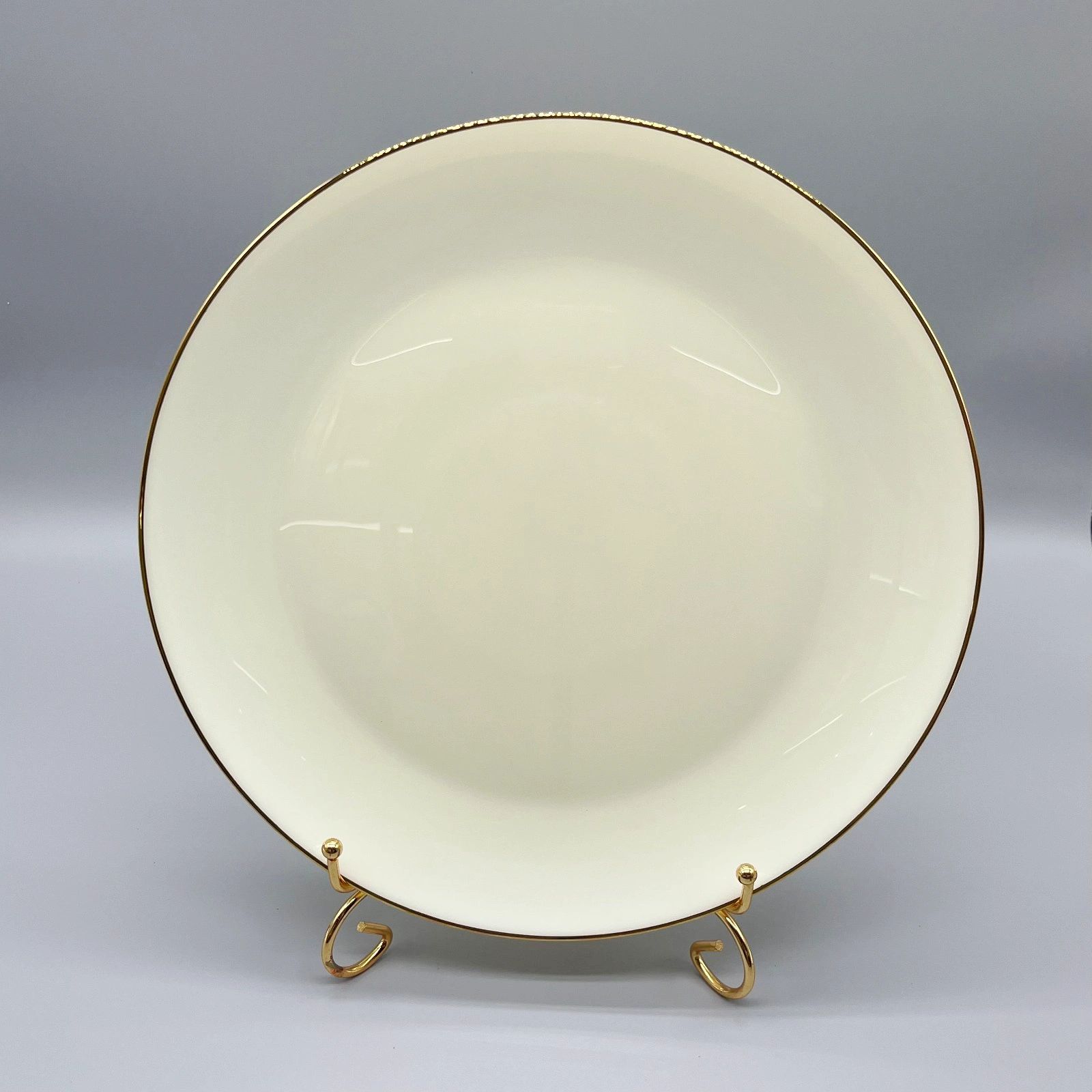
For buyers supplying hotels, holiday gift boxes, or wedding return-gift channels, this type of opal glass surface finishing is the most direct way to raise perceived product value.
For a full overview of all decoration technologies available on Opal Glass — decal, screen printing, embossing, and more — check out this Opal Glass Decoration Technique Overview.
How Does JOINTION Actually Apply Each Technique to Opal Glass?
Each of the three techniques succeeds or fails on one critical production variable. Decal depends on a precise firing-temperature curve — get it right and colors are accurate with strong adhesion. Embossing depends on mold precision — the sharper the mold, the crisper the texture. Gold rimming depends on a fixed-position rotational application method — it keeps the gold line even in width and consistent in luster.
In mass production, every technique runs its own quality loop: incoming material checks, locked process parameters, and AQL-based outgoing sampling. That’s what keeps bulk shipments looking like the sample the buyer approved. Here’s what happens at each step.
The Most Critical Production Step for Each Technique
1. Decal Transfer — Firing temperature determines color accuracy and adhesion.
Once the decal paper goes onto the Opal Glass surface, the piece enters a kiln at over 800 °C. The heat fuses pigment into the glass, locking it in place. Hit the right temperature and the color matches the design file exactly. The decal also bonds tight — it holds up through repeated dishwasher cycles without peeling or fading.
Too low, and the pigment never fully merges with the glass. Adhesion falls short. Colors start washing out within months. Too high, and sensitive shades shift or burn out entirely. JOINTION solves this by filing a specific firing-temperature profile for every decal pattern and every vessel shape. No operator guesswork involved.
2. Low-Temperature Embossing — Mold precision determines texture clarity.
Embossed textures form during glass pressing itself. Molten glass drops into the mold, and the engraved pattern transfers onto the surface in one stroke. How fine the mold is cut dictates how sharp the final relief looks. If mold lines aren’t crisp or detail work is rough, the pattern comes out blurred after demolding — edges go soft, and it falls short of the design.
The factory holds explicit precision standards for embossing molds. Line widths of 1.5 mm and above are guaranteed to render clearly. Every mold set goes through a trial press before production starts. Texture depth and sharpness have to pass verification before the mold gets scheduled.
To give a clearer picture of what this process actually looks like on the production floor, below is a walkthrough video filmed inside JOINTION’s own factory. It covers every step of the decal transfer operation
3. Gold Rimming — Application method determines line uniformity.
A gold line has to be even. Consistent width. No breaks, no pooling, no wobble between thick and thin. Gold solution goes onto the cup rim, plate edge, or target area via brush or specialized equipment. Then comes a second firing at around 560 °C–650 °C. Organic compounds burn off, the gold layer reduces, and you get a smooth, bright gold film on the glass surface.
The method here is fixed-position rotational application: the piece sits on a turntable spinning at constant speed, and the brush position stays locked. That keeps width consistent from start to finish. The firing temperature is dialed in specifically for Opal Glass’s softening point, so the gold bonds properly and the luster stays full.
A Middle Eastern buyer at last year’s Canton Fair put this to the test — he stood at the booth and scraped his fingernail repeatedly along the gold-line edge. No peeling. No width variation. He placed his first trial order on the spot. His previous supplier, he said, could never hold this step steady. Gold lines came out broken, or luster shifted noticeably between batches.
For a closer look at how this rotational application method works in practice, below is a short production video from JOINTION’s gold rimming line. It shows the actual turntable setup, brush contact positioning, and the consistency check operators perform before each run — the same steps that ensured the even gold line which convinced that buyer at Canton Fair.
How Batch-to-Batch Consistency Is Maintained in Mass Production
Every buyer’s worst-case scenario: the sample looks great, the bulk order arrives, and it’s clearly not the same thing. Color drift on decals. Shallow embossing. Dull gold lines. Any of these showing up between batches can kill end-market acceptance.
JOINTION runs a specific set of controls for each technique across the full production cycle — incoming materials, in-process parameters, and outgoing inspection. The point is simple: what you see when you open the container should be exactly what you signed off on. As a manufacturer with sixteen years of hands-on experience in white opal glass tableware decoration, the team has pressure-tested this system across thousands of bulk orders. Here’s what it looks like side by side:
| Control Dimension | Decal Transfer | Low-Temperature Embossing | Gold Rimming |
|---|---|---|---|
| Incoming Material Control | Every batch of decal paper gets color-tested on arrival and matched against the approved sample. If it’s out of range, the whole batch goes back. None of it touches the production line. | Molds go through a trial press before each production run. During active runs, they follow a fixed inspection and maintenance schedule. | Every batch of gold solution is tested for concentration before use. It has to match the standard formula. |
| In-Process Parameter Control | Kiln temperature curves are locked per decal pattern and vessel shape. Settings are filed and repeated — not left to operator judgment. | If wear starts dulling a mold’s texture depth or sharpness, it gets replaced or repaired right away. Running a worn mold is not an option. | Turntable speed and brush contact angle stay at the same fixed setting. Firing curve doesn’t change. |
| Outgoing Sampling Standard | QC checks each pulled piece under standard lighting for color accuracy after firing. The batch passes or fails based on AQL sampling rules. | AQL sampling checks texture depth and sharpness on each pulled piece, matched one-by-one against the first-article sample. | AQL sampling covers gold-line width, luster, and adhesion strength. Pass or fail is a numbers call. |
| Non-Conforming Batch Handling | If the sample data goes past the acceptance threshold, the full batch is held. “Pick out the rejects and ship the rest” doesn’t happen. | Batches that don’t meet texture standards are pulled entirely. Mold condition gets traced before anything is rescheduled. | Batches beyond the acceptance range are held in full. Every single piece goes through re-inspection before a release or rework decision is made. |
That’s the full loop — process settings, material intake, in-line monitoring, and outgoing checks all feeding into the same standard. Buyers don’t need to fly to the factory to babysit every production run. Open the container, and it matches the approved sample.
For a deeper look at how JOINTION manages quality across the entire Opal Glass production process — not just decoration — read this Opal Glass Quality Control Explained.
How Should Buyers Choose a Decoration Technique Based on Product Positioning?
Decal is color-rich and cost-friendly — built for volume-driven daily tableware and promotional giveaways. Embossing comes with built-in tactile appeal and visual distinction — the pick for mid-to-high-end lines that need to stand apart. Gold rimming pulls perceived quality up fast — a natural fit for gift sets and hotel custom orders.
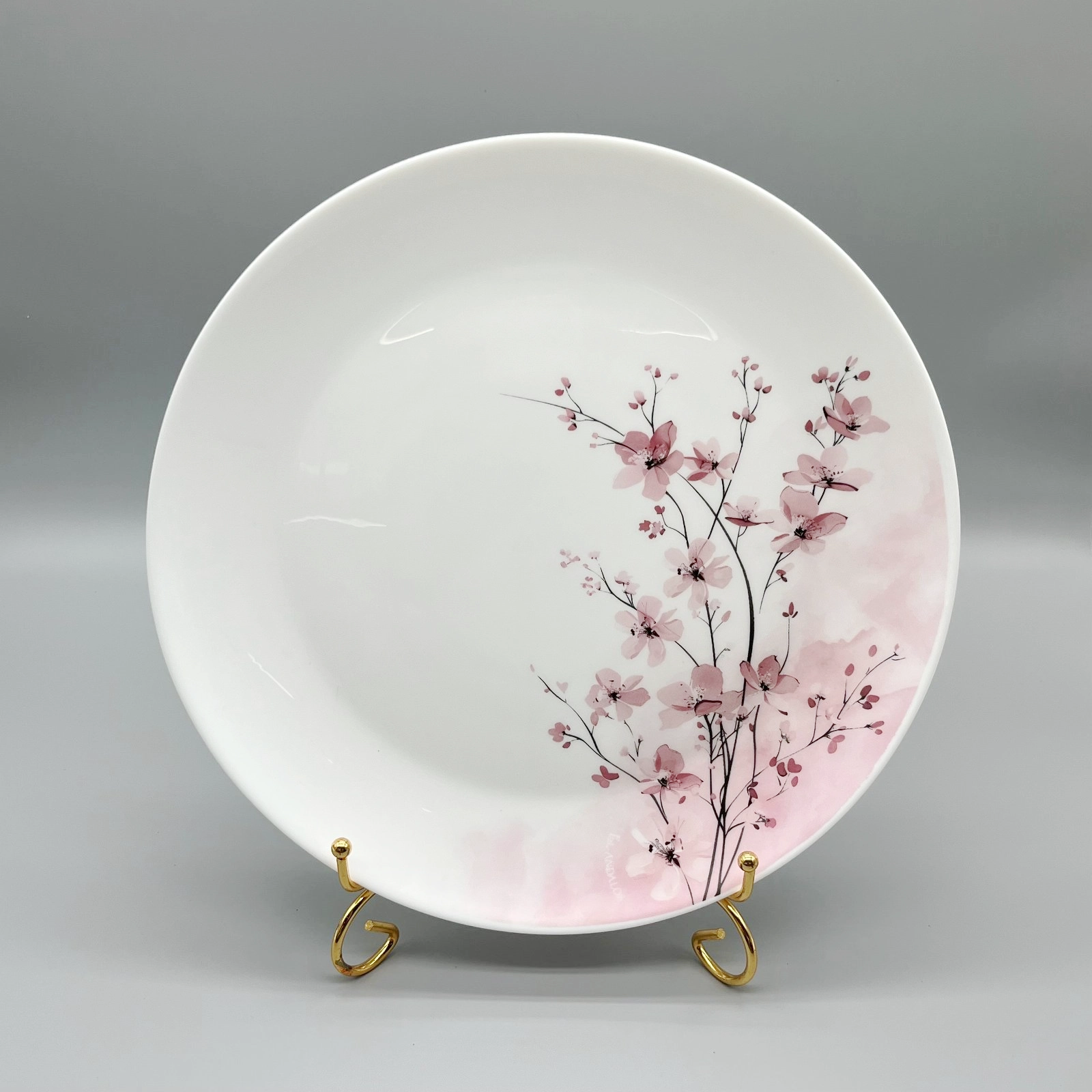
Lock in your target customer and channel first. That alone narrows the technique down. No need to sample all three and slowly eliminate. Once the direction is clear, align on per-unit cost, MOQ, lead time, and durability to finalize.
Which Technique Suits Which Type of Product
Decal Transfer — The go-to for volume and promotional channels. The core advantage is design range plus color punch, at the lowest per-unit cost of the three. Simple single-color logos, multi-color gradients, complex artwork — decal handles all of it with stable mass-production results. Supermarket-shelf daily tableware, brand promotions, holiday giveaways — anywhere that unit price matters but visual variety still counts — decal is almost always the default best answer. Designs swap fast. Scaling is easy. Total procurement spend stays under control.
Low-Temperature Embossing — The differentiator for mid-to-high-end product lines. Embossing works on a completely different level. It puts real raised texture on the glass. Drag your finger across and you feel genuine relief. Light catches the surface and subtle shadow gradients appear. That “see it, feel it” quality gap is something no flat-printing method can replicate.
If you’re building a mid-to-high-end line and need to separate your product from every other white plate on the shelf, embossing is the most direct move for brand recognition. The visual upgrade and the tactile upgrade arrive together — and that combination sticks with buyers on first contact.
Gold Rimming — The quality anchor for gift sets and hotel orders. Gold rimming delivers the most immediate visual impact of the three. One gold line around the rim, and perceived refinement jumps. The electrochemical plating process bonds the metal layer evenly, producing a warm, understated luster that turns a functional item into something with ceremony to it.
Gift sets, hotel banquet orders, upscale food-service supply — any channel where quality perception is non-negotiable — this is where gold rimming belongs. For buyers exploring opal glass dinnerware customization, you don’t need a complex pattern. A single gold border does the heavy lifting on perceived value. So the shortcut is simple: volume play — decal. Differentiation play — embossing. Prestige play — gold rimming. Direction set.
Core Parameters to Compare Before Finalizing Your Choice
Direction alone isn’t enough to place an order. A few hard numbers need to line up first. JOINTION runs all three opal glass decoration techniques in-house, so the parameter set below comes from real production data — not estimates. Use it as your comparison framework when evaluating quotes.
On cost: decal carries the lowest processing expense overall. Plate-making fees usually land within a few hundred dollars, and per-unit costs drop clearly at volume. Embossing sits higher — the process is more involved and the firing cycle is longer. Gold rimming takes the biggest upfront hit because of specialized tooling and electroplating, but it also shows the steepest per-piece savings at scale.
On MOQ: decal starts at roughly 3,000–5,000 pieces. Embossing and gold rimming both involve dedicated tooling, so they typically start from 5,000 pieces. Confirm exact numbers with the sales team when you inquire.
Lead time and durability matter just as much. If your launch window is only one to two months, that alone eliminates some options. And durability is where the most common pitfall hides: gold-rimmed pieces can’t go in the microwave — the metal triggers arcing. Gold lines also wear down under frequent machine washing, so hand-wash guidance needs to reach your end customers. Stack these four dimensions against the table below, and the decision gets a lot faster.
| Comparison Dimension | Decal Transfer | Low-Temperature Embossing | Gold Rimming |
|---|---|---|---|
| Per-Unit Cost Range | Lowest; plate-making fee $300–$750; per-unit processing cost drops notably at volume | Medium-high; process and firing costs exceed decal | Highest upfront (tooling + electroplating); drops significantly when amortized over large runs |
| Minimum Order Quantity (MOQ) | Approx. 3,000–5,000 pcs | Approx. 5,000–10,000 pcs | Approx. 5,000–10,000 pcs |
| Lead Time (artwork confirmation → shipment) | 4–6 weeks | 8–12 weeks | 8–12 weeks |
| Dishwasher Safe | Fired above 800 °C; machine-wash safe with no fading | Fired above 800 °C; machine-wash safe with no peeling | Machine-washable, but gold line may wear under frequent use; hand wash recommended |
| Microwave Safe | Yes | Yes | No (metal decoration causes arcing) |
None of these techniques is better in absolute terms. There’s only the one that fits your channel and your customer. Once your positioning is locked, use this framework to go straight to the JOINTION sales team with your target price, estimated volume, and delivery window. One round of communication gets you an actionable quote — no drawn-out back-and-forth needed.
Already know your direction? Head to the JOINTION Opal Glass Product Center to browse vessel shapes and decoration options. Picking a specific model to reference in your inquiry speeds things up even more.
Common Questions People Ask
Q1: Can one piece of tableware combine decal plus gold rimming, or embossing plus gold rimming?
No. Each piece supports only one decoration technique — you can’t layer them on the same product. That’s why locking in the technique direction before you inquire matters so much. Figure out your core selling point first: color richness, tactile relief, or a refined gold edge. Pick one and go deep, rather than trying to pack everything onto a single piece.
Q2: What if I haven’t settled on a pattern or motif yet — does JOINTION offer design support, or do I need to bring finished artwork?
Either way works. If you already have final artwork, the team jumps straight into feasibility review and sampling. If all you have is a style direction or a few reference images, JOINTION can suggest options drawn from its existing decal library and mold inventory. That shortens the path from rough concept to confirmed sample considerably.