
This guide covers every key decision point when sourcing opal glass dinnerware sets from China — from “should I buy sets or open stock” to “how do I get the goods safely into my warehouse.” No generic industry overviews here. Instead, it focuses on the problems unique to set orders: how to pick the right configuration for your market, how to tell if a supplier can actually handle sets, what extra inspection steps matter, and how to avoid transit damage. Everything is specific enough to use in your next supplier conversation.
Opal Glass Dinnerware: Sets vs. Open Stock — What’s the Difference?
Key Differences in Product Form and Sales Approach
Open stock means individual items. A plate is a plate, a bowl is a bowl — you buy them separately and sell them downstream as individual SKUs. A set bundles multiple item types into one product. At the retail level, it’s not “a bunch of separate pieces thrown together.” It’s “a ready-matched dinnerware solution.” That difference in form changes the commercial logic across the entire procurement chain.
How to Configure Opal Glass Dinnerware Sets for Different Markets
A bestselling set configuration in Market A won’t necessarily work in Market B. Before sending inquiries, clarify your target market’s preferences for piece-count and item mix. This one step alone cuts down communication costs and avoids unnecessary sample rework. Below, we break down the piece-mix logic from two angles: differences between markets, and fine-tuning within a single market.
Set Size and Piece-Mix Preferences by Major Export Market
A set that sells well in the Middle East may flop in Europe. The reason is simple — household size and dining habits differ by region, so the ideal set contents differ too. Here are the typical preferences for several major export markets:
1. Middle East and North Africa (Sudan, Algeria, Egypt, etc.)
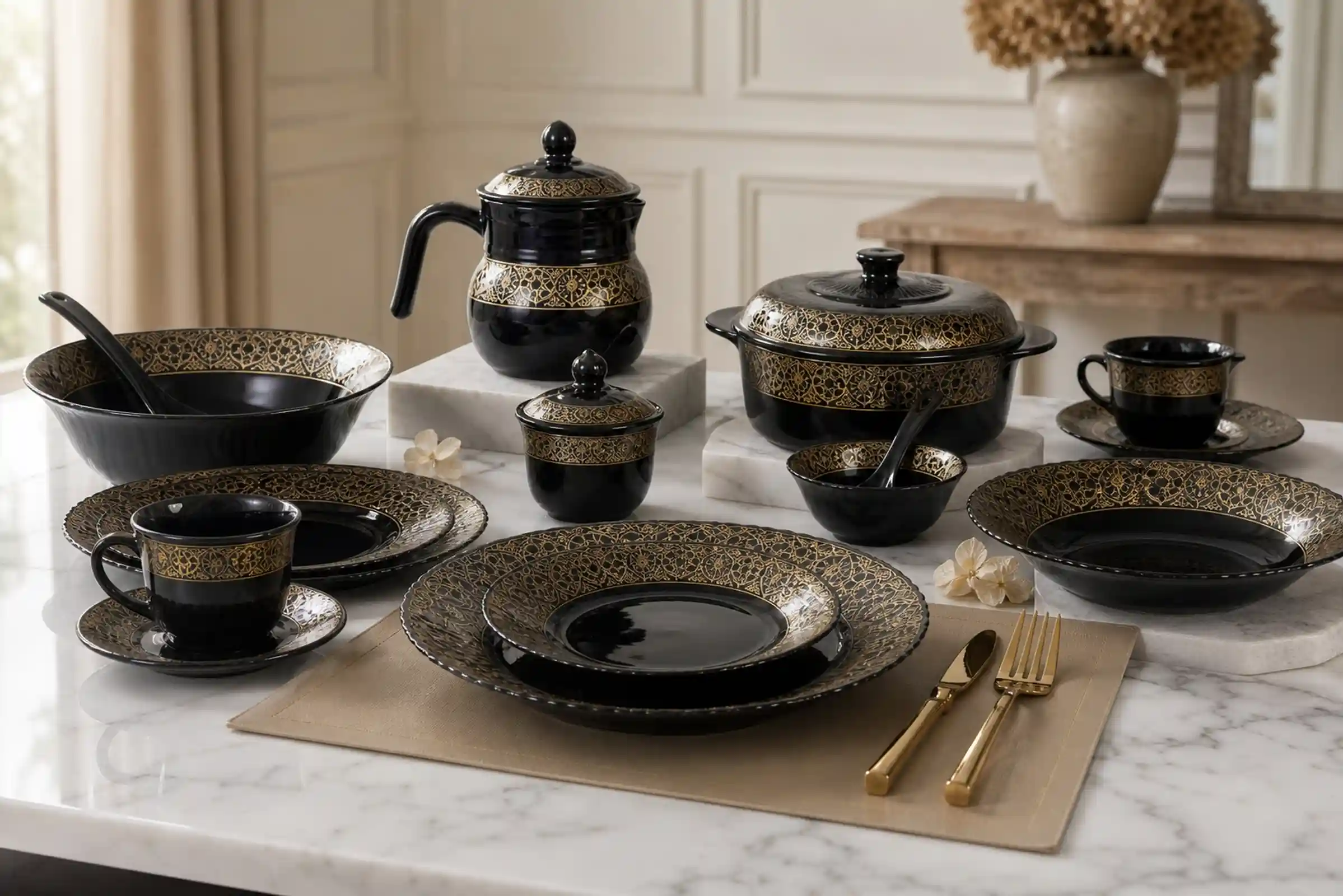
Families here tend to be large. Daily meals are often communal, with extended family around the table. That makes 58-piece and 75-piece sets the mainstream choice. The item mix needs to be comprehensive — dinner plates, deep soup bowls, serving bowls, and cup & saucer sets are all expected. Leave out any category and the end consumer feels the set is “incomplete.”
One detail that catches first-time importers off guard: North African buyers place a lot of importance on cup & saucer inclusion. In a 75-piece set, skipping the cup & saucer almost guarantees the customer will ask you to add it.
2. India
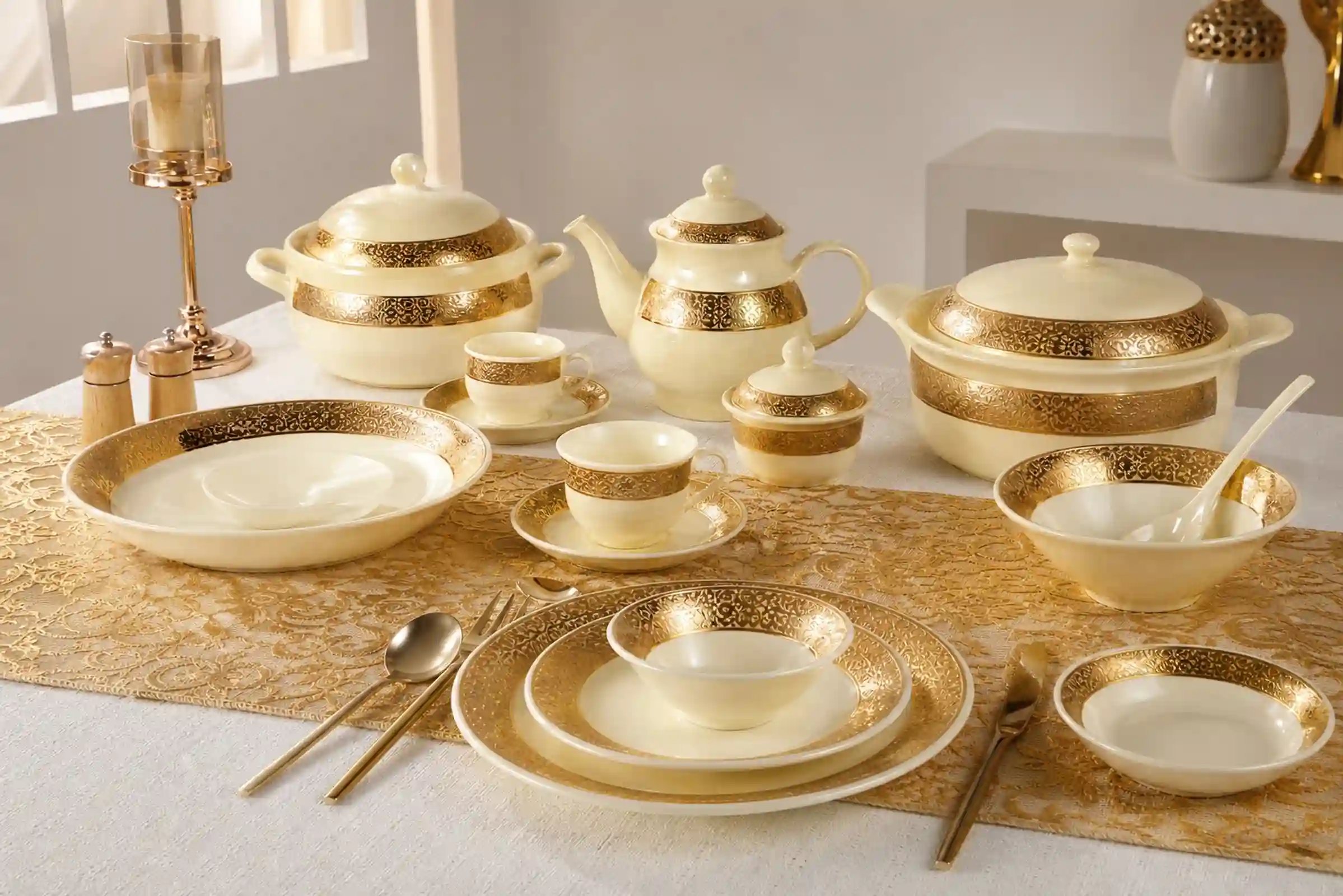
33-piece and 18-piece sets are common, matching the country’s mid-sized household structure. Color acceptance is wider here — both black and white opal glass have steady demand, unlike most markets where white dominates. Bowls and plates both get heavy daily use, so they take up a bigger share of the set. Cup & saucer combos rank lower.
3. Western Europe and North America
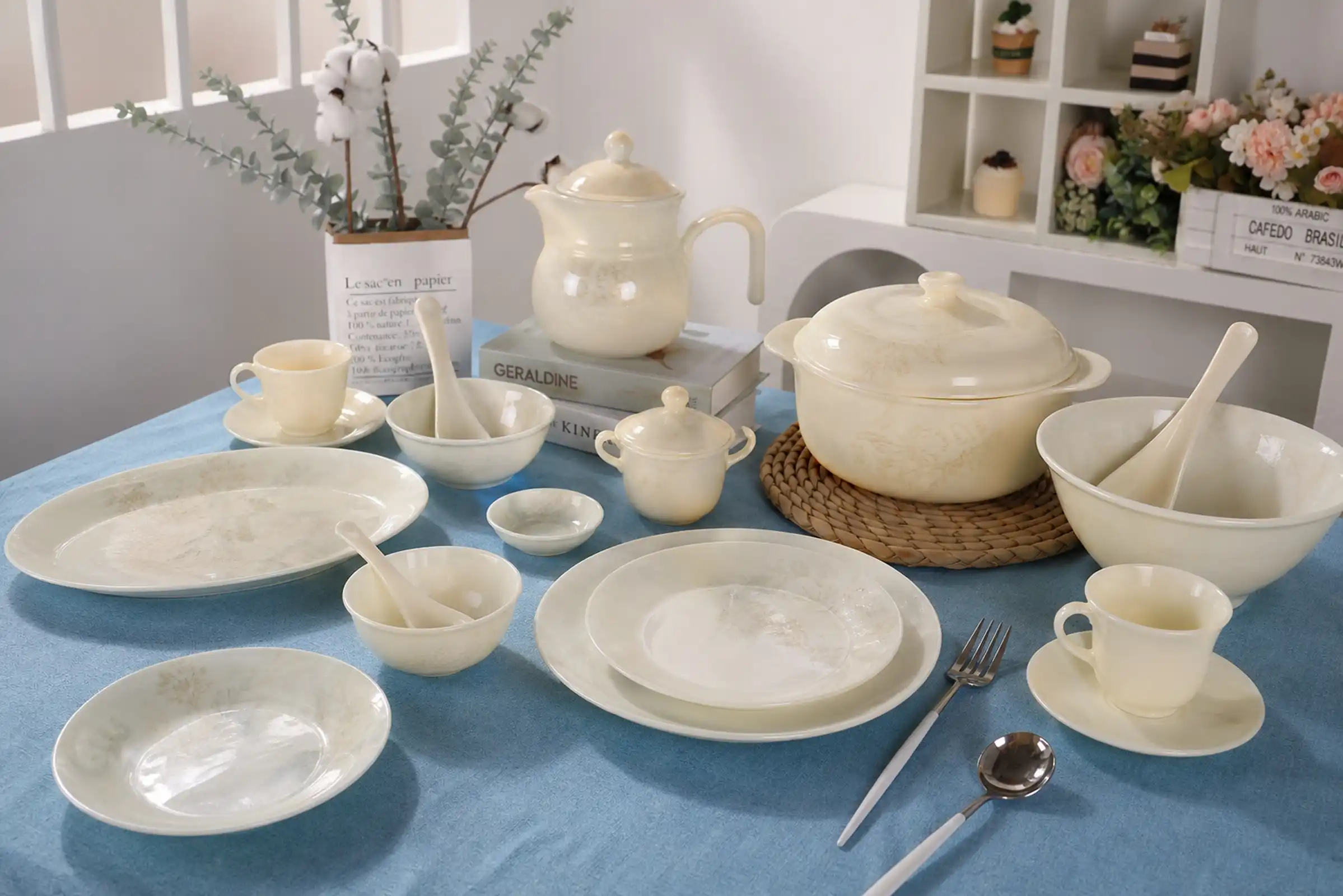
These markets prefer streamlined 18–26 piece sets for 4- or 6-person households. White is the go-to color. Unlike the Middle Eastern “big and comprehensive” approach, Western consumers value functional layering — dinner plate paired with salad plate, for example. Different sizes, complementary purposes. On a Western table, both are pretty much non-negotiable.
Mapping out these mainstream preferences before you inquire saves a lot of back-and-forth later and gives your first order a much better shot at market fit.
Fine-Tuning Set Configuration by End-User Segment Within the Same Market
Even after you’ve locked in the piece-count for your market, there’s another layer worth thinking about. Within the same market, sets for household retail and sets for hotel/foodservice channels follow very different logic. Here’s a side-by-side breakdown:
| Comparison Dimension | Household Retail Set | Hotel / Foodservice Channel Set |
|---|---|---|
| Configuration Logic | Organized by “number of persons” (e.g., 4-person, 6-person) — consumers instantly get what they’re buying | Organized by “meal occasion” (e.g., breakfast set, dinner set), split by dining period |
| Core Items | Dinner plate, soup bowl, salad plate — everyday high-frequency pieces | Breakfast sets focus on cups & saucers, small bowls, bread plates; dinner sets focus on large plates, soup bowls, entrée plates |
| Add-on Accessories | Usually excludes low-frequency items like serving bowls or sugar pots | Often needs extra serving bowls, sugar pots, and creamers |
| Packaging Style | Design-forward color box for shelf appeal | Transport safety first — corrugated cartons with dividers, sometimes neutral packaging |
| Order Volume | High volume per SKU, uniform specs | Multiple set specs in parallel, smaller volume per individual SKU |
In practice, the gap between these two segments is even more granular than this table shows. Hotel-channel buyers regularly request micro-adjustments — swapping 2 small bowls for oval serving plates, for instance, because the property uses French-style service where platters are used far more than small bowls. That kind of swap almost never comes up in household retail sets, but it’s routine for hotel projects.
The takeaway for importers: think through your end customer’s actual usage scenarios first, then work backward to decide what goes in the set and how many of each. Don’t just default to the supplier’s standard configuration. Those standard configs are usually designed for production efficiency — a “common denominator” that may not precisely fit your channel.
Translate your end-user needs into a clear configuration list before approaching the supplier. They’ll quote and sample faster. And your product will be more competitive at the retail end.
How to Judge Whether an Opal Glass Dinnerware Set Supplier Is Reliable
Making open stock and making complete sets are two different things. Many importers sourcing opal glass dinnerware sets for the first time apply the same evaluation they’d use for open-stock suppliers — check item quality, compare price, confirm lead time, done. But set orders carry an extra layer of complexity. It’s not enough for each piece to pass individually. All the pieces in one set have to look like they belong together when placed side by side.
On top of that, set packaging is a completely different challenge. Items of different shapes and sizes go into the same box and can’t knock against each other during transit. These two dimensions — visual consistency and packaging — are exactly where many “decent open-stock” suppliers tend to fall short.
The sections below help you vet both areas before placing an order. If you also want to understand opal glass’s material-level advantages and how it stacks up against ceramics, check this opal glass tableware commercial purchasing guide.
The Production Challenge of Set Orders: Multi-Item Consistency
A factory that makes great plates as open stock won’t necessarily deliver great sets. Open-stock orders test stability within a single product type. Can the factory keep 10-inch plates consistent across a run of several thousand? That’s one thing. A dinnerware set includes plates, bowls, cups, saucers — multiple shapes and sizes. These often run on different production lines, go through different kilns, and pass through different printing shifts.
That creates a problem open stock rarely faces: can whiteness, gloss, and print quality stay consistent across all item types within a single set?
Opal glass whiteness and gloss are very sensitive to the opacifier ratio and kiln temperature. Even within the same factory, visible whiteness differences can show up between kilns or batches. Open stock is usually concentrated on one line, so intra-batch consistency is easier to manage. Sets, though, require multiple item types to sit together on the same table and inside the same package — any variation gets amplified.
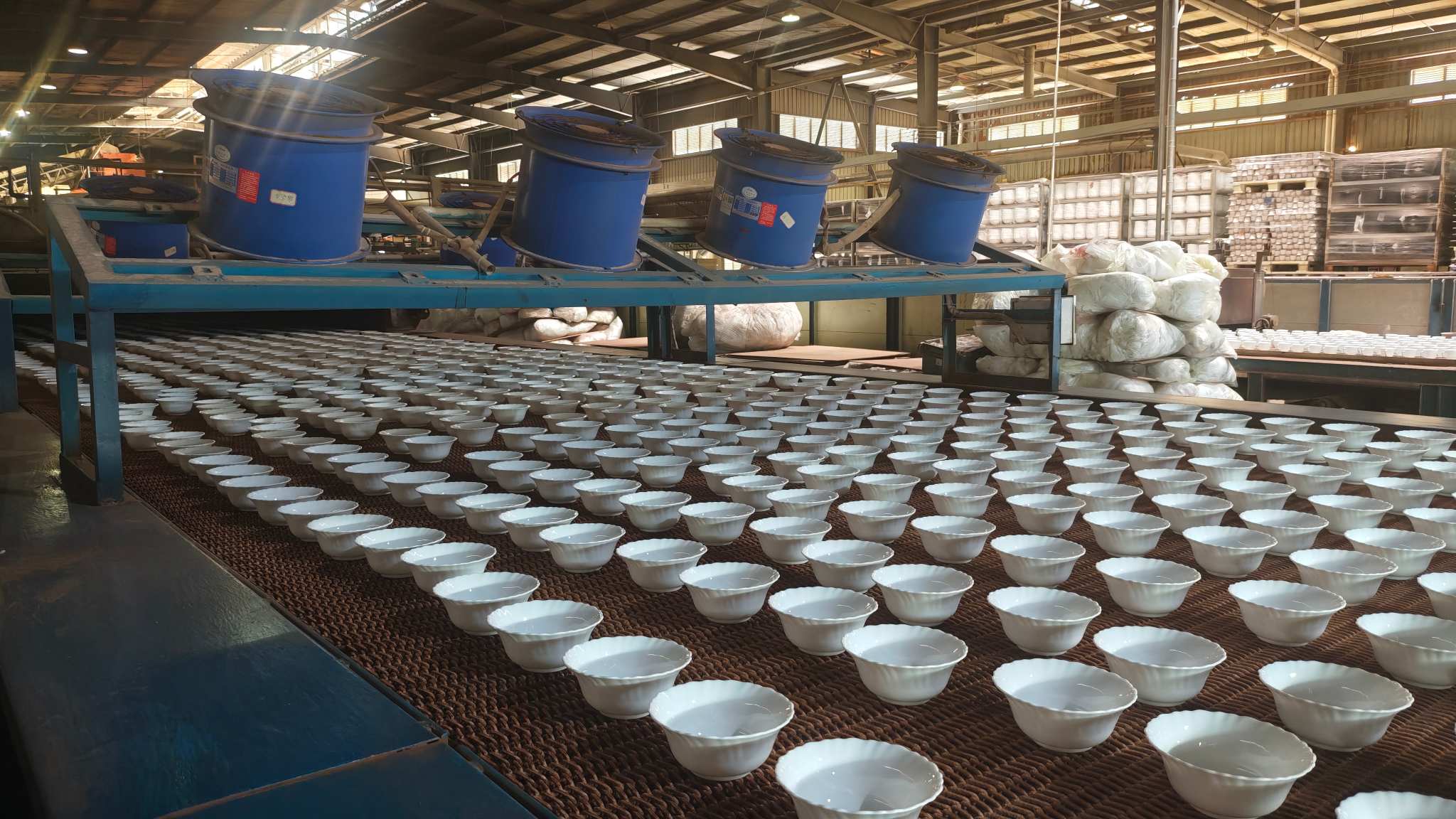
Here’s how to evaluate this before ordering:
Step 1: Ask the supplier to send a complete set sample — not individual items.
Many buyers request just one piece per item type during sampling. The problem: you can’t tell whether those pieces came from the same batch or kiln. The right approach is to request one complete set in the exact formal configuration. A 20-piece set? Ask for all 20 pieces.
Step 2: Compare everything under the same light source.
Lay out all items on one table under natural daylight or standard white lighting. Check three things: whiteness uniformity (any piece skewing gray or yellow?), gloss consistency (any piece noticeably more matte or shiny?), and pattern accuracy (same design showing different saturation or positioning on different items?).
Step 3: Read the results for what they tell you.
If the plates lean cool white, the bowls lean warm gray, and the cup patterns don’t match the plates — the supplier’s multi-item consistency control isn’t mature enough. Expect even bigger swings in mass production. On the other hand, if everything in the sample looks tightly matched on whiteness, gloss, and pattern, that’s a strong signal the supplier can coordinate across lines and kilns.
At Jointion, we lock all item types within a single set to the same raw-material batch and kiln-temperature parameters. The pattern-printing stage includes cross-item color-card calibration. These are standard procedures we’ve built over 16 years of handling set orders.
Set Packaging Capability — the Evaluation Step Most Buyers Overlook
Packaging for open stock is straightforward. Same product, stacked uniformly, dividers between layers, seal the box. Set packaging is a different story. One package has to fit plates, bowls, cups, saucers — all different shapes and sizes. They need to be arranged to save space and prevented from hitting each other in transit.
Opal glass is tempered and far more impact-resistant than ordinary glass. But the edges and rims are still only a few millimeters thick — the weakest spot on the piece. If two differently shaped items aren’t properly separated inside the carton, weeks of ocean-shipping vibration will push them against each other repeatedly. Rim chips and surface scratches follow.
If you are interested in set packaging, you can also check our packaging guide article, which covers detailed packaging considerations and Jointion’s reference video on set packaging.
This is a demand that open-stock orders simply don’t place on the supplier’s packaging capability. And it’s where a lot of “good open-stock” suppliers run into trouble on set orders. We consistently recommend including packaging capability in your evaluation before placing a set order. Here are three dimensions to assess, with a reference table for quick comparison:
| Evaluation Dimension | What a Capable Supplier Looks Like | Warning Signs |
|---|---|---|
| Set-Level Packaging Experience | Can show photos or samples from past set orders; has proven solutions for various configurations (12-piece, 20-piece, 30-piece); has done color boxes, gift boxes, or unified outer cartons | Only done open-stock packaging; set solution improvised on the spot; no past examples to show |
| Inner Packaging Separation & Securing | Custom inner liners for each item shape — EPE foam blocks for plates, paper-slot dividers between bowls and cups, every piece fixed in its own position | Items separated by thin corrugated paper only, or open-stock packaging crammed into a bigger box with no redesigned liner |
| Outer Carton Labeling | Labels include total piece count, each item type and quantity, barcodes (UPC/EAN), net and gross weight, stacking-limit symbols | Only total count or a generic name; no item breakdown; missing stacking or moisture markings — staff must open the box to verify contents |
Weak packaging can cause arrival damage even when every individual piece is well-made. This risk is higher with LCL shipments, where goods get handled multiple times at transshipment ports and stacked alongside heavy cargo from other shippers.
Before placing a set order, have a dedicated conversation with the supplier about opal glass dinnerware packaging. Request inner-packaging drawings or samples. Confirm outer-carton material and strength grade. Ask for a drop test if needed. This is the most direct way to reduce arrival-damage risk.
From the set vs. open-stock decision, to market configuration, to supplier evaluation and shipping risk — the critical nodes along the chain have been covered. If you’ve already nailed down your market direction and set configuration, browse our opal glass dinner set product range to see which existing configurations best match your target market.
From Order to Delivery: Where Are the Pitfalls?
Most of the order-to-delivery process for sets is the same as open stock. But a few stages that rarely cause problems with open stock are particularly prone to going wrong with sets. Here are the two biggest ones.
Set-Level Completeness Checks — the Extra Inspection Step Beyond Piece-Level QC
Piece-Level Sampling Doesn’t Cover All Set-Order Risks
The standard inspection approach for open stock is familiar: AQL sampling, focused on individual item quality — bubbles, black spots, rough edges, color deviation. Check those and you’re mostly covered. Sets are different. A 58-piece set has plates, bowls, cups, saucers — multiple types mixed together. Every piece passes quality checks? Still not enough. If 2 cups are missing and 2 extra bowls show up instead, that set is incomplete at retail. Consumer opens it, finds the wrong mix, and files a return.
Mis-Matching Happens More Often Than You’d Expect
This “numbers add up but items are swapped” problem almost never occurs with open stock. In set orders, it’s surprisingly common. The factory is sorting and packing several item types at the same time, so mixing up quantities or swapping models is just more likely. It’s especially tricky when the set contains items that look similar but differ in size — 8-inch plate vs. 9-inch plate. Hard to tell apart by eye. Error rate goes up.
One buyer we spoke with at a recent trade fair shared a telling example: roughly 5% of cartons in his 72-piece set shipment had incorrect item counts. Fixing the issue after the goods reached port — manual recounting, re-sorting, filling gaps — cost far more than anyone had budgeted for.
Add a “Set-Level Completeness Check” — Far Cheaper Before Shipment Than After
For set orders, add a “set-level completeness check” on top of standard piece-level AQL. The method is simple. Randomly pull several complete sets. Open each one. Verify item by item — correct count per type? Pattern matches the approved sample? Any cross-carton mix-ups between different sets?
Doing this once before shipment costs very little. Discovering the problem after goods reach port? Replacement lead time, freight, back-and-forth communication — all of it becomes extra cost.
Container Loading Plans and Transit Breakage — Confirm Before Shipping
Open-stock loading is neat. Same shape, consistent carton dimensions, even rows. You can roughly estimate how many pieces fit in a 40HQ. Sets don’t stack the same way. Each carton holds plates, bowls, cups — different shapes. Package volume per set is larger than the same number of open-stock pieces, and there are more gaps. Result: one container often fits 10% fewer sets than you’d estimate from open-stock experience. “Ordered 1,200 sets but the container only holds 1,050” — it happens.
The fix: before ordering, have the supplier provide a loading plan for that specific set. How many sets per container, in writing. Then work backward to your order quantity.
Packaging inside the container also deserves a closer look. Open-stock cartons sit stable because every piece is the same shape. Set cartons have mixed shapes inside, and weeks of ocean shipping mean a higher chance of internal shifting and piece-on-piece impact. Ask about inner dividers, positioning foam, and whether each item is independently separated. These details directly affect your arrival breakage rate.
One more thing many first-time set importers miss: if one item in a set breaks during transit, how is the claim calculated? The two methods are very different. Settle this in your contract or PI before shipping:
| Comparison | Claim by Broken Item Value | Claim by Full Set Value |
|---|---|---|
| Calculation | Only the broken piece’s ex-factory price is compensated | Full set’s ex-factory price is compensated |
| Example (58-piece set, FOB $12) | 1 cup breaks → compensation ≈ $0.20 | 1 cup breaks, set can’t be sold → compensation = $12 |
| Buyer Protection | Low — the single piece isn’t worth much, but the whole set becomes unsellable | Higher — covers the real loss of an unsellable complete set |
| Seller Pressure | Low | High — but it also pushes the seller to invest more in packaging |
| Best For | Buyers who can split sets and sell items as open stock | Buyers who sell complete sets into retail without splitting |
There’s no industry standard on which method to use — it depends on negotiation. The key: agree before shipment. Trying to resolve this after damage has already occurred multiplies both the communication cost and the frustration.
How Is Opal Glass Dinnerware Typically Shipped from China to My Destination?
Understanding the full transport chain from China to your warehouse isn’t just about timelines. It directly affects your landed cost and how much of the shipment arrives intact. Here’s what you need to know about shipping methods and breakage control.
Common Shipping Methods and Process Flow from China to Your Warehouse
The typical route looks like this: factory finishes production → goods are loaded into a container → shipped by sea from a major Chinese port (Shenzhen, Ningbo, or Shanghai) → arrive at destination port → clear customs → trucked to your warehouse. Ocean freight is the standard for opal glass dinnerware sets. It handles large volumes at reasonable cost. Here’s how each step works:
Factory Loading and Dispatch. Once production and inspection are done, goods are loaded into containers at the factory. If your volume fills a full container, FCL is more economical — straight from factory to sealed container, no intermediate handling, lower breakage risk. For trial orders or smaller quantities, LCL lets you share a container with other shippers. More flexible, but the extra handling at the consolidation warehouse slightly increases breakage odds.
Departure from Chinese Port. The container is trucked to the departure port — Shenzhen Shekou, Ningbo Beilun, and Shanghai Yangshan are the most common for opal glass production regions. After export customs clearance, it’s loaded onto the vessel. If your first order is modest, ask your freight forwarder to quote both FCL and LCL. When volume approaches half a container, FCL’s per-piece cost can actually come in lower than LCL.
Ocean Transit. Transit times vary by route. China to Southeast Asia: roughly 7–15 days. To the Middle East: 15–25 days. To Europe or North America: 25–40 days. Factor these timelines into your procurement plan and leave enough buffer for transit and customs clearance.
Destination Customs and Last-Mile Delivery. At the destination port, you or your customs broker handle clearance with the bill of lading, commercial invoice, and packing list. After clearance, arrange container pickup and inland trucking to your warehouse.
Air freight is an option too, but opal glass dinnerware sets are bulky and heavy. Air costs several times more than ocean and is generally only worth it for rush orders or small sample shipments.
How to Reduce Breakage During Shipping for Set Products
Opal glass is tougher than regular glass. But weeks of ocean vibration, port crane impacts, and inland transfer handling still create breakage risk — and set products face more of it. Multiple shapes packed in one carton means plates, bowls, and cups of different sizes are more prone to in-box collisions than single-type open-stock shipments.
At Jointion, we’ve refined our breakage-control process over years of export shipments. Our most recent batch audits show arrival breakage consistently under 0.5% for set orders — a number we maintain by controlling three layers: packaging, container loading, and insurance.
Packaging: Make sure the supplier’s inner packaging uses dividers or foam positioning to separate each item individually. Outer cartons should be reinforced 5-ply corrugated board with fragile markings on all four sides.
Container loading: The supplier should use air dunnage bags or foam boards for infill, minimizing cargo movement. The last few rows near the container doors need to be wedged especially tight.
Insurance: For glass products, All-Risk marine insurance is the right call. If breakage happens, you have a claims safety net.
Also establish a breakage-claim standard in your contract before shipping — what arrival breakage rate counts as normal attrition, and how anything beyond that gets handled. Sorting this out in advance is far less painful than arguing after the goods land. If you’re new to opal glass dinnerware sourcing China logistics, working with a capable opal glass dinnerware supplier who proactively manages these shipping details — rather than leaving them for you to figure out — saves real time and risk on your first order.
Here’s a quick-reference checklist for supplier conversations:
| Control Stage | Key Action | Reference Standard |
|---|---|---|
| Inner Packaging | Dividers or foam positioning, item-by-item separation | No direct contact between any two items in the set |
| Outer Carton | Reinforced 5-ply corrugated, fragile markings all four sides | Edge crush strength ≥ ECT 44 |
| Container Securing | Air dunnage bags / foam infill, door-end bracing | Internal gaps < 10 cm |
| Marine Insurance | All-Risk coverage | Premium ≈ 0.3%–0.5% of cargo value |
| Contract Terms | Pre-agreed breakage claim standard | Define normal attrition threshold + excess compensation method |