
This article answers one core question: at which stages, and through what specific methods, does JOINTION’s opal glass tableware OEM ODM customization capability earn the trust of procurement buyers? We walk through it step by step — from proactive professionalism during requirement alignment, to batch-to-batch quality consistency during mass production, to the long-term partnership logic behind over a decade of collaboration with Corelle. If you are evaluating an opal glass tableware supplier right now, this should help you build a clear judgment framework, fast.
What Clients Recognize First About JOINTION’s OEM/ODM Customization
It’s not the price sheet. It’s not the factory tour video. What clients recognize first is the proactive professionalism JOINTION shows before a single order is placed. That means offering concrete customization solutions during requirement alignment, then backing it up with near-finished-product accuracy at the sampling stage. Both happen before mass production even starts. Yet for most buyers, these are the real moments that decide whether a partnership goes forward.
JOINTION Proactively Offers Customization Solutions During Requirement Alignment
Most OEM/ODM factories follow a predictable sequence after receiving a client brief: quote first, schedule second, and only start engaging with the actual product after the client has locked every detail. JOINTION works differently.
When a client says they want to develop a specific opal glass tableware item, the team does not sit back and wait for instructions. They draw on years of hands-on production know-how and a deep understanding of opal glass material behavior to offer specific, actionable recommendations upfront. Here are the areas where that typically happens:
1. Structural feasibility assessment. A client’s design might look great on screen. But in actual opal glass forming, it could run into problems — uneven wall thickness, stress concentration at tight corners, or poor mold release. JOINTION flags these risks in the very first round of discussion. The team provides tested structural fixes right away, instead of waiting until after tooling to find out something doesn’t work.
Want to understand the engineering logic behind these structural recommendations? See this full breakdown of the opal glass manufacturing process.
2. Cost-effective material and process alternatives. If a client specifies a surface treatment that carries a high per-unit cost, JOINTION uses its own mass-production data to suggest alternatives. The visual result stays comparable. The cost comes down. For example, certain decal processes can be adjusted in print layering without any visible difference — but the savings per piece add up quickly across a large order.
3. Mass-production viability pre-check. Some designs work fine at the sample stage but see a sharp drop in yield rate once you scale up. JOINTION shares that information transparently during the proposal stage, so clients can make informed trade-offs early — not after costly rounds of revision. This kind of upfront honesty is what separates a capable opal tableware custom factory from one that simply follows instructions and hopes for the best.
This approach — coming to the table with solutions, not just a quote — is a fundamentally different mindset from pure contract manufacturing. At last autumn’s Canton Fair, a buyer from the Middle Eastern market walked up to the booth with a sketch of an irregularly shaped opal glass plate. Instead of noting it down and promising a quote later, the team discussed rim curvature and draft angle adjustments on the spot, referencing the physical samples and material data they had on hand.
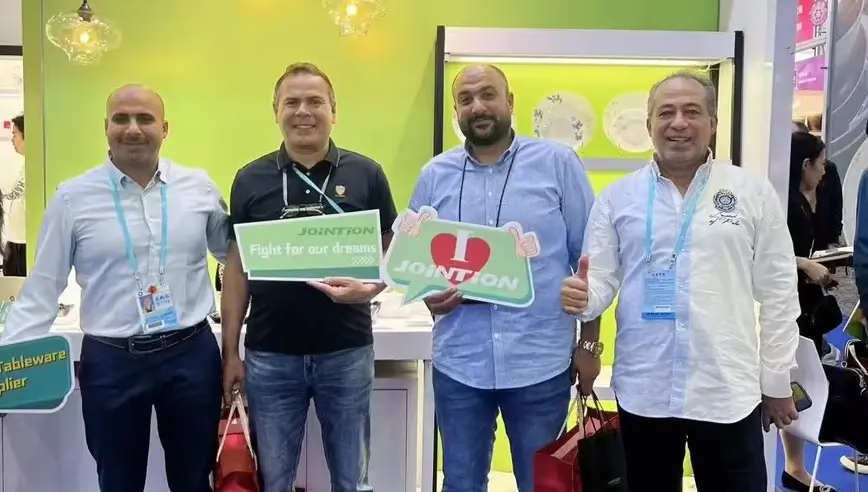
That buyer later messaged the team directly: “You’re the first factory that started solving my design problems before even quoting a price.” For anyone searching for an opal glass tableware OEM/ODM partner, whether a supplier can contribute real input at this early stage is the simplest, most reliable starting point for judging their customization depth.
Clients See Near-Finished-Product Accuracy at the Sampling Stage
Once the proposal is confirmed, all eyes move to sampling. This is the most critical checkpoint in any OEM/ODM process. Clients need a physical piece in hand to judge whether the factory can actually turn a concept into reality.
JOINTION’s approach here is straightforward: the first sample already closely matches the client’s specified structure, material, and visual details. Not “a rough shape we’ll refine later.” The whiteness and translucency of the opal glass, the curvature of the rim, the surface smoothness, the weight in your hand — the first sample is complete enough for clients to clearly picture the final mass-produced product.
What makes this possible? JOINTION is an opal glass manufacturer with over a decade of single-category focus. That means deep, accumulated expertise in mold precision, material formulation, and firing parameters. Every sample is executed to near-production standards — not treated as a rough draft.
The table below shows how this compares to what most factories do:
| Comparison Dimension | Common Industry Practice | JOINTION’s Sampling Standard |
|---|---|---|
| First-sample goal | Verify basic shape; refine details later | Completed to finished-product standard; first sample ready for client’s end-user review |
| Material used | Substitute materials may be used to cut sampling costs | Same opal glass formula as mass production, ensuring whiteness and translucency are genuinely representative |
| Surface treatment | Decals/coatings applied for indicative effect only | Executed per production-level process; color deviation controlled within client’s acceptance criteria |
| Dimensional accuracy | Tolerance range of ±1.5 mm or more | Controlled within ±0.5 mm, aligned with production mold precision |
| Revision rounds | Typically 2–3 rounds needed to approach client requirements | Most projects pass on the first sample; a few require only one round of minor adjustments |
This is why many clients build full confidence in JOINTION before mass production even begins. How complete the first sample is, whether the details are off, how far it sits from the original brief — a buyer can judge all of that the moment the sample lands on their desk. When the first sample is already close to final, the path from “initial contact” to “let’s move forward” gets much shorter.
What Makes Clients Increasingly Confident During Project Execution
Trust built during early communication and sampling is a good start. But it only holds if the factory delivers consistently once production is underway. During project execution, JOINTION earns deeper confidence through two things: fast response when the unexpected happens, and rock-solid batch-to-batch consistency in the finished product.
JOINTION’s Response Speed When Changes Arise
In opal glass tableware OEM/ODM projects, surprises are the norm. Clients revise plans mid-project. End markets suddenly demand earlier delivery. A key raw material gets delayed in transit. These things happen on nearly every order. The problem is never the change itself — it’s a supplier that reacts slowly and lets a small issue snowball.
JOINTION keeps a clear internal rhythm for handling changes:
- When clients modify requirements mid-project: The project team quickly loops in both technical and production staff and comes back with a workable adjustment plan. No waiting for multi-layer approvals. If a decal design needs revision after sampling, the team assesses the impact on existing molds and the production schedule, then tells the client the revised timeline and cost implications at the same time — so decisions stay data-driven.
- When delivery timelines are suddenly compressed: JOINTION immediately re-sequences the production line to hit the new deadline, without cutting corners on quality procedures. This works because the commercial and production teams already communicate at a high frequency every day — not just when a fire breaks out.
- When raw materials hit supply disruptions: Opal glass demands strict purity and ratio in its base materials. If a batch encounters sourcing problems, the factory activates backup suppliers immediately and proactively notifies the client about the situation and expected impact. Information stays transparent. Resolution stays synchronized. This level of responsiveness is what buyers expect from a reliable opal dinnerware OEM supplier, yet surprisingly few factories manage it consistently.
Clients grow more confident after several rounds of cooperation — often not because everything went perfectly, but because every time something unexpected came up, the team caught it fast and kept small problems from turning into big ones.
Every Shipment Matches the Approved Reference Sample
Great samples are one thing. Holding that quality across thousands of pieces in mass production is a completely different challenge. The real reason many buyers keep switching opal glass tableware suppliers isn’t poor first impressions — it’s consistency falling apart over time. The first batch looks fine. By the third batch, color drifts, thickness varies, and receiving goods feels like a gamble.
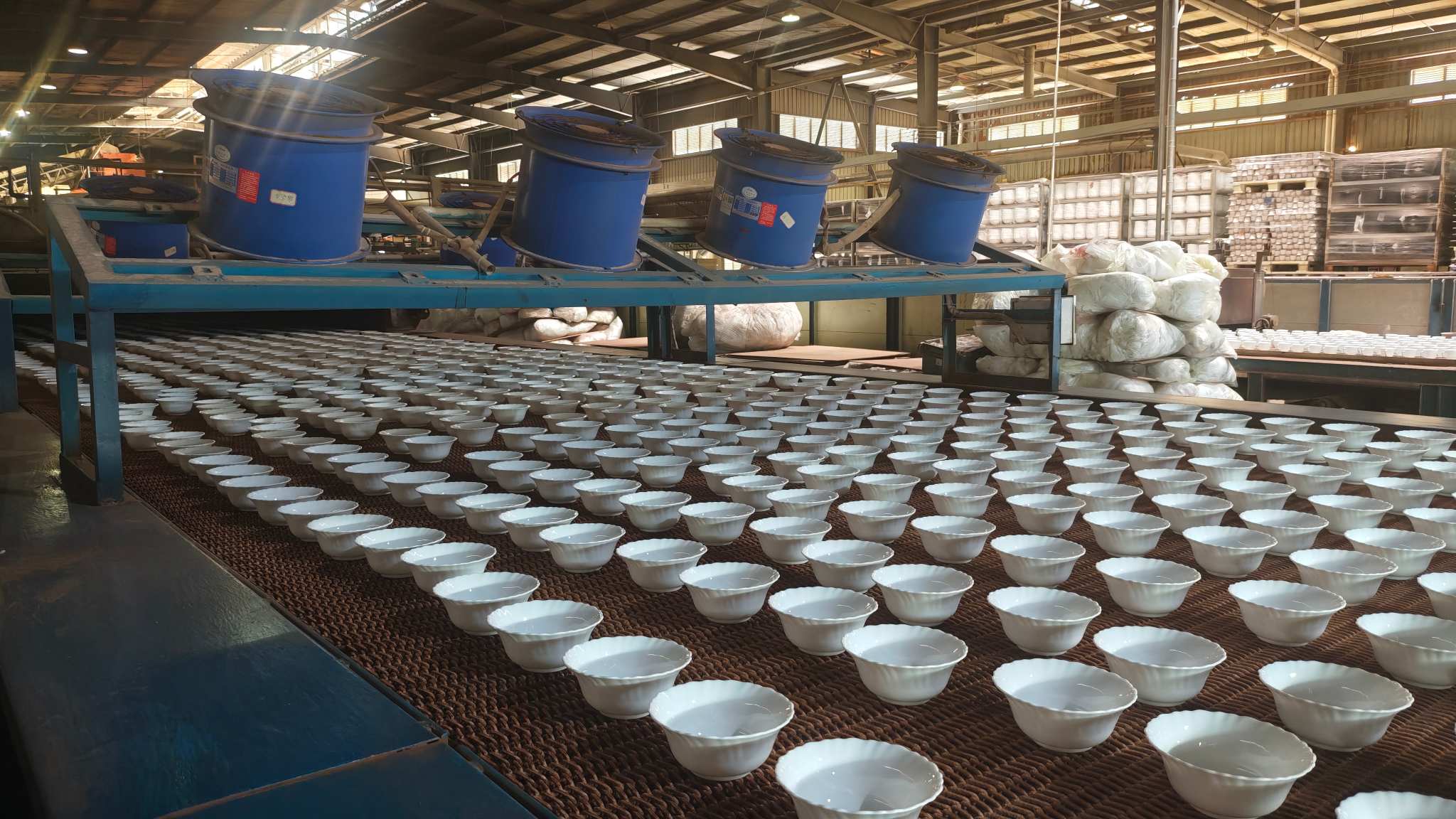
JOINTION treats this as the single most important thing to get right during production: every batch leaving the factory must match the reference sample the client signed off on. To hold that line, the team runs reference-sample benchmarking at every critical checkpoint within each batch. Deviations get caught and corrected before shipment — not left for the client to discover when they open the carton.
Here are the core opal glass quality control actions at each stage:
| Control Checkpoint | Specific Practice | Problem It Solves |
|---|---|---|
| Raw material intake | Each incoming material batch is tested against the established formula standard; non-conforming batches are not released to production | Prevents finished-product variation caused by raw material fluctuations at the source |
| First-article inspection | The first pieces off each production run are compared item by item against the reference sample (whiteness, translucency, dimensional tolerance, surface texture) | Locks in process parameters early in the run, preventing an entire batch from drifting off-spec |
| In-process patrol inspection | Samples are pulled at fixed intervals during the production run; parameters are adjusted immediately if deviation is detected | Prevents intra-batch inconsistency caused by process drift during production |
| Pre-shipment final inspection | Finished goods undergo full-parameter inspection per AQL sampling standards, with a final benchmark against the reference sample; non-conforming batches are held | Ensures what the client receives matches the approved reference sample |
The confidence behind repeat orders is surprisingly simple: “Every delivery matches what I expected.” No surprises. No scares. Stable quality, batch after batch, is the most persuasive reason to keep a partnership going. JOINTION treats this as the baseline — not a bonus.
For a closer look at the specific testing methods and acceptance criteria applied at each checkpoint, see this detailed guide to opal glass tableware quality control.
From Recognition to Long-Term Partnership: What Keeps Clients Staying
Getting a client’s first order is one thing. Keeping them for years is another. JOINTION converts first-time buyers into long-term partners because its opal glass tableware OEM ODM customization capabilities directly help clients build competitive edges in their end markets. That means exclusive product shapes, material and process solutions competitors can’t easily copy, and a new-product turnaround faster than the industry average.
When a supplier’s customization capability is already woven into a client’s product strategy and market positioning, switching suppliers means risking those hard-won advantages. That’s why an opal glass tableware long-term partnership becomes the natural outcome — not something that needs to be sold. The decade-plus collaboration with Corelle is the clearest proof of how this works in practice.
How Customization Capabilities Help Clients Achieve Market Differentiation
The real reason a client stays with an OEM/ODM supplier long-term is never “cheap enough” or “good enough.” It’s this: your capability helped me win in the market. Since setting up its Chaozhou factory in 2008, JOINTION has built full-chain, in-house manufacturing — from raw material melting to mold development to surface design. That means it can help clients create products their competitors’ suppliers simply can’t make. It’s the defining advantage of working with a vertically integrated opal glassware customization manufacturer.
Here’s how that plays out in real partnerships:
1. Unique product-shape design. JOINTION runs its own press-forming lines and has an in-house mold development team. That allows it to build exclusive shapes from scratch based on a client’s brand positioning — not pick a “close enough” form from a shared mold catalog. When a client’s tableware stands out instantly on the shelf, that shape becomes a brand asset in itself.
2. Material and process solutions competitors can’t access. Differentiation in opal glass tableware isn’t just about shape. It extends to material texture and decorative technique. JOINTION has deep mass-production experience in areas like low-temperature embossed decals and specialized-color opal glass formulations — solutions that peer factories find technically difficult to replicate.
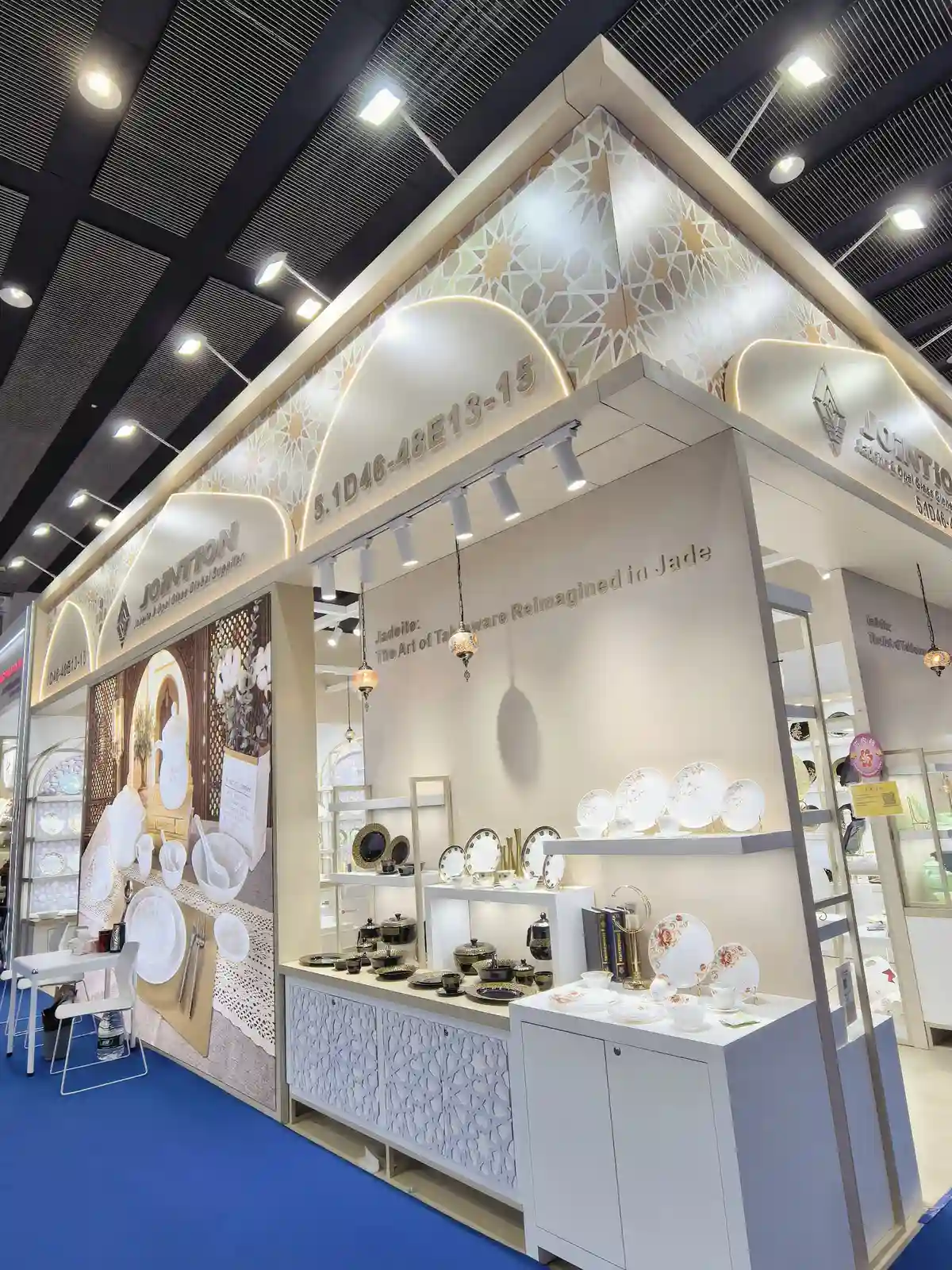
At this year’s Canton Fair booth (Hall 5.1, D46-48 & E13-15), several sets of embossed-decal samples drew a consistent reaction from visiting buyers: they had not seen this type of decorative effect from any supplier they’d worked with before.
3. New-product iteration faster than peers. For brand clients updating product lines by season or holiday, supplier speed directly decides who hits shelves first. JOINTION’s design, sampling, and mass production all happen within the same Chaozhou factory. No cross-supplier coordination delays. The cycle from concept to shipment is significantly shorter. Buyers seeking an opalware wholesale custom supplier with this kind of integrated speed rarely find it outside a fully self-contained production setup.
This differentiation isn’t a one-sided supplier showcase. It translates directly into the client’s end-market competitiveness. When a client realizes the most distinctive, hardest-to-copy SKUs in their product line all come from JOINTION’s custom design and manufacturing support, the relationship stops being a procurement transaction. It becomes part of their product strategy.
At that point, switching suppliers isn’t just about re-quoting and re-auditing. It means risking the loss of the market advantages those custom products created. When OEM/ODM customization capability has already become part of a client’s competitive edge, long-term partnership isn’t something you need to pitch. It just happens.
The Corelle Long-Term Partnership: OEM Capability in Action
Everything discussed above — custom shapes, proprietary process solutions, fast turnaround — finds its most direct proof in the collaboration with Corelle. As a globally recognized tableware brand with strong consumer awareness across North America and Asia, Corelle sets supplier standards well above the industry average. The fact that JOINTION has served as their OEM partner for over ten consecutive years — without a single supply disruption — says more than any capability brochure could. It’s the kind of track record that shows what a dedicated opalware OEM ODM factory can deliver at scale.
Corelle has the resources and reach to work with any opal glass factory on the planet. They chose JOINTION — and kept choosing JOINTION for a decade. That isn’t built on a pitch deck. It’s built on every batch meeting quality standards, every delivery landing on time, and every new-product cycle being deeply coordinated, year after year.
The table below maps Corelle’s core OEM supplier requirements against JOINTION’s actual track record:
| Corelle’s Core OEM Supplier Requirements | JOINTION’s Actual Performance |
|---|---|
| Customization precision: shapes, dimensions, and decal patterns must strictly comply with brand specifications | In-house mold development and press-forming lines; supports from-scratch tooling with tolerance control meeting brand shipment standards |
| Quality stability: batch-to-batch quality variation must be controlled within an extremely narrow range | Over ten years of continuous supply with no supply interruptions or batch rejections caused by quality issues |
| Capacity assurance: must support simultaneous distribution across North American and Asian markets | Factory daily output capacity of 70,000 pieces; capable of fulfilling multi-region market orders concurrently |
| Delivery cadence: orders must ship within specified windows without affecting brand launch schedules | On-time delivery record maintained throughout ten years of partnership; zero supply disruptions |
| New product support: must align with the brand’s quarterly or annual product refresh cadence | Design, sampling, and mass production completed in a closed loop within the same factory; new-product response cycle shorter than industry average |
JOINTION earning client trust doesn’t need to be self-proclaimed. Corelle’s decade of continuous partnership is the most authentic endorsement there is. When an international brand trusts you with their product for ten years straight, that speaks louder than any marketing campaign. For buyers currently looking for an opal glass tableware OEM/ODM partner, this case alone is a trust anchor worth referencing.

The hardest part of choosing a supplier is never finding one that can do the job. It’s finding one that can keep doing it well. JOINTION steps into design optimization from the proposal stage, builds trust through production-grade sample accuracy, delivers on promises through batch-to-batch consistency, and ultimately embeds its customization capability into the client’s product strategy — turning one-time orders into lasting partnerships.
If you’re looking for an OEM/ODM partner for your opal glass tableware project — one that does more than take orders and produce — JOINTION’s capabilities deserve to be your evaluation benchmark. To see the full cooperation workflow from requirement confirmation through sampling, tooling, and mass-production shipment, visit the JOINTION OEM/ODM service process page directly.
Common Questions People Ask
Q1: I already have a finalized product design with complete drawings. Can JOINTION simply produce to my specifications without getting involved in the design?
Yes — fully supported. You provide complete drawings, and the project goes straight into sampling and mass production. That said, the technical team will still flag anything related to opal glass forming compatibility during the review — for instance, whether a tight corner radius needs a slight adjustment to improve yield rate. You decide whether to adopt the suggestion or not. Either way, it won’t slow down your timeline.
Q2: My order volume isn’t large. Will the minimum order threshold be too high? Does JOINTION only prioritize large clients?
No. The production lines support flexible scheduling, and small-to-medium batch orders are accepted. For first-time clients, the team recommends a reasonable minimum quantity based on the specific product type and process complexity — rather than setting a one-size-fits-all high threshold that locks out smaller buyers. Response speed and quality-control standards stay the same regardless of order size.