⚡ Short note: EU tariff hikes drive up ceramic dinnerware import costs, making opal glass a more stable cost option for global buyers
- Ceramic tariff burden: The EU imposes a 79% tariff on Chinese ceramic dinnerware, which stacks onto its inherent high production energy and heavy shipping costs
- Opal glass unit tax: Opal glass has a lower FOB price, creating smaller per-unit tariff increases at a 25% tax rate than ceramic
- Opal glass shipping: Opal glass is lightweight, allowing more units per container and cutting down individual transportation costs
- Opal glass long-term costs: Opal glass features a lower damage rate, reducing ongoing expenses from restocking and daily use wear
How Rising Tariffs Affect Ceramic Dinnerware Prices
When tariffs become a variable, price is no longer just a comparison of ex-factory prices, but a complete recalculation of costs. For buyers evaluating “Opal Glass vs Ceramic Dinnerware”, the question is no longer simply about material preference, but: against the backdrop of rising tariffs, has the price structure of ceramic dinnerware changed? Could this change give alternative materials a realistic chance?
Imagine a specific scenario: a European importer is preparing a quarterly restocking plan for a chain of supermarkets. The quotation is agreed, the goods value is determined, and production scheduling is completed, but when the goods enter the customs clearance process, the tax rate increases, and the import cost rises passively. The product itself has not changed, the design has not changed, and even consumer demand has not changed; the only change is the tariff ratio. This change is not an abstract concept, but a real number that directly impacts profit margins.
Focusing on this issue, the core logic can be broken down more directly:
- Will the import tax burden of ceramic dinnerware increase with the rise in tariffs?
- After costs are raised, will channel profits be squeezed?
- When profits are squeezed, will buyers recalculate the overall landed cost?
- Under such calculations, is there an alternative material with more price elasticity?
Understanding these four questions is key to grasping the real focus of this section—not emotional preferences for materials, but cost structures.
Rising Tariffs Increase the Import Cost of Ceramic Dinnerware
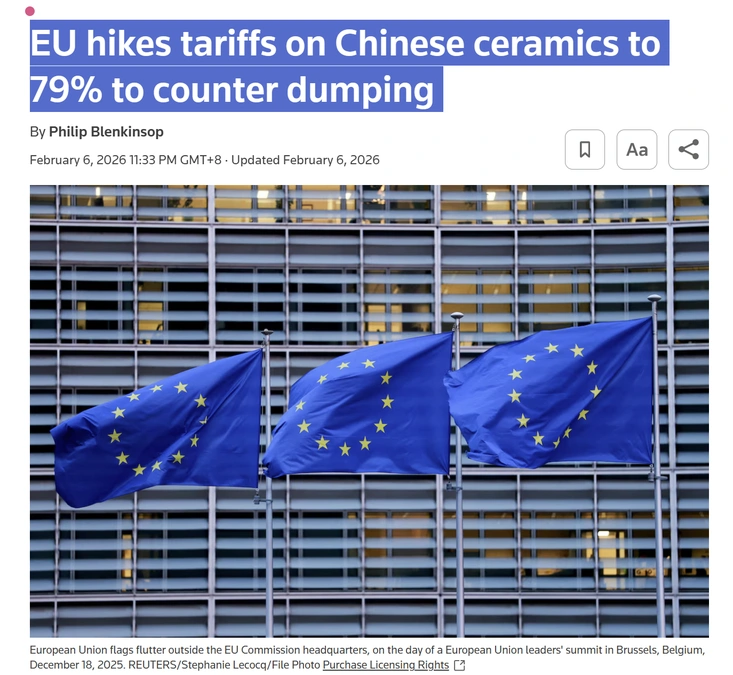
Taking the EU market as an example, a Reuters report points out:
“The European Union has sharply increased tariffs on imports of ceramic plates, cups, bowls and other table and kitchenware from China… applying a blanket 79% duty on the products…”
Relevant content can be found in the Report on the EU’s Tariff Hike on Ceramic Dinnerware.
The report clearly states that a uniform 79% tariff is applied to ceramic plates, cups, bowls and other table and kitchenware. To put it in more understandable terms: when the tax rate is close to 80% of the goods value, the cost structure at the import stage has been rewritten. Tariffs do not decrease because products sell well, nor are they buffered by stable channels; they are levied in accordance with established rules and reflected in the landed cost.
In such cases, price changes usually do not happen overnight, but are transmitted step by step through the chain. Importers face higher tax burdens, squeezing profit margins; wholesalers recalculate pricing while maintaining gross profit margins; retailers have to consider whether to adjust selling prices. On the surface, it is a rising price curve; in essence, it is a tariff-driven redistribution of costs.
More importantly, when tariffs remain high for a long time, purchasing decisions undergo both psychological and structural changes. In the past, ceramic could be chosen based on market inertia; now, it is necessary to return to more rational calculations: can each dollar of landed cost still support the original profit model? If the answer becomes ambiguous, alternative solutions will be put back on the agenda.
Higher Prices Lead Buyers to Consider Other Materials
If purchasing decisions are compared to a balance scale, tariffs are the weights suddenly added to one side. After the balance tilts, the other side will naturally be re-examined. At this point, the question is no longer “Is ceramic classic?”, but “Under the current tax rate structure, which material has better comprehensive cost performance?”
Ceramic dinnerware usually requires high-temperature firing, resulting in high energy consumption during production, and the finished products are relatively heavy. When tariffs are levied as a percentage of the goods value, manufacturing costs and tax burdens form a superimposed effect. Any increase in one link will be amplified in the final landed cost. For cost-sensitive markets, this amplification effect means increased uncertainty in profit margins.
In such an environment, Opal Glass is included in the comparison not by accident, but as a natural result. It usually adopts mechanized pressing processes, with high production efficiency, relatively controllable fluctuations in unit labor costs, and a more lightweight structure in terms of weight. Lightweight not only brings transportation convenience, but also means there may be more flexible space in the calculation of overall loading efficiency and comprehensive costs.
Imagine two cost calculation sheets placed on a conference table: one is the landed cost of ceramic after the tax rate has been raised, and the other is the cost structure of Opal Glass with a different structure. Purchasing managers will not only look at the material name, but focus on the numbers: what is the tax burden ratio per unit product? Is the comprehensive transportation cost more controllable? Under the premise that profits are not excessively squeezed, which plan is more robust?
Price Changes Shift the Way Buyers Judge Product Value
The so-called cost performance is not simply low price, but a balance between cost and value. When tariffs push up the landed cost of ceramic dinnerware, the formula for calculating cost performance is rewritten. Even if the appearance and function of the product remain the same, as long as the cost structure changes, the original advantages need to be re-verified.
The 79% tariff is not a symbolic number; it represents the real impact of the policy environment on the industry. In this context, the market will not wait passively, but take the initiative to find more stable solutions. Whether cost-effective opal tableware is more likely to become a choice with stable cost performance does not lie in the material itself, but in the comparison of comprehensive costs under the tariff environment.
Opal Glass vs Ceramic Dinnerware: Which Is More Cost-Effective as Tariffs Rise?
Against the backdrop of continuous adjustments to global trade policies, the way of calculating dinnerware procurement is quietly changing. In the past, price discussions were more centered on ex-factory prices; now, once tariffs are raised, what really determines profit margins is the comprehensive cost of the product after final landing. For this reason, more and more buyers are beginning to rethink a practical question: in an environment of rising tariffs, do ceramic dinnerware still maintain their original price advantages? Will Opal Glass become a more reliable alternative?
A public economic explanatory video What are tariffs and how do they affect businesses and consumers mentions: “tariffs are taxes on imported goods” “the importer pays the tariff”. These two sentences actually explain the key logic—when tariffs rise, costs fall first on importers, not on the production side. Subsequently, this part of the cost will be gradually reflected in wholesale prices, retail prices, and even the final consumer bills.
To break down the problem more intuitively, it can be understood as follows:
- The higher the ex-factory price of a product, the higher the tariff amount levied as a percentage.
- The heavier the product, the higher the transportation cost, and taxes are often superimposed on the higher total declared value.
- Under the same tax rate, unit price and weight determine the extent to which costs are amplified.
- The larger the order quantity, the more obvious the cumulative unit gap.
When tariffs increase, not all products are affected equally. Structural differences will lead to different amplitudes of cost fluctuations.
Tariff Increases Gradually Raise the Total Cost of Ceramic Dinnerware
Imagine an actual scenario: a catering brand plans to import a batch of ceramic dinner plates, and the original budget has been finalized. Suddenly, the tax rate increases by 5% or 10%. The number may seem small at first glance, but if the unit FOB price is $2.00 and the tax rate is 25%, each piece increases by $0.50; if the order is 100,000 pieces, the tax amount alone increases by $50,000. Adding rising sea freight and insurance costs, the total amount will expand further.
The production characteristics of ceramic dinnerware make this amplification effect more obvious. Multiple high-temperature firings mean high energy costs; the products are heavy, accounting for a large proportion of transportation volume and weight; the number of pieces that can be loaded in a container is relatively limited; if damage occurs during transportation, additional restocking costs may be incurred. Rising tariffs do not change the production method of ceramics, but make the originally high unit price and weight more “sensitive” under a proportional tax system. It’s like a backpack that is already full—adding a little more weight makes the burden feel obvious.
In addition, tariffs are usually levied based on the declared value, which often includes the goods value and part of the freight. When freight itself rises, the tax base also expands, resulting in a superimposed trend of costs. For heavy ceramic products, this superposition is more likely to be amplified.
Opal Glass Carries Lower Cost Pressure Under the Same Tariff Rate
If replaced with Opal Glass, the cost model presents a different form. Opal Glass usually adopts a one-time high-temperature forming process, with a high proportion of automated production, lighter unit weight, and higher container loading efficiency. lightweight commercial dinnerware like opal glass fits far more units per container than ceramic alternatives, even for the same specification of dinnerware with a FOB price of $1.50 that sees a $0.375 increase under a 25% tax rate. The tax rate is the same, but the tax base is different; the unit gap may seem small, but it will continue to accumulate in bulk orders.
Lightweight means lower unit transportation costs and more pieces can be loaded in the same container; the relatively low damage rate also reduces potential after-sales and restocking expenses. When tax rates rise, products with lightweight structures often have more controllable absolute growth amounts. It can be understood that under the same external pressure, products with lighter weight have greater elasticity.
If tax rates continue to fluctuate in the future, this gap will be further amplified. Products with high unit prices and high weight have a steeper growth curve under a proportional tax system, while products with a lower tax base and higher transportation efficiency have a relatively gentle growth curve. From a long-term procurement perspective, stability itself is a cost advantage.
| Technical Indicator | Opal Glass Dinnerware | Ceramic Dinnerware |
|---|---|---|
| Production Process | High-temperature one-time forming, high automation ratio | Multiple high-temperature firings, relatively complex process |
| Unit Weight (Same Specification) | Lightweight (about 30-40% lighter than ceramic) | Heavy, high density |
| Container Loading Efficiency | High (15-20% more pieces per container) | Low, limited by weight and fragility |
| Damage Rate (Transport & Usage) | Low (about 1-2% in bulk transportation) | High (about 5-8% in bulk transportation) |
| Energy Consumption per Unit | Low, controllable due to automated production | High, due to repeated high-temperature firing |
| Tax Burden per Unit (25% Tariff Rate, FOB $1.5 for Opal, $2 for Ceramic) | $0.375 | $0.5 |
Overall Spending Determines Which Option Is More Cost-Effective
When discussing “cost performance”, what really needs to be answered is not which product has a lower price, but which product rises more slowly and fluctuates less when tariffs increase. Comprehensive landed costs include ex-factory price, import tax, freight, insurance premium, damage rate, and final profit margin. As long as the base of one of these items is high, the proportional tax system will continue to amplify the gap.
Therefore, when making comparisons against the backdrop of rising tariffs, the core is no longer just the material itself, but the differences in cost structure models. Due to their unit price and weight characteristics, ceramic dinnerware are more likely to form cost superposition in an environment of rising tax rates; under the same tax rate conditions, if a product has a lower tax base and better transportation efficiency, its overall cost fluctuation is more gentle.
Based on this logic, in the international trade environment with continuous tariff fluctuations, Opal Glass is more likely to become a choice with stable cost performance. This judgment is not based on a single price comparison, but a rational result of the combined effect of tax burden mechanisms, transportation structures, and cost bases.
Restaurant Purchasing Choices Under Rising Tariffs
Against the backdrop of continuous fluctuations in the global trade environment and rising import tariffs, the procurement pressure on the catering industry is being truly amplified. For restaurants, hotels, and chain brands that rely on imported ceramic dinnerware, rising tariffs are not an abstract policy change, but a numerical change directly reflected in quotations. The procurement budget that was acceptable last year is obviously tight this year; the store expansion plan that was originally planned has to be recalculated for cost structure.
Imagine a specific scenario: a chain catering brand is preparing to uniformly purchase dinner plates for new stores. The procurement manager opens the supplier’s quotation and finds that due to rising tariffs, the unit cost is higher than expected. At this time, he is faced with more than just the question of “whether a slight price increase is acceptable”, but a more realistic consideration—if procurement costs continue to rise, how long can profit margins be sustained? Is there a more stable and controllable choice?
When the import cost of ceramic dinnerware increases due to rising tariffs, enterprises face not simply a “price increase”, but a series of chain reactions: rising procurement unit prices, increased transportation and customs clearance costs, expanded occupation of inventory funds, and potential repeated restocking costs that may arise later. The core of the problem begins to shift to a more practical direction—how to truly save overall costs against the backdrop of rising tariffs, rather than just comparing unit prices.
To make procurement decisions clearer, this problem can be understood in the simplest and most direct way:
- Rising tariffs will directly increase the import cost of ceramic dinnerware, and the procurement unit price will rise accordingly.
- The increase in unit price, superimposed with transportation and customs clearance costs, will amplify the pressure on the overall procurement budget.
- If the dinnerware has a high damage rate in high-frequency use, it will also generate continuous repeated procurement expenditures.
- Therefore, choosing products that are more durable, have higher transportation efficiency, and a more stable price structure can truly reduce long-term total costs.
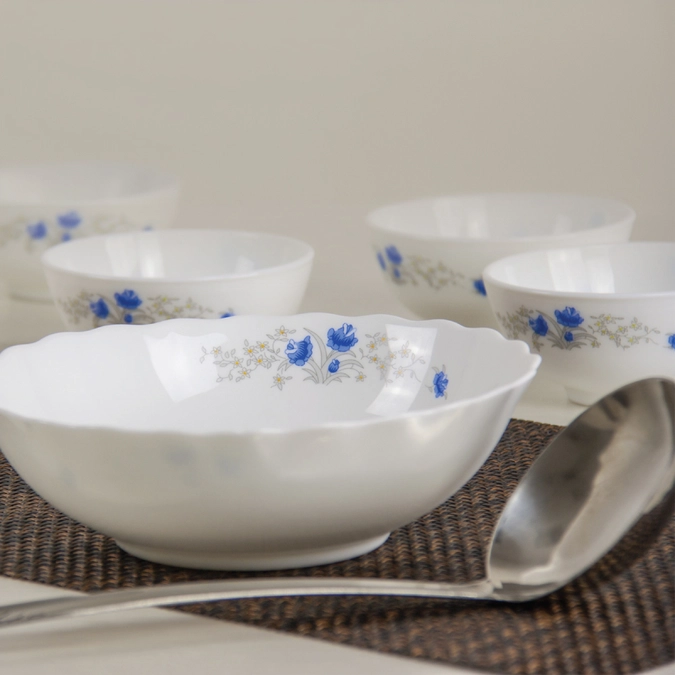
It is under this realistic logic that Opal Glass has gradually been included in the procurement evaluation scope of more catering enterprises. For a more in-depth understanding of the structural advantages and application logic of Opal Glass in catering and hotel scenarios, you can refer to the Opal Glass Tableware Commercial Solutions Guide, which provides a more specific analysis of bulk procurement, durability characteristics, and long-term use costs. Compared with some ceramic products that rely on high-temperature firing and complex glaze processes, tempered opal glass dinnerware usually adopts tempered glass pressing processes, with more standardized production processes and higher scale levels. This industrialized production method makes unit costs more controllable and more conducive to maintaining price stability during bulk procurement.
The Unit Price Alone No Longer Reflects the Real Cost
In the past, many procurement decisions often stayed at the level of one-time quotations—choosing whoever is cheaper. But in an environment of rising tariffs, this way of thinking has become insufficiently comprehensive. Unit price is only the surface cost, and what really affects profits is the comprehensive expenditure throughout the entire service cycle.
In the daily operation of a restaurant, dinnerware is frequently transported, cleaned, and stacked. A slight bump may cause cracks on the edge of the plate; an inadvertent collision may lead to the scrapping of the entire plate. Seemingly occasional small losses will continue to accumulate in high-frequency scenarios. The number of restocks increases, the number of transports increases, the complexity of inventory management increases accordingly, and financial expenditures also rise unconsciously.
In contrast, tempered opal glass dinnerware, when treated with tempering, usually has more stable impact resistance. Under the same usage intensity, its damage probability is relatively low, and it serves as reliable impact-resistant dinnerware solutions for high-frequency use in catering settings. This is not simply a material comparison, but an impact on long-term operating costs. If the number of restocks is reduced within a year, the safety stock level can be lowered, and the pressure on capital turnover will also be reduced. In other words, saving costs is no longer just about lowering the unit price, but reducing “continuous losses”.
Shipping and Storage Costs Add to the Final Expense
Rising tariffs are often accompanied by fluctuations in logistics costs. When the procurement scale reaches tens of thousands of pieces, the differences in transportation structures will be significantly amplified. Products with unified specifications and higher packing efficiency can be loaded in larger quantities within the same container space, and the unit transportation cost will naturally decrease. Seemingly subtle differences will form obvious cost gaps in bulk procurement.
The same applies to inventory management. Products with a high degree of standardization are easier to purchase centrally and allocate uniformly. For catering enterprises operating multiple stores, this means more efficient inventory allocation and lower management costs. Imagine if tableware of different batches and specifications are mixed, the complexity of warehousing and inventory checking will increase significantly; while products with unified specifications can make the entire management process smoother. The simpler the process, the lower the hidden costs.
Stable Purchasing Plans Reduce the Impact of Price Fluctuations
The biggest challenge brought by rising tariffs is not just the current price change, but uncertainty. Is today’s quotation still applicable tomorrow? Will the import cycle be extended? Will restocking be restricted? In such an environment, catering enterprises need a predictable cost structure more than ever.
Opal Glass, relying on large-scale production and a relatively stable raw material system, is more likely to maintain stability in its price structure. For catering brands that need long-term planning, stability itself is valuable. It makes budgets more controllable, expansion plans more evidence-based, and operational decisions no longer constrained by frequently fluctuating procurement costs.
How Opal Glass Competes with Ceramic in a High-Tariff Market
Under the core issue of “Opal Glass vs Ceramic Dinnerware: Can It Become a New Cost-Effective Choice Against the Backdrop of Rising Tariffs?”, what really affects procurement decisions is not simply the price level, but which material can maintain profit margins after tariffs rise. Ceramic dinnerware are solid and mature in traditional cognition, but when tariffs, energy, and logistics costs rise simultaneously, the originally stable cost structure begins to become heavy. At this time, Opal Glass is no longer just “another choice”, but a variable re-calculated in the cost model.
Imagine a scenario: a dinnerware importer is re-calculating the annual procurement budget. The same quantity of ceramic dinnerware could maintain a reasonable profit last year, but this year, due to tariff increases and rising freight costs, the profit margin has been squeezed to almost no buffer space. If prices are raised at the terminal, will customers be lost? If prices are not raised, will profits be eroded? Under such real pressure, the evaluation of alternative materials becomes very specific, rather than an abstract concept.
Many people ask, in the case of rising tariffs, what makes Opal Glass a more cost-effective choice? It can be understood in a more direct way:
- When tariffs increase, is the growth rate of the overall procurement cost of Opal Glass relatively smaller?
- For the same volume, can unit freight be reduced through lighter weight and higher container loading rate?
- Can restocking costs caused by damage be reduced during transportation and daily use?
- In high-frequency use scenarios, is it more durable, thereby extending the replacement cycle?
- At the level of appearance and function, is it sufficient to meet the actual needs of household and catering markets?
After these questions are verified one by one, substitution becomes a rational choice rather than an emotional judgment.
Purchasing Decisions Are Shifting from Unit Price to Total Spending
When tariffs rise, many people’s first reaction is to compare ex-factory prices. But what really affects profits is the overall cost structure. Ceramic dinnerware rely on long-time firing in high-temperature kilns; once energy costs rise, the manufacturing side will be directly amplified; adding tariffs and international transportation costs, the final landed cost accumulates layer by layer. It’s like a piece of luggage that is already heavy, with a little more weight added at each link, and it naturally feels heavy in the end.
In contrast, Opal Glass has a higher degree of automation in the production process, a faster manufacturing rhythm, and more controllable unit energy consumption. During the period of rising tariffs, its cost curve is more gentle. This gentleness does not mean an absolute low price, but a larger buffer space when prices fluctuate. For wholesalers, this buffer space is the safety margin for profits.
Looking at the issue from the transportation perspective again. Assuming the same container, if the product is lighter and easier to stack, it means more pieces can be loaded, and the unit transportation cost is naturally spread out. When the damage rate decreases, the costs hidden in after-sales reissues, inventory backlogs, and delivery delays also decrease. Often, profits are not eaten up by explicit tariffs, but slowly consumed by repeated losses. The advantages of Opal Glass in impact resistance and stacking efficiency control this “chronic loss”.

Opal Glass Shows More Stable Performance in Restaurants and Homes
durable glassware for restaurants stands out in high-frequency use scenarios, and Opal Glass shows more stable performance in restaurants and homes. If a chain restaurant needs to clean and transport a large number of dinnerware frequently every day, lighter weight and stronger impact resistance mean easier operation for employees, less damage, and improved overall operational efficiency. If a family hopes that dinnerware can be put into microwaves and dishwashers, and at the same time not easily absorb stains after long-term use, then whether the material is water-absorbent and easy to clean becomes important.
Opal Glass is non-absorbent, not easy to retain oil stains, and maintains a milky white appearance after long-term use. In terms of visual presentation, it is simple and modern, similar to the white texture of traditional ceramics. Consumers tend to pay more attention to practical experience rather than material names. When the usage experience is close to or even better, the psychological threshold for substitution is naturally lowered.
From the past to the present, the market has changed. In the past, procurement emphasized tradition and inertia; now, it emphasizes efficiency and risk control. In the future, if tariffs continue to fluctuate, will enterprises be willing to continue bearing high fluctuation costs, or choose a more stable structure? This question is not a short-term discussion, but a long-term strategy.
Reliable Supply Supports Long-Term Cooperation
In an uncertain trade environment, reliance on a single material often means higher risks. If ceramic products are concentrated in specific producing areas, once policies are adjusted or costs rise, prices will be transmitted quickly. Opal Glass production has a high degree of scale, a concentrated and mature supply chain, and a more flexible quotation system. During the period of rising costs, whoever has a smaller price fluctuation range is more likely to maintain market competitiveness.
It can be understood as follows: when the external environment changes constantly, enterprises cannot control tariffs, but they can choose a product structure with stronger resilience. The competitiveness of Opal Glass is not a single point of advantage, but the result of the combined effect of cost, transportation, durability, and supply chain stability.
Against the backdrop of rising tariffs, substituting ceramic dinnerware is not simply a material replacement, but a cost optimization strategy. When overall accounting shows lower risks, smaller fluctuations, and higher usage efficiency, Opal Glass will naturally enter the vision of more procurement decision-makers and become an important option in the high-cost-performance path. For a more in-depth comparison from the perspective of material structure and long-term usage performance, you can also refer to the Durability Comparison Analysis of Opal Glass vs. Mainstream Dinnerware Materials to more intuitively understand the actual differences between different materials in high-frequency use environments.
Frequently Asked Questions (FAQ)
1. Why does Opal Glass have a lower cost burden than ceramic dinnerware when tariffs rise?
Opal Glass has a lower tax base (lower FOB price) compared to ceramic dinnerware under the same tariff rate, resulting in a smaller absolute increase in unit tariff costs. Additionally, its lightweight structure improves container loading efficiency, reducing unit transportation costs, and its lower damage rate cuts down on restocking expenses. These factors together make the overall cost growth of Opal Glass more gentle when tariffs rise, while ceramic dinnerware face amplified cost superposition due to higher unit prices, heavier weight, and higher energy consumption in production.
2. Can Opal Glass fully replace ceramic dinnerware in catering and household scenarios?
Opal Glass can meet most of the practical needs of catering and household scenarios: it is lightweight, impact-resistant, non-absorbent, easy to clean, and compatible with microwaves and dishwashers, with a visual texture close to traditional white ceramics. However, in some high-end catering or gift-giving scenarios that pursue the unique texture and craftsmanship of ceramic (such as hand-painted ceramic tableware), ceramic still has irreplaceable advantages. Overall, Opal Glass is a highly viable alternative for cost-sensitive and high-frequency use scenarios, while ceramic remains preferred for scenarios emphasizing craftsmanship and premium positioning.