• Surface performance: Dense opal glass surface prevents food residue adhesion, requiring minimal scrubbing for daily cleaning even with oil or butter remains.
• Temperature resistance: Opal glass handles -20℃ to 120℃ temperature shifts, functioning for hot oatmeal, cold salads and microwave reheating in daily use.
• Bump resistance: Opal glass shows no structural damage after minor knocks, with only small matte marks in family use with children over 2 years.
Common Observations on the Appearance Durability of Opal Glass
What kind of tableware can still “look decent” after long-term use? The answer is often hidden in users’ daily real experiences – not the strength parameters in the laboratory, but the imperceptible changes in appearance over time: whether it looks old, whether it leaves marks, whether it can stand the test of time. Around these long-term feedbacks, the appearance durability of opal glass tableware contains too many user observations worth pondering in detail. These observations stem from authentic long-term opal glass dinnerware experience shared by households worldwide.
“Not looking old” after long-term use is the most frequently mentioned appearance experience. Have you ever seen tableware that still looks new after 5 years of use? Opal glass can often give a satisfactory answer. In real records from many ordinary overseas families, a set of breakfast plates used frequently every day, washed in the dishwasher 3-4 times a week, after thousands of times of picking up, stacking and friction, the overall whiteness is almost the same as when newly purchased, with only extremely faint matte marks at the edge of the plates where they contact the cupboard, which can only be noticed by the naked eye upon close inspection. In contrast, ordinary clear glass bowls purchased at the same time have dense fine scratches on the inner wall after only about 1 year of use due to repeated contact with spoons and knives; under light irradiation, the scratches form obvious light and shadow lines, and the edges turn gray and lose transparency due to long-term cleaning, visually appearing “old” long ago. This difference in the speed of visual aging is particularly prominent in family and catering scenarios – opal glass usually does not lose uniformity like some materials with use; even after repeated cleaning and daily bumps, its appearance is closer to a “continuous use state” rather than an “obviously aging state”, which is perhaps one of the core basis for users to judge its appearance durability.
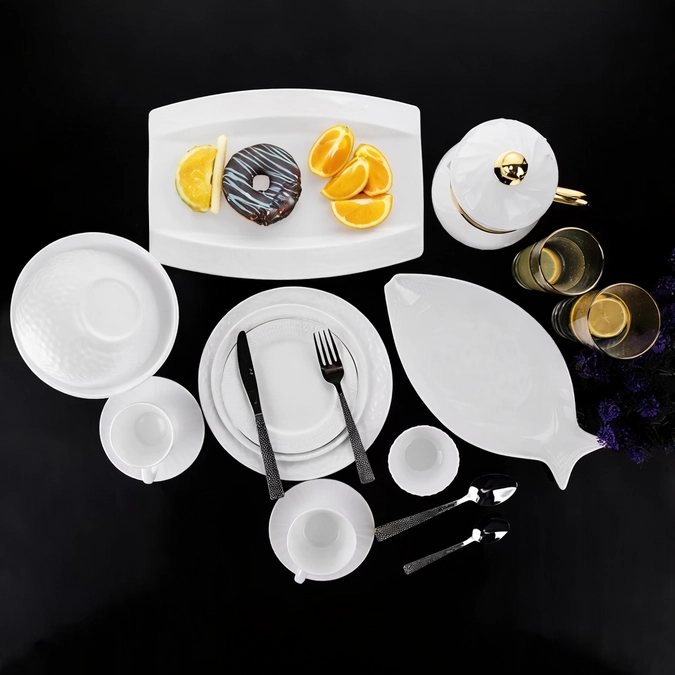
Minor wear is not easy to be amplified, and the overall visual perception is more stable. In real use, friction between tableware and knives and forks is inevitable, but there are differences in the “scratch resistance performance” of different materials. Imagine: when cutting steak with a dinner knife, will the plate leave clear scratches, or make the marks “invisible”? Opal glass usually leans towards the latter. An overseas user shared on the Reddit community: “I use opal glass plates to eat steak, and most of the marks left by the dinner knife are not easy to notice, while the previous clear glass plates had a clear scratch every time after cutting, and the entire plate surface looked ‘scratched’ after long-term use.” Compared with transparent materials that easily highlight scratch contours, the appearance of opal glass is more “uniform overall” – even if there are slight use marks, it is not easy to damage the set consistency. A set of 6-piece opal glass bowls has almost no visual difference between individual pieces after 4 years of use; while transparent glass or ceramic tableware sets often have a messy look of “some new, some old” due to different degrees of wear on individual pieces, which is the gap in the ability to handle minor wear. Families with limited cabinet space value stackable lightweight opal glass plates for their space-saving design, as their regular shape and stable stacking further enhance practicality.
Under repeated cleaning and high-frequency use, the change in appearance state is limited. Long-term use is usually accompanied by high-frequency cleaning; the repeated effects of dishwashers, hot water and cleaning agents are a considerable test for the appearance of tableware. But opal glass performs very “calmly” – even when used in hard water areas, after long-term dishwasher cleaning, only a uniform mist-like water mark forms on the surface, which can restore texture with a light wipe of a dry cloth; while ordinary clear glass tableware, under the same conditions, forms dot-shaped, uneven white marks due to limescale adhesion, which need to be repeatedly soaked with cleaning agents such as citric acid to remove. Users’ feedback is not “no change at all”, but “the change is not obvious and does not affect use and vision”. The reason why it can perform like this is that its material structure is relatively stable, less susceptible to corrosion by cleaning agents, and less prone to yellowing, color difference or surface imbalance due to water temperature changes – this “tough” characteristic is also one of the important reasons why its appearance durability is frequently recognized. Many users emphasize that easy to clean opal glass dinnerware significantly reduces daily housework burden, as the minimal appearance changes after cleaning mean less time spent on touch-ups.
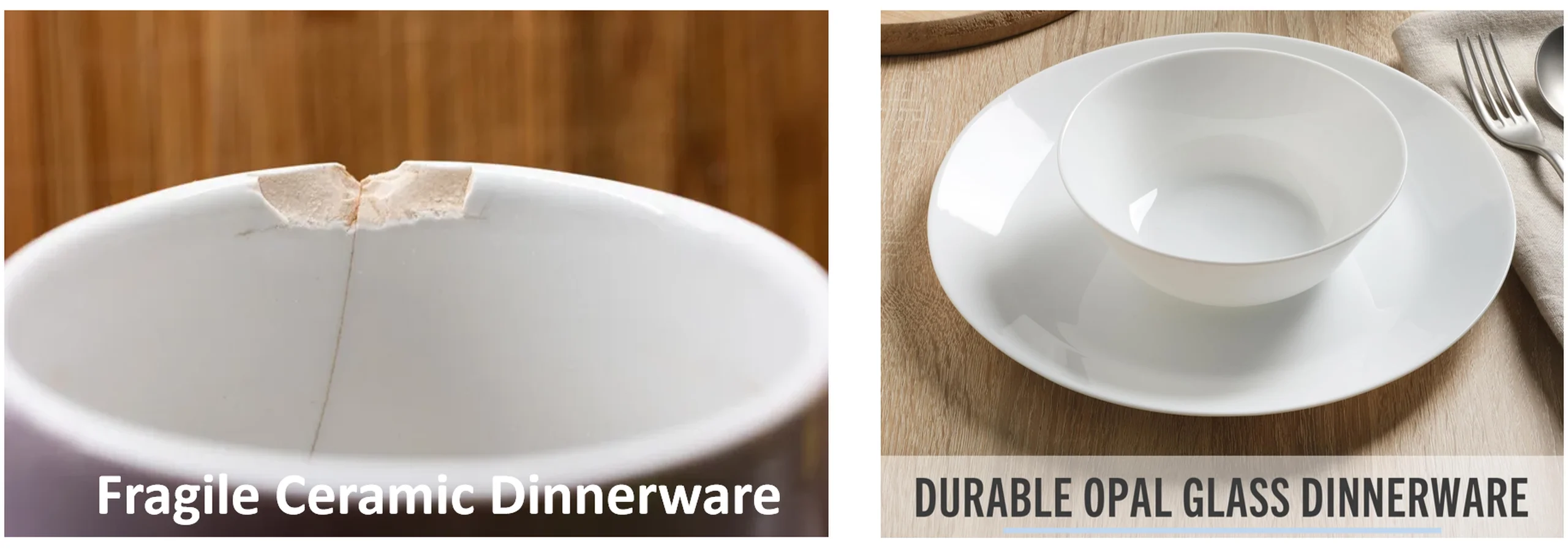
The “appearance integrity” after minor bumps is more acceptable. Tableware bumps are almost a daily occurrence in families; what long-term users really care about is not “whether it will bump”, but “whether it looks good after bumping”. Families with children feel this most deeply: if a child accidentally knocks an opal glass bowl off the edge of the dining table onto a wooden floor, the bowl only has a small matte mark at the bottom where it contacts the ground, with no chips or cracks, basically not affecting normal use; while a ceramic bowl of the same size that experiences a similar bump will most likely have glaze chipping or chips, and a clear glass bowl may even shatter directly. This “acceptable use mark” can not only reduce the replacement frequency to a certain extent, but also make users gradually trust its durability in long-term use. In fact, what long-term users really care about is never just “whether it is shatter-resistant”, but whether the tableware maintains a safe and controllable state in the real environment of daily bumps and repeated use. Around this issue, we have additionally written a special article titled Is Opal Glass Safe to Use?, which provides a more complete explanation of the safety boundaries of opal glass in daily use scenarios.
Material structure provides the basic conditions for appearance durability. Why can opal glass perform like this? The answer lies in its material. Unlike ordinary clear glass, opal glass does not rely solely on surface hardness, but affects the visual performance after long-term use through its internal structure. Regarding its basic composition, formation principle and common misunderstandings, we have a more systematic explanation in another article titled What Is Opal Glassware? A Simple Guide for Beginners (if you are interested, you can read it).
Essentially, it is a type of glass material with opaque structural characteristics. During the melting process, components such as phosphates and fluorides are added to form a microcrystalline structure, which causes light to undergo diffuse reflection inside. Relevant material descriptions mention: “Milk glass is an opaque or translucent glass that is white in color.” The direct benefit of this structural characteristic is that even if there are minor wear marks on the surface, it is difficult to form obvious light and shadow contrast, making it not easy to notice visually; while the amorphous structure of ordinary clear glass causes strong contrast between light refraction at the scratches and the surroundings, making the scratches naturally more prominent. It is this material-level difference that provides the basic conditions for the appearance durability of opal glass, which is also mentioned in the Wikipedia article.
Practical Benefits of Everyday Cleaning and Storage with Opal Glass
What is the core of “being easy to use” for long-term used tableware? It is not the amazement of the first use, but the peace of mind and effortlessness after repeated cleaning and storage. The convenience of opal glass tableware in daily cleaning and storage is never a “highlight moment” of a single characteristic, but life details that are slowly confirmed and continuously amplified by users in daily use. Users often praise the dishwasher friendly opal glass dinnerware set for its stable performance in various cleaning programs, which is a key part of its long-term appeal.
First is the stability of cleaning experience. Opal glass has a flat and dense surface overall with almost no porosity – this means that after daily meals, residues of oil, soup, and seasonings are difficult to form obvious adhesion. After breakfast, egg and butter residues on the plates can be easily rinsed off with warm water and a small amount of dish soap, no need for repeated wiping with a scouring pad; if it is ceramic tableware with fine pores in the glaze, oils such as butter are prone to seeping into the pores, making it often difficult to clean without strenuous scrubbing. As easy to clean opal glass dinnerware, it performs consistently well even in frequent dishwasher cycles, as the smooth surface prevents residue buildup. In most family scenarios, cleaning opal glass tableware is more like a “basic operation” rather than a “tough battle” against stubborn stains. After long-term use, users will find that cleaning such tableware has relatively controllable requirements for cleaning intensity and time, and there are fewer cases of “needing to rewash after one cleaning” – this “no trouble” cleaning experience is exactly what is needed in daily life.
This advantage in cleaning efficiency is particularly prominent in high-frequency use scenarios. Imagine: daily-used utensils such as breakfast plates and dinner bowls, if cleaning them once requires extra time and repeated scrubbing, the housework burden will be heavy when accumulated over a long period of time? A user who eats three meals a day at home once calculated: cleaning a set of opal glass tableware takes an average of only 5 minutes, while the previously used ceramic tableware takes 10-12 minutes; over a year, more than 2000 minutes can be saved just on tableware cleaning – the time saved is enough to make the daily rhythm more relaxed. The performance of opal glass is never an “over-expected performance” in a single cleaning, but a relatively stable “no extra trouble” in the long term. This experience of “no additional trouble” is exactly one of the rigid demands in high-frequency use scenarios.
In terms of dishwasher use, long-term feedback also cannot do without the word “peace of mind”. Due to the smooth and uniform surface, water flow and cleaning agents can easily cover the entire surface of the utensil in normal dishwasher programs, and the cleaning results are relatively stable and consistent. Of course, objectively speaking, whether water marks or slight fogging occur after dishwasher cleaning is still affected by external conditions such as water hardness and cleaning agent type, but opal glass is not a material that is particularly sensitive to dishwasher conditions – this reduces users’ additional concerns. Some users have done experiments: they have used different brands of dishwasher detergents and tried various dishwasher programs, and the cleaning effect of opal glass tableware has always remained stable; while ceramic tableware may have obvious loss of luster on the glaze after using strong alkaline detergents. This “tolerance” for dishwashers makes the busy daily life less “cautious”, and the dishwasher friendly opal glass dinnerware set lives up to its name in real-world use.
The difference brought by weight during cleaning cannot be ignored. Opal glass is overall lightweight; a plate of the same size weighs about 200 grams for the opal glass version, while the ceramic version weighs about 450 grams, less than half the weight of ceramic. The convenience of stackable lightweight opal glass plates becomes more evident during family gatherings when multiple sets need to be stored and moved. The comfort brought by this lightweight is particularly obvious when rinsing with one hand, turning over for cleaning, or moving multiple sets of tableware centrally after a dinner party. Short-term use may feel little difference, but in family environments where multiple sets of tableware need to be cleaned frequently – such as cleaning 10-15 pieces of tableware after a weekend family dinner – the gap in the burden on the wrists and arms will gradually appear over time. For family members responsible for daily cleaning, especially the elderly or users with weak hand strength, this “a little lighter” experience is more perceptible than parameter advantages.
In the storage link, the convenience of opal glass lies in “a sense of order” and “predictability”. Most plates and bowls have regular design shapes with rounded right-angle edges, and the center of gravity is stable after stacking, not easy to slide. In long-term use, users can form a fixed storage method without frequently adjusting the placement order or relying on additional anti-slip and separation tools. For families with limited cabinet space, this advantage is more prominent: opal glass tableware only needs to reserve 1 centimeter of gap between each layer when stacked, while ceramic tableware needs to reserve 2-3 centimeters due to poor anti-slip performance of the glaze – the cabinet space utilization rate of the former can be increased by about 50%, and daily sorting is also more time-saving.
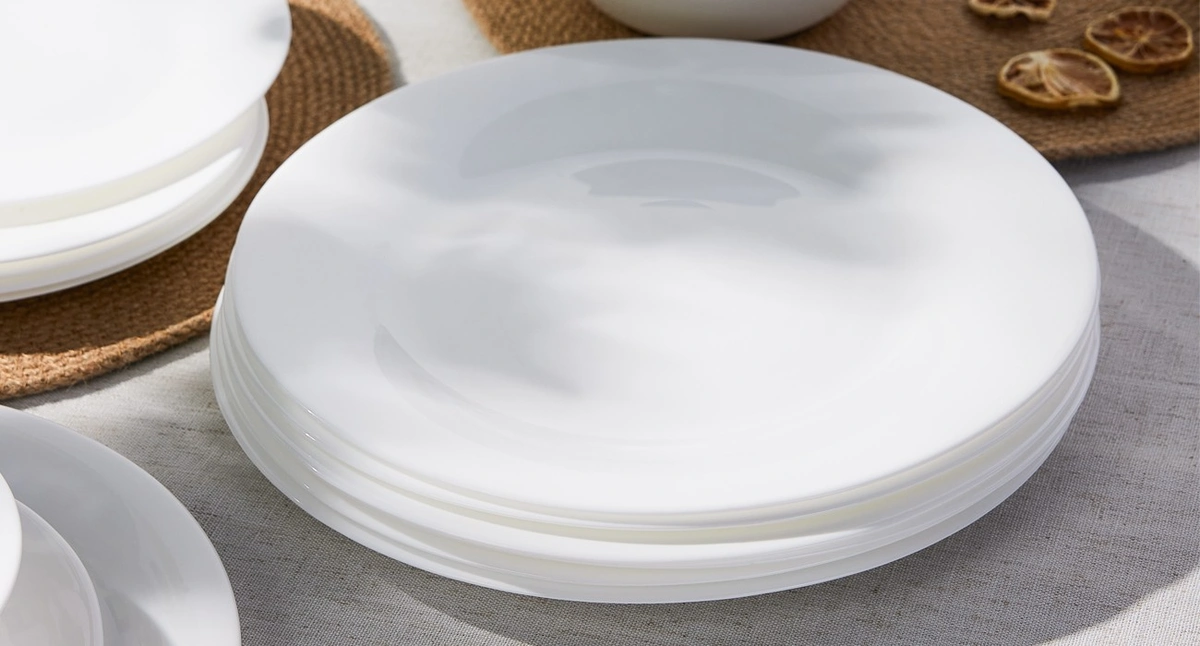
In addition, not easily retaining odors after cleaning and storage is also a small detail surprise in long-term use. After normal cleaning and natural drying, opal glass is not easy to absorb food odors – even if it has contained heavy and strong-flavored curry or sauce, it still has no obvious odor when taken out of the cabinet weeks after cleaning and drying; while if ceramic tableware is not cleaned thoroughly, the odor remaining in the glaze pores may exist for a long time, and even need to be cleaned again before use. In families with mixed diet types, this point is particularly important: it can reduce repeated cleaning due to odor problems, making daily use more worry-free.
Comprehensively looking at long-term use experience, the practical convenience of opal glass in daily cleaning and storage is concentrated in the following repeatedly verified aspects:
- The surface is relatively flat and dense, making daily food residues not easy to adhere, and the cleaning process is more efficient;
- It performs stably in dishwashers, with low dependence on placement and programs;
- The lightweight feel reduces physical burden during cleaning, moving and centralized storage;
- Regular shape and stable stacking make long-term storage more space-saving and worry-free.
These advantages do not come from a one-time comparative test, but are results continuously confirmed in daily cleaning and storage day after day. It is these recurring but not easily emphasized details that constitute users’ core perception of opal glass tableware as “easy to care for, durable, and suitable for long-term use” – the peace of mind in daily life is always hidden in these “inconspicuous” conveniences. Such consistent performance is a key reason why opal glass dinnerware reviews consistently highlight its practicality for daily use.
Objective Comparison Table of Core Characteristics Between Opal Glass and Common Tableware Materials
| Characteristic Dimension | Opal Glass | Ordinary Clear Glass | Ceramic |
|---|---|---|---|
| Appearance Aging Speed | Slow, stable whiteness/consistency after 5 years of use | Fast, prone to graying and color difference in 1-2 years | Moderate, glaze prone to fading/peeling in 2-3 years |
| Visual Performance of Minor Wear | Uniform marks, almost invisible to the naked eye | Clear scratch contours with strong visual contrast | Exposed base material after glaze wear with obvious marks |
| Dishwasher Compatibility | High, uniform cleaning, water marks easy to clean | Moderate, prone to limescale buildup, scratches easy to worsen | Low to moderate, glaze pores easy to absorb cleaning agent residues |
| Appearance Integrity After Minor Bumps | High, only small matte marks with no chips | Low to moderate, prone to cracks/shattering | Low, prone to chips/glaze chipping |
| Weight of the Same Size (Reference Value) | Approx. 200g (plate) | Approx. 250g (plate) | Approx. 450g (plate) |
| Odor Absorption | Low, no residue after natural drying | Low, but scratches easy to trap dirt and odors | Moderate, glaze pores easy to absorb food odors |
| Microwave Heating Compatibility | High, resistant to temperature difference from -20℃ to 120℃ | Moderate, prone to cracking with large temperature difference | Moderate, some styles not microwave-safe/easy to get hot |
How Opal Glass Dinnerware Works Across Different Diets and Cooking Styles
Family menus change rapidly; can tableware keep up? Chinese-style stir-frying, Western-style cold dishes, microwaved leftovers, morning porridge, afternoon fruits – is there a type of tableware that can switch relatively seamlessly in these scenarios without frequent replacement? The versatility of opal glass tableware is gradually discovered and recognized by long-term users in this highly fragmented and frequently switching usage environment. The versatility highlighted here is a key part of long-term opal glass dinnerware experience that users appreciate, as it eliminates the need for multiple specialized tableware sets.
From a long-term experience perspective, the advantage of opal tableware is never “being extreme in a certain scenario”, but “not being too picky in most common diet types”. It will not look bulky because it holds hot dishes, nor abrupt because it holds cold food. In the morning, it holds boiling hot oatmeal, with moderate heat insulation on the bowl wall, so it will not be too hot to hold by hand; at noon, the same bowl holds cold vegetable salad, and the material texture is completely harmonious with cold food; in the evening, it holds hot stir-fried dishes, and the bowl body generally will not deform or discolor due to high temperature – this characteristic of “no obvious shortcomings” makes it easier to become the main daily tableware for families, rather than a “supplementary option” only used on specific occasions.
In the actual cooking process, the role of tableware is far more than just “holding food”. The operation path of modern families is more like a series of continuous actions: directly plating after cooking, some dishes need short-term reheating, and then serving on the table. If tableware can only undertake one link, users have to frequently replace containers – this trouble will be continuously amplified in long-term use. A common feedback on opal glass tableware is: the same piece of tableware can naturally run through multiple links without deliberately distinguishing uses. For example, take refrigerated leftover soup out of the refrigerator, put it directly into an opal glass bowl, then put it into the microwave to heat, and serve it on the table without changing the bowl after heating; while ordinary clear glass bowls may crack due to temperature difference, and ceramic bowls are too hot on the outer wall after heating, usually needing a heat insulation pad to hold – this continuity of “one utensil for multiple uses” is one of the core manifestations of versatility.
From a long-term perspective, the reason why opal glass tableware can adapt to multiple diets and cooking styles is not because it is “omnipotent”, but because it maintains a relatively consistent use experience in most high-frequency family scenarios. This experience is concentrated in the following commonalities observed over the long term:
- The diet content changes constantly, but the tableware choice is highly fixed: whether it is hot dishes, soups, pasta or cold food, the same set of tableware appears repeatedly, reducing the probability of replacing tableware due to diet changes;
- Heating needs occur frequently, but the cost of usage judgment is low: when needing to microwave leftover meals or simple meals, there is no need to repeatedly confirm whether the material is suitable, and the overall operation is more coherent;
- High appearance rate is maintained even after changes in cooking methods: even if family cooking habits adjust – such as changing from steaming and boiling to frying and stir-frying – the tableware is usually not marginalized due to “incompatibility with new practices”;
- Stable mental expectations are formed after long-term use: users gradually clarify which scenarios can be used directly, reducing unnecessary replacement and hesitation.
Comprehensively looking at these long-term experiences, the versatility of opal glass tableware is not a conclusion drawn from a single test or a single function, but a result naturally precipitated in multi-diet structures, multi-cooking methods and long-term repeated use. Precisely because of this adaptive ability of “low sense of presence but high stability”, it is often described in long-term use feedback as a daily choice that “is not frequently discussed but is difficult to be truly replaced” – after all, tableware that can be well integrated into various dietary scenarios is often the “practical model” really needed by families. Such genuine feedback across years constitutes the most trustworthy opal glass dinnerware reviews for families seeking reliable tableware.
Which Lifestyles See Higher User Satisfaction with Opal Glass Dinnerware?
Is the high praise for opal glass tableware randomly distributed? The answer is no. Its positive feedback is highly concentrated in specific lifestyle groups – these users choose it not because of the gimmick of material parameters, but form stable recognition after long-term, high-frequency and real use.
An obvious commonality is: the daily dining scenarios of these users are real enough, frequent enough, and “not deliberately treated”. In such a life rhythm, whether the tableware is durable, worry-free, and acceptable after several years is far more important than the initial design sense or visual freshness – after all, no one will “enshrine” tableware every day, and practicality is the core demand.
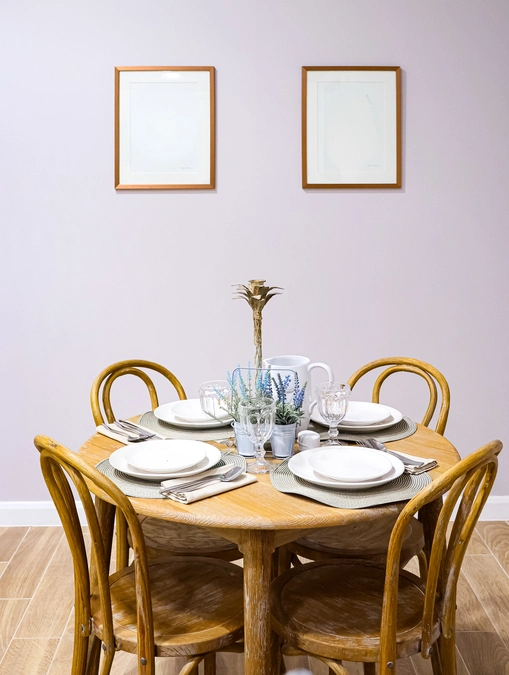
Among them, family environments with multiple users, especially those with children, are the group with the highest concentration of feedback. The use of tableware in such families has several typical characteristics: high frequency of use, fast rotation, inaccurate picking, placing and storage, and cleaning pursuing efficiency rather than ritual sense. Under such conditions, tableware is difficult to be “carefully protected” and can only stand long-term tests by its own performance. In real experience, the praise judgment of such users often revolves around three dimensions:
First, whether there is still stable overall usability after continuous high-frequency use. For multi-person families, what really matters is not that the tableware “has no wear at all”, but whether it is still suitable as daily main tableware after a long time of use, rather than being gradually marginalized. For example, a family of four uses opal glass tableware for 3 years; although the tableware has slight use marks, no piece has been replaced due to damage or severe aging, and it can still meet daily dining needs; while the previously used ceramic tableware has been replaced nearly 10 pieces within 3 years due to bumps and glaze peeling, which not only increases costs but also leads to “mismatch” of the tableware set – this stability of “long-term usability” is what multi-person families value more.
Second, whether it is worry-free enough to adapt to the usage habits of different family members. When tableware needs to be used by adults, the elderly and children together, characteristics such as light weight, durability and no need for special maintenance are more likely to gain long-term recognition than exquisite design. When used by the elderly, lightweight tableware will not increase the burden on the hands; when used by children, even if accidentally dropped, it is not easy to shatter and cause safety hazards; when used by adults, there is no need to deliberately avoid contact with knives and forks or wash by hand alone – this low threshold of “suitable for all ages” makes daily use less restrictive.
Third, whether it can stand repeated picking, placing and occasional collisions in scenarios involving children. Whether it can be continuously used in a state of “not being used carefully” is one of the core demands of such families for tableware. In Reddit’s family and parenting-related communities, a user shared long-term use results: “We absolutely love ours, we’ve had ours for two years and not one chip, crack or break… kids can easily clear their places“. These discussions have nothing to do with material parameters, but focus on real use results – whether the tableware is durable and worry-free in high-frequency, multi-member scenarios, which is highly consistent with the focus of long-term opal glass users.
In addition to families with children, adult households that dine at home frequently are also groups with high praise. Such users often have two or even three meals a day at home, and the tableware is used in rotation for a long time, rarely replaced frequently due to “ritual sense”. In long-term feedback, they care more about the overall state of the tableware after several years of use – whether it is still clean, uniform and acceptable. Opal glass can just meet this expectation well: a pair of single users who eat three meals a day at home use opal glass tableware for 4 years, and the appearance of plates and bowls remains uniform without local yellowing, dense scratches and other problems; while the previously used clear glass tableware was all replaced due to appearance problems in 2 years – this “long-term stable” texture is exactly one of the core demands of high-frequency users.
At the same time, users who prefer a simple and orderly lifestyle are also more likely to give positive evaluations of opal glass. Such users do not pursue tableware to be the visual focus, but hope that it will not damage the overall look of the dining table even after years of use. Their table style is mostly minimalist; the pure white matte texture of opal glass, even after years of use, is not easy to break the overall beauty due to scratches or discoloration; while colored ceramic tableware is prone to fading, and clear glass has obvious scratches, both of which may damage this sense of order. In long-term use, whether the tableware “looks old” and affects the overall coordination often directly determines whether users continue to use it – the “low-key and durable” feature of opal glass just fits this life concept.
Comprehensively speaking, the high praise for opal glass tableware never comes from a single advantage, but is concentrated in lifestyles with high-frequency use, multi-person sharing, and pursuit of worry-free and long-term acceptability. These evaluations are not “a whim” of short-term experience, but result judgments gradually formed in the real life rhythm – it is these long-term feedbacks from ordinary families that constitute the most valuable part of the “summary of real long-term use experiences”.
Frequently Asked Questions (FAQ)
- Q: How does opal glass dinnerware maintain its appearance after years of high-frequency use compared to ceramic and clear glass?
A: Opal glass dinnerware ages much slower in appearance; after 5 years of daily use (including 3-4 dishwasher cycles per week), its whiteness and overall consistency remain nearly unchanged, with only faint matte marks visible only on close inspection. In contrast, clear glass dinnerware shows obvious graying, discoloration and dense scratches within 1-2 years, while ceramic dinnerware often has glaze fading or peeling in 2-3 years, with visible marks when the glaze wears off to expose the base material. - Q: What makes opal glass dinnerware more convenient for daily cleaning and storage than other materials?
A: Opal glass has a smooth, dense surface with no porosity, so oil, egg, butter and other food residues can be easily rinsed off with warm water and a small amount of dish soap without strenuous scrubbing. It is lightweight (about 200g per plate, less than half the weight of ceramic), stackable with stable gravity (only 1cm gap needed between layers vs. 2-3cm for ceramic), improving cabinet space utilization by about 50%. Additionally, it does not absorb food odors after cleaning and drying, unlike ceramic which may retain odors in glaze pores. - Q: For which family types is opal glass dinnerware most recommended, and why?
A: It is most recommended for families with children and multi-person households, as it resists minor bumps (only small matte marks instead of chips, cracks or shattering), is lightweight for the elderly to use easily, and requires no special maintenance (compatible with dishwashers and knife/fork contact). It is also ideal for households that dine at home frequently (2-3 meals a day) and users who prefer a minimalist lifestyle, as it maintains a uniform, unaged appearance over years, preserving the overall table aesthetic.