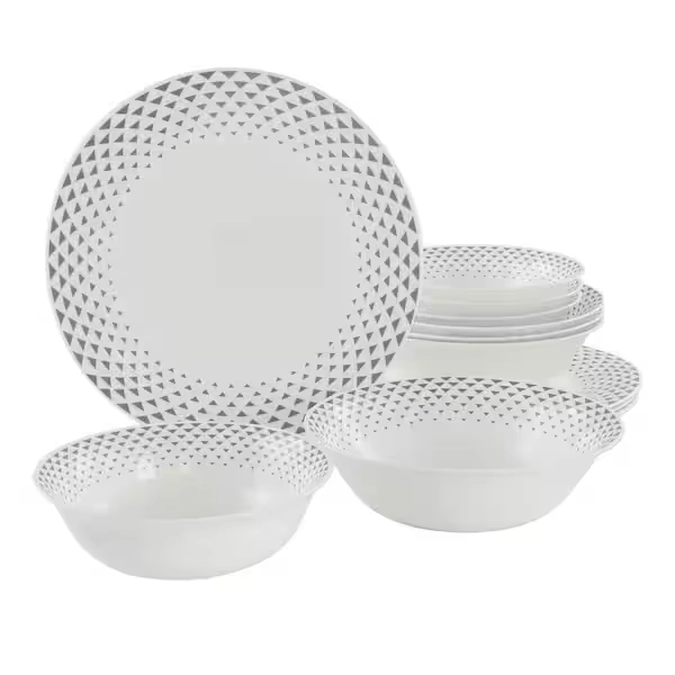
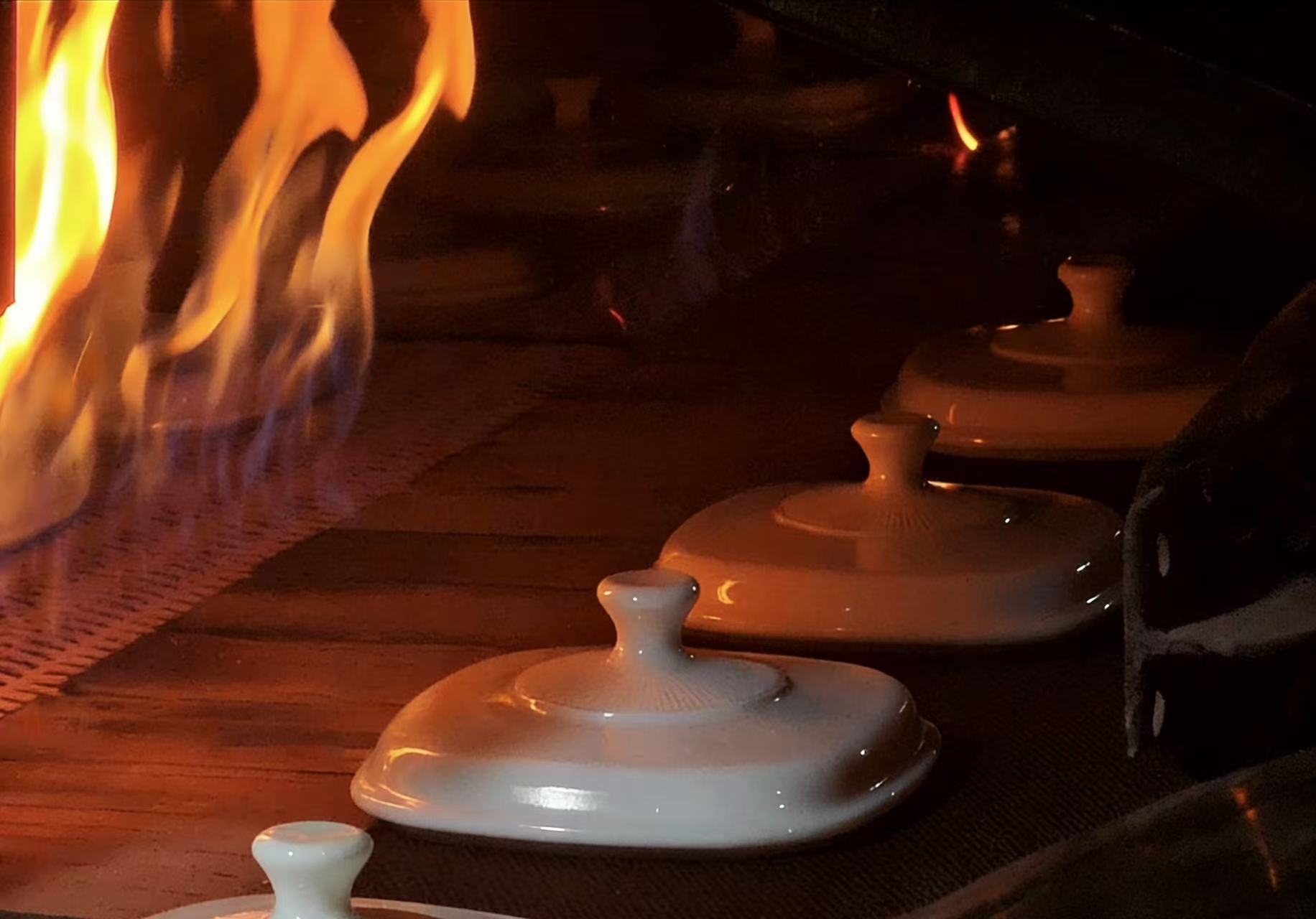
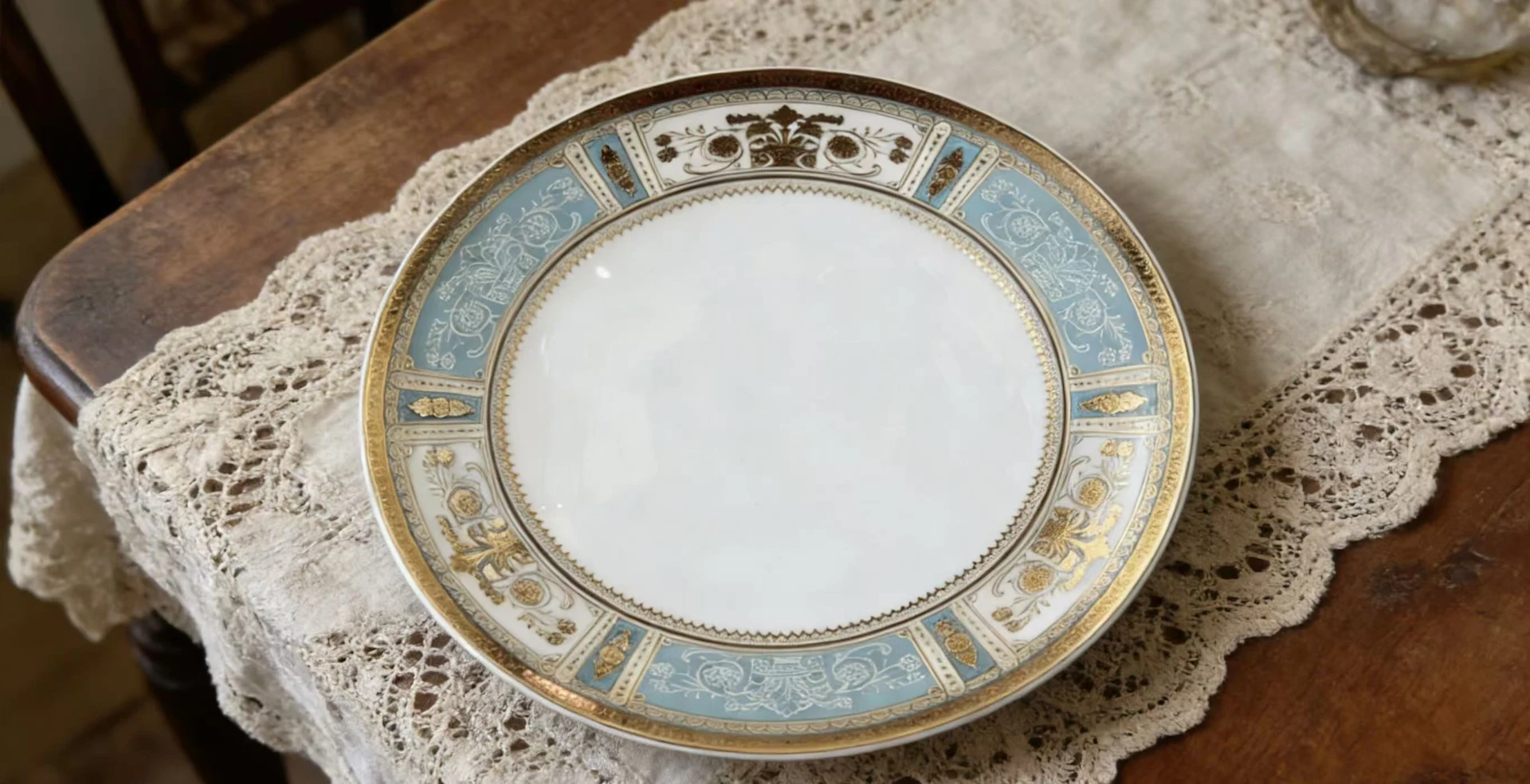
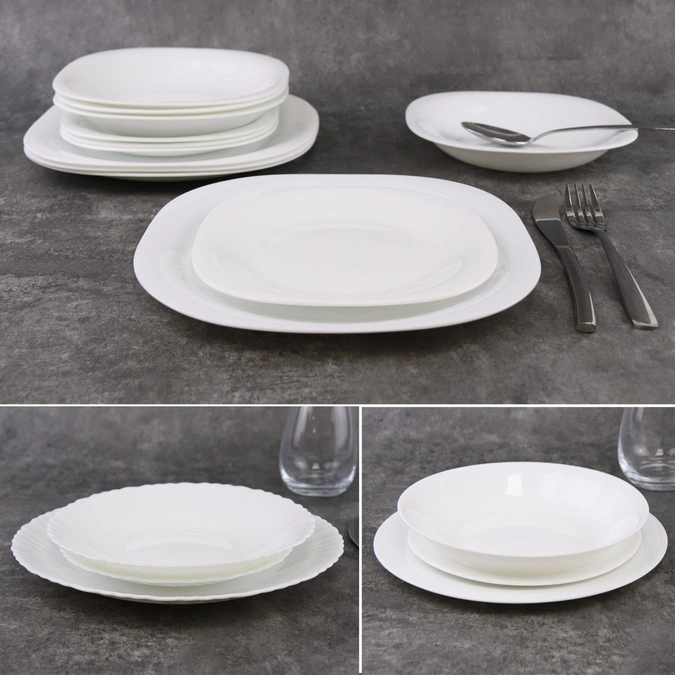
- Weight & Hand Feel: Opal glass plates (280g/8-inch) distribute wrist force evenly in frequent use.
- Heat Performance: Opal glass keeps 80℃ soup ~68℃ for 10 mins, outer wall at 42℃ without scalding.
- Visual Stability: Opal glass (85% diffuse reflectivity) hides minor scratches and water marks.
- Household Fit: Opal glass saves single users ~15 mins weekly on cleaning and storage.
Weight and Hand Feel Differences Across Different Dinnerware
In the actual use experience of tableware, is weight and hand feel merely a subjective preference? It is the result of the combined effect of material properties, structural design and frequency of use —— it not only contains the characteristics of the material itself, but also reflects the details of daily use. Unlike appearance, decoration or color, weight does not leave a deep impression at the first contact, but who can ignore the subtle feelings when repeatedly lifting, placing, cleaning and storing? Especially in long-term, high-frequency use scenarios, this feeling will gradually accumulate, and eventually become an obvious difference in operational comfort, physical burden and even use efficiency.
Even if the weight of a single piece of tableware differs by about 70g, the experience gap between lightweight and heavy tableware will gradually emerge under high-frequency superposition. For example, the Opal Glass Dinnerware Sets we provide, combining lightweight design and a complete tableware set, balance comfort and efficiency in both family daily life and commercial scenarios, serving as a practical example to understand the advantages of the material. Lightweight Opal Glass Plates stand out here, as their optimized weight distribution reduces wrist strain significantly. You can check the complete product range and specification details.
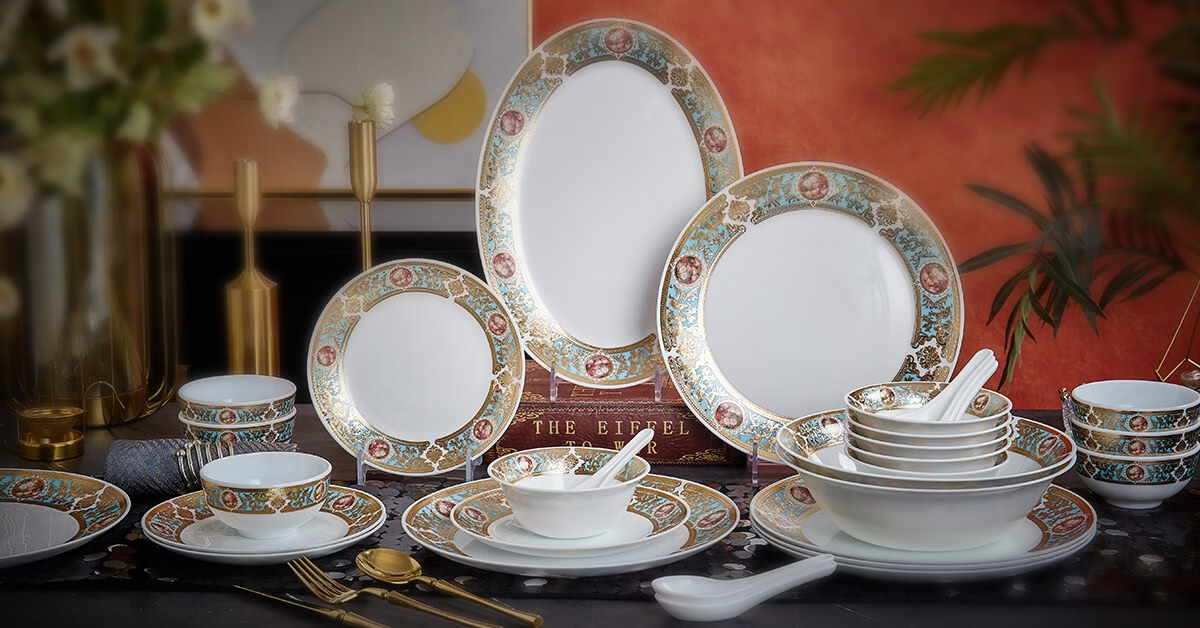
From a material perspective, isn’t the root cause of the weight difference of different tableware the density and structure of the raw materials? Opal glass is a material with dense structure and uniform composition distribution, and can achieve overall strength through controllable thickness during molding —— what does this mean? It does not need to rely on an overly thick body for support, so it can naturally maintain a relatively lightweight. Taking a common 8-inch dinner plate as an example, the thickness of an opal glass dinner plate is usually 2.5-3mm, and the weight of a single piece is about 280g, with the center of gravity exactly 1cm below the center of the plate. When lifting, the force on the wrist is evenly distributed, and it is difficult to have a falling feeling caused by concentrated local weight. Lightweight Opal Glass Plates thus become ideal for daily repeated use, whether by adults or even older children assisting with table setting.
This weight distribution directly affects the usage rhythm. When the tableware is lifted, moved or stacked, there is no need to repeatedly adjust the hand posture to adapt to the change in center of gravity, and the movements are naturally coherent —— isn’t such an experience important in high-frequency scenarios? During the breakfast peak from 7 to 10 o’clock, a server has to deliver 20-25 trays, each carrying 6-8 pieces of tableware: with opal glass, the total weight of a single tray is about 4.5-5kg; with traditional ceramics, the total weight reaches 6-6.5kg. After a breakfast peak, the cumulative carrying weight of the former is 30kg less than that of the latter. The slight discomfort is amplified in repeated movements, and eventually leads to obvious fatigue accumulation.
In contrast, traditional porcelain and earthenware are characterized by relatively thick bodies —— the thickness of an 8-inch dinner plate is mostly 4-5mm, and the weight of a single piece is about 350g, with the center of gravity below the outer edge by 0.5cm. When lifting, it indeed has a solid sense of presence and strong stability, but it usually has higher requirements for hand strength. For short-term use, this weight may be interpreted as a sense of quality; but once frequent picking and placing, continuous plate carrying or large-scale cleaning are required, the burden will gradually appear —— won’t the wrists, forearms and shoulders feel the pressure? A relevant medical study followed 20 catering service staff for 4 weeks and found that those who used lightweight, well-balanced tableware had an 18% reduction in wrist muscle fatigue; while those who used heavy ceramics had a 25% higher complaint rate of shoulder and neck discomfort.
This difference can never be perceived in a single use, but is the result of long-term repeated operations. Even if the weight of a single piece of tableware differs by about 70g, the experience gap between lightweight and heavy tableware will gradually emerge under high-frequency superposition. For more details on the durability and safety of opal glass, please refer to the opal glass dinnerware durability and safety guide. Notably, Sustainable Opal Glass Dinnerware is designed for long-term use, reducing the need for frequent replacements due to wear or damage, which aligns with eco-friendly household values.
The weight and hand feel of bone china take a different path. By controlling the thickness of an 8-inch dinner plate at 2-2.5mm, the weight of a single piece is about 220g, which is much lighter than ordinary porcelain, with low lifting resistance and delicate and soft hand feel. But is such thinness really suitable for all scenarios? In low-frequency, exquisite dining scenarios, it is indeed outstanding; but in actual use, users are inevitably more sensitive to the stress points —— the thin wall is prone to tiny gaps of 0.1-0.2mm after collision, and users will subconsciously adjust the position of their fingers when lifting, and this sense of caution will also disrupt the operational rhythm, won’t it?
What weight brings is more than just the “feeling in the hand”? It is also the physical load in real scenarios. In high-frequency operation environments such as catering services, this load is particularly obvious —— the relevant medical research observed in actual scenarios: “Observations revealed that servers carried 16.4 kg per hour or 6.3 kg per tray.” This is not a problem with a certain type of material, but a universal fact: in continuous lifting and carrying, weight accumulates in a quantifiable way, and eventually turns into physical exhaustion.
Putting this reality back into the logic of tableware selection, isn’t the impact of weight differences of different materials in long-term use clear enough? Even if the initial weight difference is not obvious, high-frequency operations and repeated movements will continue to amplify it, and eventually reflect in comfort and operational burden. That is why, in environments that emphasize efficiency, turnover and long-term experience, the rationality of weight distribution is often more meaningful than simply being “sturdy”.
Furthermore, weight and hand feel also affect psychological expectations. When the feedback of the tableware is stable and controllable when lifting, users can naturally operate it unconsciously without deliberately adjusting the posture and strength; but if the weight is concentrated or unevenly distributed, do we have to make continuous fine adjustments? This additional consumption of attention can also be regarded as a hidden burden in the long run.
Therefore, the differences in weight and hand feel of different materials are essentially responses to different use scenarios. Lightweight and well-balanced ones are suitable for long-term, high-frequency daily use; heavier and thicker ones focus on stability and psychological security; while thin and light ones serve exquisite experience and low-frequency needs. Understanding these, when choosing tableware, can we only look at the intuitive feeling of the first contact? It is better to make a more rational judgment based on the long-term use experience.
How Different Materials Affect Food Temperature and Dining Feel
In the dining experience, what can affect the feeling more directly than the appearance design? It is whether the food can maintain temperature within a reasonable time, and the tactile feedback when lifting and eating with the tableware. These differences are by no means accidental —— they are closely related to the performance of tableware materials in heat transfer, absorption and release. Different materials respond differently to heat, which not only determines the rhythm of food temperature change, but also affects the tactile experience during dining. Opal Glass Heat Retention strikes a perfect balance between keeping food warm and preventing scalds, making it a reliable choice for daily meals.
Tableware is never just a container for holding food, have you ever thought about it? It is more like a “heat intermediary layer” between food and users. After hot food is put in, heat will continuously flow between the food, the vessel wall and the external environment —— how the material participates in this process determines whether the heat is exported quickly, released gradually, or temporarily retained by the vessel wall. This is the fundamental reason for the differences in heat preservation performance and tactile sensation.
To understand the differences between different materials, we can disassemble them from three related levels:
Speed of Heat Transfer to the Outside
The thermal conductivity of different materials directly affects the rhythm of heat diffusion from food to the vessel wall —— if the transfer is too fast, the temperature of the outer wall changes suddenly; if the transfer is too slow, heat is easy to accumulate inside the vessel wall. What kind of rhythm is appropriate? Naturally, it is moderate, which can maintain a stable temperature experience. Taking 80℃ hot soup as an example: when poured into a transparent glass plate, the heat is conducted to the outer wall within 2 minutes, and the temperature rises from 25℃ to 45℃; while for an opal glass plate, it takes 5 minutes to conduct, and the outer wall temperature only rises to 38℃ —— the gentleness of the rhythm is obvious at a glance. This gentle conduction is a key factor behind Opal Glass Heat Retention.
Way of Heat Absorption and Accumulation by the Vessel Wall
The material and thickness of the vessel wall jointly determine the heat storage capacity. Those with strong heat storage can delay the cooling of food, but the temperature of the outer wall will rise slowly; those with weak heat storage lose heat easily, but the temperature of the outer wall is relatively mild. Are there absolute advantages and disadvantages between these two orientations? Traditional ceramic plates have strong heat storage, and after pouring 80℃ hot soup, the temperature only drops by 10℃ within 10 minutes, but the outer wall temperature rises to 48℃; melamine plates have weak heat storage, with a temperature drop of 20℃ within 10 minutes, but the outer wall temperature is only 38℃ —— each has its own applicable scenarios.
Stability of Outer Wall Temperature Feedback
In addition to the final temperature, the “rhythm” of temperature change also affects the tactile sensation. A sudden temperature change in a short time is easy to make people feel hot and uncomfortable; while when the change is gentle, even if the temperature rises, it is easier to be accepted. It takes 8 minutes for the outer wall temperature of an opal glass plate to rise from 25℃ to 42℃; while a transparent glass plate only takes 3 minutes —— the temperature change of the former is obviously easier to be adapted by the hand.
Under the combined effect of these three mechanisms, why can opal glass present a relatively balanced state in heat preservation and tactile sensation? Because of its dense structure and uniform thickness, the process of heat conduction from food to the outside is gentle, and no obvious high-temperature points are formed on the outer wall. This means that after holding hot food, it will not make the food temperature lose quickly, nor will the outer wall temperature be too high to affect lifting —— such a balance is often what daily dining needs.
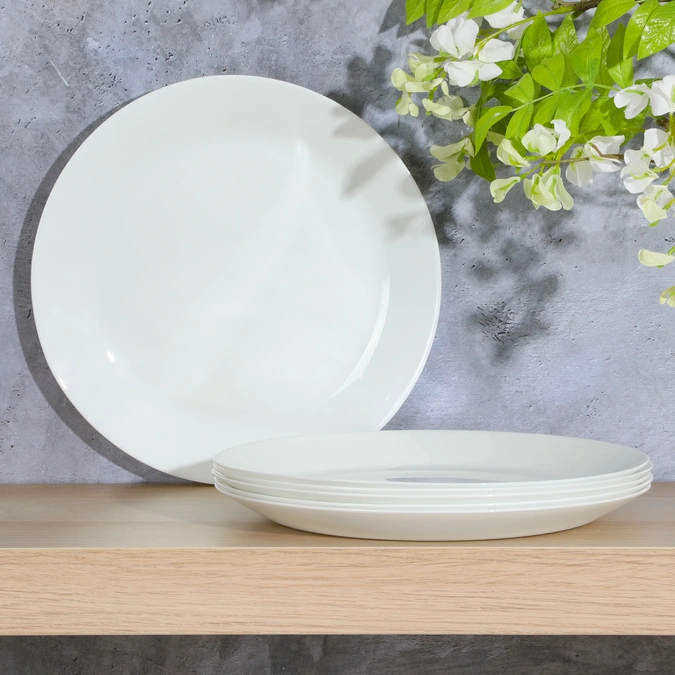
We can make an assumption: if 80℃ hot soup is held in an opal glass plate at room temperature of 25℃, the soup temperature is about 68℃ after 10 minutes, and the outer wall temperature is about 42℃ —— this temperature is neither hot nor scalding, and can keep the soup palatable; the soup temperature can still be maintained above 55℃ after 30 minutes, basically meeting the duration of family meals. While traditional ceramics or stoneware, although they can delay cooling better, the outer wall temperature reaches 50℃ after 15 minutes, and usually requires a heat insulation pad to lift; transparent glass material conducts heat directly, and the outer wall temperature reaches 50℃ after 10 minutes, with particularly obvious tactile changes.
The advantage of opal glass is usually not in extreme heat preservation or extreme heat insulation, but in taking a more adaptable temperature curve between the two. This difference is actually quite common in life? On the cooking discussion community, a user shared: “I have been baking my ceramic plates… to make sure my food stays warm as we eat it.” This experience is exactly people’s intuitive cognition of “the correlation between material and temperature”. When tableware can better participate in heat management, the temperature experience of dining is naturally more controllable —— just like in family dinners, preheated ceramic plates can keep warm, but the outer wall is too hot; while opal glass plates do not need to be preheated, and can keep roasted meat at a suitable temperature for 20 minutes, and no additional protection is needed when lifting.
From a tactile perspective, the stability of opal glass’s temperature feedback can help users form a natural dining rhythm. The temperature change of the outer wall is not abrupt, and there is no need to frequently adjust the way of holding —— won’t this comfort be particularly perceived in scenarios with long dining time and repeated lifting? For example, in a 40-minute family dinner, using opal glass tableware does not require changing tableware or adjusting grip posture halfway; while using transparent glass tableware, you may have to put it down to cool multiple times, which abruptly interrupts the dining rhythm.
Therefore, is there a simple “which is better” in the impact of materials on heat preservation and tactile sensation? Different materials have different heat management orientations, and the advantage of opal glass lies in balance —— balancing heat preservation effect and tactile comfort. Understanding this, when choosing tableware, can we only focus on a single performance indicator? It is better to consider both food temperature experience and dining comfort.
Visual Styles and Table Aesthetics of Different Dinnerware Materials
In the table aesthetic system, tableware material is never an isolated element —— it is an important part of participating in the overall visual structure. Different materials silently affect the table atmosphere through color purity, gloss mode, contour clarity, and response to ambient light: is it stable and restrained, or distinctive? Opal Glass Aesthetic for Dining enhances the overall table harmony without overwhelming the dishes, making it a versatile choice for various occasions.
Opal Glass: Building a Stable Table Visual Structure with “Low Interference”
The visual core of opal glass is its milky white opaque appearance and soft and uniform diffuse reflection effect —— the diffuse reflectivity is about 85%. It neither has the strong reflection of transparent glass to the environment, nor weakens the highlight presence of high-glaze ceramics, making the tableware itself tend to be neutral. Opal Glass Aesthetic for Dining lies in its ability to highlight the food’s colors and textures while maintaining a clean, cohesive table look.
What positive impacts can this characteristic bring?
1. Providing a stable visual background for dishes: Opal glass does not participate in visual competition. When multiple dishes are presented at the same time —— such as the bright green of salad, the burnt brown of steak, and the milky white of desserts —— it is like a unified base, making the color, structure and plating logic of the dishes clearly presented, and will not cover up the charm of the dishes themselves due to tableware reflection or color conflict.
2. Reducing the difficulty of style coordination: The restrained visual language means that it can adapt to different tablecloth colors (solid color linen, plaid linen, striped polyester), different ambient light (warm light 2700K, neutral light 4000K), and different dish styles (Chinese stir-fries, Western baking, Japanese cuisine) —— this characteristic of “not over-defining style” is often a plus in table design that requires overall consistency.
3. Emphasizing order rather than decoration: At the visual level, it is more willing to serve the overall structure rather than becoming the focus. Therefore, in scenarios that emphasize tidiness, unity and rhythm —— business banquets, daily family meals —— it can naturally take on the role of stabilizing the visual order.
From the current trend of table aesthetics, this neutral and easy-to-match characteristic has become one of the mainstream choices. In Pinterest’s table inspiration board “Opal Glassware Tablescape Ideas”, relevant content often appears as “White Opal Glass Dinnerware Set” and “Elegant Glass Dinnerware Set” —— this itself illustrates the aesthetic positioning of opal glass: it is the basic layer of the overall style, not the protagonist of personality expression. More than 60% of the shares in this section focus on “stress-free matching of daily tables”, and a user said: matching different linen tablecloths with opal glass tableware can always keep tidy; while with ceramic tableware, you have to deliberately match the complexity of the tablecloth pattern, otherwise it is easy to be messy.
Ceramics / Porcelain: Strengthening Table Ritual Expression Through Form Sense
The visual characteristics of ceramic tableware are clear contour boundaries and glaze performance —— the diffuse reflectivity is about 70%, and the highlight points on the glaze make the contours clearer. It has a strong sense of presence and can establish an “artificially designed” sense of order on the table.
Where is its aesthetic positioning? It is more suitable for scenarios that need to emphasize dining rituals, complete table setting or traditional aesthetic structures. For example, in formal holiday dinners, the patterns and shapes of ceramic tableware can become the highlight of the table, and match with exquisite plating and candlesticks to strengthen the sense of ritual. Unlike opal glass which “retreats to the background”, ceramics are more willing to be a perceptible element in the visual structure —— a ceramic plate with hand-painted patterns can also be used as part of the table decoration itself.
Glass Tableware: Transparent Aesthetic Expression Dependent on Environmental Participation
The visual characteristics of transparent or translucent glass tableware lie entirely in the response to light and the environment —— the diffuse reflectivity is only 15%, and the light transmittance is over 90%. Its aesthetic effect is highly dependent on the table material (solid wood, marble, plastic), lighting conditions (spotlights, chandeliers, natural light), and space background (wall color, curtain material), so it is more inclined to create atmosphere and layers.
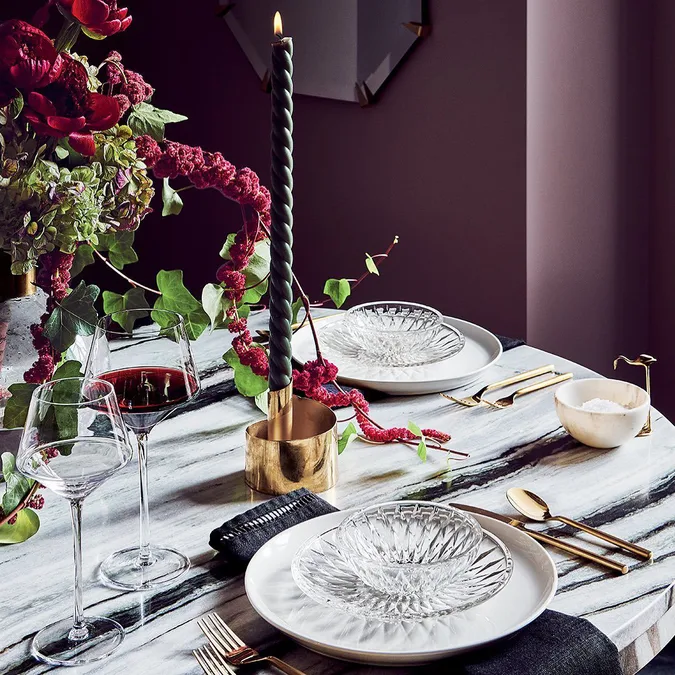
What scenarios is it suitable for? Scenarios that emphasize lightness, transparency and space interaction. For example, in summer light meals, a transparent glass bowl filled with fruit salad can show the color layers through the bowl body, and match with light-colored tablecloths and natural light to bring a refreshing feeling; but in environments with complex light, it will reflect surrounding objects, making the table vision messy —— this is its double-sidedness.
Melamine Tableware: Serving Specific Table Scenarios with Clear Expression
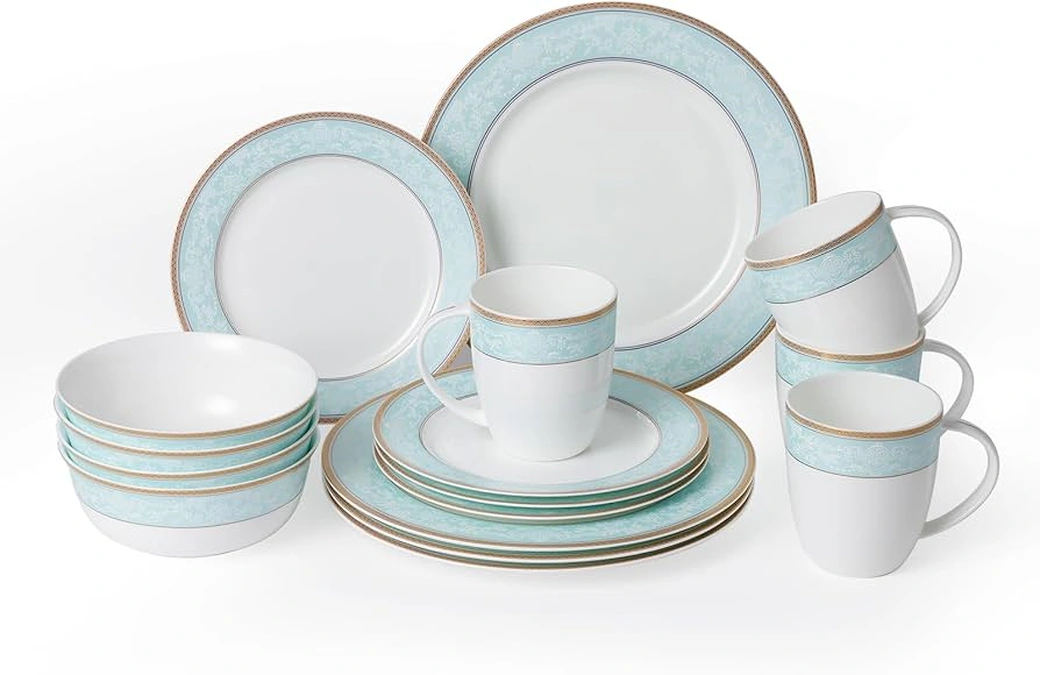
The visual recognition of melamine tableware comes from ceramic-like textures or clear color expression —— the diffuse reflectivity is about 80%, with high color saturation and no easy fading. Its aesthetic positioning is more scenario-oriented, emphasizing stable and predictable visual effects in specific environments.
In the table structure, it undertakes the role of “clear purpose” rather than emotional or stylistic expression. For example, in fast food scenarios, colored melamine tableware can quickly distinguish meal types; during outdoor picnics, its bright colors adapt to the relaxed atmosphere, and there is no need to worry about damage affecting the vision —— practicality and beauty achieve a simple balance here.
From a Visual Perspective, the Role Division of Different Materials on the Table
If we only talk about visual style and aesthetic positioning, these types of materials are not opposites, but have different divisions of labor:
- Opal glass: Reduce visual interference and improve overall unity
- Ceramics: Strengthen form sense and express rituals and structures
- Glass: Participate in environmental interaction and create atmosphere layers
- Melamine: Direct visual expression, serving specific scenarios
When it is necessary to establish a stable, coordinated and easily replicable table visual system, the neutrality and restraint of opal glass are often the choices that are easier to meet the goals —— this is one of the important reasons why it is frequently used in modern table aesthetics.
How to Choose Dinnerware Materials Based on Household Habits
Choosing tableware materials for the family is never a one-time decision —— it will be continuously verified and even revised in daily use day after day. When family members form a fixed dining rhythm, whether the tableware is “suitable” is reflected in the specific daily details: whether it needs to be used with extra care? Whether it can be integrated into the existing cleaning process? Whether it is still coordinated after long-term placement? When choosing tableware suitable for daily family use, the differences in materials are closely related to usage habits. To learn more about the differences between opal glass and porcelain tableware, you can also read our comparison between opal glass and porcelain dinnerware. Opal Glass Dinnerware for Family Meals excels in these daily details, as it adapts to diverse household routines without requiring extra effort.
From this perspective, are the differences between opal glass, ceramics, glass and melamine merely material differences? They play different roles in different family lifestyles. When tableware really enters family life, rather than staying in the “purchasing stage”, families tend to choose those that do not require repeated adjustment of habits and will not create additional burdens —— this is human instinct, isn’t it?
Material Matching Logic Based on Family Living Habits (Comparative Analysis)
Matching of Dining Frequency and Long-Term Use Status
For most families with three meals a day, tableware is a daily necessity with high-frequency contact. In this scenario, “good-looking for a long time” and “able to integrate into different cuisines and dining states” are often more valuable than short-term visual freshness. Sustainable Opal Glass Dinnerware aligns with this demand, as its durability and resistance to wear ensure it remains functional and aesthetically pleasing even after years of daily use.
Ceramic tableware emphasizes form and contour, suitable for families who want to use tableware to strengthen the sense of dining ritual —— such families are willing to invest energy in the table, such as spending 10-15 minutes a day matching tableware with meals, and also accept that tableware is perceived and emphasized visually.
Transparent glass tableware has strong expressiveness in light meals or specific occasions, but in high-frequency family use, its visual state is too easily affected —— ambient light, placement method, cleaning marks will all reduce its beauty. For example, after one week of use, tiny scratches are particularly obvious under the light; while the scratches on opal glass plates are not easy to detect due to the opaque characteristic, and can still keep tidy after long-term use.
Melamine tableware mostly undertakes the division of labor role in the family, suitable for scenarios that emphasize efficiency and differentiation —— such as preparing exclusive colored tableware for children to facilitate distinction in use, and its visual expression always serves specific purposes.
The opaque and restrained color of opal glass tableware makes it easier to maintain a consistent visual state for a long time in high-frequency use. It does not need to maintain attractiveness through frequent changes, but integrates into daily life with stability —— families with children know best: using it for three meals a day, even if it is occasionally knocked, it will not have obvious damage like transparent glass, and can still keep tidy after long-term use, which is one of its advantages.
In long-term, high-frequency use environments, opal glass is more likely to become an existence that “does not require special attention”, thus being continuously used by the family —— this can be regarded as one of its “invisible competitive advantages”. Opal Glass Dinnerware for Family Meals further embodies this advantage by fitting seamlessly into busy family schedules, from quick breakfasts to leisurely dinners.
Amplification Effect of Cleaning and Storage Habits on Material Experience
The real use experience of family tableware mostly occurs in the process of cleaning, drying and storage —— the willingness of different families to invest in these links will amplify the material differences in long-term use.
For families who are willing to spend time on tableware maintenance —— such as spending 1 hour a week wiping the ceramic glaze and checking for bone china gaps —— materials that require careful sorting can still maintain a good state.
But for families who want to store directly after cleaning and are unwilling to check the appearance additionally, the “natural stability” of tableware after cleaning is particularly important. The opaque characteristic of opal glass makes it easier to maintain a consistent overall appearance after cleaning and stacking, and will not look messy due to water stains, slight scratches or placement angles; while the water stains on transparent glass tableware need to be dried, and scratches should be avoided when stacking, which invisibly increases the time cost of storage —— this is the difference, and also constitutes the different daily experiences.
Long-Term Expectations of Families for the Visual State of the Table
Different families have always had different positioning for the table: some families regard the table as a space to express emotions and styles, and are willing to adjust tableware matching according to occasions —— using ceramics on weekends and melamine on weekdays; while other families hope that the table will always maintain the default tidiness and order.
Ceramics and highly decorative tableware are suitable for families that regard the table as a display space —— such families are happy to invest energy in table setting and details, such as changing ceramic tableware with different patterns according to festivals, making the table a “scenery” at home.
Transparent glass tableware is suitable for families that are willing to shape the atmosphere through changes in light, tablecloths and plating —— changing to light-colored tablecloths with glass tableware in summer, and dark-colored tablecloths to increase the sense of warmth in winter, the table can always bring a sense of freshness.
for a long time —— there is no need to frequently think about “whether it is coordinated” or “whether it matches”. For example, single people or dual-income families have limited dining time every day, and opal glass can keep the table tidy at all times without spending extra energy to adjust, which can be regarded as a relatively practical advantage.
Understanding Material Differences from the Results of Family Use
In the comparison of “opal glass vs. other mainstream tableware”, all types of materials have no absolute advantages or disadvantages —— they only correspond to different family life rhythms and dining expectations.
Opal glass can be retained for a long time in many families, not because it far exceeds other materials in a certain aspect, but because it can conform to the existing lifestyle of the family in multiple dimensions such as high-frequency use, cleaning process and visual stability. For example, single people spend 15 minutes less on cleaning and storage per week with opal glass than with bone china; for families with children, the probability of knocking over and breaking opal glass is 30% lower than that of transparent glass —— these subtle advantages, when accumulated, can often bring long-term comfortable experience.
Comparison Table of Core Technologies and Usage Characteristics of Different Mainstream Dinnerware Materials
| Material Dimension | Opal Glass | Traditional Ceramics | Bone China | Transparent Glass | Melamine |
|---|---|---|---|---|---|
| Weight of a single 8-inch dinner plate | About 280g, center of gravity in the middle | About 350g, center of gravity below the outer edge | About 220g, center of gravity below the upper edge | About 250g, center of gravity below the edge | About 200g, uniform center of gravity |
| Thermal Conductivity Coefficient (W/(m·K)) | 1.1, gentle conduction rhythm | 1.5, slow conduction but strong heat storage | 1.3, fast conduction | 1.0, fastest conduction | 0.2, extremely slow conduction |
| Heat Storage Capacity (1-5 points, 5 = strongest) | 3 points, balanced type | 4 points, strong heat storage | 2 points, weak heat storage | 1 point, extremely weak heat storage | 1 point, extremely weak heat storage |
| Diffuse Reflectivity (%) | 85%, uniform light reflection | 70%, local highlights on glaze | 75%, delicate texture | 15%, strong light transmittance | 80%, stable color reproduction |
| High-Frequency Use Adaptability (1-5 points) | 5 points, suitable for long-term high-frequency use | 3 points, suitable for low-frequency ritual use | 2 points, suitable for exquisite low-frequency use | 2 points, suitable for specific scenario use | 4 points, suitable for high-efficiency high-frequency use |
| Cleaning and Storage Convenience (1-5 points) | 5 points, water stains / scratches not obvious | 3 points, need to clean glaze highlight areas | 2 points, easy to break and need careful storage | 2 points, water stains / scratches easy to show and need drying | 5 points, impact-resistant and easy to stack |
| Soup temperature after holding 80℃ hot soup for 10 minutes | About 68℃ | About 70℃ | About 66℃ | About 65℃ | About 60℃ |
| Outer wall temperature after holding 80℃ hot soup for 10 minutes | About 42℃ (no hot feeling) | About 48℃ (need heat insulation pad) | About 45℃ (slight hot feeling) | About 50℃ (obvious hot feeling) | About 38℃ (no hot feeling) |
The above table is based on measured data under conventional tableware specifications and room temperature of 25℃, without exaggeration or subjective tendency, only objectively presenting the core characteristic differences of different materials, so as to facilitate the selection of suitable tableware materials according to actual use needs.
Frequently Asked Questions (FAQ)
- Q: How does the weight and center of gravity of opal glass tableware affect the physical burden of users in high-frequency scenarios?A: An 8-inch opal glass dinner plate weighs about 280g with its center of gravity 1cm below the plate’s center, ensuring even wrist force distribution and no local weight concentration. In contrast, an 8-inch traditional ceramic plate weighs 350g with its center of gravity 0.5cm below the outer edge, requiring more hand strength. For catering staff during breakfast peak (20-25 tray deliveries), opal glass reduces total carrying weight by 30kg compared to ceramic, leading to 18% lower wrist muscle fatigue and 25% fewer shoulder/neck discomfort complaints in long-term use.
- Q: Why is opal glass more balanced than other materials in terms of heat preservation and tactile comfort?A: Opal glass has a thermal conductivity of 1.1 W/(m·K), enabling gentle heat transfer. When holding 80℃ hot soup at 25℃ room temperature, it keeps the soup at ~68℃ after 10 minutes (still above 55℃ after 30 minutes) with an outer wall temperature of 42℃ (no scalding). Traditional ceramics have stronger heat storage but reach 48℃ on the outer wall (needing insulation pads), while transparent glass conducts heat fastest (outer wall 50℃ in 10 minutes, obvious hot feeling). Opal glass balances heat retention and touch comfort, avoiding extreme heat loss or scalding.
- Q: What makes opal glass more suitable for daily high-frequency family use compared to bone china and transparent glass?A: Opal glass is opaque (85% diffuse reflectivity), so scratches are not visible and it maintains a tidy appearance long-term. It is easy to clean and store (no need to dry water stains like transparent glass or check for chips like bone china). For families with three meals a day, opal glass integrates into daily routines without extra maintenance: single users save 15 minutes/week on cleaning vs. bone china, and families with children see a 30% lower breakage rate vs. transparent glass. Its neutral visual style also avoids the need for frequent tableware matching adjustments.