
When a restaurant chain scales to 50 locations, color variation across tableware stops being a quality control issue. It becomes a material issue. This guide breaks down five mainstream materials and how they actually perform in multi-unit restaurant operations — so you can make the right call before you scale.
- Tableware Color Variation Is a Material Problem
- Five Common Tableware Materials: Color Variation Comparison for Chain Restaurants
- After Choosing the Material, How to Completely Eliminate Color Variation
- What Tableware Material to Choose for Fast Food, Casual Dining, and Mid-Range Chains
- What Tableware Material Should a 50-Store Restaurant Chain Choose
- Common Questions People Ask
Tableware Color Variation Is a Material Problem
Most people blame the supplier. Or the store manager. But chain restaurant tableware color variation almost always traces back to the material itself — specifically, how it’s made.
Ceramic tableware is shaped by three variables at once: glaze batch, kiln temperature, and where the piece sits inside the kiln. Every production run comes out a slightly different shade. Melamine has a different issue. Its color is sprayed onto the surface, and that coating wears off unevenly — with each store fading at its own pace.
Here’s how each mechanism works.
Why Ceramic Tableware Often Has Color Variation
Ceramic tableware — reinforced porcelain, standard porcelain, all of it — picks up color variation from three sources that compound each other.
Glaze batch differences. Every batch of glaze has slight shifts in mineral composition. Even the same formula from the same supplier won’t produce an identical color twice. Kiln temperature fluctuations. Just 10–20°C of drift changes the glaze color. Inside the same kiln, spots near the heat source run hotter than spots farther away. Kiln position. Upper rack vs. lower rack, front vs. back — heat distribution is never perfectly even. Products from the same firing come out in slightly different shades.
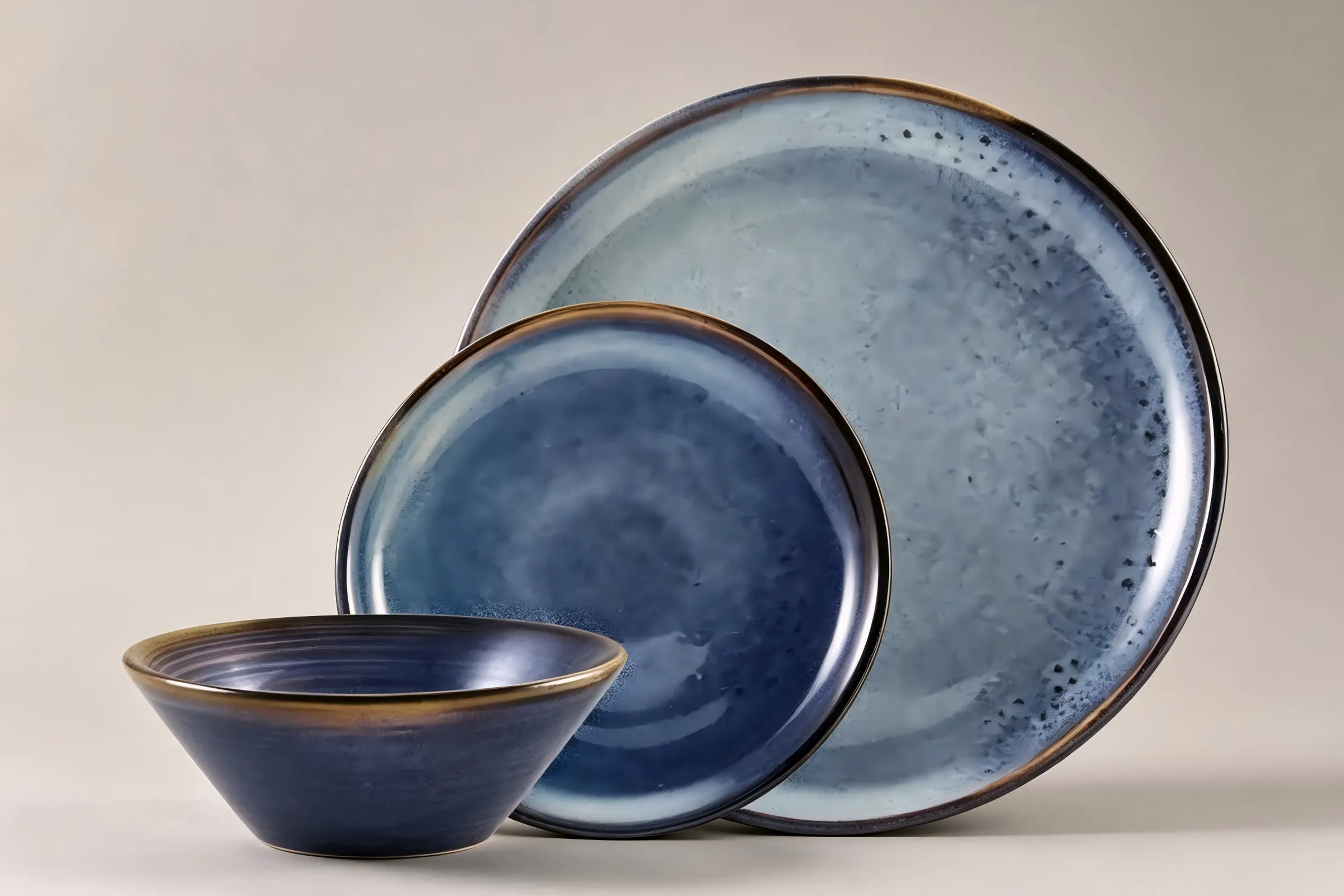
All three variables are always in play. That’s why ceramic tableware color variation between batches isn’t a matter of “if” — it’s a matter of “how much.”
Long-term use makes it worse. Ceramics are a two-layer structure: glaze on top, clay body underneath. Those two layers expand and contract at different rates. After hundreds of commercial dishwasher cycles, the glaze develops micro-cracks — the industry calls this crazing. Gloss drops. Color darkens.
And here’s the catch: different stores use their tableware at different intensities. A high-turnover location runs more wash cycles, so its glaze ages faster. Six months in, the same batch of plates already looks different from store to store. That’s not a supplier problem. It’s baked into the material.
Why Melamine Tableware Starts Discoloring After Six Months
Most melamine tableware gets its color from a spray coating — not from the material itself. That creates a basic problem: color that lives on the surface will get worn off. Hot water speeds up fading. Acidic foods — vinegar, tomato, lemon juice — eat into the coating. Forks and knives leave scratches every service. All of this is just normal daily use in a chain restaurant.
There’s another issue people often miss. Melamine’s surface is much softer than ceramic, so scratches pile up fast. Three to four months in, plates start looking gray and hazy. Nothing is cracked or chipped. They just look old.
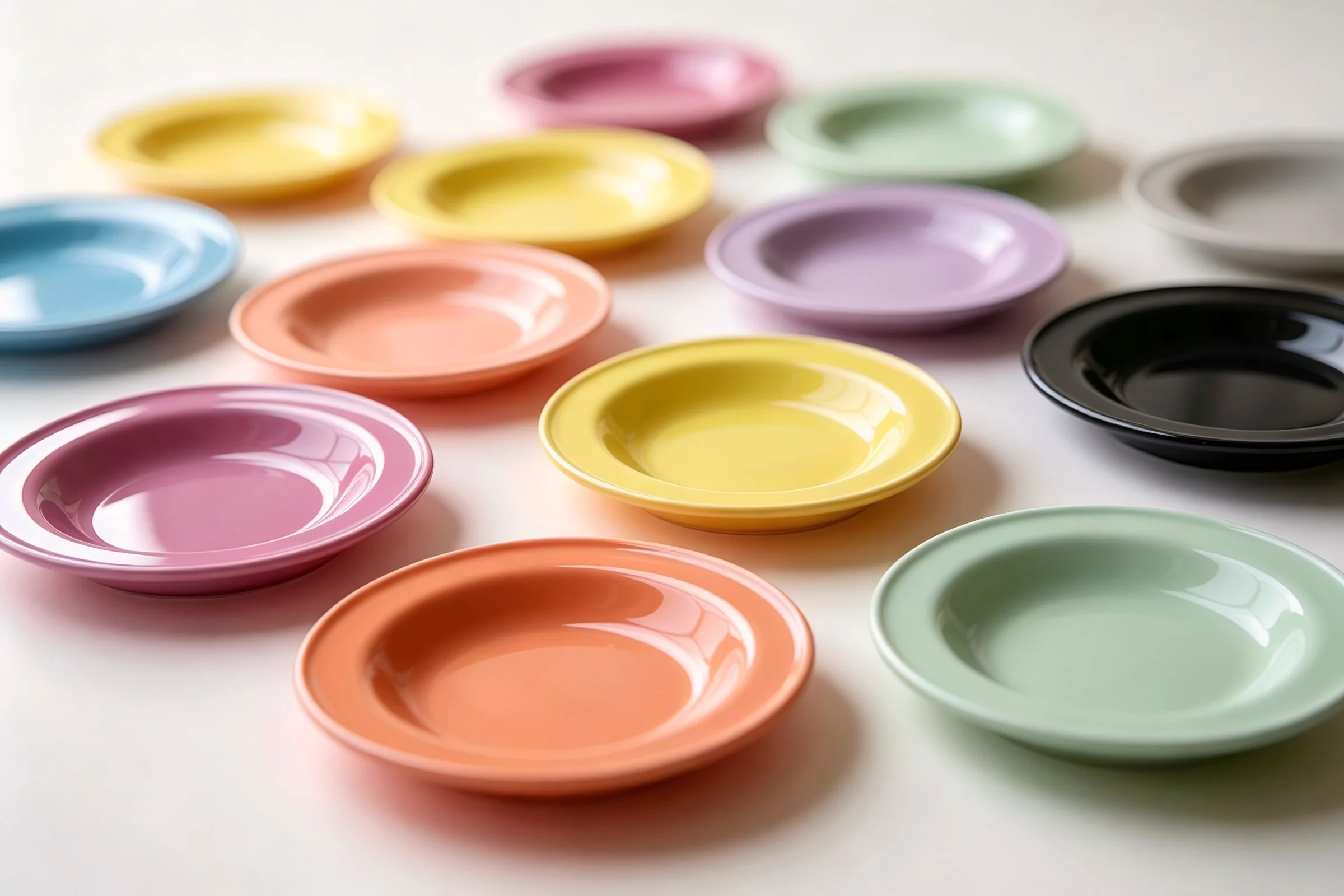
Melamine’s physical lifespan far outlasts its visual lifespan. The plate still works fine. But it’s already hurting how your brand looks.
Since every store has different traffic, the “aging speed” varies too. After six months, some locations still look okay while others are clearly faded — and that gap is what kills chain restaurant dinnerware consistency across stores. Similar discoloration worries aren’t limited to melamine, either. If you’re considering light-colored options like jade porcelain, this analysis of whether jade dinnerware turns yellow breaks down how different materials discolor over time.
Five Common Tableware Materials: Color Variation Comparison for Chain Restaurants
Across 50+ locations with ongoing reorders, tempered opal glass delivers the best tableware batch consistency reorder after reorder. It’s a single-substance material formed in industrial molds — no glaze layer to age, no kiln variables to manage. After 2,000+ commercial dishwasher cycles, the whiteness barely shifts.
Reinforced porcelain carries color mismatch risk with every restock. Melamine starts out consistent but fades unevenly within months. Bone china can hold its color but costs too much at scale. Stoneware and standardization simply don’t mix. Below is a material-by-material breakdown — a straightforward dinnerware material comparison for chain restaurants.
Reinforced ceramic: Color difference is prone to occur when restocking.
Reinforced porcelain is the most common material in chain restaurants today. Plenty of suppliers, wide price range, lots of shapes and sizes. There’s a reason everyone uses it.
But every one of the three variables from the ceramic section — glaze batch, kiln temperature, kiln position — hits reinforced porcelain in full.
Managing it is possible. You can write Delta E tolerances into your contracts, set up a master sample system, visually inspect every incoming shipment, and reject batches that don’t match. Done well, this keeps variation within a range. But it’s expensive to maintain and completely dependent on people following through.
Here’s what often gets overlooked: reinforced porcelain in commercial kitchens has an annual replacement rate of about 50%–150%. That means in a single year, you may need to restock half your inventory — or more. Every reorder opens a new window for color mismatch. The more often you reorder, the more new and old batches get mixed together, and the more visible the differences become.
Bone china and stoneware: color difference range is small
Bone china does hold its whiteness better than reinforced porcelain. The 30%–50% bone ash content makes the body denser, which narrows the color range after firing. But bone china runs 2–3× the price per piece. At 50 stores, once you factor in annual reorders, the total cost gets steep. Unless your brand lives in the premium tier with a ticket size to match, bone china doesn’t pencil out at scale.
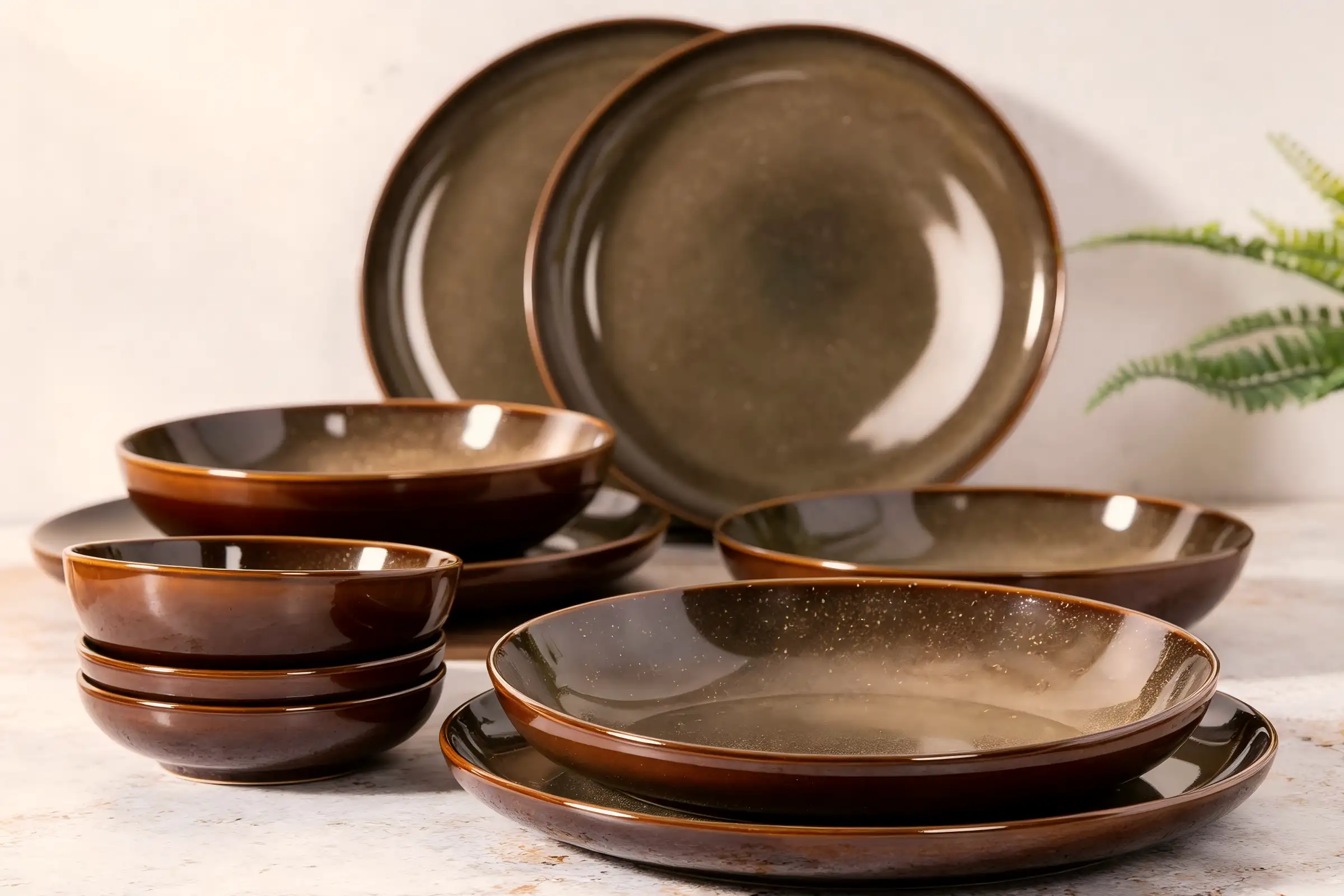
Stoneware is a different story entirely. Its reactive glaze is the selling point — every piece comes out unique, with flowing patterns and random color shifts. That’s great for a single-location concept. It’s a problem when your goal is tableware standardization for restaurant chains that need 50 stores to look the same. Stoneware suits artisan brands. It doesn’t suit multi-unit consistency.
Melamine tableware: The color difference is not obvious at first, but it becomes noticeable after six months.
Melamine is mold-formed, so right out of the box, batch-to-batch variation is genuinely small — much smaller than kiln-fired ceramics. Day one, it looks great.
The trouble starts after a few months of use.
As covered earlier, melamine fades and scratches quickly, and stores degrade at different speeds. A busy location serving acidic dishes might see plates graying in three months. A quieter store might look fine at the six-month mark. Over time, the visual gap between locations just keeps widening.
On paper, melamine’s annual replacement rate is only about 10%–20%. But that number only counts physical damage — cracks and breaks. Factor in plates that “still work but already look bad,” and the real replacement need is noticeably higher.
Tempered opal glass (with virtually no color difference)
Opal glass isn’t widely known in the domestic market yet, but it’s been a workhorse in commercial food service overseas for over 60 years. The French brand Arcopal launched its opal glass line back in 1958, and it’s still widely used in hotels and chain restaurants globally. If you want a deeper look at the material science and performance data before comparing, start with this complete guide to opal glass commercial tableware.
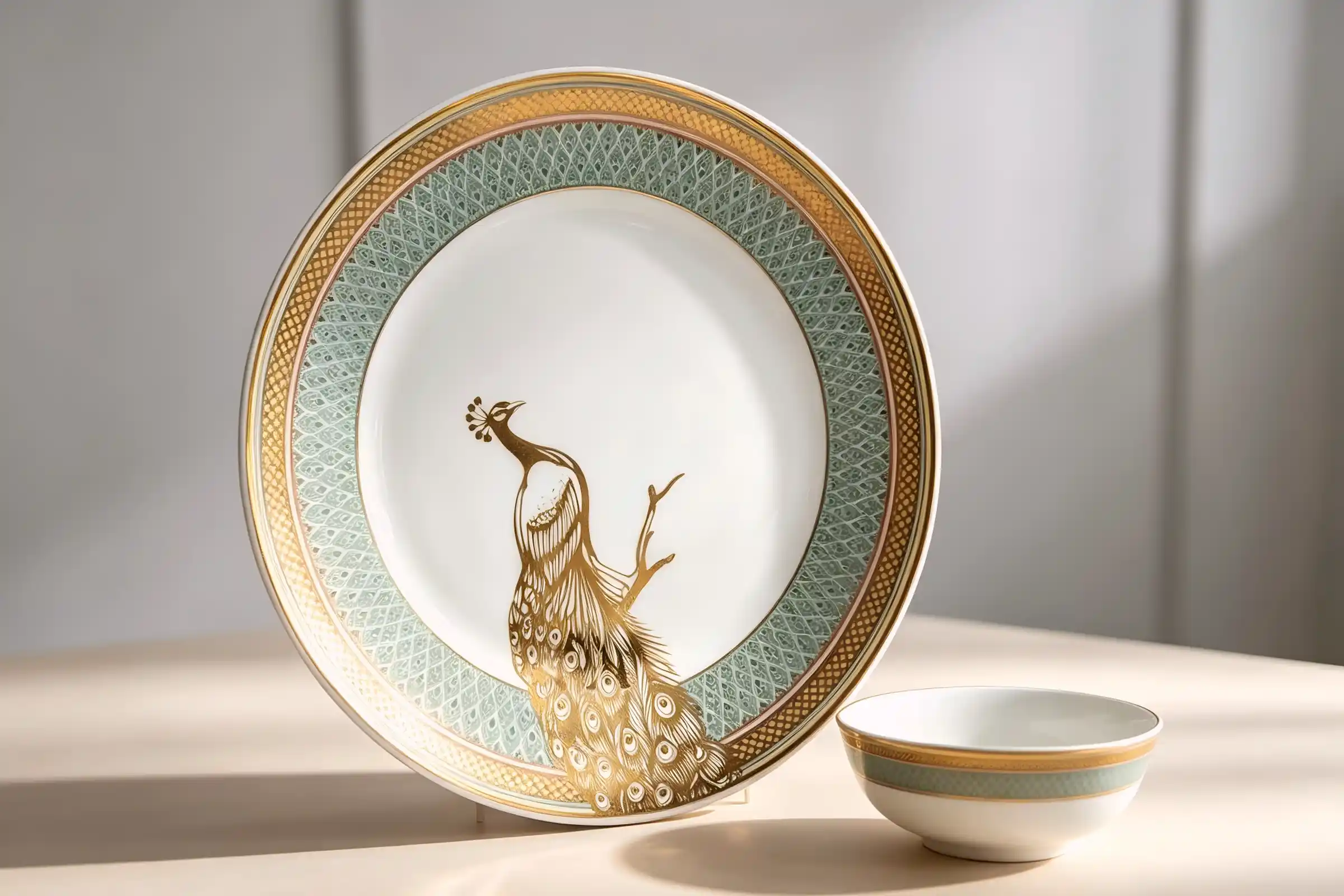
For a decision-maker running 50 stores, opal glass tableware for chain restaurants works on a completely different logic. It doesn’t solve color variation by managing harder. It solves it by removing the variables at the material level.
Why is opal glass naturally consistent from batch to batch?
First, it’s a single-substance material. The milky white color comes from the glass body itself — through fluoride or phosphate opacifiers — not from a glaze layer over a separate clay body. No two-layer structure means no glaze aging. No crazing. Put a plate from this quarter next to one from two years ago, and you can barely tell them apart.
Second, it’s formed in industrial molds, not fired in kilns. No kiln-position lottery. Dimensions, weight, and whiteness come out highly uniform from batch to batch.
Third, the surface is tempered. It’s harder than melamine, so scratches build up much more slowly. After 2,000+ commercial dishwasher cycles, gloss and whiteness hold steady. You won’t see the pattern where some stores’ plates look dull while others still shine.
We supplied a fast-food chain with 38 locations in Southeast Asia. They had been on reinforced porcelain and needed dedicated staff to check color variation every quarterly reorder. Their return rate sat at 8%–12%. After switching to opal glass, they went four straight quarters with zero color-related returns. Reorders went from the truck to the table, no inspection needed.
Annual breakage runs about 3%–5% — compared to 50%–150% for reinforced porcelain. Fewer reorders means fewer chances for new and old batches to clash. When weighing opal glass vs porcelain for a restaurant chain, that difference in reorder frequency alone changes the math on long-term brand consistency.
To be clear about the trade-offs: opal glass won’t give you the handcrafted feel of stoneware or the translucent elegance of bone china. The shape selection is narrower than porcelain — round plates, soup bowls, and cup-and-saucer sets are all well-covered, but unusual shapes and specialty forms are still limited. And it does break when dropped on a hard floor, unlike melamine. For outdoor seating or kids’ areas, melamine may still make sense as a supplement.
A study in the International Journal of Applied Glass Science (published by the American Ceramic Society) examined the structure and durability of opal crystallized glass. The conclusion: the microcrystalline structure gives opal glass strong resistance to both thermal shock and mechanical impact. That lines up with what we’ve seen across years of real-world supply. (Source: Int. J. Appl. Glass Sci., 2024)
Five Tableware Materials Color Variation Comparison Table
Here’s everything above in one table. Every dimension focuses on color variation and quality control at 50-store scale:
| Dimension | Reinforced Porcelain | Bone China | Stoneware | Melamine | Opal Glass |
|---|---|---|---|---|---|
| Batch-to-batch color control difficulty | High | Medium | Extremely high | Medium (low at first, uneven later) | Low |
| Appearance after 1,000 commercial washes | Glaze starts darkening | Relatively good | Noticeable change | Fading and scratching | Almost no change |
| Annual replacement rate (= how often color risk resets) | 50%–150% | 15%–30% | 30%–60% | 10%–20% | 3%–5% |
| Extra QC system needed for color control | Yes (Delta E clauses + master samples) | Yes | Can’t manage it | Moderate | Barely needed |
| Unit weight (10-inch plate) | 400–600 g | 250–400 g | 500–700 g | 150–250 g | 300–450 g |
| Microwave / Oven / Heat lamp | All ✓ | Microwave ✓ Oven ✓ (no metal trim) | Microwave ✓ Oven: verify first | None | Microwave ✓ Oven ✗ Heat lamp ✓ |
| Standardization-friendliness at 50 stores | Medium | Medium-high | Low | Medium | High |
Over on Reddit’s r/BuyItForLife (3.87 million members), there’s plenty of long-term feedback on opal glass. Multiple users say their Corelle sets — also opal glass — have lasted 20–30+ years with no chipping and no color change. One user wrote that her set “survived 10 moves, 2 kids, and after 20 years all 8 plates are still here.” That’s a household setting, but it tells you something real about how well the material holds its appearance over time. (Source: Reddit r/BuyItForLife)
After Choosing the Material, How to Completely Eliminate Color Variation
Picking the right tableware material for multi-location restaurants handles about 80% of the color variation problem. The last 20% comes down to two things: a master sample system and a clear acceptance standard in your procurement contract. For commercial white tableware, Delta E ≤ 1.5 is the recommended threshold.
For opal glass, these measures are a safety net you’ll rarely need. For ceramics, they’re the front line — and you’ll rely on them constantly.
One Set of Master Samples Is All You Need for Every Reorder
From your first bulk order, pick a set of pieces that best represents the target appearance. These are your master samples. Tag them with batch number, production date, and material code. Keep one set at HQ and send one to the supplier.
Every time a reorder arrives, hold a new piece next to the master sample under natural light. If you can see a difference, pull it before it hits the floor.
For ceramics, don’t just keep one “standard” sample. Keep three: lightest acceptable, standard, and darkest acceptable. That gives you a tolerance range. Anything that lands inside it passes. For opal glass, where batches already come out nearly identical, the master sample system is just a backstop — not something you’ll be running through on every delivery.
How to Write Color Variation Acceptance Standards into Procurement Contracts
No matter which material you go with, put a color variation standard in your contract. For white commercial tableware, Delta E ≤ 1.5 is the industry baseline — anything beyond that counts as a fail. Having that threshold written down is the foundation of tableware quality control across multiple locations.
Keep it simple. Two things need to be defined: what counts as unacceptable color variation, and what happens when it’s exceeded. With those two clauses in place, every future dispute has a clear reference point. Less arguing, faster resolution.
Also worth adding: require the supplier to keep production samples from each batch. That way the next reorder has a physical benchmark to check against.
What Tableware Material to Choose for Fast Food, Casual Dining, and Mid-Range Chains
Fast food and high-turnover chains are best served by opal glass — consistent out of the box, low maintenance on reorders. Mid-range chains with aesthetic ambitions should weigh opal glass against high-QC porcelain. The deciding factor comes down to what matters more to your brand: texture or management overhead.
How Fast Food and High-Turnover Chains Should Choose Tableware
In this segment, the priority is simple: reordering shouldn’t require worrying. High turnover, heavy wash loads, lots of locations spread across a wide area — if color control takes a dedicated team, it won’t get done consistently.
Opal glass fits this scenario best. Batches match out of the box. Reorder frequency is low. Old and new stock sit side by side with no visible gap. Long-term total cost is the lowest of the five materials.
If some of your locations have outdoor seating or kids’ zones, melamine works well as a local supplement for those areas. It’s virtually unbreakable, and that’s what matters most in those spots.
How Mid-Range Chains That Care About Brand Aesthetics Should Choose Tableware
Mid-range brands often need their tableware to carry some personality. It can’t look purely functional. There needs to be a sense of refinement.
You have two paths:
Path one: High-QC commercial porcelain, backed by a strict master sample system and Delta E contract clauses. Porcelain gives you the widest range of shapes and styles. The downside is ongoing management cost and chain restaurant tableware color variation risk on every single reorder.
Path two: Opal glass in well-designed shapes, letting the material’s built-in consistency do the quality control work for you. Management is lighter and long-term costs are lower. The trade-off is a narrower range of shapes — brands that need very distinctive forms may find the selection limiting.
Which path wins depends on your brand’s priorities. There’s no single right answer. But both options deserve a proper side-by-side evaluation before you commit.
What Tableware Material Should a 50-Store Restaurant Chain Choose
If you boil this entire guide down to one line:
For most chain brands in active expansion, opal glass delivers the best overall performance on color variation and quality control.
Not because it’s the prettiest option. Not because it’s the cheapest per piece. Because its material structure eliminates the variables that cause color drift — no glaze aging, no kiln fluctuation, no surface fading. Keeping 50 stores visually consistent stops being a management burden.
If you’re still weighing your options, here’s a low-risk way to test: run a 3-month trial in 1–2 stores. Use opal glass alongside your current tableware under the same conditions. After one quarter, compare color variation and breakage data. Numbers tell you more than any recommendation can.
If you’re already leaning toward opal glass, browse our opal glass tableware product line to see specs and shapes by category, and find the right fit for your operation.
Common Questions People Ask
Q: We only have 10 stores right now. Should we switch materials this early?
A: 10 stores is actually the cheapest time to switch. The more locations you have, the bigger your existing inventory, and the more expensive a full swap becomes. Wait until you hit 30–50 stores and you’re looking at tens of thousands of old plates to phase out, plus weeks of running two systems in parallel. Switch earlier, and every reorder from that point on costs less.
Q: We use black or dark-colored tableware. Doesn’t that hide color variation?
A: It hides shade differences, yes. But scratches and wear marks show up far more on dark surfaces — every light scratch looks like a white chalk line. Dark melamine is especially bad for this. After three months, you’ll see a gray haze across the plate. Dark porcelain ages too — it just shows up as “flat and dull” instead of “yellowed.”
Q: Our supplier guarantees no color variation in the contract. Isn’t that enough?
A: A contract covers you after something goes wrong. It doesn’t prevent the problem. Getting a replacement batch takes 2–4 weeks minimum. During that gap, stores either use mismatched plates or run short. Frequent returns also push up hidden freight costs. The better move is to choose a material where color variation rarely happens in the first place — then the contract becomes a safety net, not something you lean on every quarter.
Q: Is opal glass safe when it breaks? Are the fragments a risk in restaurant settings?
A: Tempered opal glass tends to break into larger, blunt-edged chunks — not the small, razor-sharp shards you get from regular glass. Cut risk is significantly lower. That said, it’s not unbreakable. Drop it on tile or terrazzo and it will crack. A standard glass-breakage protocol in back-of-house covers it — the same kind you’d already have in place for porcelain.