
Before buying dinnerware, cleaning is often the last thing holding you back. Is it easy to wash? Will it pick up odors? Will it need extra care after a few years? These are the questions that decide whether you’ll actually use it every day. This article isn’t about how to wash opal glass — it’s about whether opal glass dinnerware cleaning is something you’ll ever need to worry about in the first place.
What Makes Opal Glass So Easy to Clean?
It’s not about finding the right sponge or the right soap. The advantage is built into the material. Opal glass is easy to clean because of how it’s made — not because of anything you do after dinner. Three reasons explain why. If you’re new to this material and want to understand the basics first, here’s a quick beginner’s guide to opal glassware.
No Pores on the Surface — Grease Just Wipes Off
The opal glass non-porous surface is what makes the biggest difference. Unlike ceramic or stoneware, there’s nothing for food to grab onto.
Ceramic dinnerware is built in two layers: a clay body underneath, and a glaze on top. When it’s new, the glaze looks perfectly smooth. But after a year or two, tiny cracks form in that glaze — too small to see, but big enough for grease and sauce to seep in. That’s why old ceramic plates always feel like they have a film on them, no matter how hard you scrub.
Opal glass is different. There’s no glaze layer. The whole piece is one solid material, inside and out. The surface is so dense that oil and sauce just sit on top — there’s nowhere for them to go. A plate covered in egg grease or braised meat sauce? Warm water, a drop of dish soap, one pass with a cloth. Done.
We saw this clearly in a pre-shipment test last year for a fast-food chain client. The QC team coated both opal glass and white ceramic plates with chili oil, left them at room temperature for 30 minutes, then washed each once — same water temperature (25°C), same detergent amount, same wiping pressure.(We also made our own comparison video, where you can see just how easy opal glass dinnerware is to clean.)
The opal glass bowl came out spotless. The ceramic plate still had faint oil traces along the glaze edges and needed a second wash. That gap may seem small for one plate. But for a restaurant doing 800 plates a day, it’s a real difference in labor over a year — and one reason opal glass plates are easy to wash at scale.
| Feature | Opal Glass | Regular Ceramic | Melamine |
|---|---|---|---|
| Surface Porosity | Zero | Micro-pores develop as glaze ages | Roughens over time |
| How Grease Adheres | Sits on top only | Seeps into micro-cracks | Seeps into scratches |
| Routine Cleaning | One rinse | Sometimes needs a second wash | Often needs soaking |
| Hard Scrubbing Needed? | No | Yes, once glaze wears | Frequently |
The short version: opal glass is easy to clean because grime simply can’t stick to it.
No Lingering Smells — What You Wash Off Stays Off
This one gets overlooked until it starts bothering you.
A plate that held fish still smells fishy after washing. A coffee cup makes the next glass of milk taste slightly off. With plastic containers, this happens all the time. With low-fired ceramics, it happens too. The cause is the same — pores in the material trap odor molecules below the surface. You clean the outside, but the smell keeps seeping out.
Opal glass shuts that down completely. There are no pores for odor molecules to hide in. They rinse off with the water, and the piece is truly clean — no need to let it “air out.”
At home, this means one bowl can go from cereal in the morning to curry at lunch to fruit salad at dinner, with zero flavor carryover between uses. In a restaurant, it means the second seating won’t catch traces of what the first table ordered. That kind of detail matters more than people think.
No Yellowing After Years — No Bleaching, No Special Products
White dinnerware has one common problem: it doesn’t stay white. After a year, it starts looking yellowish. Then come the workarounds — bleach soaks, baking soda scrubs, stronger detergents. All of that is extra work to fix a material weakness.
Melamine is the worst offender. Its resin surface oxidizes from heat and detergent exposure, turning visibly yellow within six months to a year. Ceramic holds up better, but once the glaze wears down, tea and coffee stains can creep into the body underneath.
Opal glass works differently. Its white color isn’t a coating — it’s built into the glass itself. During production, opacifying agents like fluorides and phosphates are distributed evenly through the entire piece. No surface layer means nothing to fade or wear through. So does opal glass stain? The structure of the material makes long-term discoloration essentially a non-issue.
In practical terms, this means you never have to do extra work just to keep it white. No scheduled bleaching. No specialty stain removers. Just wash it normally. That’s what truly makes opal glass low maintenance — it removes an entire upkeep routine you’d need with other materials.
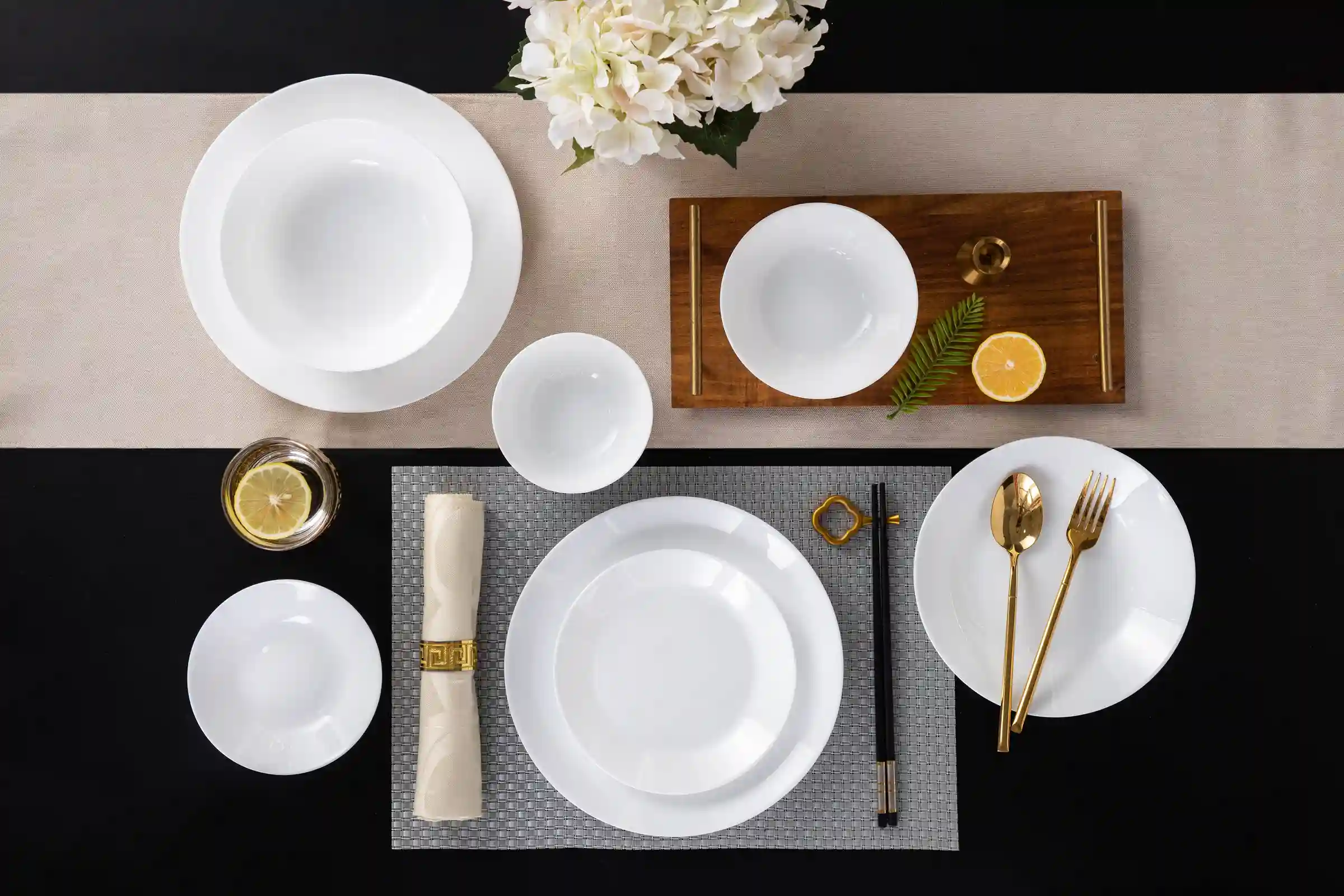
Long-term users consistently report the same thing: opal glass plates used daily for five years, going through the dishwasher three to four times a week, show virtually no change in whiteness. That’s roughly 750 to 1,000 wash cycles with no visible color shift. The only change is faint matte marks on plate edges where they rest against the dish rack — and you’d have to look closely to notice them.
| Material | After 1 Year | After 3 Years | Why It Discolors | Extra Stain Treatment? |
|---|---|---|---|---|
| Opal Glass | Almost no change | Almost no change | N/A — color is inside the glass | No |
| White Ceramic | Minimal if glaze is intact | Possible localized staining | Stains seep through worn glaze | Occasionally |
| Melamine | Starts yellowing | Yellowing gets worse | Resin layer oxidation | Frequently |
| Bone China | Minimal, depends on glaze | Possible tea stain buildup | Micro-pores absorb stains | Occasionally |
Pay attention to the last column. When choosing white dinnerware, the real question isn’t how white it looks on day one. It’s how much effort you’ll need to keep it that way three years later.
Is Opal Glass Dishwasher Safe? And Does It Actually Come Out Clean?
Yes. Opal glass is dishwasher safe — no caveats.
But there’s a difference between “safe to put in the dishwasher” and “actually comes out clean.” Plenty of dinnerware claims to be dishwasher safe, then comes out with grease still on the rim and food stuck to the bottom. You end up hand-washing it anyway, which defeats the point.
Opal glass performs well in the dishwasher for the same reason it’s easy to hand wash — nothing sticks to the surface. High-pressure water jets clear everything in a single cycle. No pre-rinsing, no soaking. Load it and go. (Foodservice publication GoFoodService confirmed this efficiency advantage for non-porous glass surfaces in machine-wash settings in their glass dinnerware review.)
Ceramic tells a different story. As glaze micro-pores develop over time, they become harder to clean by machine. A dishwasher can’t focus on one stubborn spot the way your hand can. If residue is lodged in those pores, water pressure alone won’t get it out. That’s why some people feel their ceramic plates come out cleaner by hand than by machine.
Opal glass doesn’t have that problem. No dead spots, no pores, no glaze seams for residue to hide in. Long-term users describe the result the same way again and again: “It looks brand new coming out of the dishwasher.” That’s not an exaggeration — it’s just what happens when a non-porous material meets high-pressure water.
One related concern: will opal glass turn cloudy after hundreds of machine washes? Short answer — no, not under normal use. The tempering process gives opal glass a compressive stress layer that resists alkaline dishwasher detergents far better than ordinary glass. If your area has hard water, adding rinse aid or softener salt takes care of any water spots. That’s standard advice for all glassware, not something specific to opal glass.
What Do Real Users Say About Washing Opal Glass?
Material specs are one thing. What people say after actually living with it is another.
On Reddit’s BuyItForLife subreddit — a community of nearly 4 million people focused on products that last — a “Corelle vs. Luminarc” thread drew close to 90 comments. Several users shared their experience with opal glass dinnerware, including IKEA’s Oftast line and various Luminarc sets. On Reddit’s IKEA board, there’s also a dedicated thread on the everyday use of Oftast opal glass dinnerware, where multiple users confirmed hassle-free daily cleaning and reliable machine washing — real-world proof that opalware is easy to clean.
A few patterns stand out in the feedback:
“Rinse and done.” This was the most common description. Multiple users said opal glass plates need no soaking — just a quick rinse and a pass with a sponge. Compared to stoneware or rough ceramics they’d used before, the time spent washing dropped noticeably. One user put it this way: after switching to opal glass, “dishwashing went from a chore to just a rinse.”
“Years of use, still white.” Several users noted their IKEA Oftast sets stayed clean and bright through years of daily use and multiple drops. Another user mentioned their mother’s Corelle set — over 30 years old and still looking like new. Corelle and opal glass aren’t identical in process, but on the question of long-term whiteness, both user groups report the same result.
“Straight into the dishwasher, no issues.” Long-term machine washing came up often, with no reports of hazing or surface damage. Borosil users from India echoed the same: “No stains, no odors, dishwasher safe — very easy for busy households.”
A few users mentioned faint utensil marks appearing over time. That’s normal wear from metal-on-glass contact — it has nothing to do with how easy the piece is to wash.
Across all these threads, the takeaway lines up with the material data: opal glass is genuinely low-effort to keep clean, day after day.
Is opal glass easy to clean? Yes — and the reason is baked into the material. No pores means no trapped grease, no absorbed odors, and no gradual yellowing. It handles dishwasher use over the long term without issues. Real-world feedback from homes and restaurants confirms what the specs suggest. If low-maintenance dinnerware matters to you, opal glass deserves a serious look. Ready to explore options? Browse our opal glassware product catalog.
Common Questions People Ask
Q1: Our hotel restaurant serves a lot of curries and turmeric-heavy dishes. Will opal glass plates pick up the color?
No. The non-porous surface gives pigments nowhere to penetrate. Turmeric sits on the outermost layer and comes off with normal washing. Ceramic, once its glaze is micro-damaged, is a different story — turmeric seeps in and needs a baking soda paste to remove. If heavily pigmented dishes are a regular part of your menu, opal glass saves you that extra step.
Q2: We buy in bulk and use commercial dishwashers with much stronger detergent than household machines. Will that damage the opal glass surface over time?
Commercial detergents are more concentrated and more alkaline, which can affect standard glass. Opal glass, however, is tempered — its surface carries a compressive stress layer that handles alkaline exposure far better. Testing shows the surface stays smooth and fully functional after more than 2,000 commercial dishwasher cycles.
Q3: We’re thinking about replacing our ceramic dinnerware with opal glass. Will we actually notice a difference in daily cleaning?
You will, in two ways. First, each wash is faster — opal glass cleans fully in one dishwasher cycle, while aged ceramic often needs a second pass or hand touch-up. Second, you eliminate ongoing maintenance like periodic bleaching and deep stain removal, because opal glass doesn’t absorb color or odor. For a kitchen washing hundreds of pieces a day, those two savings add up quickly.