
Decide What Kind of Dinnerware You Need Before Going to the Canton Fair
The biggest challenge buyers face at a trade show is usually not a lack of products, but too many choices. Plates, bowls, and cups may look similar, yet their materials, weight, workmanship, and cost can be completely different. If you arrive with only a reference image and no requirements for dimensions, price, or quality, your conversations can quickly lose direction.
The goal of preparation is clear: help manufacturers determine within a few minutes whether they can make the products, while helping buyers decide whether a manufacturer is worth further discussion.
Write Down the Required Dinnerware Sizes, Shapes, and Appearance
Do not simply write “we need a dinnerware set” or “we are looking for products similar to this image.” Descriptions like these are difficult to quote and do not help you judge whether a manufacturer’s recommendation is truly suitable. A more effective approach is to describe each item separately. Once this checklist is prepared, you can use it directly when meeting factories at the show.
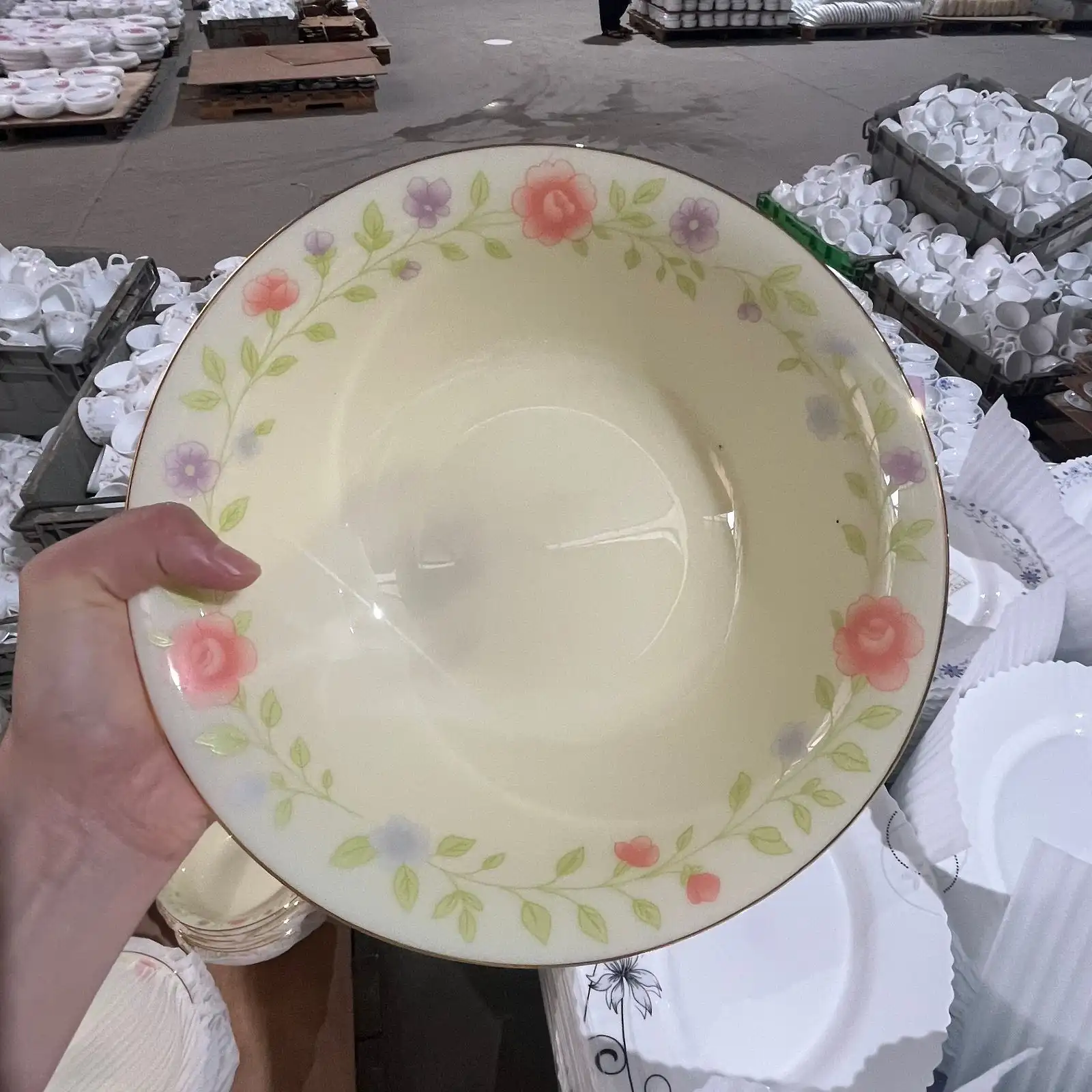
Your sourcing requirements should include at least the following:
- Items included: Flat plates, deep plates, bowls, cups, saucers, salad bowls, or other accessories.
- Dimensions and capacity: Plate diameter; bowl diameter and capacity; cup capacity and height.
- Shape: Round, square, irregular, wide-rimmed, narrow-rimmed, straight-sided, or flared.
- Use requirements: Whether the products need to be stackable or suitable for dishwashers, microwaves, or high-volume food-service use.
- Appearance: Color, pattern, glossy or matte finish, brand logo, backstamp, and packaging style.
- Set configuration: Which items are included in each set, the quantity of each item, and whether individual replacement items will also be needed.
Different materials also require different information. For standard ceramic dinnerware, bone china, and stoneware, you usually need to confirm the glaze, firing result, and decoration method. For opalware, specify the target weight, rim thickness, set configuration, and decoration requirements. Dinnerware can all look white on the outside, but the manufacturing methods and cost structures may be very different. They should not be quoted as if they were the same product.
| Item to Confirm | Unclear Wording | Wording Better Suited for the Manufacturer |
|---|---|---|
| Plate size | We need a large plate. | 10.5-inch round flat plate with a narrow rim. |
| Bowl requirements | We need a salad bowl. | Approximately 700 ml, stackable, with a white exterior. |
| Surface finish | Make it matte. | Matte exterior, glossy interior, with a reference color code. |
| Set configuration | We need a 16-piece set. | Four flat plates, four small plates, four bowls, and four mugs. |
The clearer the specifications, the more time you will save at the show. Manufacturers can also determine more easily whether they can use an existing mold or need to develop a new one.
How to Find Suitable Dinnerware Manufacturers Quickly at the Canton Fair
The Canton Fair is large and often crowded. Without a route and clear screening criteria, it is easy to spend your time at irrelevant booths. An efficient visit is not about seeing more booths. It is about visiting the best-matched manufacturers first and using the remaining time to explore additional options.
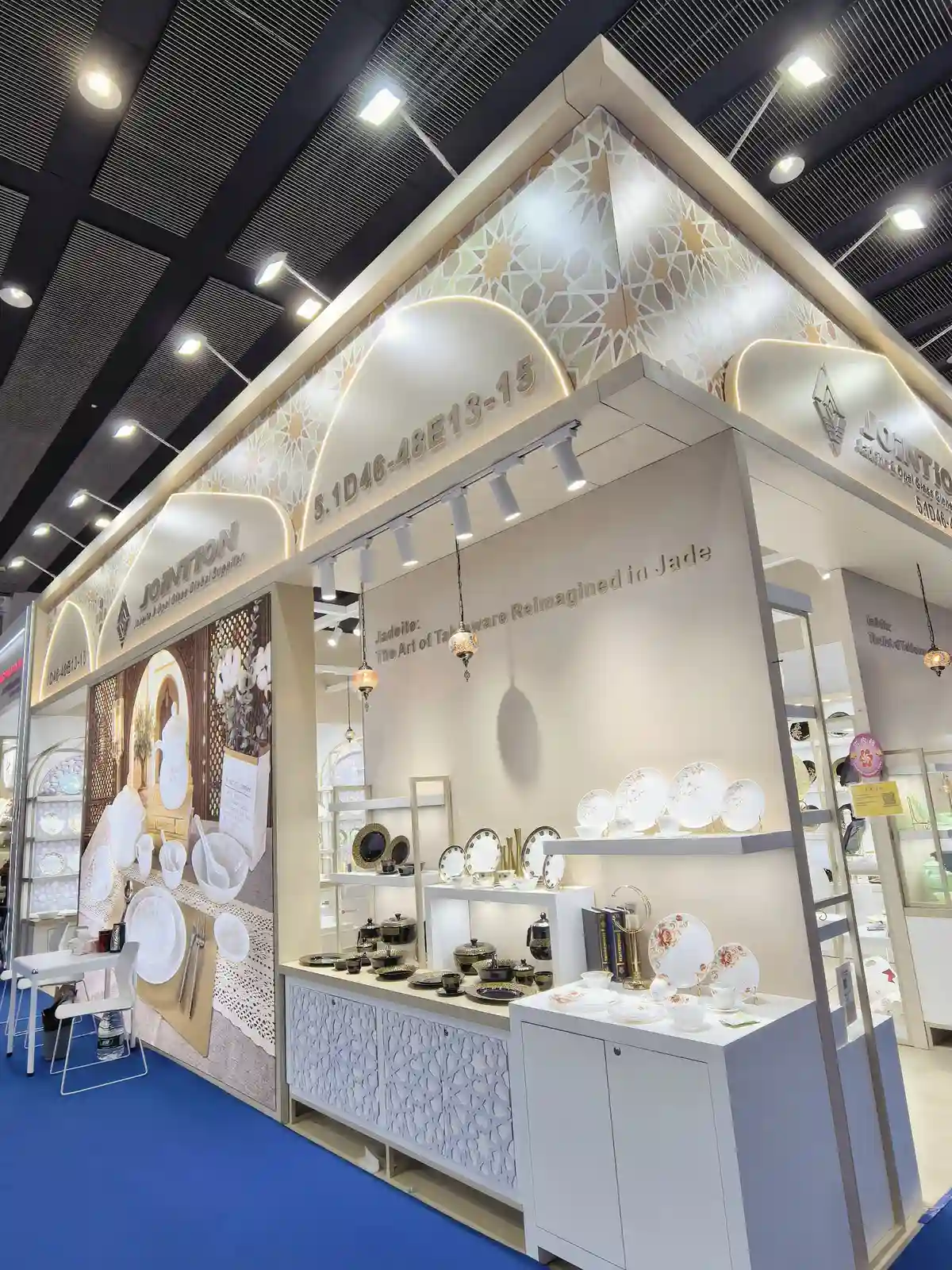
Organize Your Target Halls and Booths in Advance
Before you leave, use the exhibition-area plan, exhibitor list, and venue map published for the relevant Canton Fair session to screen companies whose main business is dinnerware. Do not search only for “dinnerware.” You can also classify exhibitors by specific materials and product terms, such as ceramic dinnerware, bone china, opalware, and stoneware.
Prepare a simple visit list containing at least:
- Company name and booth number;
- Main materials and key products;
- Whether the company has product series close to your sourcing requirements;
- Visit priority;
- Questions that need to be confirmed at the show;
- Estimated time needed at the booth.
You can divide exhibitors into three priority levels:
- Category A: The main products, materials, and target market are all highly aligned with your needs. Visit these companies first.
- Category B: Some products meet your requirements, but production capability needs to be confirmed on site.
- Category C: Information is limited or only a few products are relevant. Visit these companies if time allows.
Plan your route by exhibition hall and room location, not by company name. Visit Category A manufacturers in the morning, when you are more focused, and use the afternoon to cover Categories B and C. If you plan to have an in-depth discussion with an important supplier, arrange a meeting in advance so the right contact is not busy with another customer when you arrive.
This step may seem simple, but it directly affects your efficiency at the show. Once your route is planned on the map, you are less likely to be distracted by prominent booths or last-minute recommendations after entering the venue.
Check Whether the Manufacturer’s Main Products Match Your Needs
When you reach a booth, you do not need to sit down and discuss prices immediately. First, look at the materials, shapes, and styles that make up most of the display. Then decide whether the company is worth further discussion.
For example, if you plan to source opalware, first check whether the booth displays complete plate, bowl, and set series or only a small number of opal-colored products. Then confirm whether these products are standard items that the factory produces regularly. The same logic applies when sourcing bone china or stoneware: one or two matching samples do not prove that they are the manufacturer’s main products.
Use the following questions to make a quick assessment:
- What percentage of your regular orders use this material?
- Which products displayed at the booth are made in your own factory?
- Which products use standard molds, and which require new development?
- Have you handled orders for markets similar to ours?
- Can the same series be replenished over the long term?
A manufacturer saying “we can make everything” is only the beginning of the conversation, not proof of capability. A genuinely suitable supplier can usually explain standard sizes, production limitations, available decoration options, minimum order quantities, and approximate lead times relatively quickly. The more specific the answers, the more worthwhile it is to continue the discussion.
Screen Each Manufacturer Using the Same Sourcing Requirements Sheet
A good sourcing requirements sheet does not need to be long. One or two pages is enough. The key is to show every manufacturer the same conditions, so you have a fair basis for comparison after the show.
Arrange the requirements in the following order:
- Target market and sales channel;
- Product material;
- Item dimensions and set configuration;
- Shape, color, and pattern;
- Expected purchase quantity;
- Target price range;
- Packaging requirements;
- Required use or testing requirements.
At the booth, do not simply hand the sheet to a salesperson and wait for an answer. Go through it item by item. Confirm which requirements existing products can meet, which items need customization, and which requirements the factory cannot meet for now. If a question cannot be answered immediately, ask the representative to mark it on the sheet and provide the information in writing later.
Based on our observations from real trade-show sourcing discussions, the most efficient buyers are often not the people who ask the most questions. They are the people with the clearest requirements sheet. They use the same questions with different manufacturers and can eliminate obvious mismatches on site. By contrast, if you change the dimensions, material, or budget at every booth, you may collect many quotes but still find it difficult to compare them.
The purpose of the requirements sheet is not to prevent manufacturers from recommending new products. It is to protect the boundaries of the sourcing project first. Once your requirements are clear, you can review new products and judge them more steadily.
Record and Classify Each Booth Before You Leave
After visiting a dozen or even dozens of booths in one day, it is almost impossible to remember which company each photo came from. Therefore, complete a short record before leaving every booth.
Use a consistent order:
- First photograph the booth number or business card;
- Then photograph the products of interest and their product numbers;
- Record the main materials and matching products;
- Write down the conditions the representative has already confirmed;
- Mark the documents or information that still need to be provided;
- Place the manufacturer temporarily in Category A, B, or C.
On-site classification is not the final decision. Category A means the company should be followed up first, Category B means more information is needed, and Category C means it is not currently a match. At this stage, there is no need to compare every quote or decide on a supplier simply because the salesperson communicated smoothly.
Use a consistent naming method for photos as well. For example, use “company abbreviation—booth number—product number.” When you return to your hotel or office, you will not need to guess which supplier each product belongs to.
Recording information takes only a few minutes, but it prevents a great deal of rework. If you wait until the end, it is usually too late.
How to Check Dinnerware Materials, Workmanship, and Food Safety at the Show
Displayed products are selected samples. They can show a company’s product direction, but they do not necessarily represent the average quality of a production order. The purpose of an on-site inspection is to identify obvious problems, confirm the limits of the material and workmanship, and decide whether it is worth requesting formal samples. It cannot replace laboratory testing or a pre-shipment inspection.
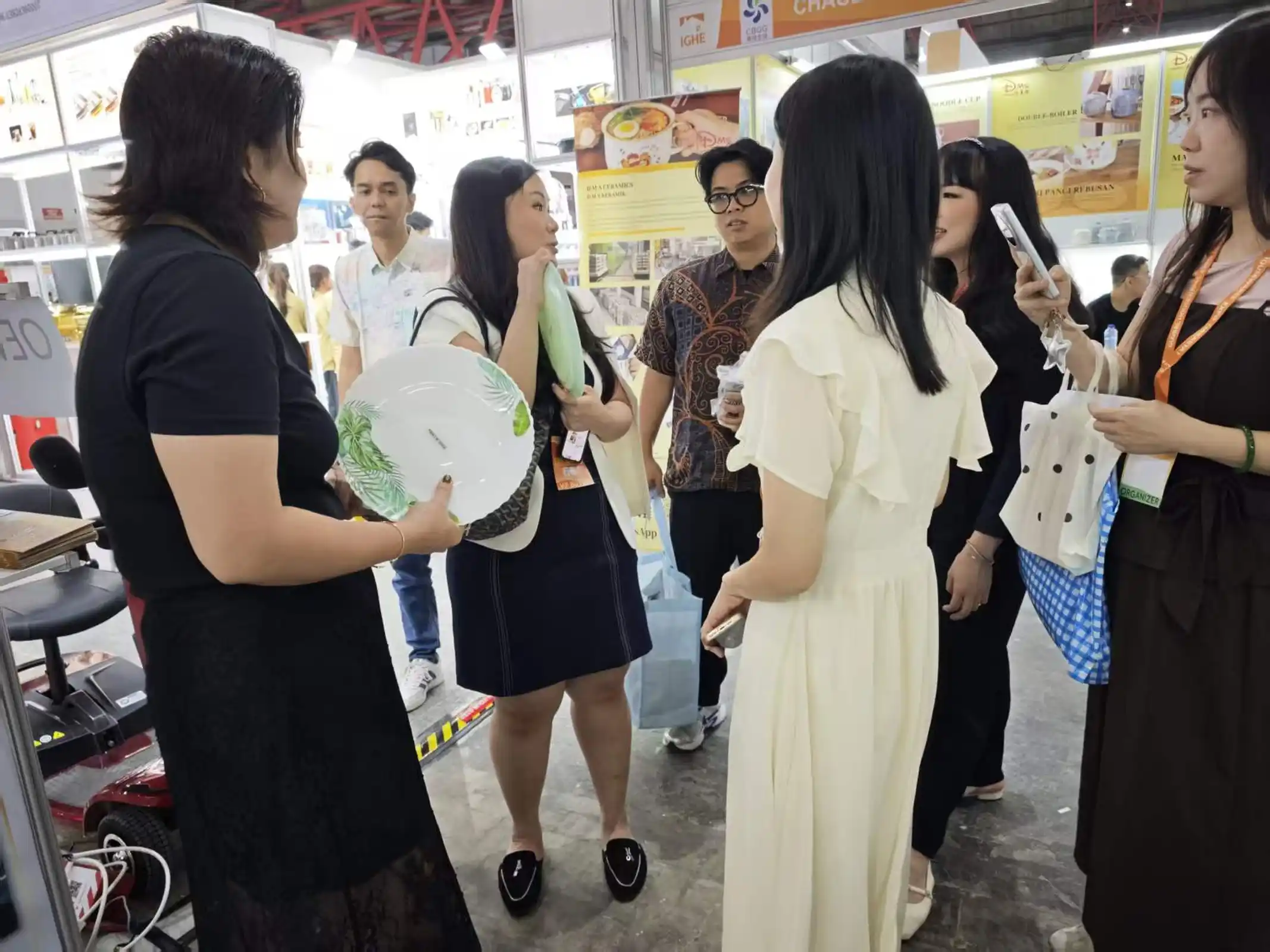
Confirm the Actual Material Used for the Sample
Color and weight can help with an initial assessment, but they should not be the only basis for judgment. Standard ceramic dinnerware, bone china, stoneware, and opalware may have a similar white appearance, but their raw materials, forming methods, product performance, and intended applications are different.
First check the sample label, product description, model number, and material information provided by the manufacturer. Then ask several key questions:
- Will the sample on display and the product in the subsequent quotation use the same material?
- Will the approved sample and mass-produced products use the same formula and process?
- If the product is bone china, how does the manufacturer define its product category and support the stated material basis?
- If the product is opalware, is it clearly identified as opal glass dinnerware rather than being sold under a vague name such as “white porcelain”?
- For products with color, printing, or other decoration, do the test documents cover the relevant process?
Document requirements for food-contact materials are not exactly the same in every market. First tell the manufacturer where the products will be sold, then request documents that match the target market and the specific product. Check the product name, material, model, decoration method, test items, test date, and testing organization on the report. A report cover page alone is usually not enough to determine what the report covers.
Also distinguish between two concepts: a material description answers “What is the product made of?” Testing documents answer “Does this specific product meet the applicable requirements?” One cannot replace the other.
Inspect the Glaze, Rim, and Base Carefully
Move the sample to a well-lit area and turn it slowly. For standard ceramic dinnerware, bone china, and stoneware, focus on the glaze, rim, shape, and base. For opalware, pay attention to surface impurities, bubbles, mold marks, edge finishing, and the flatness of the base.
Inspect the product in the following order:
- Check the surface: Look for obvious black spots, pinholes, bubbles, scratches, color variation, cracks, or pattern misalignment.
- Feel the rim: Check whether it is smooth and whether there are chips, burrs, or areas that could scratch the hand.
- Check the shape: See whether round plates are visibly warped, whether cup rims are regular, and whether matching items look consistent as a set.
- Place it on a flat surface: Check whether the base is stable and whether the product rocks easily.
- Inspect the base: Check whether the grinding is even, whether the backstamp is clear, and whether the area touching the table is rough.
Product safety cannot be judged by appearance alone. On March 22, 2024, the Associated Press reported the recall of approximately 440,000 Starbucks-branded ceramic mugs in the U.S. market. Citing regulatory information, the report said the mugs could overheat or break when filled with very hot liquids or used in a microwave, creating a risk of burns and cuts. The news confirmed a recall involving a specific product; it does not mean that all similar ceramic mugs have the same problem. For sourcing, the lesson is practical: after checking appearance, confirm requirements for hot liquids, microwave use, and structural safety based on the product’s actual application. An attractive display sample should not be treated as a fully verified mass-produced product.
Lead and cadmium migration, as well as other food-contact safety issues, cannot be judged with the naked eye. The correct approach is to check testing documents that apply to the target market and the specific decoration process, and arrange independent testing when necessary. On-site inspection identifies visible defects. Laboratory reports address questions that cannot be answered visually. Both are necessary.
Compare Thickness and Weight
Do not judge the feel of a product from a single sample. Select several plates, bowls, or cups from the same series and in the same size, then compare their thickness and weight. This can help you identify obvious differences between samples at an early stage.
During the check, pay attention to:
- Whether the thickness of the cup rim, plate edge, and bowl rim is even;
- Whether products of the same size have similar weights;
- Whether the center of gravity feels natural or the product feels top-heavy when handled;
- Whether multiple pieces remain stable when stacked;
- Whether the total set weight suits the target sales channel and packaging method.
Different materials should not be evaluated by the same standard. Bone china is often valued for being light and thin, but pursuing the lowest possible weight does not make it suitable for every application. Stoneware is generally thicker and heavier; the key is whether its feel, stability, and ease of use are balanced. Standard ceramic dinnerware should be assessed in combination with its shape and intended use. The lightweight feel of opalware is important to many household and retail projects, but the rim, total weight, and actual use requirements still need to be confirmed.
Transportation also matters. An increase of only a few dozen grams per piece may change packaging costs and shipping efficiency when multiplied across a full set, an outer carton, or a container. For e-commerce projects, excessive weight can also increase last-mile delivery costs and the pressure caused by breakage and returns.
Weight comparisons at the show are only suitable for initial screening. During formal evaluation, record the unit weight and permitted variation using approved samples, then include these requirements in the specification sheet. Feel is an impression; the specification is the reference.
How to Judge Whether a Dinnerware Manufacturer Is Reliable and Can Supply Consistently
A tidy booth, attractive samples, and smooth communication only show that the manufacturer prepared well for the exhibition. Long-term cooperation depends on whether the production relationship is transparent, actual capacity matches your needs, and quality control has been built into a process.
Confirm the Actual Producer and the Party Responsible for Quality
First clarify whether the exhibiting company is a manufacturer, trading company, or integrated manufacturer-trading business. This is not about deciding which type is automatically better. It is about knowing who makes the products and who is responsible for quality.
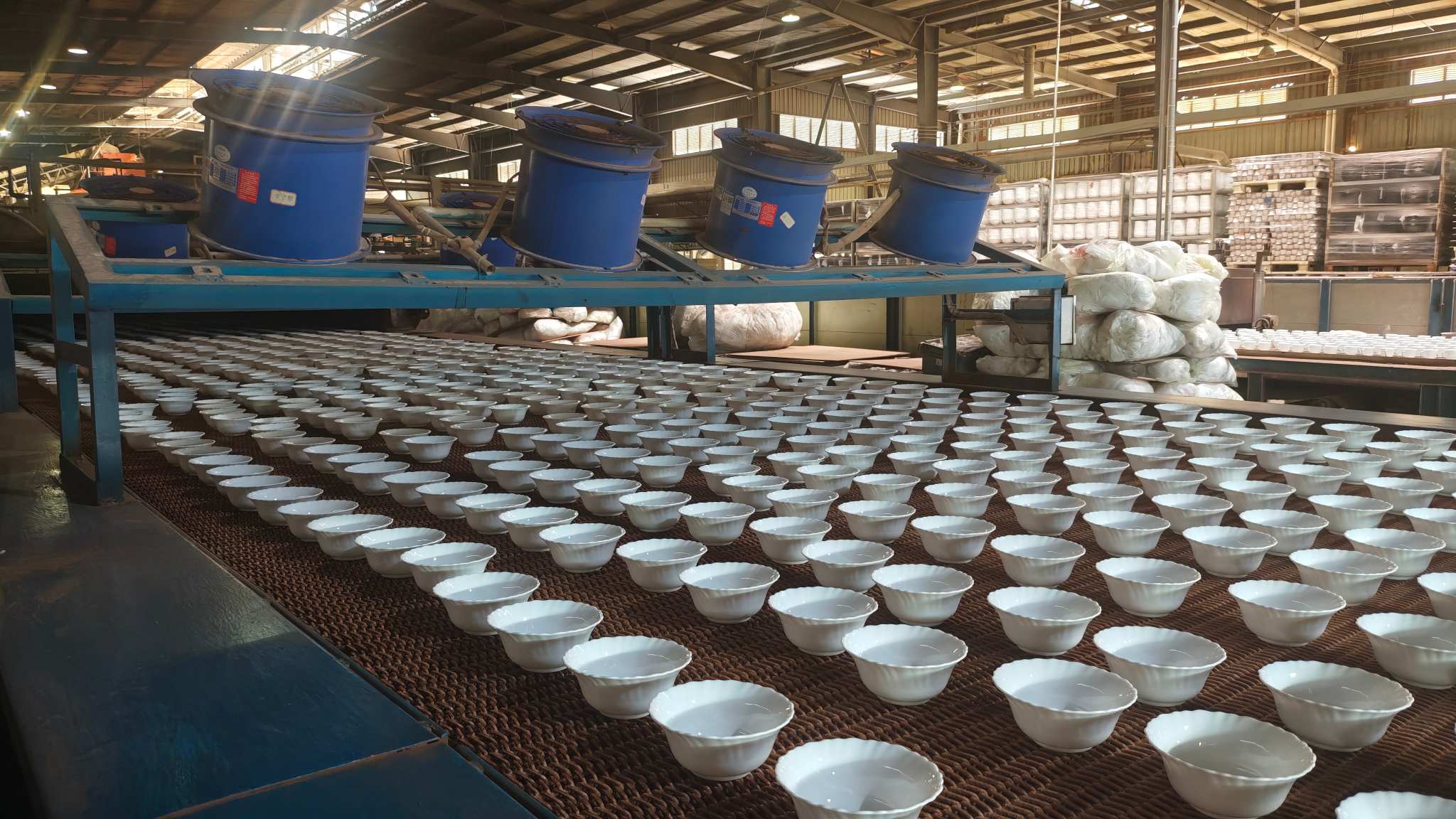
If a supplier displays standard ceramic dinnerware, bone china, opalware, and stoneware at the same time, confirm each category separately. Different materials usually require different raw materials, equipment, and production processes. Ask directly:
- Which products are made in your own factory?
- Which products are supplied by long-term partner factories?
- Where are forming, firing, decoration, testing, and packaging completed?
- Who approves the mass-production sample and shipment quality?
- If a quality problem occurs, which company is responsible for correction, replacement, or compensation?
A trading company is not necessarily unreliable, and a manufacturer is not automatically reliable. The real risk is unclear information: the sales company says the factory is responsible, while the factory says the specifications were confirmed by the sales company. When a problem occurs, both sides pass responsibility to the other. Important information should therefore remain in written documents. The quotation, sample approval, quality standards, inspection arrangements, and responsible party should all refer to the same company or clearly explain the relationship between the parties. The supply chain may be complex, but responsibility cannot be vague.
Verify the Production Lines and Actual Capacity
“Our production capacity is very large” is not an adequate answer. You need to confirm whether the manufacturer has the production conditions required for the target products and can complete your order within the planned delivery time.
Ask specific questions about the product:
- Which production line handles the target material?
- What key forming and processing equipment is used?
- Which processes are completed in-house, and which are outsourced?
- What is the normal monthly output for this product?
- How far ahead is the current order schedule booked?
- How is capacity arranged during the peak season?
- If the order quantity increases, how will the lead time change?
The forming, firing, glazing, and decoration conditions for standard ceramic dinnerware, bone china, and stoneware are not exactly the same. Opalware also requires the appropriate equipment for producing opal glass dinnerware. A manufacturer having a large factory building does not automatically mean it can produce every material consistently.
Compare the production volume stated by the manufacturer with your order quantity. For a small order, confirm whether it can enter the normal production schedule. For a large order, confirm whether the stated capacity is more than a theoretical figure. Also ask about the yield rate, number of molds, and bottleneck processes. The factor limiting delivery is often not total output, but one critical process.
When necessary, verify the information through a video factory audit, an on-site factory visit, or a third-party audit. The key question is not how new the factory looks, but whether the target product is being produced there continuously and in real conditions.
Check How the Manufacturer Controls Product Quality
A reliable manufacturer should be able to explain where each inspection takes place, who is responsible, and what happens when a problem is found. If the only answer is “our quality is very good,” the information is still insufficient.
Ask questions along the production process:
| Production Stage | Quality Control Points to Confirm |
|---|---|
| Raw material receiving | Whether raw materials and supplier information are checked by batch. |
| Forming or processing | Whether dimensions, shape, thickness, and obvious defects are checked. |
| After firing or forming | How warping, cracks, bubbles, impurities, and other problems are handled. |
| Decoration | How color, pattern placement, and adhesion are controlled. |
| Finished-product inspection | Whether the rim, base, weight, and consistency of the set are checked. |
| Before packing | Whether quantity, labels, packaging, and product numbers are checked. |
| Before shipment | Whether the manufacturer accepts buyer or third-party inspection. |
For dinnerware sets, quality control is not only about checking whether each individual piece has defects. It is also about whether the different items look coordinated together. Differences in color, whiteness, pattern placement, and weight may be difficult to notice individually but become obvious to consumers when the pieces are displayed as a set.
Also confirm whether the manufacturer keeps batch records, how reworked products and defective products are separated, and who has the authority to stop production if a deviation appears during mass production. Consistent quality does not come from one final selection. It comes from process control at earlier stages.
How to Follow Up and Select the Final Manufacturer After the Fair
The end of the trade show is not the end of sourcing. It is the point at which on-site impressions need to become comparable evidence. Follow-up should be fast, but the comparison standard must also be consistent. Otherwise, the more business cards you collect, the harder it becomes to find the information that actually matters.
Put All Candidate Manufacturer Information into One Comparison Sheet
It is best to make a quick update at the end of each day and complete the full candidate comparison sheet within two to three days after the show. Your memory of the conversations will still be fresh, and you can quickly ask about any missing information.
The sheet can include the following columns:
- Company name, booth number, and contact person;
- Main materials and matching products;
- Actual producer and outsourced processes;
- Existing molds and customization capabilities;
- Initial price range and minimum order quantity;
- Production lead time and capacity information;
- Quality control and available testing documents;
- Formal sample arrangements;
- Questions that remain unconfirmed;
- Follow-up priority.
When recording information, distinguish between “facts provided by the manufacturer” and “judgments formed by the buyer at the booth.” For example, “the factory stated that its monthly output is a certain quantity” is a statement from the other party. “The booth samples appeared to have consistent workmanship” is an on-site observation. Both can be recorded, but neither should be treated as a verified conclusion without further confirmation.
After the first round of review, remove suppliers whose main business is clearly unrelated, whose key information remains unclear, or whose statements contradict one another. Keep a small number of manufacturers that are genuinely worth further verification. This will keep the next stages—sampling, quoting, and factory audits—focused.
Ask Every Manufacturer to Quote in the Same Format
Whether quotations can be compared depends on whether they are based on the same conditions. Send the same specification file to each candidate manufacturer and ask each one to reply in a consistent format. Do not compare a lightweight product from one factory with a heavier product from another. Do not place standard packaging and gift packaging in the same price field either.
A comparable quotation should include at least:
- Product material, model, and dimensions;
- Unit weight or the weight range agreed by both parties;
- Set configuration and order quantity;
- Color, pattern, and decoration method;
- Unit price and price terms;
- Minimum order quantity;
- Sampling fees, mold fees, printing fees, or design fees;
- Inner packaging, outer cartons, and other packaging costs;
- Sample lead time and mass-production lead time;
- Payment terms;
- Quotation validity period;
- Costs not included.
If a manufacturer recommends changing the material, reducing the weight, changing the dimensions, or adjusting the packaging, list the alternative proposal separately. Do not change the original requirements and provide only a lower price. Otherwise, the price may appear better, but you are no longer comparing the same product.
Allow room for changes in transportation time as well. On December 18, 2023, Reuters reported that shipping companies rerouted around the Cape of Good Hope in response to Red Sea shipping security incidents, causing supply-chain delays. The report confirmed route changes during a specific period; it cannot be used to predict that every future order will be delayed. The practical advice for buyers is to confirm the production lead time, estimated sailing date, transportation plan, and communication responsibilities in the event of an exception separately when requesting a quotation and placing an order. Do not treat the factory completion date as the final delivery date.
For the final comparison, place the unit price, product fit, sample quality, completeness of documentation, production capability, and quality responsibility in the same scoring sheet. The lowest quotation is not always the lowest total cost. Rework, delays, breakage, and customer returns can all change the cost again.
The core of Canton Fair sourcing is not collecting as many business cards as possible. It is reducing the number of choices step by step using the same standard: start with clear requirements to find suitable manufacturers, verify the products through samples and documents, and then choose the cooperation partner through comparable quotations and clear responsibility terms.
If your sourcing focus is opalware dinnerware, you can provide Jointion with your target market, dimensions, set configuration, estimated quantity, packaging method, and reference images. Our recommendation is to confirm the actual requirements first and then discuss existing products or customized solutions. This makes communication faster and quotations more meaningful.
Media references mentioned in the article (no external links have been added):
- Reuters, April 2024, reporting on low-price competition at the Canton Fair and pressure on exporters’ margins.
- Associated Press, March 22, 2024, reporting on the recall of Starbucks-branded ceramic mugs due to risks of overheating or breaking.
- Reuters, December 18, 2023, reporting on ships being rerouted and supply-chain delays related to the Red Sea shipping incidents.