
Why Is Glass Considered an Eco-Friendly Dinnerware Material?
Glass Can Be Reused Repeatedly, Giving It a Longer Service Life
The environmental value of eco-friendly glass dishes is closely tied to how long they stay in use. A household set may be washed after breakfast and returned to the table at dinner; in a restaurant, plates move repeatedly between the dishwashing area, the prep area, and the dining room. Withstanding that level of use is the first reason glass is considered an eco-friendly dinnerware material.
Waste Glass Can Be Recycled into New Glass
Turning waste glass back into new glass requires the entire recycling chain:
- Collection and drop-off: waste glass is sent into the local recycling system.
- Sorting: glass is separated by color, material, and intended use.
- Cleaning: labels, caps, food residue, and other contaminants are removed.
- Crushing: the glass is processed into cullet that can be returned to the furnace.
- Melting and re-forming: cullet enters the furnace and becomes raw material for new glass products.
GPI’s material guide states that glass is 100% recyclable and can be reused repeatedly without loss of quality or purity; cullet can also improve furnace efficiency and reduce energy use (GPI: What Is Glass). This explains why recycled glass can re-enter the raw-material stream.
Is Eco-Friendly Glass Dinnerware Always Safe?
Glass Is Usually Safe, but Here Is How to Verify Certification
Glass is generally safe for food contact, as covered earlier today. However, if certification matters to you, it is worth verifying a few things before you buy. The steps below show how to check.
| Inspection Item | What to Check | Purpose |
|---|---|---|
| Standard | Whether the food-contact standard applies to glass dinnerware | Confirms the test basis matches the product |
| Sample | Whether the model, material, color, and decoration match the purchased product | Confirms the report represents the current product |
| Conditions | Food simulant, temperature, time, and contact method | Confirms the test conditions are close to actual use |
| Result | Whether lead and cadmium migration are within applicable limits | Confirms food-contact safety compliance |
ISO 6486-2:1999 sets permissible limits for the release of lead and cadmium from ceramic ware, glass-ceramic ware, and glass dinnerware in contact with food (ISO 6486-2:1999). The report should also correspond to the specific model, decoration method, and food-contact surface. When purchasing, rather than relying only on a one-page pass result, it is more important to confirm that these three elements match the product being bought.
Clear, Opal, or Colored Glass Dinnerware: Which Is Better for Your Table?
Clear Glass Is Ideal for Cold Dishes, Desserts, and Showcasing Food Colors
A fruit salad with clearly defined layers shows off particularly well in a clear bowl: the food itself becomes the visual focus. Clear glass works for cold dishes, salads, desserts, and fruit precisely because it does not hide the details. It fits both home dining tables and restaurant presentations, and it makes the layers easier to capture in photos.
For table pairings, clear pieces display color and texture, while opal or colored pieces can handle rich, dark sauces. Oil marks and water spots are more visible on clear surfaces, so drying promptly after washing keeps the glass looking clearer. The value of clear glass lies in revealing the food; it is best suited to people who already care about plating and color.
Opal Glass Better Masks Food Colors and Suits Everyday Hot Dishes
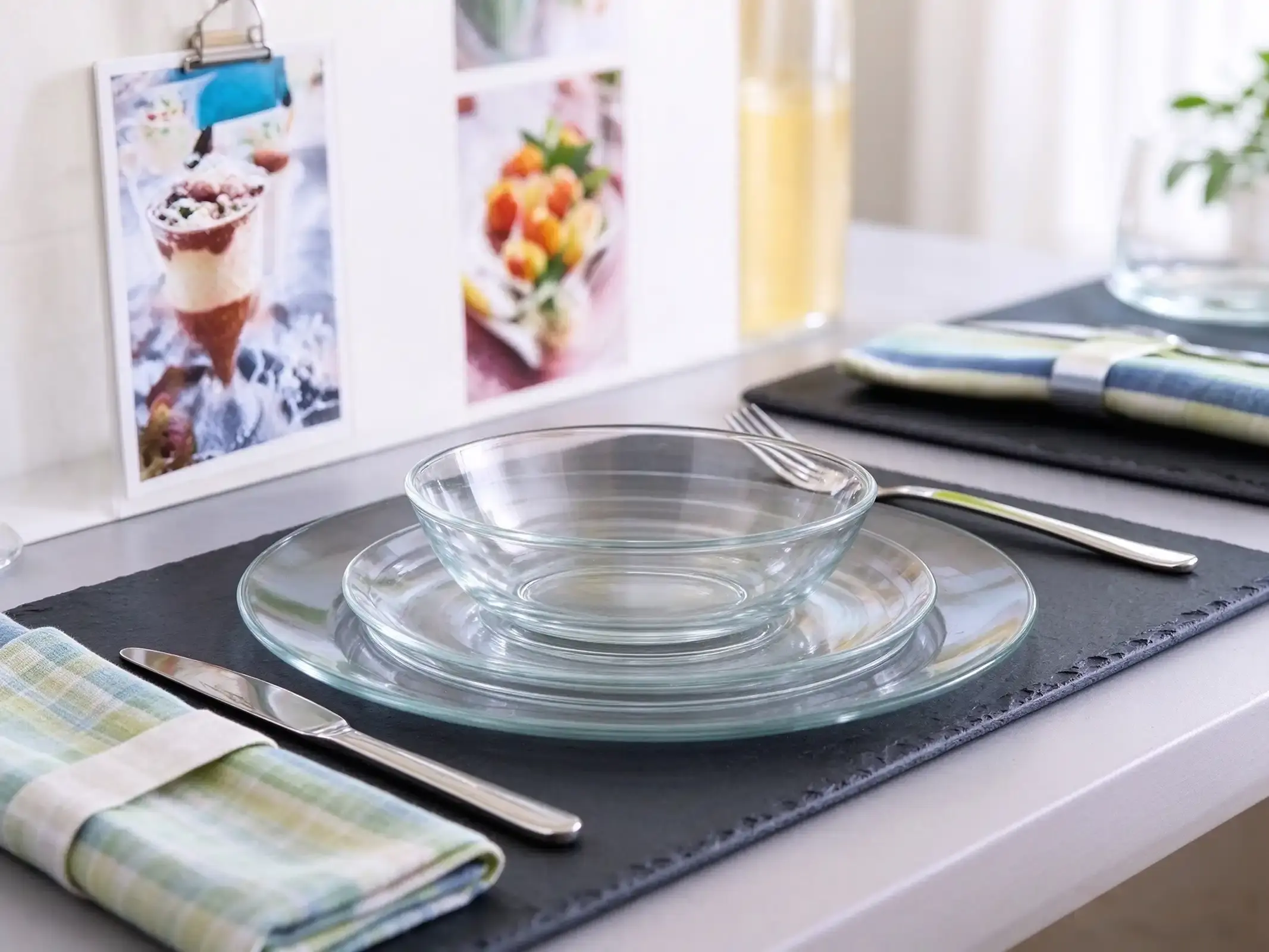
Once a hot dish reaches the table, sauce and oil residue at the base of the plate can easily affect the presentation; opal glass keeps those marks less visible. Its opacity comes from light scattering, which makes it a better fit for everyday hot dishes, soups, dark sauces, and high-use family dining tables.
Restaurants and hotels often use opal pieces as a basic option when setting a uniform table. When buying, focus on whether the color tone stays consistent within the same color code, production batch, and lighting conditions. A uniform surface and consistent translucency at the edges make a set look more orderly on the table. To review the actual color first, see Jointion’s glass dinnerware product catalog and confirm with a sample.
Colored Glass Works Best as an Accent; Using It Across the Whole Table Can Compete with the Food
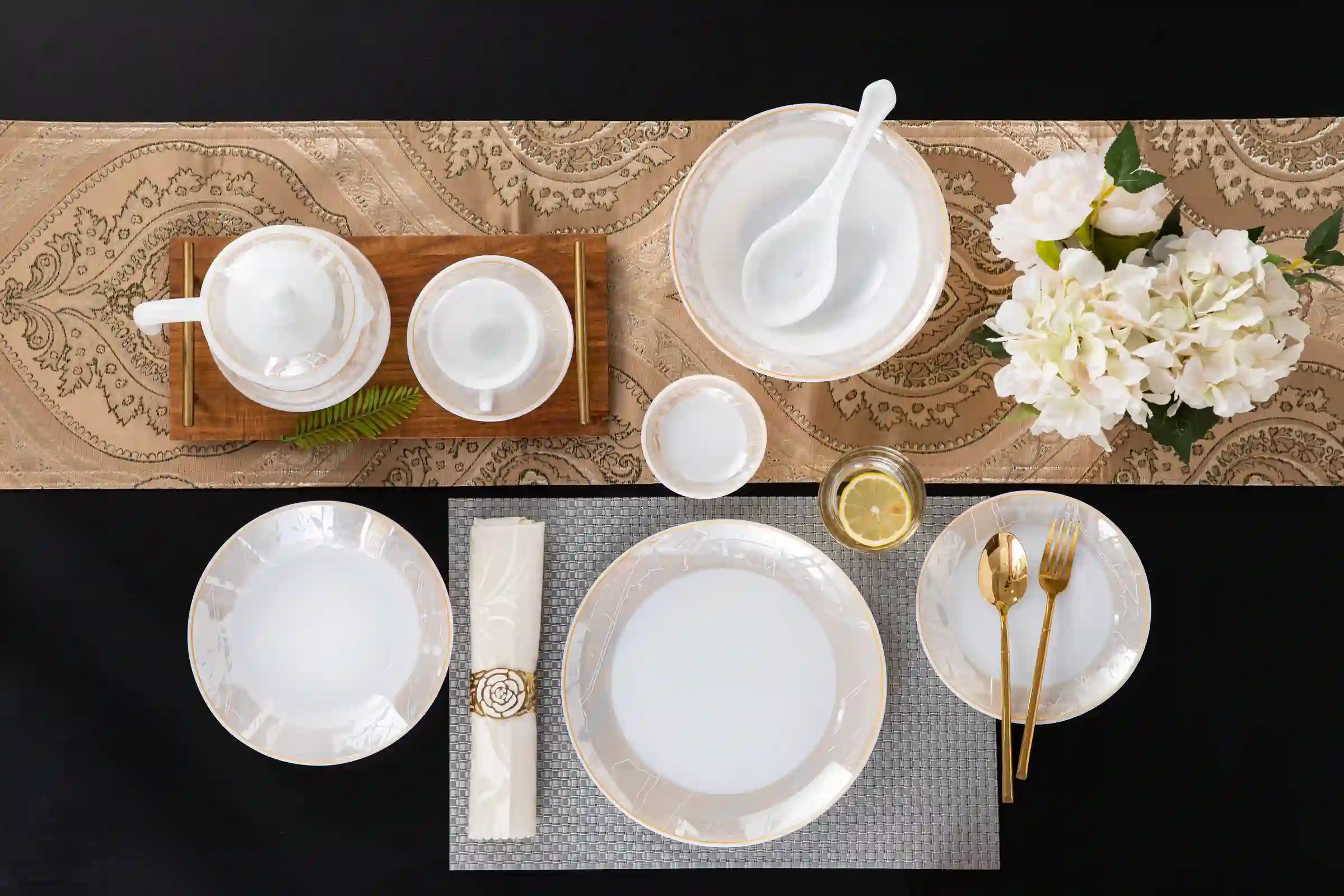
When the whole table is set with white plates, one colored salad bowl is enough to create a focal point. Colored glass works best for small bowls, saucers, or a single accent piece; it does not need to cover the table. When color is concentrated in a few pieces, the table gains character and the food does not get lost against the background.
If the tablecloth or the food already has a rich color palette, reduce the area of colored glass further and use one or two colors as a visual echo. Colored glass works as an accent and a point of connection; keep the quantity controlled, and the overall table composition becomes clearer.
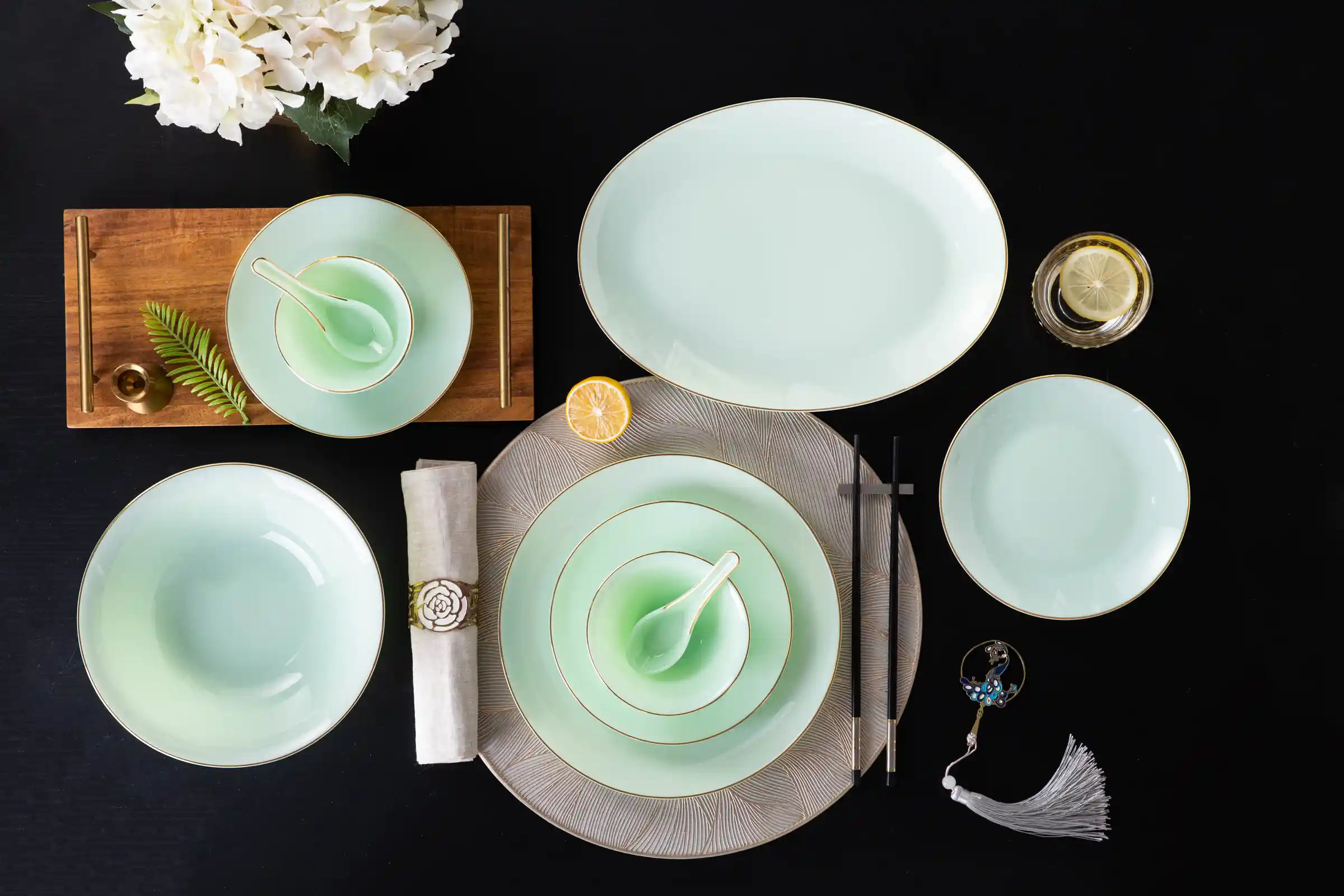
Which Is More Eco-Friendly: Glass, Ceramic, or Melamine Dinnerware?
Glass Is More Eco-Friendly Than Melamine, Provided It Is Used Long Term and Recycled
The environmental difference between glass and melamine mainly comes down to long-term use and what happens after disposal. Glass dinnerware can be melted and re-formed. Melamine is a thermoset plastic, so it cannot be melted and reshaped directly like glass; recycling usually requires specialized processing. Glass recycling is closer to conventional raw-material remelting, while melamine relies more heavily on dedicated recycling routes.
Glass production requires melting at 1,300–1,600°C in a furnace (Glass Alliance Europe: The World of Glass). The production stage uses energy, so raw materials are only one part of the environmental case for glass. Long-term use spreads the production-stage input across more uses, while cullet returning to the furnace reduces reliance on virgin raw materials. The advantage only holds when both factors are considered together.
The more often glass dinnerware is used in homes, restaurants, and hotels, and the better breakage is controlled, the more clearly its reuse and recycling benefits show. Frequent use and occasional use followed by long-term storage can produce very different environmental outcomes.
Glass and Ceramic Are Fairly Close, but Ceramic Firing Uses More Energy and Has Fewer Recycling Channels
Glass and ceramic are both durable, reusable, hard dinnerware materials. During the use phase, the difference is small; when production enters the comparison, ceramic’s firing burden becomes more apparent. Ceramic dinnerware requires high-temperature firing, and the firing stage accounts for an average of about 74% of its total carbon footprint (Taylor & Francis: Effect of functional unit and processing types on carbon footprint). Because firing makes up such a large share, both raw materials and kiln operations must be included when comparing the two materials.
The end-of-life stage also differs. Glass can return to the glass recycling stream and be turned back into cullet; after firing, ceramic has a different composition from container glass and cannot be reprocessed as the same type of cullet. Many curbside recycling programs accept only glass bottles and jars, so whether ceramic dinnerware can be recycled depends on whether a specialized local channel exists.
Then why say the two are fairly close? Ceramic often has a long service life, which spreads its production-stage energy use across more uses. To reach a more accurate conclusion, include actual service life, breakage rate, and recycling conditions. Looking only at the material name can flatten a complex question into a label.
If You Have to Choose One, Glass Is Usually the More Eco-Friendly Option for Long-Term Use
When use is frequent, breakage is controlled, and local glass recycling is available, glass is usually the more reliable choice among the three. It can withstand repeated service and can return to the glass recycling stream after disposal. Melamine is lightweight and impact-resistant, but its end-of-life handling depends more on dedicated routes. Ceramic is durable, but it carries higher firing energy use and narrower recycling access.
An LCA study on reusable dinnerware also notes that reuse count and washing method significantly change environmental outcomes (ScienceDirect: Comparative life cycle analysis of disposable and reusable tableware). For the same plate, frequent use, sensible washing, and entry into a recycling system after use produce a better environmental result than occasional use followed by long-term storage. A purchasing decision that accounts for these conditions is more reliable.
| Material | Reusability | End-of-Life Path | Best-Fit Settings |
|---|---|---|---|
| Glass | Suited to frequent washing and repeated service | Can be melted and re-formed where recycling is available | High-use homes, restaurants, hotels |
| Ceramic | Built for long-term use | Recycling access varies by location | Buyers who value weight and a traditional table setting |
| Melamine | Lightweight and impact-resistant | Requires a specialized conversion or recycling path | Lightweight needs and low-breakage settings |
Where Can You Buy Eco-Friendly Glass Dinnerware?
For Small Purchases, Look for In-Stock Items on Alibaba and Major Local E-Commerce Platforms
If you only need a few plates or one household set, start with channels that carry stock and have low minimum order quantities. Retail or small-batch stores on Alibaba, along with major local e-commerce platforms, can be starting points. When screening, check in this order:
- Is the item in stock, and what is the minimum order?
- Size, color, intended use, and packaging
- Breakage rate and color variation mentioned in reviews
- Material, testing, and use instructions
Breakage rate, color variation, and use instructions directly affect the experience after purchase, so checking them before price saves time. Jointion is a manufacturer and does not focus on single-piece retail; for small quantities, buyers can request a sample first or state the quantity and intended use clearly during an inquiry.
For Bulk Purchasing, Contact a Glass Dinnerware Manufacturer Directly
For restaurants, hotels, or brands buying in bulk, the main value of buying direct from a factory is consistency and customizability. Contacting a glass dinnerware manufacturer directly makes it easier to confirm raw materials, colors, printed decoration, packaging, and batch consistency than when buying through multiple retail layers. Before requesting a quote, state the intended use and quantity clearly, then confirm the following points:
- MOQ and samples
- Test reports and target markets
- Production lead time and packaging method
- Responsibility for breakage replacement and shipping
Quotes are more complete when they include sampling, testing, packaging, freight, and breakage replacement in the total cost. If you want an initial overview of Jointion’s product range, production capabilities, and collaboration process, start with the Jointion glass dinnerware manufacturer website and then review the relevant product categories; final order details remain subject to confirmation.