
This article explains what usually comes in a dinner set: plates, bowls and cups. It also covers how 12-, 26-, 33- and 48-piece sets are put together, and how pieces, covers and purchase quantities translate into one another. It is written for people choosing dinnerware for the home, stocking a restaurant or hotel, or trying to make sense of a set list. It also explains what dinner sets usually leave out, so you do not discover missing items only after placing an order. By the end, you will be able to judge how many people a set can serve and calculate a more sensible purchase quantity for a household, restaurant or hotel.
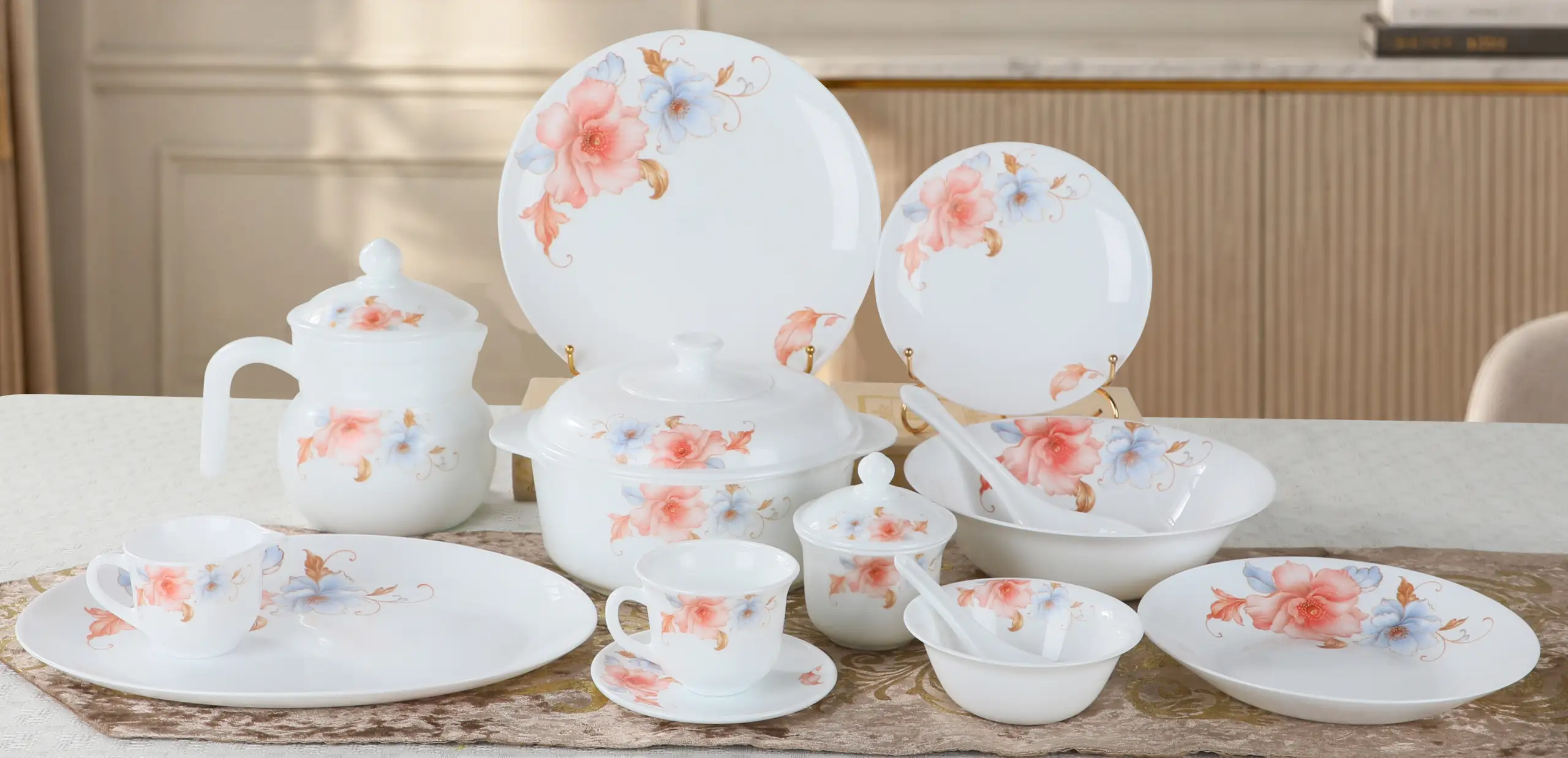
What do you usually get in a dinner set: plates, bowls and cups?
Each guest usually gets one dinner plate, one side plate, one bowl and one cup
How do you break down one place setting? Most basic dinner sets divide one guest’s dinnerware into four pieces: a dinner plate, a side plate, a bowl and a cup. The dinner plate holds the main course, the side plate holds salad, bread or dessert, the bowl holds soup, cereal or dessert, and the cup is for water, tea or coffee. Each piece has one job, and together they cover most meals.
This is also why set lists are often written as one setting per person. Wikipedia puts it plainly: a place setting is the complete setup for one guest (Wikipedia: place setting definition). Change the menu and the bowl may become a soup bowl or the cup may become a mug, but the unit of calculation remains one setting per person.
| Piece | Main use | Common variations |
|---|---|---|
| Dinner plate | Main courses, pasta, breakfast plates | Flat plate, deep plate |
| Side plate | Salad, bread, dessert | Salad plate, dessert plate |
| Bowl | Soup, cereal, dessert | Soup bowl, deep bowl |
| Cup | Water, tea, coffee | Mug, teacup, glass |
Shape makes a real difference to how a table is set. A flat plate and a deep plate take up different amounts of space, even when both are called dinner plates; a soup bowl and a cereal bowl hold different volumes, even when both are called bowls. When you need to check a list against actual shapes, compare it with Jointion opal glass plates and Jointion opal glass bowls.
Once this basic unit is fixed, piece counts, covers and purchase quantities all use the same basis.
What is included in 12-, 26-, 33- and 48-piece dinner sets?
A 12-piece set contains 4 dinner plates, 4 side plates and 4 bowls.
A 12-piece set is the easiest to work out: four individual settings, each with one dinner plate, one side plate and one bowl. 4 × 3 = 12, so it usually serves four guests.
- 4 dinner plates: for main courses
- 4 side plates: for salad, bread or dessert
- 4 bowls: for soup, cereal or dessert
- No cups: add four cups to this set and you have 16 pieces
This refers to a combination of four dinner plates, four side plates and four bowls. When checking a list, do not focus only on “12 pieces.” First count whether there are four groups, and whether each group has these three pieces.
If you are looking at a ready-made dish set, use the list for Jointion opal glass dinner sets to compare all four groups item by item.
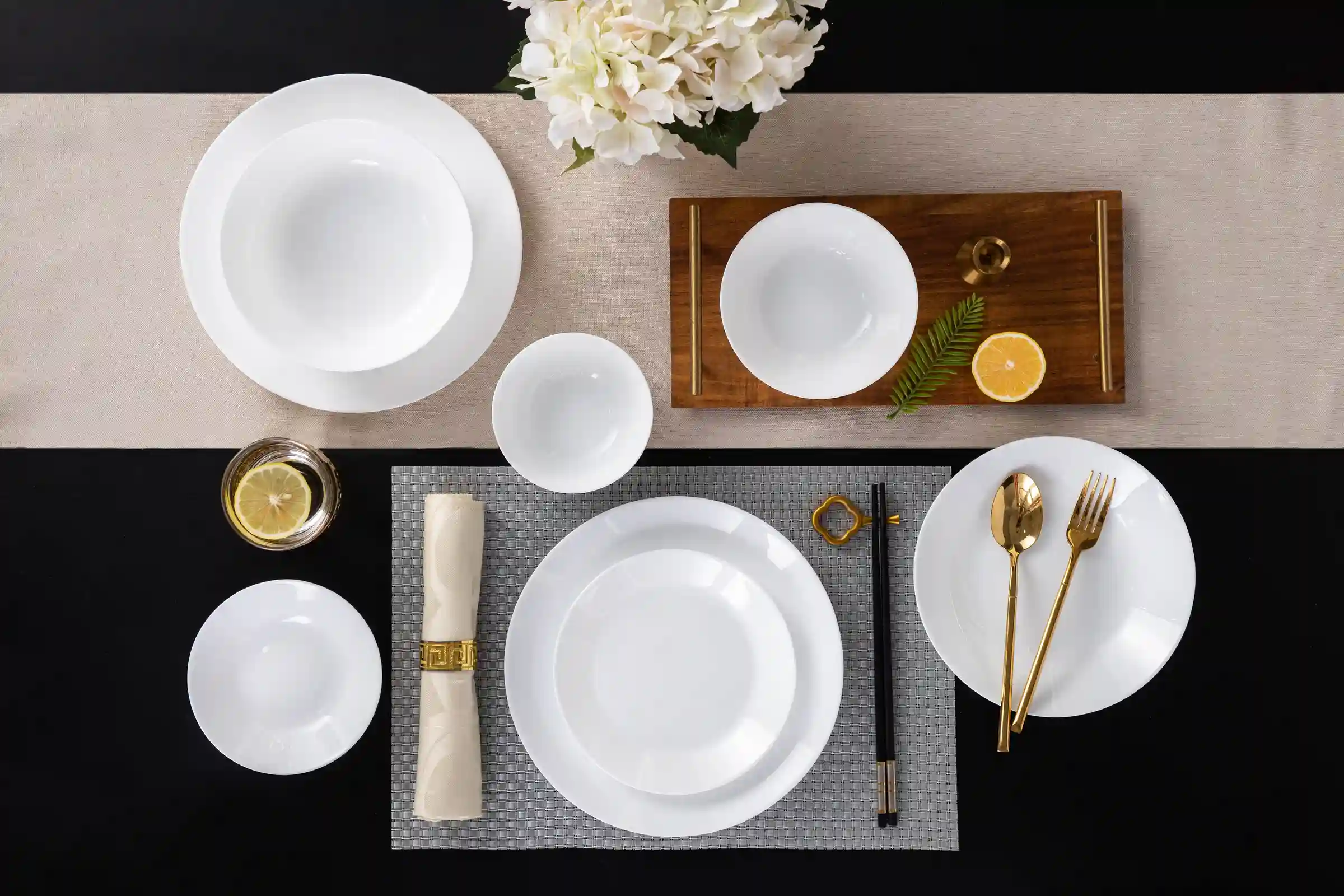
A 26-piece set is usually 24 basic pieces plus 2 extra pieces.
A 26-piece set is a little different. You cannot work it out from the total alone. The clearest breakdown is six basic settings plus two extra pieces: 6 × 4 = 24, plus 2, for 26 pieces in total.
Those two pieces may be cups, bowls or spare pieces. Configurations vary by manufacturer, so first confirm whether the 24 basic pieces form six settings, then confirm what the two extra pieces are.
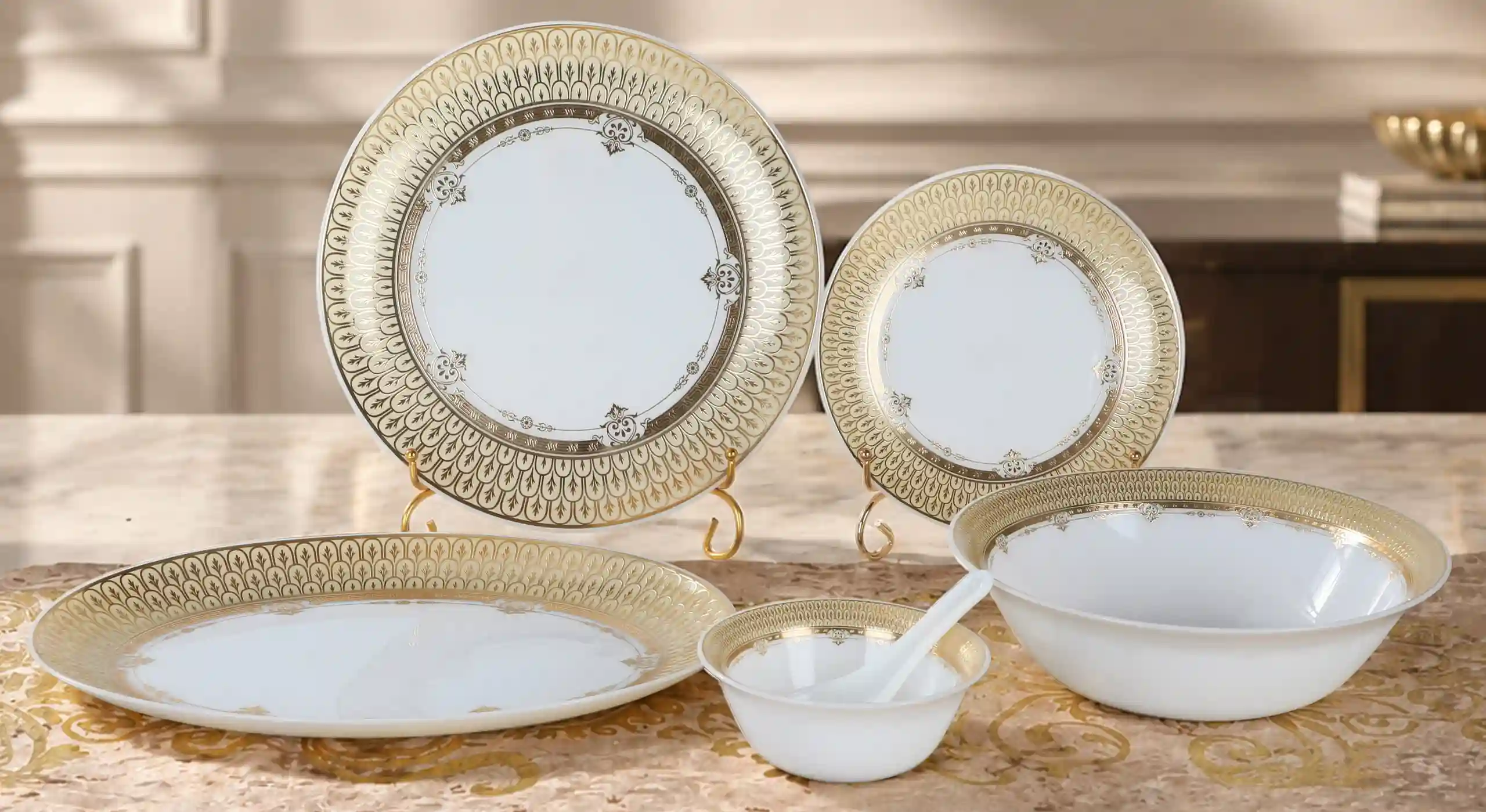
A 33-piece set is usually 32 basic pieces plus 1 extra piece.
A 33-piece set is best broken down the same way: eight basic settings make 32 pieces, plus one extra piece. 8 × 4 = 32, for 33 pieces in total.
That single extra piece is the easiest part to misread. It may be a cup, a bowl or a spare piece. If the list is not clear, a buyer may treat the 33-piece set as a standard eight-person configuration and come up one piece short. Check the 32 basic pieces first, then the extra piece. The order matters.
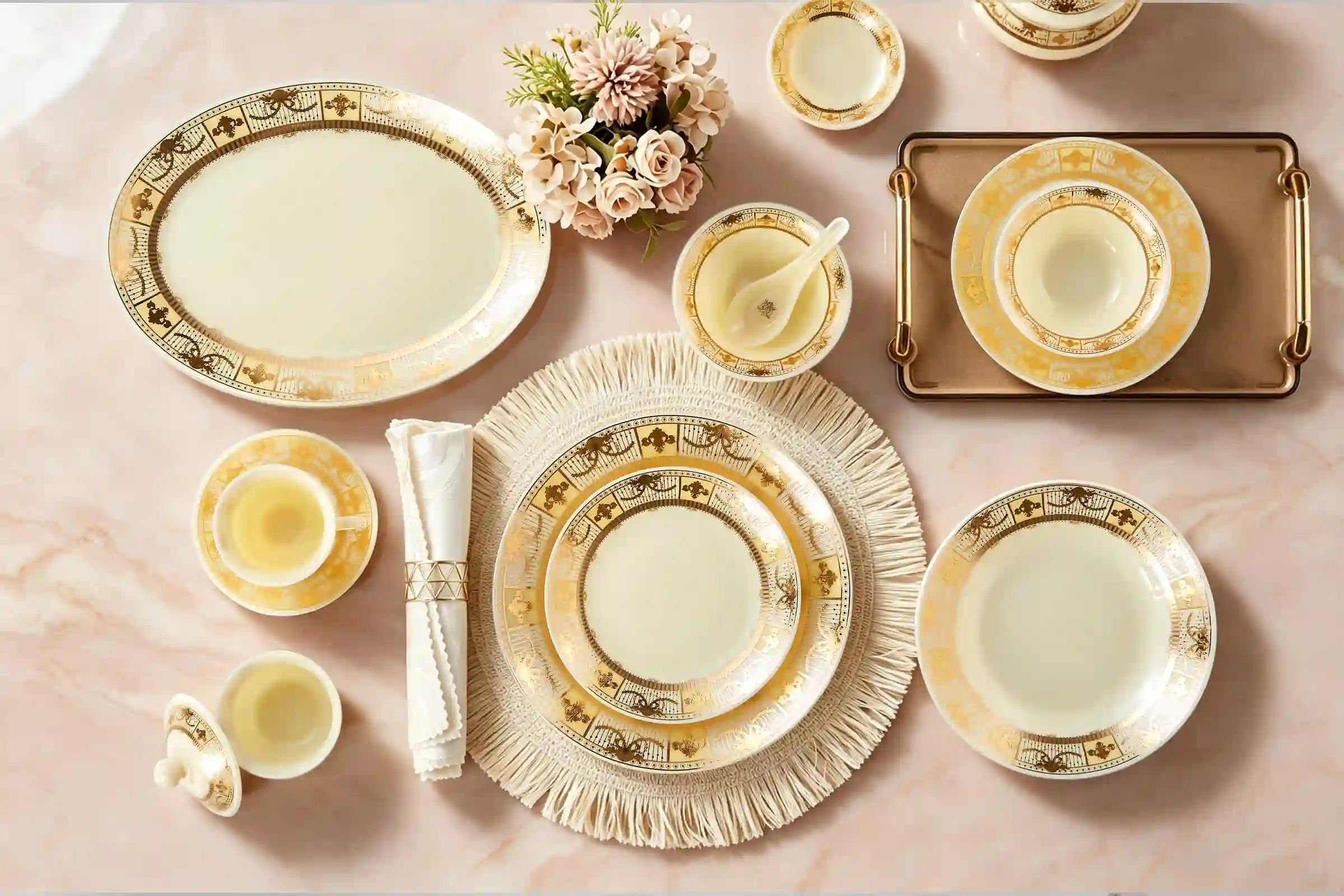
A 48-piece set contains 12 dinner plates, 12 side plates, 12 bowls and 12 cups.
A 48-piece set breaks down clearly by group: 12 individual settings, four pieces per setting, 12 × 4 = 48.
| Category | Quantity | Use |
|---|---|---|
| Dinner plates | 12 | Main courses |
| Side plates | 12 | Salad, bread, dessert |
| Bowls | 12 | Soup, cereal, dessert |
| Cups | 12 | Water, tea, coffee |
It is not “12 dinner plates plus 36 other pieces,” but 12 pieces in each of four categories. With a 48-piece set, count 12 groups first, then check that all four piece types are present in each group.
If the cups in the set need to match your existing table setting, compare cup shapes and cup-and-saucer combinations in Jointion opal glass cups and saucers, then confirm the specifications of the 12 cups in the 48-piece set.
How many people can each set serve?
Divide the total piece count by the pieces per person to see how many people a set can serve.
The formula is simple: number of people served = total pieces ÷ pieces per person. In foodservice, “people” are covers.
Core Food Consulting defines one guest as one cover (Core Food Consulting: 1 cover = 1 guest); 100 guests means 100 covers. Foodservice operators usually count covers by meal period or business day, so a cover is neither a plate count nor a seat count.
The result changes with the number of pieces per person. A 12-piece set at three pieces per person serves four; a 48-piece set at four pieces per person serves 12. A 26-piece set at four pieces per person serves six, with two spare pieces left over—not 6.5 people.
| Set | Pieces per person | Calculation | Result |
|---|---|---|---|
| 12 pieces | 3 pieces | 12 ÷ 3 | 4 people |
| 48 pieces | 4 pieces | 48 ÷ 4 | 12 people |
| 26 pieces | 4 pieces | 26 ÷ 4 | 6 people + 2 spare pieces |
When there is a remainder, do not force the extra pieces into a fraction of a person. First see whether they are spares, cups or serving pieces, then decide how to classify them.
How should households, restaurants and hotels calculate how much dinnerware to buy?
Households should calculate around headcount and gatherings, then add one spare set.
Household buying has three tiers: everyday, peak and spare.
- Everyday: number of regular household members × pieces per person
- Peak: number of guests for gatherings × pieces per person, covering only the shortfall beyond everyday needs
- Spare: one additional everyday set, kept in the cupboard and left unused
Suppose a family of four normally has four people at home and eight for holiday gatherings, at four pieces per person. Everyday use requires 16 pieces, peak use requires 32, and one spare four-person set brings total demand to 48 pieces. The spare set is not brought out every day, and no one has to scramble for plates when guests arrive.
This method is more reliable than simply buying one set based on headcount. It solves the most common household conflict: enough for everyday use but not enough for guests, or enough for guests but too much storage space the rest of the year.
Restaurants should calculate around seats, daily table turns and breakage, then add turnover stock.
Remember one thing first: seat count is not covers. Table turns multiply covers—a four-person table turned twice produces eight covers (Wikipedia: 4-person table × 2 turns = 8 covers). Dwell time varies widely by table type (Restaurant365: table-turn time): about one hour for a two-person table, about 75 minutes for a four-person table, and about 1.5 to 2 hours for parties of six or more. That is why restaurants more often measure full capacity by daily table turns (REMS Hospitality: daily turns) rather than reporting total seats alone.
Restaurant calculations can be broken into three steps:
- Full-capacity use for one turn = seats × pieces per person
- Daily covers = seats × daily table turns
- Purchase quantity = in use + in wash + spare, not daily covers × pieces per person
Example: 100 seats with three turns a day is 300 daily covers. But those 300 guests are not dining at the same time; dinnerware is washed and reused. Purchasing needs to account for three pools:
| Pool | Role | Calculation approach |
|---|---|---|
| In use | Needed for simultaneous service | Seats × pieces per person |
| In wash | Turnover during the wash cycle | Based on wash time and table-turn speed |
| Spare | Replacement for breakage | Based on historical breakage and purchasing lead time |
There is no universal breakage rate. Your own breakage records are more reliable than adding one set by guesswork.
Hotels should calculate around room count, occupancy and banquet use, then add replenishment stock.
Hotels are different from restaurants. At minimum, a hotel has two lines: guest rooms and banquets.
Guest rooms: number of rooms × occupancy rate × pieces configured per room. Banquets: number of banquet tables × guests per table × pieces per person.
Do not simply add the two lines together. First see whether they occur at the same time, then use the peak. That total is the real upper limit the hotel needs to prepare for.
Do not guess at replenishment stock, either. Tableware is a durable product, so a par level can also set a minimum stock line (Toast: par level minimum stock). A more reliable approach is to separate everyday and peak levels: the everyday level covers normal occupancy, while the peak level covers banquets and high season. Keeping the two levels separate avoids excess stock in quiet periods and shortages at peak times.
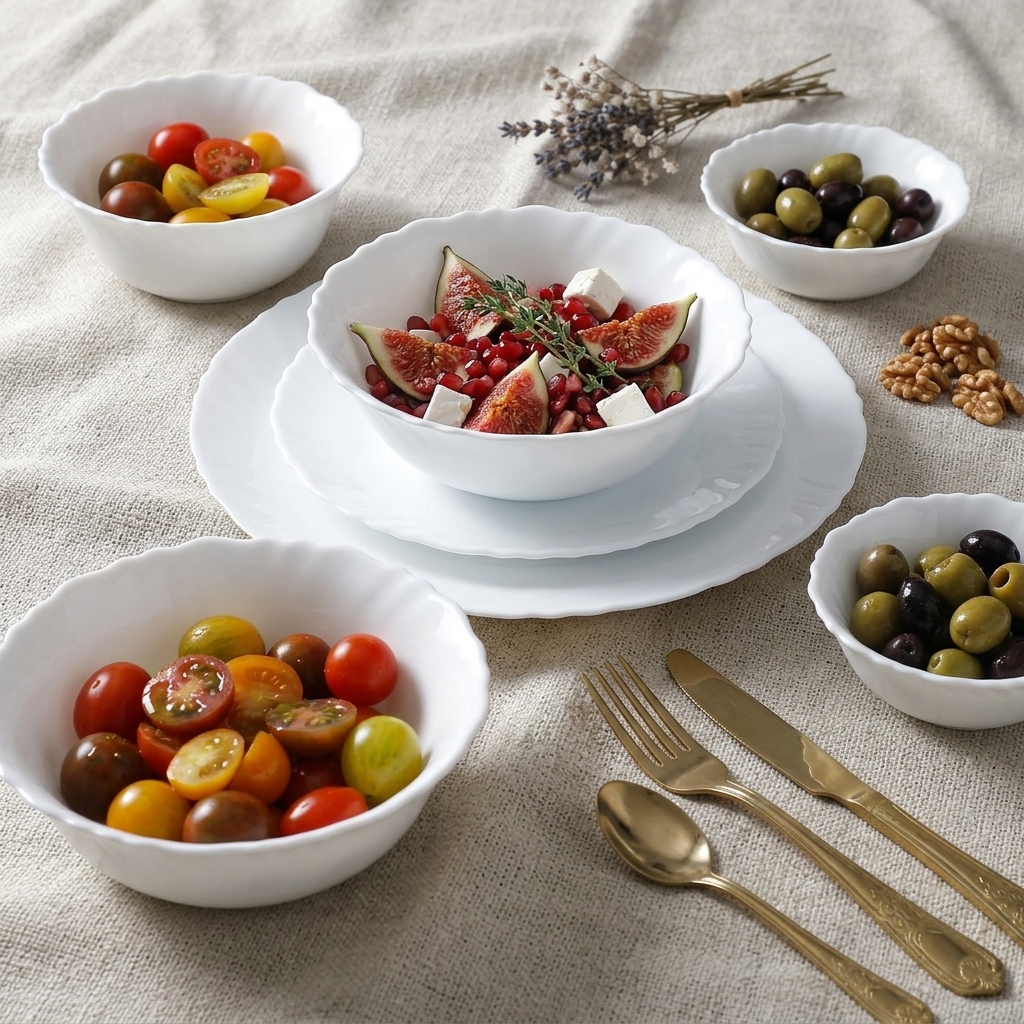
What is usually not included in a dinner set, and what needs to be added?
A dinner set usually excludes cutlery, glassware and napkins, which must be added for each guest
A dinnerware set only covers the plate, bowl and cup layer. A complete cover also includes cutlery, glassware and napkins.
| Category | Usually included in a dinner set | Still needs to be added |
|---|---|---|
| Plates, bowls, cups | Yes | Check against the set list |
| Cutlery | Usually not | One set per guest |
| Glassware | Usually not | One per guest, with more for additional drinks |
| Napkins | Usually not | One per guest |
So buying a set is not the same as buying a complete table setting. Check the set list first, then add cutlery, glassware and napkins by headcount. Do not reverse the order. If you buy from Jointion, the set and the additional items can be configured separately, making pricing and lists clearer.
A dinner set usually excludes serving platters, serving spoons and teapots, which must be added by menu
The second gap is shared items. Serving platters, serving spoons and teapots are not allocated by headcount; they are allocated by table count, dishes and service style.
For a table of 10, you may need only one or two serving platters, one serving spoon and one teapot. Allocating one serving spoon per guest would definitely be too many; allocating by table count gets closer to actual service needs.
- Serving platters: by dish type and table count
- Serving spoons: by dishes that need portioning
- Teapots: by table count and beverage service style
Individual pieces are calculated by covers; shared pieces are calculated by tables and menu. Keep the two lines separate so purchasing does not leave you short in one area and overstocked in another.
A dinner set looks like nothing more than plates, bowls and cups, but break it down and you get three things: pieces, covers and calculations. Set the individual portion first, then break down the set by piece count, and finally calculate turnover and spares for a household, restaurant or hotel. Get the order right, and buying dinnerware no longer relies on guesswork.
When you are ready to buy from Jointion, start with the Jointion opal glass dinnerware homepage, then continue by category: sets, plates, bowls and cups.