
This guide covers dinnerware MOQ for wholesale buyers: typical minimum-order ranges by material, the difference between stock and custom dinnerware, how mixed orders are calculated, small-batch trials, and the terms to confirm when requesting a quote. It helps wholesale buyers assess quotations, plan first-order quantities, and leave room for repeat orders. Treat the figures as a planning reference for your dinnerware minimum order; the final quantity should always follow the supplier’s written quotation.
What MOQ Range Is Common for Different Dinnerware Materials?
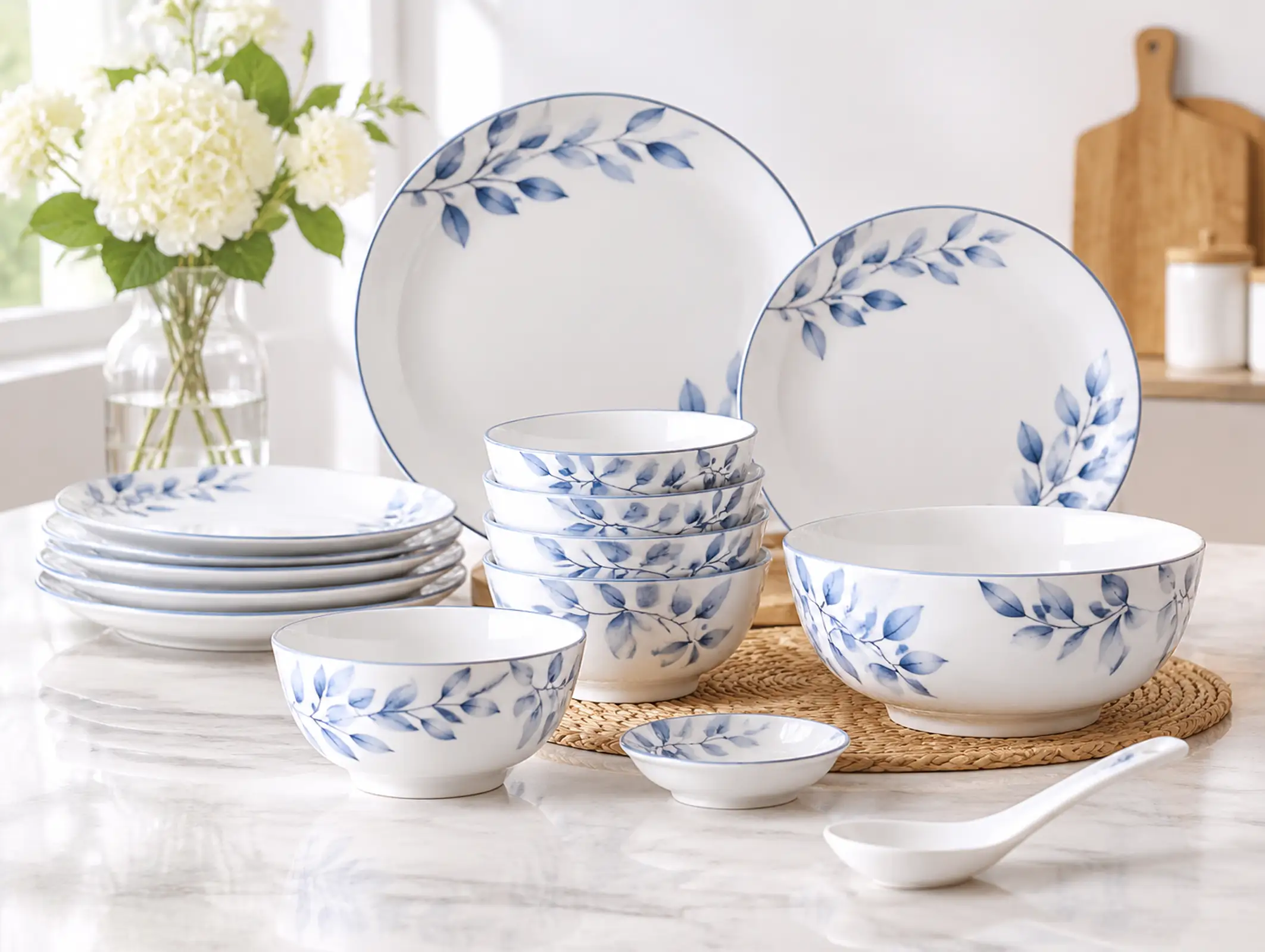
Ceramic Dinnerware MOQ Is Usually Around 500–1,000 Pieces
Ceramic dinnerware commonly starts at around 500–1,000 pieces. That range is useful for budgeting, but where an order lands depends on the shape, pattern, and firing batch.
Ceramic dinnerware goes through kiln loading, firing, glaze mixing, decal plate-making, and first-article approval before it can ship. Each step carries a one-time setup. A kiln does not cut a full heating, holding, and cooling cycle just because the order is 300 pieces; molds, decal plate fees, and trial-production scrap still have to be covered. The smaller the order, the more those costs land on each piece, so the factory sets MOQ at a level that covers the setup.
| Fixed cost | Impact on MOQ |
|---|---|
| Kiln loading and firing | Energy, kiln adjustment, and defect loss for a firing cycle do not shrink in proportion to order quantity. |
| Molds and first-article approval | A new shape needs development and trial production; too small a run cannot amortize the cost. |
| Color matching and decal plate-making | Custom colors, decal paper, and logos add plate fees and trial-production cost. |
Firing cost has a clear energy basis. Energies: ceramic tunnel kiln energy review notes that tunnel kilns are widely used in ceramics because they run continuously and provide stable performance, but firing is still highly energy-intensive. A partially loaded kiln does not reduce energy and kiln-adjustment costs in proportion to the number of pieces.
So 500 pieces is usually a better fit for standard shapes and existing patterns, while 1,000 pieces or more is better able to cover custom colors, decals, and first-article approval. If a quote comes in below 500 pieces, ask which setup step is being reduced, then compare the unit price together with the setup cost.
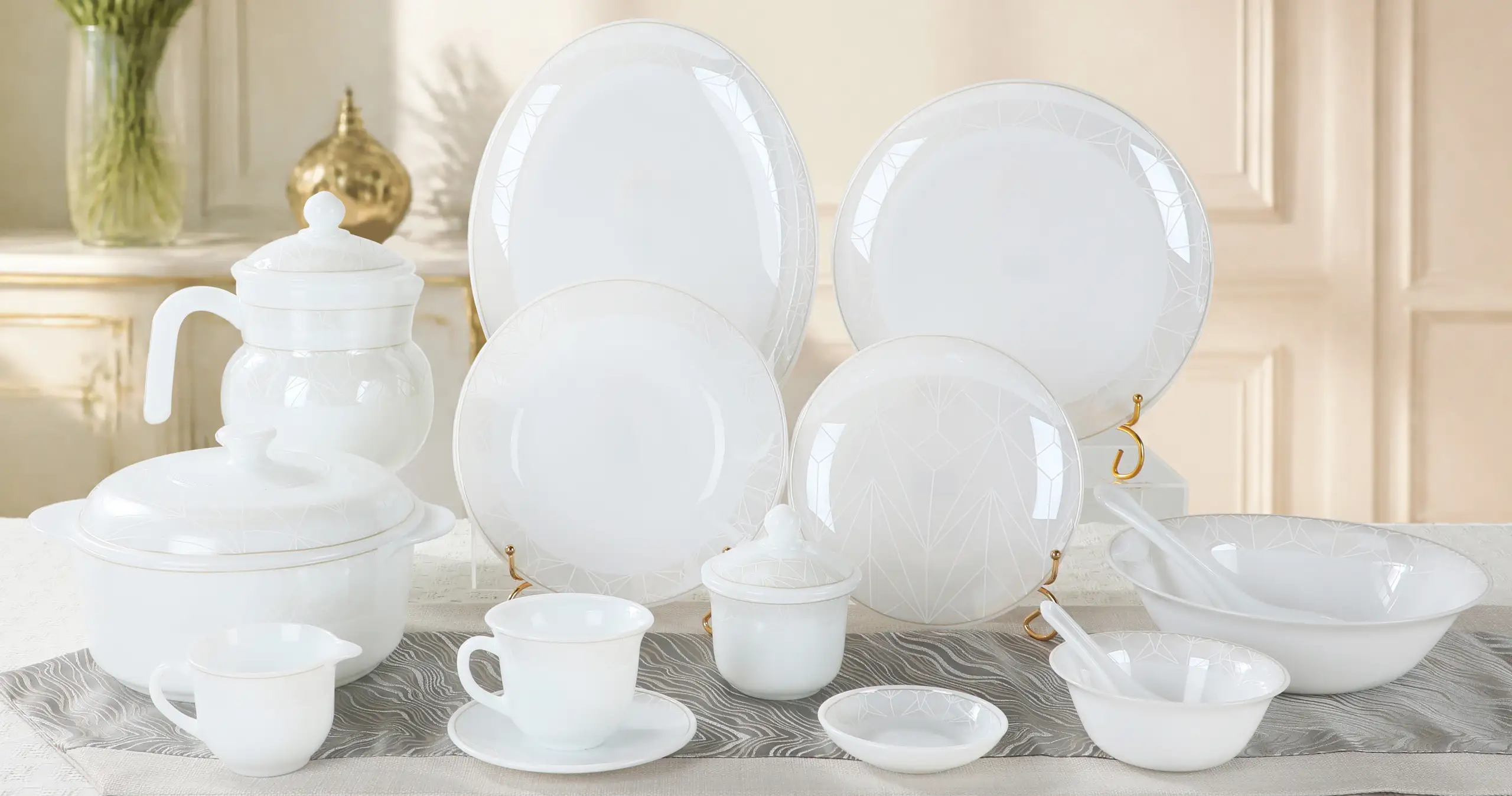
Glass Dinnerware MOQ Is Usually Around 1,000–3,000 Pieces
Glass dinnerware commonly starts at around 1,000–3,000 pieces. Standard shapes and standard colors usually sit near 1,000 pieces; new molds, special colors, decoration, or complex shapes are more likely to land near 3,000.
Glass production has a start-up sequence that must be completed:
- Changing molds and starting the line require a stable furnace temperature; trial pieces still need annealing and inspection.
- A color change requires cleaning the channel and residual material; the more unusual the color, the longer cleaning and adjustment take.
- A new shape needs trial molds, trial production, and breakage-rate checks; the first batch is not automatically stable.
Each of these steps has a minimum run. If the order is too small, start-up and scrap losses cannot be spread thin, so the factory protects unit cost through MOQ. The difference between 1,000 and 3,000 pieces is essentially the same setup cost spread across different quantities.
ACEE: glass color and energy shows that glass manufacturing is a high-volume process; furnace age, batch composition, and glass color all affect energy use and stability. The production process is also more complex, so MOQ is somewhat higher than for ceramic.
At the quotation stage, it is clearer to list MOQ separately for stock, color-change, and new-mold options. For a standard plate shape, Jointion’s glass plate category is a useful place to review available shapes. (The final figure—1,000 or 3,000 pieces—should be confirmed against the selected item’s quote.)
Stainless Steel Dinnerware MOQ Is Usually Around 500–2,000 Pieces
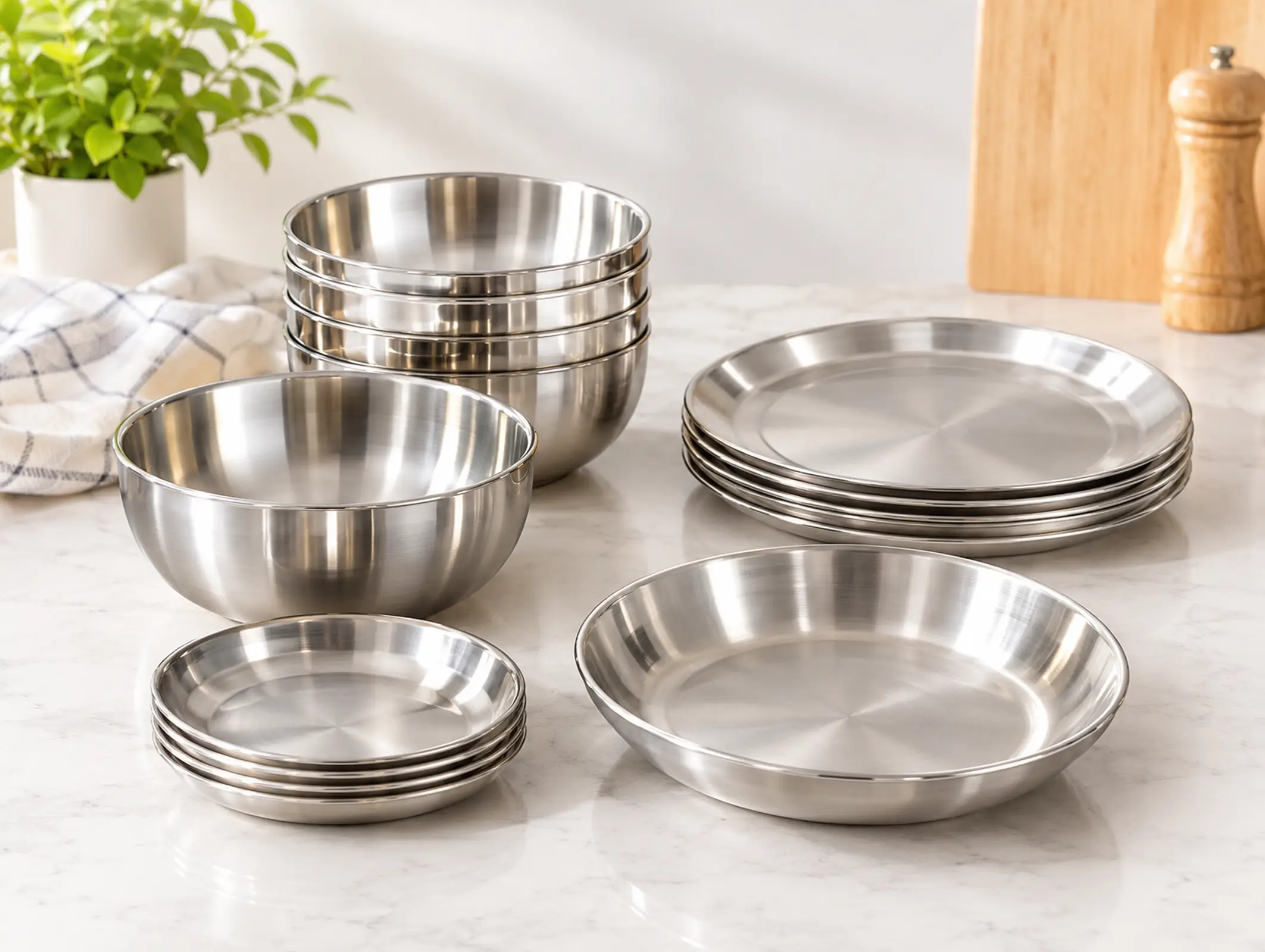
Stainless steel dinnerware commonly starts at around 500–2,000 pieces. Simple uncoated pieces usually sit near the lower end; complex drawing, colored surfaces, PVD finishing, or matching packaging are more likely to sit near the upper end.
Fixed costs fall into three main areas:
- Press or draw molds must be built, installed, and adjusted.
- The first run produces setup scrap and trial-mold loss.
- Polishing, PVD, or other surface finishing only becomes economical at a certain batch size.
Below that setup volume, unit cost rises noticeably. The factory uses MOQ to protect cost, and the quote reflects the actual setup work.
ASME: small-batch stamping cost notes that tooling and fixtures dominate the cost of small-batch stamping. That also explains why uncoated and colored pieces in the same material land at different thresholds.
Melamine Dinnerware MOQ Is Usually Around 500–2,000 Pieces
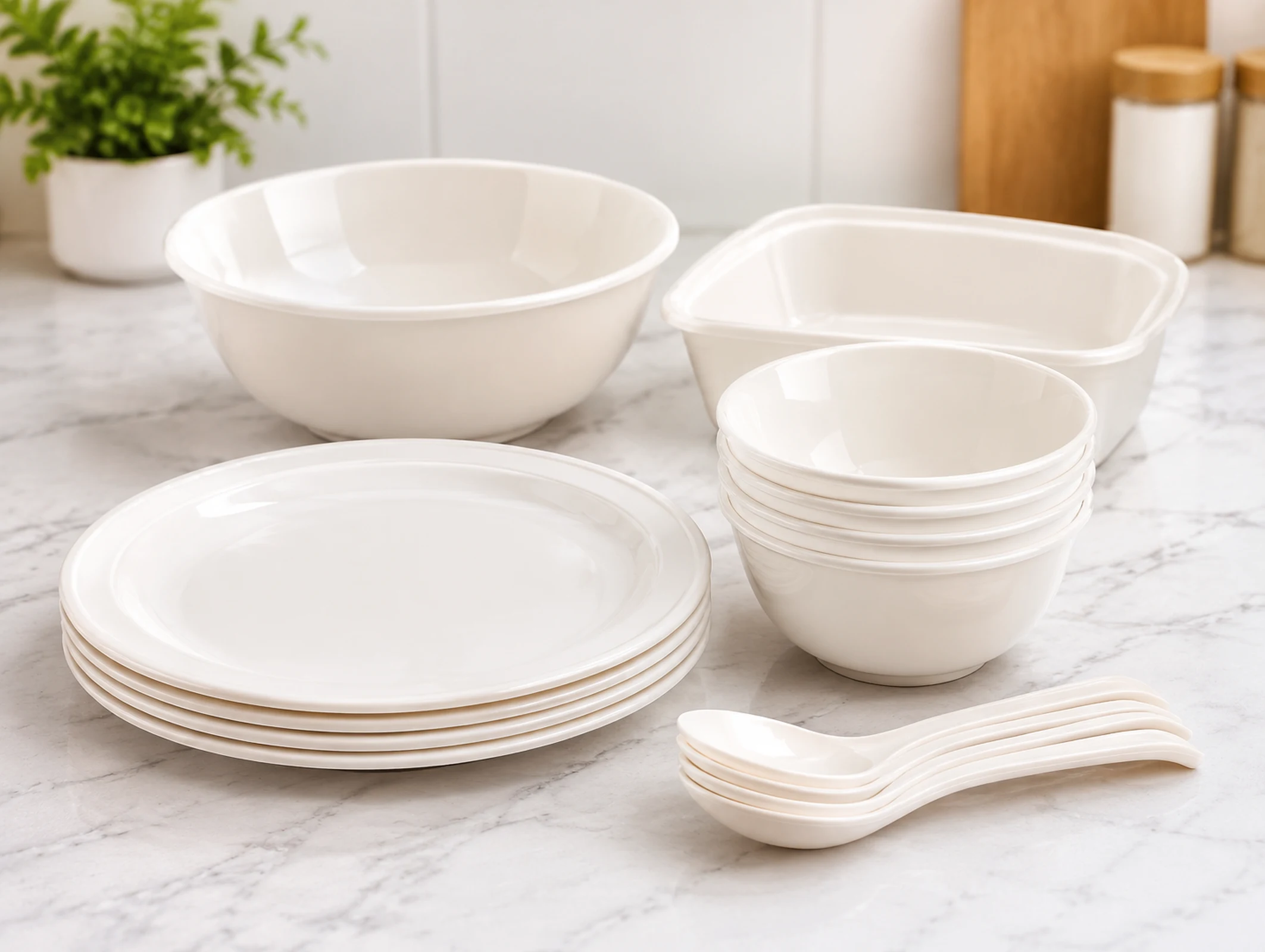
Melamine dinnerware commonly starts at around 500–2,000 pieces. Solid-color standard items usually sit near the lower end; new molds, two-tone designs, decals, transfers, or custom packaging usually sit near the upper end.
Melamine dinnerware is mainly compression molded. Steel mold development, mold-temperature adjustment, pigment batches, decal paper or transfer film minimums, and trial-run scrap are all upfront costs. If the quantity is too small, those costs cannot be amortized, so the factory uses MOQ to control unit cost.
Why Is There Such a Big Difference Between Stock and Custom Dinnerware MOQ?
Stock Dinnerware Already Has Finished Goods and Packaging, So MOQ Is Lower
Stock dinnerware has a lower MOQ for a simple reason: the product is already made, inspected, and packed, so the order is mainly picked from the warehouse. No new molds, color matching, plate-making, or trial production are needed. MOQ is mainly limited by the existing carton size, pallet configuration, and stock quantity, which makes it the simplest path to a bulk dinnerware MOQ. A custom order, by contrast, has to cover a full production run first, so the threshold is naturally higher.
Changing the Pattern or Printing a Logo Requires New Materials and Raises MOQ
Changing the pattern or printing a logo turns the order from warehouse picking into a new production run, so MOQ goes up.
Colors need matching, sampling, and trial production; a logo needs plate-making, sampling, and machine adjustment; packaging needs a new print run or a new minimum order. These fixed costs do not disappear because the order is smaller. Spreading the same setup cost across 300 pieces and 1,000 pieces produces very different unit results.
A Brand-New Shape Requires Tooling and Trial Production, So MOQ Is Highest
A brand-new shape has the highest MOQ because the order starts with tooling and has to get a new production line running smoothly.
The process usually runs through:
- Mold design and mold making.
- Trial molding to confirm dimensions, appearance, and thermal stability.
- First trial run to handle scrap and yield ramp-up.
- Sample approval before mass production is scheduled.
Mold cost divided by 1,000 pieces and by 5,000 pieces gives completely different per-piece amortization. The heavier the setup, the higher the MOQ. A new shape also adds sample approval and first-batch yield ramp-up, so a higher threshold than a simple pattern change is normal.
Can Mixed Styles, Colors, and Sizes Be Combined to Meet MOQ?
Mixed Styles in the Same Material and Process Can Usually Be Combined
For mixed dinnerware styles, colors, or sizes, a buyer can usually combine them to reach the total MOQ when the material and process are the same. What gets combined is the total order quantity; the minimum per style is calculated separately under the supplier’s rules.
Using the same material means raw materials can be shared, and using the same process reduces machine changes and changeovers, so the factory is willing to calculate the total order as one run. Mold changes, printing, and packaging each carry a cost, and each shape keeps a minimum quantity so the combined order can actually run.
| Check item | 1,000 pieces split into 5 styles, 200 pieces each | Conclusion |
|---|---|---|
| Total order MOQ | 1,000 pieces combined | Can be negotiated as a combined order |
| Minimum per style | 200 pieces per style | Depends on the supplier’s per-style minimum |
| Line and mold changes | Reduced by the same material and process | Charged by the number of changeovers |
Combining orders reduces separate line changes and makes scheduling smoother; mold, printing, and packaging costs are still calculated separately for each style’s actual setup. The same combining logic also applies to wholesale tableware MOQ when a buyer mixes plates, bowls, and serving pieces.
If you are curious about how many pieces or styles are in a dinner set, Jointion, a glass dinnerware manufacturer, has a feature article on what’s included in a dinner set.
What If the MOQ Is Too High? Practical Ways to Lower It and Start with a Small Trial Order
Choosing a Standard Style Is the Most Direct Way to Lower MOQ
Standard styles already have molds, raw materials, colors, and packaging; the cost of tooling, color matching, plate-making, and trial production has long been amortized by previous orders. A low MOQ dinnerware manufacturer can therefore offer these items at a lower starting quantity. A new custom item has to put those setup costs into the first order, so the threshold is naturally higher. Using a standard style for the first order moves the fixed setup cost back onto existing capacity, and custom work can be evaluated later with less risk.
Reducing Logo, Decal, and Color Customization Can Lower MOQ
Reducing logo, decal, and color customization removes the corresponding plate-making, color-matching, and trial-production setup, so MOQ can come down.
Rank the reductions by fixed cost: first find out which item costs the most, then remove the customization that matters least to sales. (Cost structures differ by supplier; simply rank them by the actual quote.)
The practical sequence has three steps:
- List the plate-making, color-matching, and trial-production costs for color, decal, and logo separately.
- Cut the highest-cost item that has the least impact on product recognition first.
- Keep the brand mark that matters and move the rest back to the existing standard.
Once setup and changeover costs come down, production batches have room to get smaller; reducing customization is simply taking that setup cost out of the quote.
Accepting a Small-Batch Surcharge Makes Suppliers More Likely to Accept Orders Below Standard MOQ
Accepting a small-batch surcharge makes suppliers more likely to accept orders below standard MOQ. The surcharge recovers the startup, machine-adjustment, and low-efficiency losses that were not spread across a full batch; the standard MOQ itself stays in place.
In 2025, Restaurant Dive: tariffs push up restaurant costs reported that tariffs could raise equipment and opening costs for restaurant companies. When cost pressure rises, starting with a small trial order and replenishing based on sales becomes a more workable purchasing pattern. A small-batch surcharge fits that pattern.
Standard MOQ covers one production setup. Below the threshold, that cost still exists; it simply moves from “spread into the unit price” to “charged separately.” Divide the fixed surcharge by the reduced quantity, and you can see how the supplier covers the loss.
This fee buys one low-volume production opportunity; standard MOQ stays unchanged, and the surcharge, mixable range, and lead time should be written into the quotation.
What Conditions Should You Confirm Before Asking a Supplier About MOQ?
MOQ Can Be Calculated per Style, per Color, or per Order, and the Real Threshold Differs
The same “1,000 pieces” can mean per style, per color, per packaging type, or per order, and the real threshold is different in each case.
| Quote wording | What the supplier actually checks | 1,000 pieces split across 10 colors |
|---|---|---|
| 1,000 pieces per style | At least 1,000 pieces per style | 100 pieces per color usually does not qualify |
| 1,000 pieces per color | At least 1,000 pieces per color | 100 pieces per color usually does not qualify |
| 1,000 pieces per packaging type | At least 1,000 pieces per packaging specification | Also depends on how many packaging specifications are involved |
| 1,000 pieces per order | All colors combined total 1,000 pieces | Qualifies, then check the per-color minimum |
Only when the quote states the calculation basis can the buyer judge the real threshold; the same number under four bases represents four different order structures.
Whether Packaging, Logo, and Sample Fees Are Extra Changes the Total Cost Behind the MOQ
A low-MOQ quote may be for bare goods only. Whether packaging, logo, and sample fees are included changes the total cost behind the MOQ.
| Cost item | What to confirm | Impact on total cost |
|---|---|---|
| Packaging | Whether there is a separate MOQ, printing plate fee, or carton requirement | A low MOQ can be pushed up by the packaging threshold |
| Logo | Whether plate, printing, and sampling fees are charged separately | One-time costs should be separated from per-piece costs |
| Sample fee | Whether it is refundable or deductible after the order | The first-order cash outlay changes |
Packaging itself has an MOQ. Jointion’s glass dinnerware packaging guide breaks down carton sizes, inserts, and printing minimums, so you can check them directly during inquiry.
Two quotes with similar unit prices need packaging, logo, and sample fees added line by line before the true total cost behind the MOQ becomes clear.
Does Repeat-Order MOQ Have to Match the First Order?
The MOQ for a repeat dinnerware order may differ from the first order, so confirm it separately.
The first order usually includes tooling, plate-making, color matching, and trial production. When a repeat order uses the same molds, colors, and packaging, MOQ has room to fall because the first-order setup has already been amortized; a color change, packaging change, or the end of an existing stock batch is recalculated as a new order. Buyers should confirm three things:
- Whether the repeat quantity can use the first-order standard when the mold, color, and packaging are unchanged.
- Whether a color-only or packaging-only change is recalculated as a new order.
- Whether standard items still keep a low-volume repeat-order tier after the original batch sells out.
That is why it is worth clarifying these points with the manufacturer before you finalize a minimum order for dinnerware; clear terms help both sides avoid the biggest losses.