
Is opalware heavy or light? That’s usually the first thing people want to know when they come across this material. Not which brand to pick, not how much it costs — just a simple, honest question: what does it actually feel like when you pick it up?
This article answers one thing: the real opalware weight in grams, and what being light means for your everyday routine.
How Light Is Opalware? Real Weight Numbers
Why Opalware Is Lighter Than Ceramics
A lot of people assume opalware is some kind of ceramic. It’s not.
Opalware is glass. During production, opacifiers like fluorides and phosphates are mixed into a standard soda-lime glass formula, then the pieces are tempered after forming. The base material is glass — not fired clay.
That difference is what drives the weight gap.
Ceramics come from natural clay, sintered at 900–1200°C. The fired structure is dense and thick, typically landing at a density of 2.3–2.5 g/cm³. Porcelain sits in a similar range.
Opal glass works differently. Its matrix is amorphous — molecules in a continuous, non-crystalline arrangement, without the packed-particle structure of ceramics. On top of that, fluorides in the formula form sub-micron crystals as the glass cools. These tiny crystals scatter through the matrix, keeping the material strong while holding density down to roughly 2.0–2.2 g/cm³.
A gap of 0.3 g/cm³ sounds small. But density times volume equals weight. A 10-inch dinner plate has real volume, and that 0.3 gap adds up to a 30–40% weight difference in the finished piece.
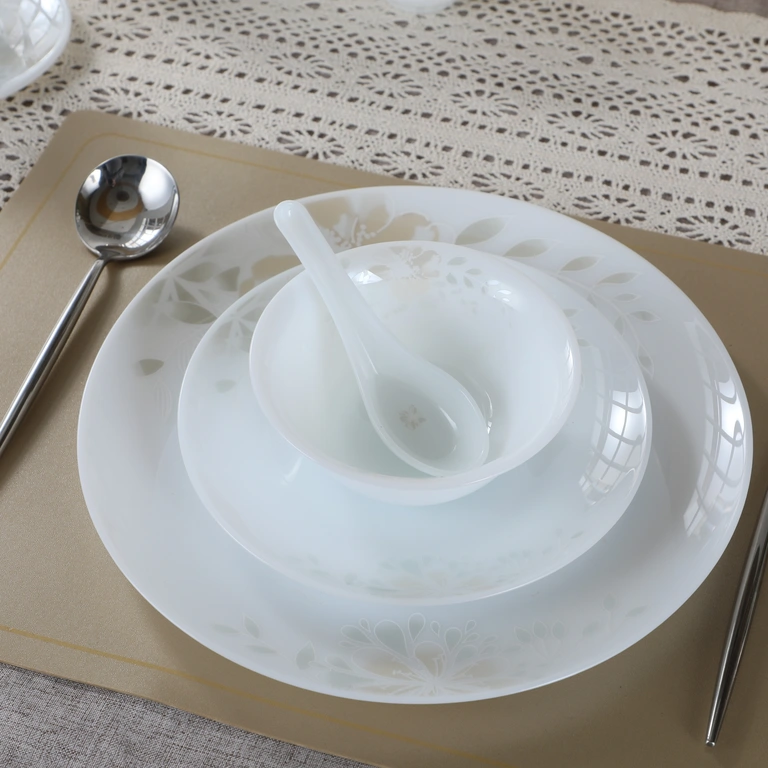
So is opal glass dinnerware lightweight? Yes — and not because it’s thinner. The microstructure of the material itself is what makes it lighter. A journal under the American Ceramic Society covers this in detail — their study on opal crystallized glass plate structure and durability breaks down how fluoride crystals distribute within the glass matrix.
How Much Does Opalware Weigh?
We pulled 10-inch dinner plates in three materials from our warehouse — five of each — and put them on a digital scale one by one. Here’s what we got:
| Material | 10-Inch Plate Avg. Weight | Feels Like |
|---|---|---|
| Opalware | 320–380 g | A paperback book |
| Ceramic | 550–680 g | A full water bottle |
| Bone China | 420–530 g | Somewhere in between |
Exact numbers vary by manufacturer and shape, but the ratio stays consistent. Among common dinnerware materials, opalware sits in the lightest tier.
Want to feel the difference yourself? Browse our opal glass dinnerware catalog — samples are available for hands-on evaluation.
This Light — Won’t It Break Easily?
Light and Strong Answer Two Different Questions
Pick up something this light, and the worry comes naturally: if it’s this light, can it really take a hit?
Fair concern. But “light” and “fragile” are about two completely separate properties.
Opalware is light because the glass matrix is less dense than fired clay. That’s a microstructure fact — it has nothing to do with strength.
The strength comes from tempering. After forming, each piece goes into a tempering furnace at over 600°C, then gets hit with cold air from both sides for rapid cooling. This creates a compressive stress layer across the surface — a built-in “pre-tensioned shell.” Any impact has to break through that layer first.
So is opalware lightweight and durable? The data says yes. A 2024 study in the International Journal of Applied Glass Science found that fully tempered opal glass can reach surface compressive stress above 100 MPa, giving it 2–3 times the impact resistance of ordinary ceramics.
We saw this firsthand during pre-shipment testing for a hotel client in the Middle East. Same drop height, same tile floor. A standard white porcelain plate chipped on the first or second drop. The opal glass plate held up through multiple consecutive drops with no edge damage.
We have a dedicated drop-test video that shows our dinnerware remains unaffected whether it’s dropped from a height by a person or tested using a specialized drop-testing device — its light weight doesn’t make it prone to breaking.
That’s not a knock on ceramics — they have their own strengths. The point is simpler than that. Density controls weight. Tempering controls strength. Two separate lines.
Light to hold, tough to break. In opalware, those aren’t competing — they coexist. For the technical details, Construction and Building Materials published a systematic study on tempered glass compression layer depth, confirming how 100 MPa-level stress significantly boosts impact performance.
What Does “Light” Mean for Everyday Use?
Less Strain When Serving and Washing
This one’s straightforward, but people who cook and clean daily feel it more than anyone.
Plating food, clearing the table, standing at the sink — these motions repeat dozens of times a day. One plate being 100–200 g lighter barely registers on a single pickup. Wash a dozen after dinner, three meals a day, and the difference adds up fast.
It matters most for a few groups:
- Older adults — less wrist strength means a lighter plate is easier to grip and less likely to slip.
- Kids — when children start carrying their own bowls, lighter dinnerware gives them more control and fewer accidents.
- Anyone doing heavy kitchen duty — washing stacks of dishes back to back, you’ll notice real relief in your wrists and forearms when each piece weighs less.
It’s not dramatic. It’s the kind of comfort that’s quiet — until you switch back to heavier dishes and feel the difference immediately.
Stacks Higher, Moves Easier
Opalware is light, and its tempered edges resist chipping — so you can stack with more confidence than you would with ceramics.
A kitchen cabinet has fixed space and weight limits. Ceramic plates stacked five or six high already feel heavy. Push it further and you start second-guessing. Opalware stacked eight to ten high weighs about the same as six ceramic plates. Same shelf, nearly double the capacity.
Moving day makes the gap even clearer. One person can carry a full box of opalware without trouble. The same count in ceramic runs close to double the weight — most likely a two-person job.
Small things. But if your kitchen is tight on space or you relocate every few years, lighter dinnerware takes real friction out of daily life.
Common Questions People Ask
Q1: Is opalware heavy or light compared to Corelle?
Very close. Corelle uses Vitrelle — a three-layer laminated glass. Opalware is single-layer tempered opal glass. For the same size plate, the weight gap is usually within 20–30 g. In hand, it’s hard to tell which is lighter. Both sit at the lightest end of glass-based dinnerware.
Q2: Will opalware slide around in a dishwasher because it’s so light?
No. Opalware has a foot-ring base that keeps it stable on the rack. Being light actually helps here — pieces won’t press down on neighbors under strong water jets. No extra securing needed at normal loading density.
Q3: How heavy is opalware plate versus ceramic in bulk shipping?
A box of 40 ten-inch opalware plates weighs roughly 12–15 kg. The same count in ceramic runs 22–28 kg. That means 20–30% more pieces per container. For ocean freight at volume, lighter plates mean more units per shipment and noticeably lower cost per piece.