
What Types of Lead-Free Tableware Do We Offer?
Plates, bowls, and cups can be purchased separately or combined into a coordinated collection. However, creating a set takes more than putting several pieces of white tableware together. If the rim profiles, depths, colors, or decoration positions do not match, the difference becomes obvious on the table. Poorly planned sizes are even more inconvenient in everyday use.
Plates and Saucers
When choosing a plate, the easiest thing to overlook is not its diameter, but the amount of usable surface area. Two plates may have similar listed dimensions, but if one has a wider rim, the space available for food can be noticeably smaller. Hotel breakfasts, buffets, and household dinnerware sets also call for different plate shapes, so a front-view photo alone is not enough to make a decision.
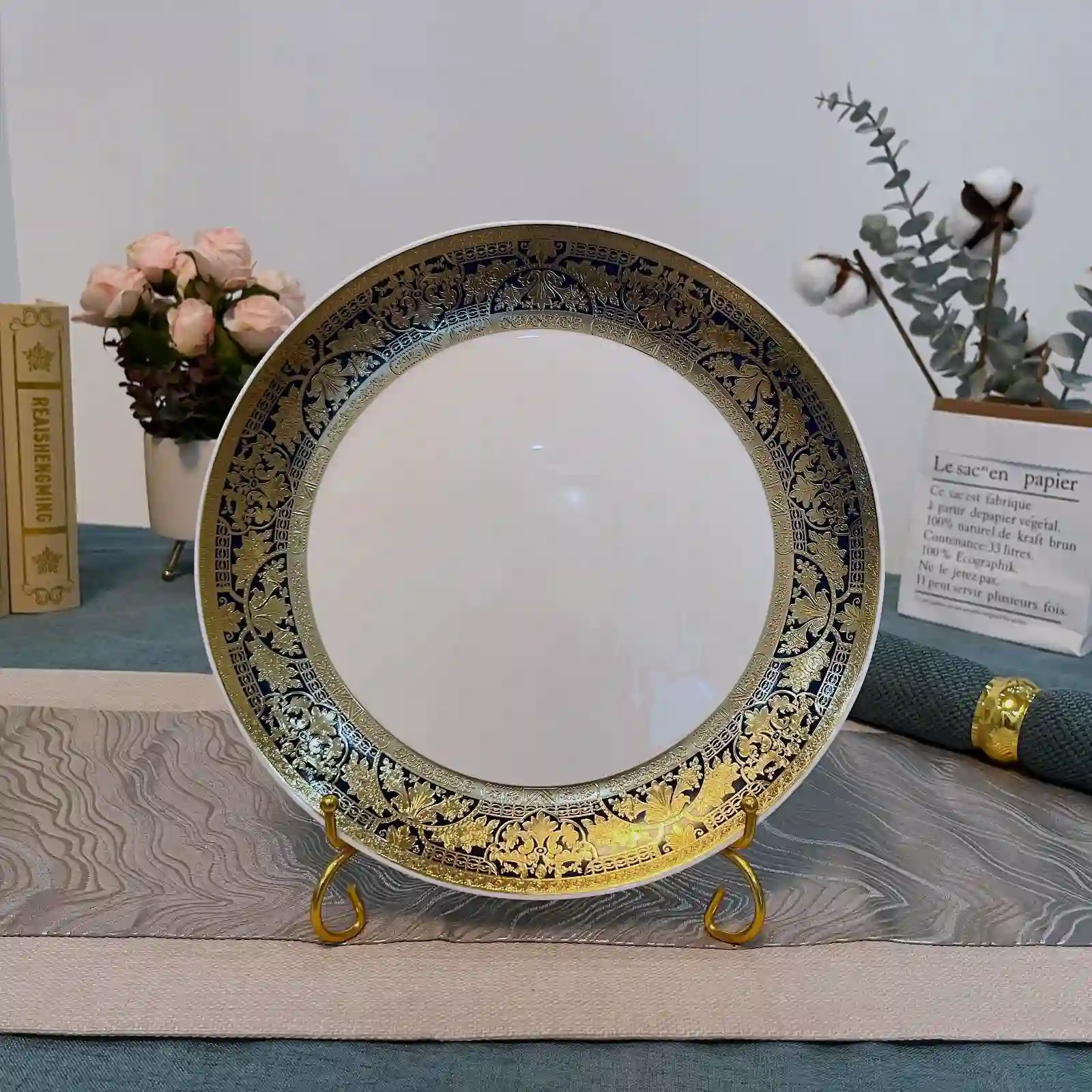
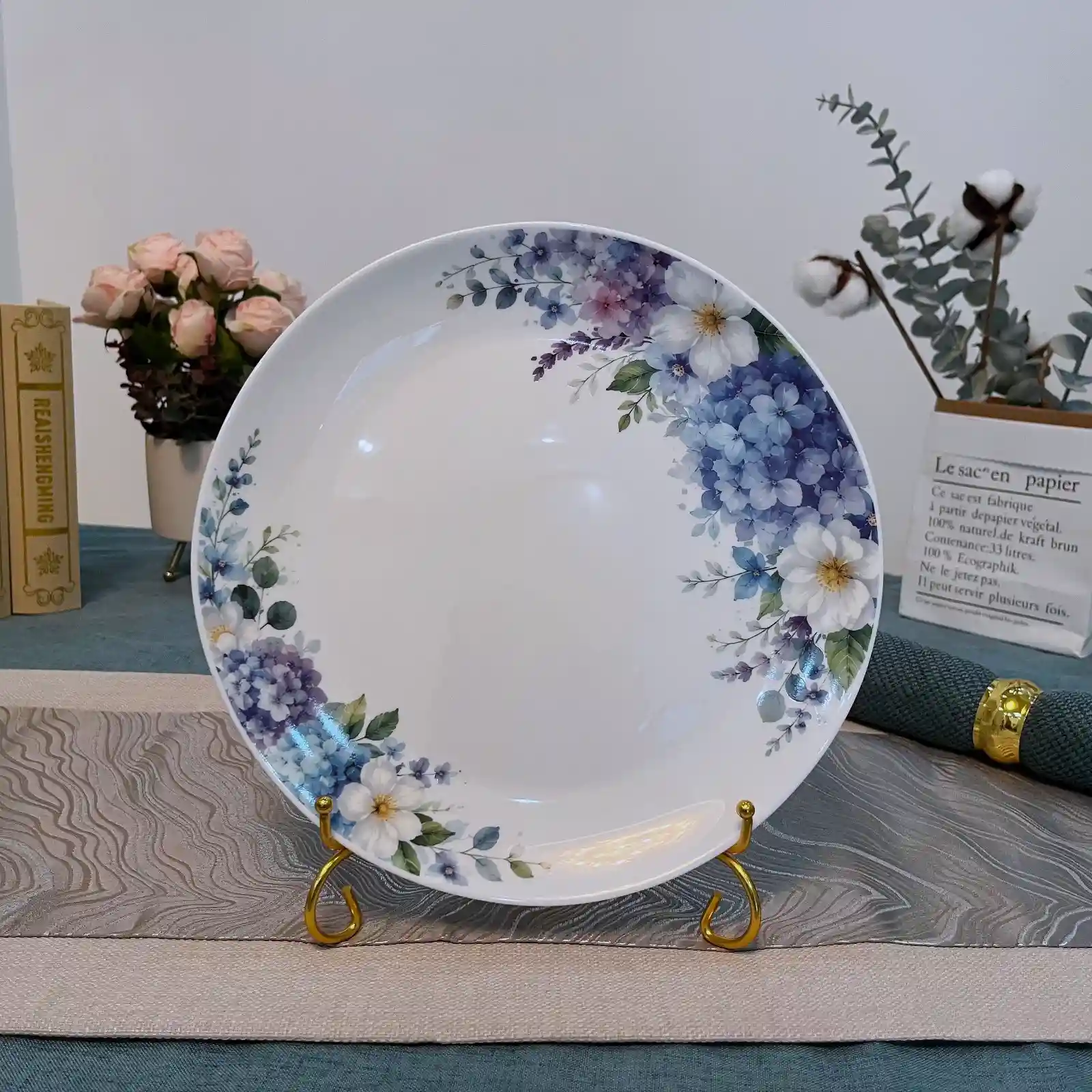
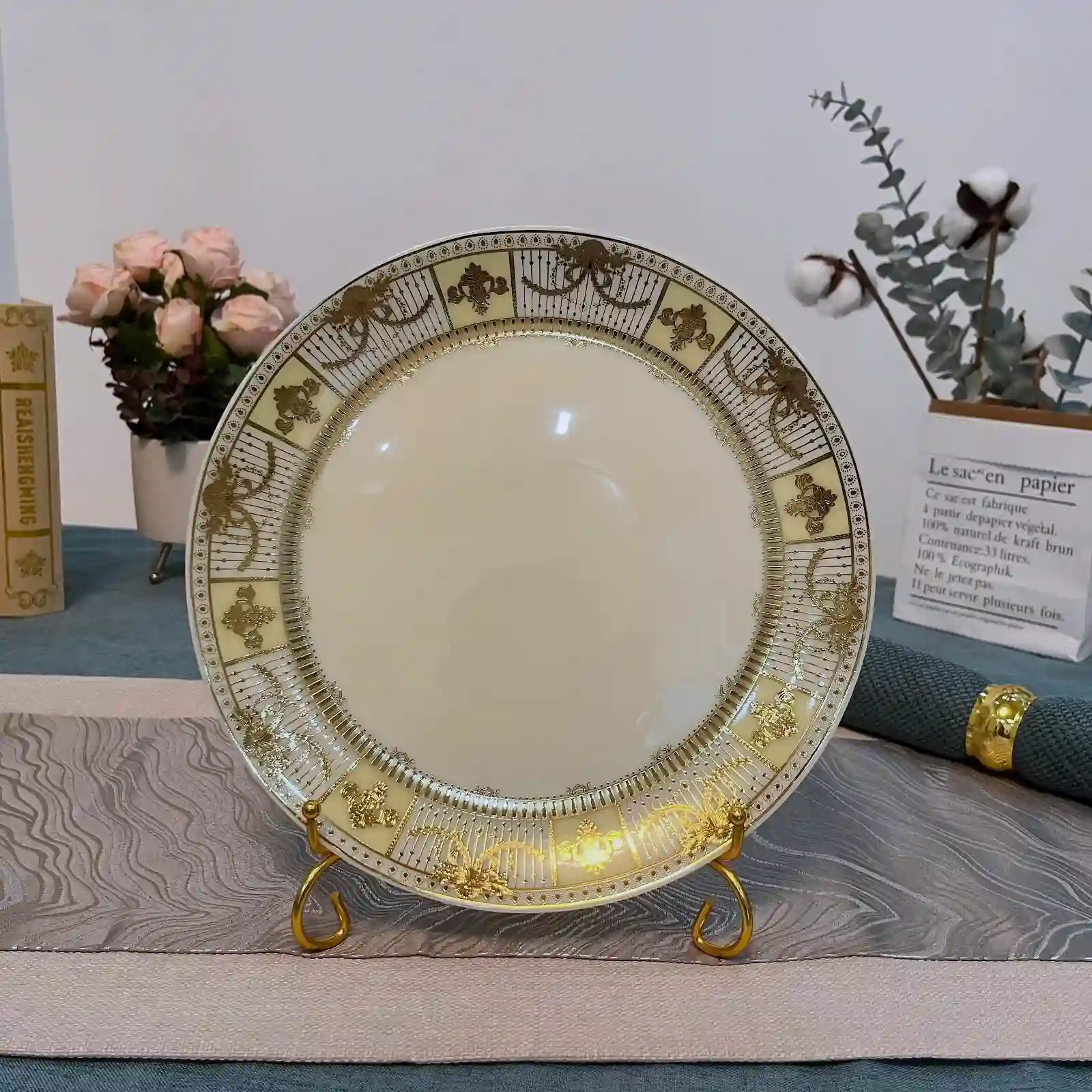
Jointion offers lead-free Opal Glass products such as flat plates, deep plates, dessert plates, and matching saucers. Flat plates work well for main courses and everyday meals, deep plates are better suited to dishes with sauces, and smaller plates can be used for desserts, condiments, or as part of a cup-and-saucer set. When selecting a style, it is best to confirm the following points together:
- Plate diameter, plate depth, and usable surface area;
- Whether the rim is easy to grip and whether stacked plates take up too much space;
- Whether flat plates, deep plates, and dessert plates need to form one coordinated collection;
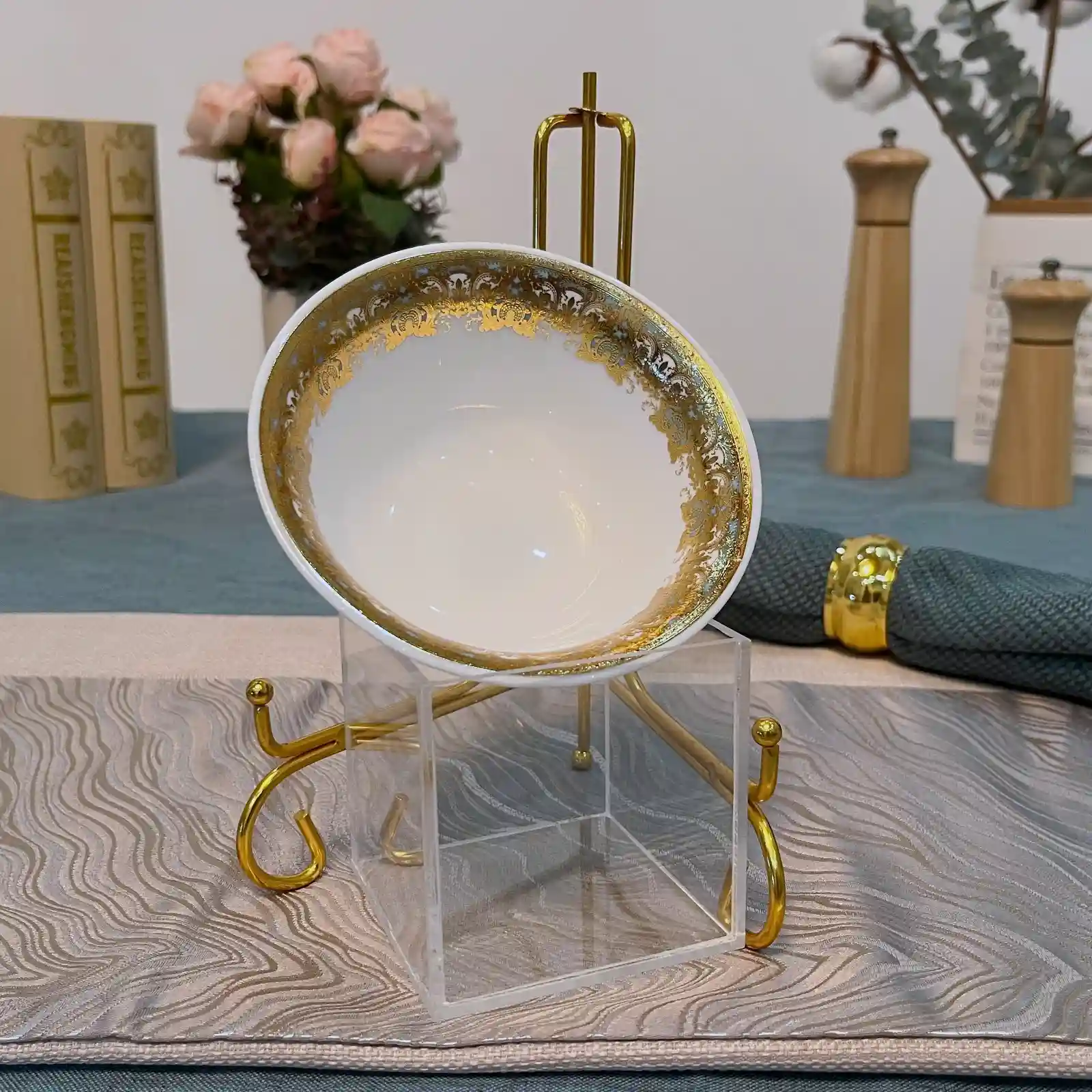
- Whether the positions of decals, low-temperature relief decorations, gold rims, or electroplated gold decorations are consistent.
Dining Bowls and Soup Bowls
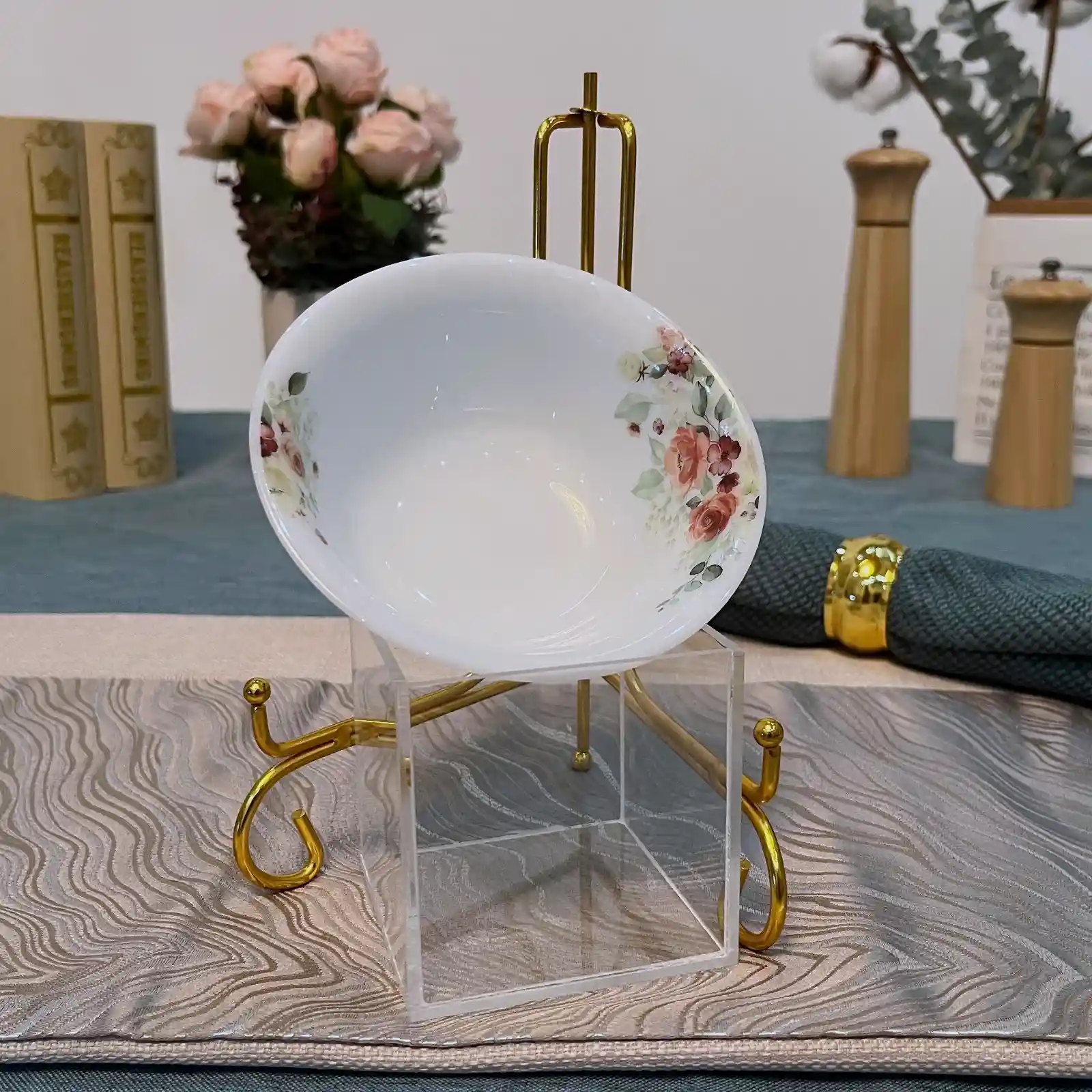
A bowl should not be judged by its diameter in inches alone. Two bowls with the same rim diameter can hold food differently, feel different to carry, and reach different stacking heights because of variations in depth and the curve of the base.
Shallow bowls are suitable for rice, salads, and side dishes. They provide easy access to the food and make it easier to present attractively. Soup bowls need more depth so that soup, noodles, and dishes with sauces are less likely to spill over the rim. However, deeper bowls usually create taller stacks. If back-of-house shelving is limited or a large quantity must fit into each carton, this needs to be checked in advance.
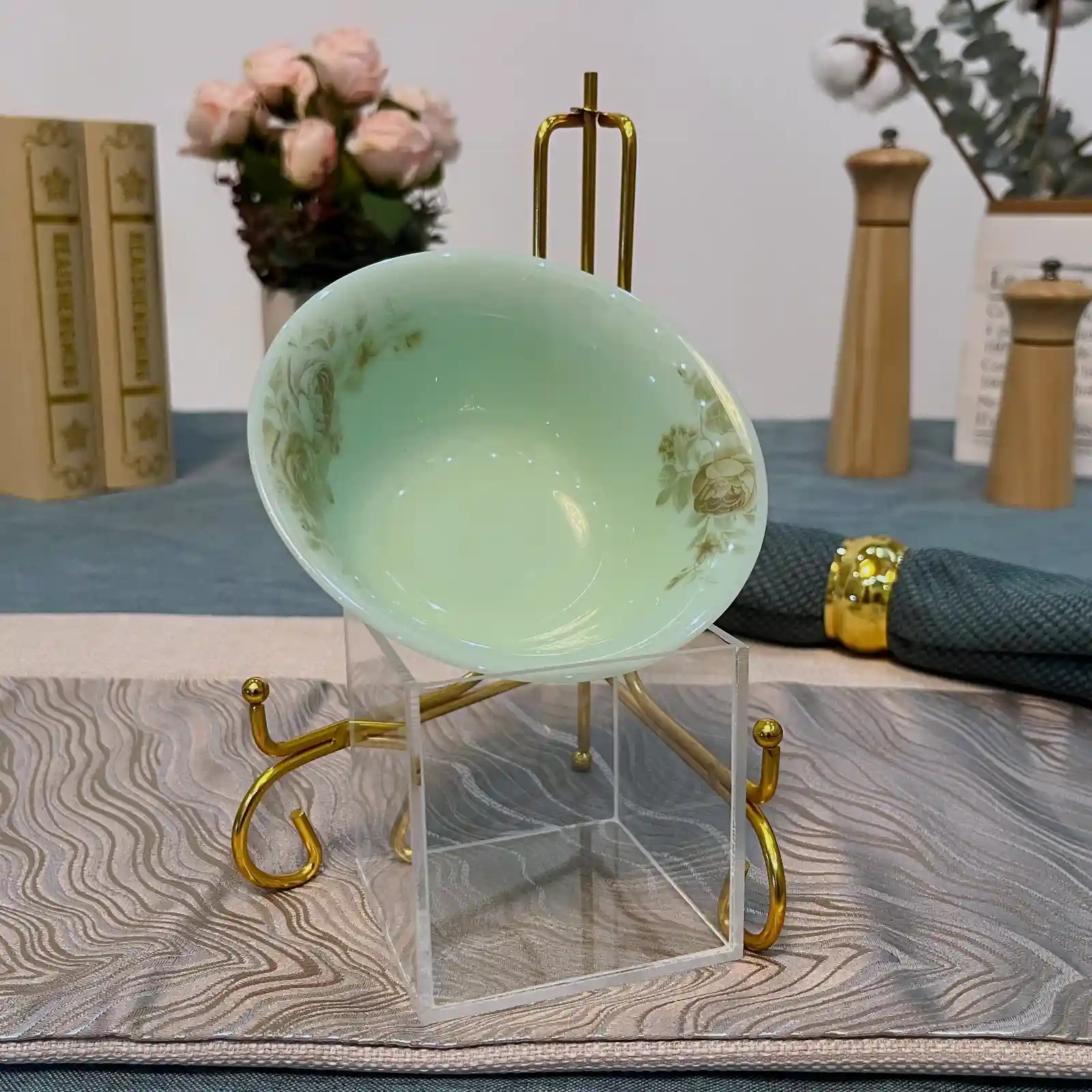
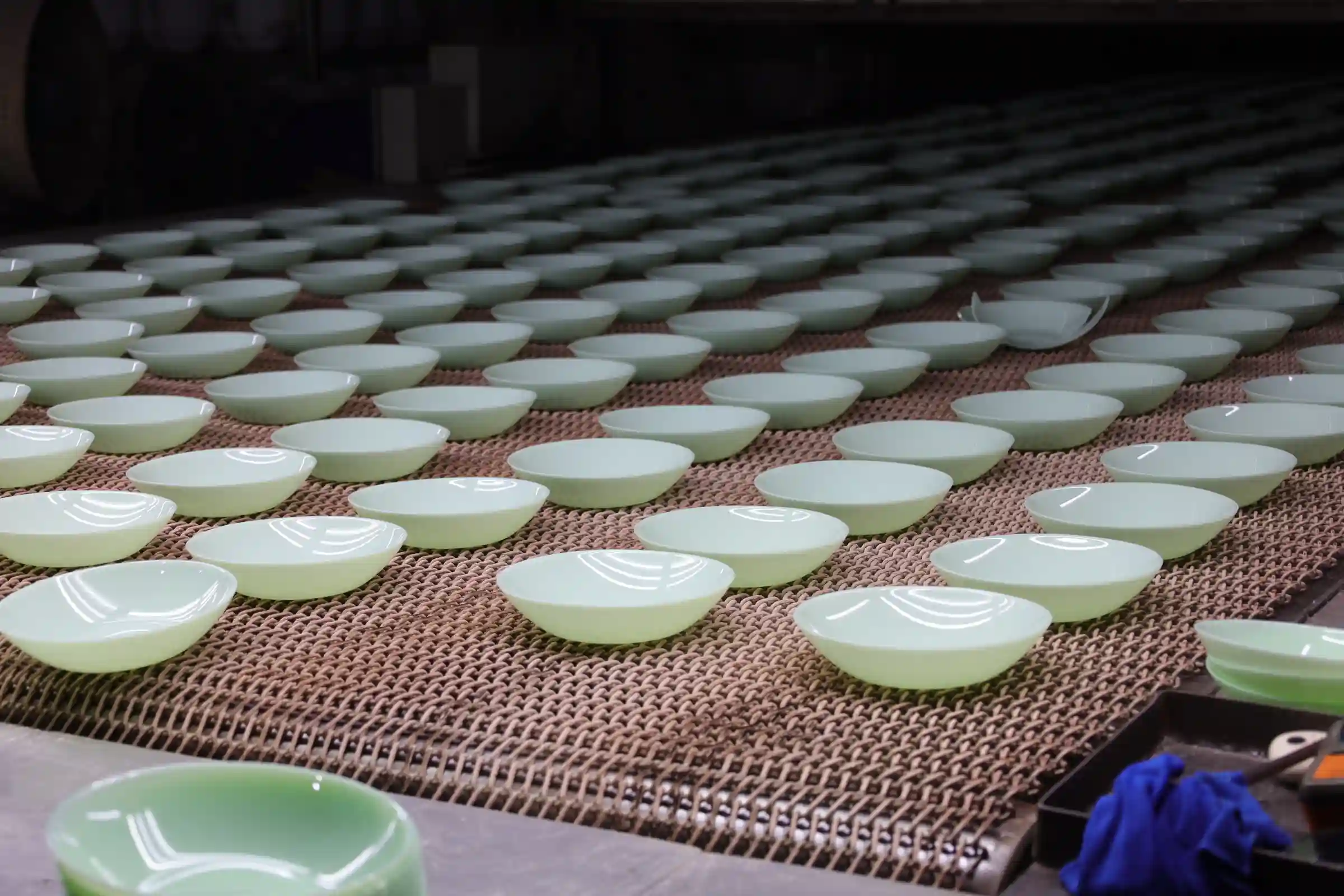
Jointion offers lead-free Opal Glass dining bowls and soup bowls in different rim diameters, depths, and capacities. When requesting a quote, it is more useful to explain what the bowl will hold, the approximate serving size, and whether it needs to match existing plates than simply writing, “We need soup bowls.” For foodservice use, buyers should also check whether sauce or broth tends to remain around the rim and whether the bowls stack easily after washing. These small details often say more about whether a bowl is suitable than its product name does.
Various Cup Series
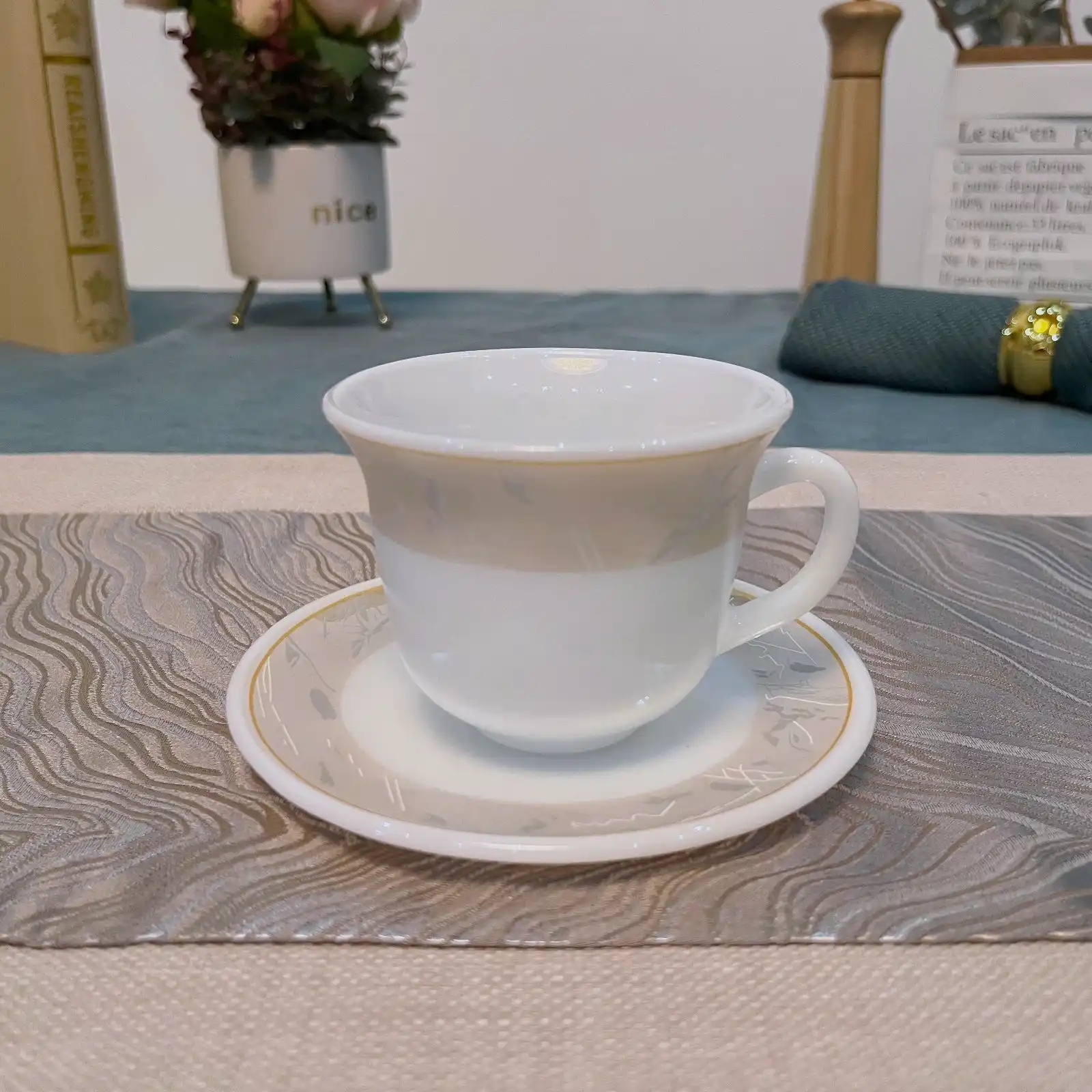
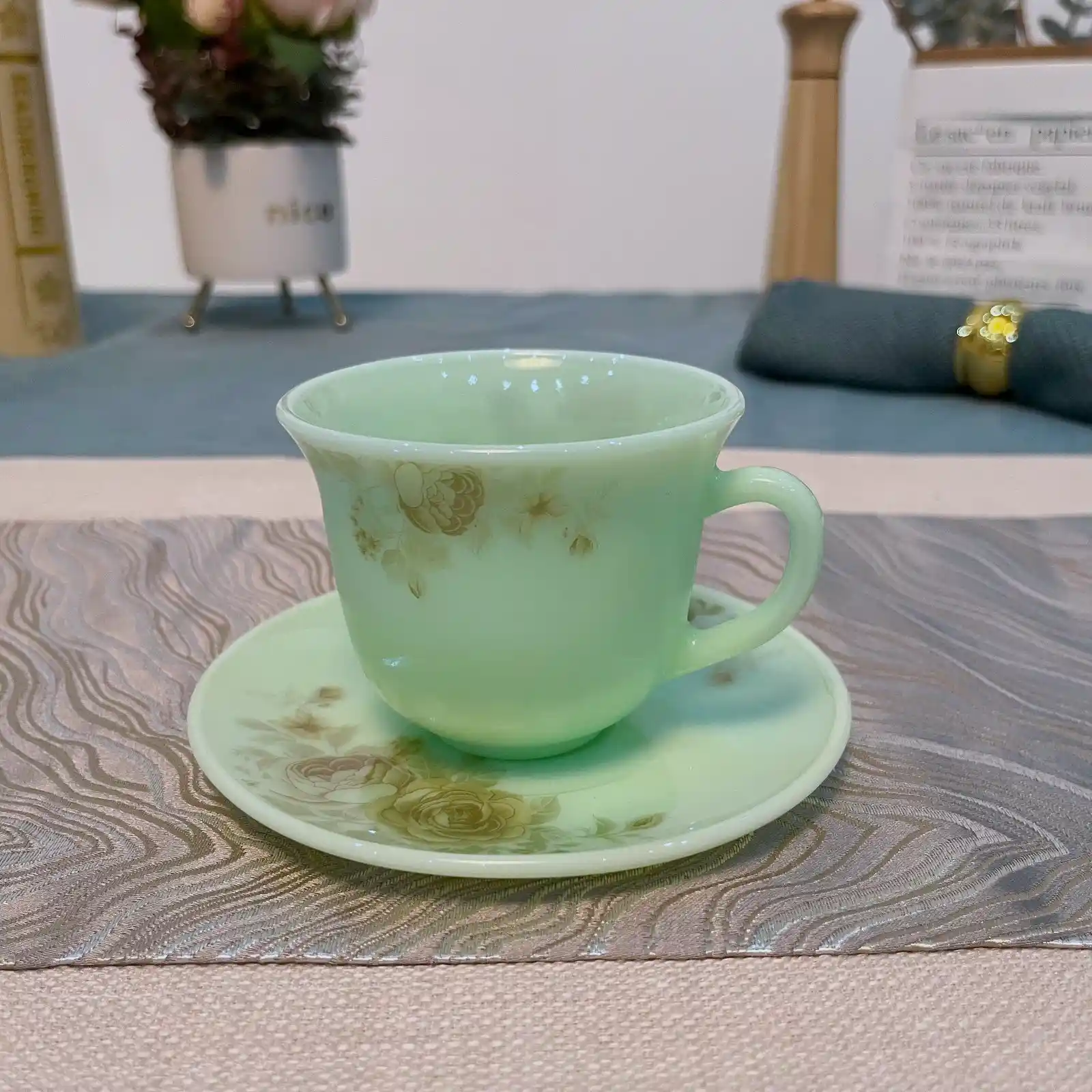
Cups may look straightforward, but bulk orders often run into problems with matching pieces and packaging. The size of the rim affects the drinking experience, the height of the cup changes how it fits inside the carton, and handled cups need enough space to prevent the handles from pressing against one another. If a cup comes with a saucer, the foot of the cup must also fit properly; otherwise, the cup may wobble when lifted.
Jointion’s lead-free Opal Glass cups are available in different shapes, capacities, and handled designs. Some can be coordinated with plates, bowls, or saucers to create a collection. Smaller cups are better suited to coffee, tea, and gift sets, while larger styles can be used for water, juice, or general foodservice.
When choosing cups, start with three practical questions: What will they be used to serve? Will they come with saucers? How will they be packed? If even one of these points is unclear, the quotation and packing quantity may need repeated revisions later. Handled cups usually require more protective space than handleless cups, which means the outer carton size and the number of pieces per carton may differ. Comparing only the unit price of the cup does not tell the whole story.
Jointion’s Opal Glass tableware factory video provides an initial look at production, quality inspection, and packaging. Online images are useful for narrowing down styles, but the fit between cups and saucers, stacking performance, and actual feel should still be confirmed through approved samples and written specifications.

Why Is All Our Tableware Lead-Free?
A white color, transparent appearance, or smooth surface does not by itself prove that tableware is lead-free. Buyers need to confirm two things: the raw materials used for the tableware body and the materials used for the surface decoration. Simply asking, “Is it lead-free?” does not provide enough information.
Controlling Lead at the Raw Material Stage
No lead-containing ingredients are added to the raw materials used for Jointion’s Opal Glass tableware, and no materials that require lead are introduced during production. Setting the material requirements at the raw material stage is more reliable than simply applying a “lead-free” label to the finished product. It also makes it easier to match product models and production batches with the relevant test documents later.
For bulk orders, raw material control usually comes down to three practical checks:
- Confirm the composition requirements for the Opal Glass raw materials used in production;
- Check that supplier documentation, incoming materials, and the materials actually used in production are consistent;
- Confirm which finished-product tests and documents are required for the destination market or sales channel.
Jointion can provide raw material statements, supplier documentation, or relevant test documents according to the order requirements. The exact scope should be confirmed based on the product and target market. One general document should not be used to represent every style. If the tableware body, decoration process, or sales region changes, the items that need to be checked may change as well.
Decals, Low-Temperature Relief Decorations, and Gold Accents All Use Lead-Free Materials
Lead-free requirements cannot apply only to the tableware body. A plain white product may meet the requirement, but that does not mean the same conclusion automatically applies after patterns or gold accents are added.
Jointion tableware does not use painted decoration. The current decoration options mainly include decals, low-temperature relief decorations, gold rims, and electroplated gold decorations. These decorations do not use materials that require lead. Decals are suitable for creating coordinated patterns across a collection, low-temperature relief adds texture and depth to the surface, and gold rims and electroplated gold decorations are commonly applied to cup rims, plate edges, or bowl rims. Each creates a different effect and has different sampling and mass-production requirements.
For decorated products, the material, pattern position, width of the border, and approved sample should be confirmed for each specific style. The reason is simple: the customer sees the finished appearance as a whole, while the factory must control the material, position, and process separately during production. If any one of these details is missing from the sample and order documents, the mass-produced pieces may look close enough on their own but inconsistent when placed together.
Can Our Lead-Free Tableware Be Purchased Wholesale?
Yes. Jointion supplies bulk orders of lead-free Opal Glass tableware to brands, importers, wholesalers, hotel supply channels, and foodservice buyers. Plates, bowls, and cups can be purchased by product category or combined into a collection using the same decoration scheme.
Bulk Orders Supported, with MOQ Confirmed by Style
There is no single minimum order quantity that applies to every product. Standard styles, decal designs, low-temperature relief designs, and gold-decorated styles require different production preparation. Quantities for plates, bowls, and cups also normally need to be confirmed by individual model.
For example, if a set includes plates, bowls, and cups, saying “We need 10,000 pieces in total” is not enough. The factory still needs to know the quantity of each model, the decoration to be used, and the packing method. Otherwise, the total may appear large enough for a wholesale order while the quantity of one particular cup or bowl is still too low to schedule production separately.
For an initial quotation, prepare the following information:
- Product model numbers or reference images;
- Estimated quantity for each model;
- Whether decals, low-temperature relief decorations, gold rims, or electroplated gold decorations are required;
- Retail boxes, standard export cartons, or other packaging requirements;
- Intended sales market and delivery region.
Jointion will confirm the MOQ based on the specific style. If the quantity has not yet been finalized, buyers can provide an estimated range first, but the entire set should not be listed only as one total quantity.
Wholesale Pricing Depends on Style and Order Quantity
Even among lead-free Opal Glass plates, quotations will vary according to diameter, depth, weight, decoration, and the number of pieces per carton. Decals, low-temperature relief decorations, gold rims, and electroplated gold decorations also involve different materials and processing steps, so the price of a plain white standard style cannot simply be applied to them.
Order quantity affects unit cost, but “a larger quantity is always much cheaper” is not the full picture. If an order contains many models with a low quantity for each, there is still considerable work involved in changing production runs, confirming decorations, and sorting products into separate cartons. By contrast, an order with fewer styles and clearly defined specifications is usually easier to calculate and schedule.
When comparing supplier quotations, place the product specifications, decorations, packaging, and trade terms in the same table. Comparing unit prices alone often leaves out inner boxes, outer cartons, sampling costs, or the scope of delivery. A difference of a few cents in the initial quote may not save as much as avoiding repacking later. It is better to calculate the full cost from the start.
What Are Our Bulk Supply and Quality Control Capabilities?
An approved sample does not guarantee that the bulk order will automatically be consistent. The real test is whether every stage of production works from the same specifications and approved sample, and whether any deviation can be addressed before packing.
Our Capacity Supports Bulk Production
Jointion can arrange bulk production of lead-free Opal Glass plates, bowls, cups, and related sets. Standard styles can enter production according to the manufacturing schedule. For designs with decals, low-temperature relief decorations, gold rims, or electroplated gold decorations, the pattern, placement, and sample result must be confirmed first.
However, production capacity cannot be discussed without considering the order itself. A large order of one model is not as difficult to arrange as an order that combines more than a dozen models in different quantities. The actual lead time is usually affected by the total quantity, number of models, complexity of the decoration, packaging versions, and the current production schedule.
A more reliable sequence is to approve the product and decoration samples first, then confirm the quantity of each item, packaging, and lead time before arranging raw materials, forming, decoration, inspection, and packing. Changing the pattern or packaging close to production does more than create another document revision; it can also disrupt production steps that have already been coordinated.
If the order must arrive in time for a sales season, trade show, or product launch, provide both the latest acceptable shipping date and the latest acceptable delivery date during the inquiry stage. They are not the same date. The factory can assess the production schedule, while transit time must also be calculated according to the destination and route.
Our Testing Procedures Are Sufficient
Quality inspection for lead-free tableware should not stop at checking the surface for cracks. Jointion’s inspection process covers materials, forming, decoration, dimensions, packaging, and shipment. Relevant test documents are also confirmed according to the order or the requirements of the target market.
For bulk orders, the key checks include:
- Material confirmation: Check the Opal Glass raw materials and the materials used for decals, low-temperature relief decorations, gold rims, electroplated gold decorations, and other finishes;
- Appearance inspection: Check for cracks, chips, stains, obvious deformation, and decoration defects;
- Dimensional inspection: Verify order specifications such as diameter, depth, capacity, and cup height;
- Decoration inspection: Compare the pattern position, relief effect, and gold accents against the approved sample;
- Packaging and pre-shipment inspection: Verify quantities, inner boxes, outer cartons, and internal protection to reduce packing errors, missing pieces, and damage caused by items colliding in transit.
The most useful thing here is not a general statement that “we conduct quality inspections,” but a set of references that can be checked against one another: the approved sample, written specifications, decoration positions, and packing requirements. Looking at one finished piece in isolation makes it difficult to judge whether the whole batch is consistent. Deviations are much easier to identify when the product is checked against the sample and order documents.
If a customer requires a third-party test report, the test items, sampling scope, and report format should be confirmed before the order is placed. This is especially important for decorated styles. The report needs to correspond to the actual materials and products; a report for one plain white style cannot be used as a blanket report for the entire order.
How Long Do Bulk Orders Take, and How Is Shipping Arranged?
Finishing production does not mean the tableware has arrived at the warehouse. Packaging, container loading, sea or land transport, customs clearance, and final delivery all take time. Treating the production lead time and the arrival date as the same thing is a common misunderstanding in bulk purchasing.
Lead Time Depends on Order Style and Quantity
The general production and order preparation time for Jointion’s bulk lead-free Opal Glass tableware orders is 30–60 days. The actual timing depends on the styles, quantities, decoration processes, and the point at which the order is considered confirmed. Not every order has a fixed 30-day or 60-day lead time.
Standard styles require fewer confirmation steps. Products with decals, low-temperature relief decorations, gold rims, or electroplated gold decorations require confirmation of the pattern, color, placement, and sample. The more models an order contains, the more complex the coordination becomes among forming, decoration, inspection, and packing. Large orders also require raw materials and packaging materials to be prepared in advance.
When confirming the lead time, clearly define these four points:
- Whether the countdown begins after the deposit is received, the sample is approved, or all order details are confirmed;
- Whether the 30–60 days include packaging and order preparation;
- When the pre-shipment inspection is expected to be completed;
- How much additional time is needed for international shipping, customs clearance, and final delivery.
The Tom’s Guide report mentioned earlier concerned specific imported metal cookware, not Opal Glass tableware. It may seem unrelated to lead time, but both points highlight the same purchasing habit: material documents and order requirements should be confirmed early. Waiting until just before shipment to complete testing documents can put buyers in a difficult position when trying to meet a vessel schedule.
If the goods need to arrive in time for a sales season or trade show, provide the latest acceptable delivery date rather than simply saying “as soon as possible.” Jointion can then check the production schedule and shipping route. The production completion date and the warehouse delivery date should always be treated separately.
Shipping Is Arranged Based on the Delivery Address
Jointion will determine a suitable delivery arrangement for lead-free Opal Glass tableware based on the destination country, city, port, full address, and order quantity. Common options include EXW, FOB, CIF, and door-to-door delivery.
These terms describe the delivery point, allocation of costs, and transfer of risk. They are not four different modes of transport. In simple terms:
- EXW: The buyer collects the goods from the agreed location and mainly arranges the subsequent transport and related formalities;
- FOB: The seller delivers the goods to the agreed port of shipment and loads them onto the vessel, while the buyer arranges the onward sea freight;
- CIF: The seller arranges and pays for freight and insurance to the agreed destination port, but the charges and procedures after arrival still need to be confirmed separately;
- Door-to-door: The goods are delivered to the specified address, but the quotation must clearly state whether customs clearance, duties, taxes, final delivery, and unloading are included.
Shipping fragile tableware involves more than choosing a trade term. Plates and bowls need separators and cushioning, handled cups need protective space around the handles, and the outer cartons must suit the container-loading method. Thicker packaging is not automatically better; if there is too much empty space inside the carton, the products can still move around in transit. A more reliable approach is to confirm the packing arrangement with the actual products and a packaging sample.
Buyers can use the Jointion contact page to submit the product category, reference images, estimated quantity, decoration requirements, and delivery address. Jointion can then confirm the styles, minimum order quantities, wholesale pricing, lead time, and suitable shipping arrangement.
Choosing a supplier for lead-free dinnerware wholesale ultimately comes down to a few straightforward questions: Are the products suitable in actual use? Can the supplier provide relevant evidence for the materials and decorations? Can the bulk order be produced according to the approved sample? Are the packaging and delivery terms clearly defined? Asking these questions first, before discussing collections, pricing, and long-term cooperation, usually saves a great deal of back-and-forth later.