
What Milk Glass Tableware Styles Are Available for Wholesale? (Shapes and Finishes)
Wholesale Milk Glass Dishes Primarily Include Plates, Bowls, Cups and Saucers, and Trays (Shapes)
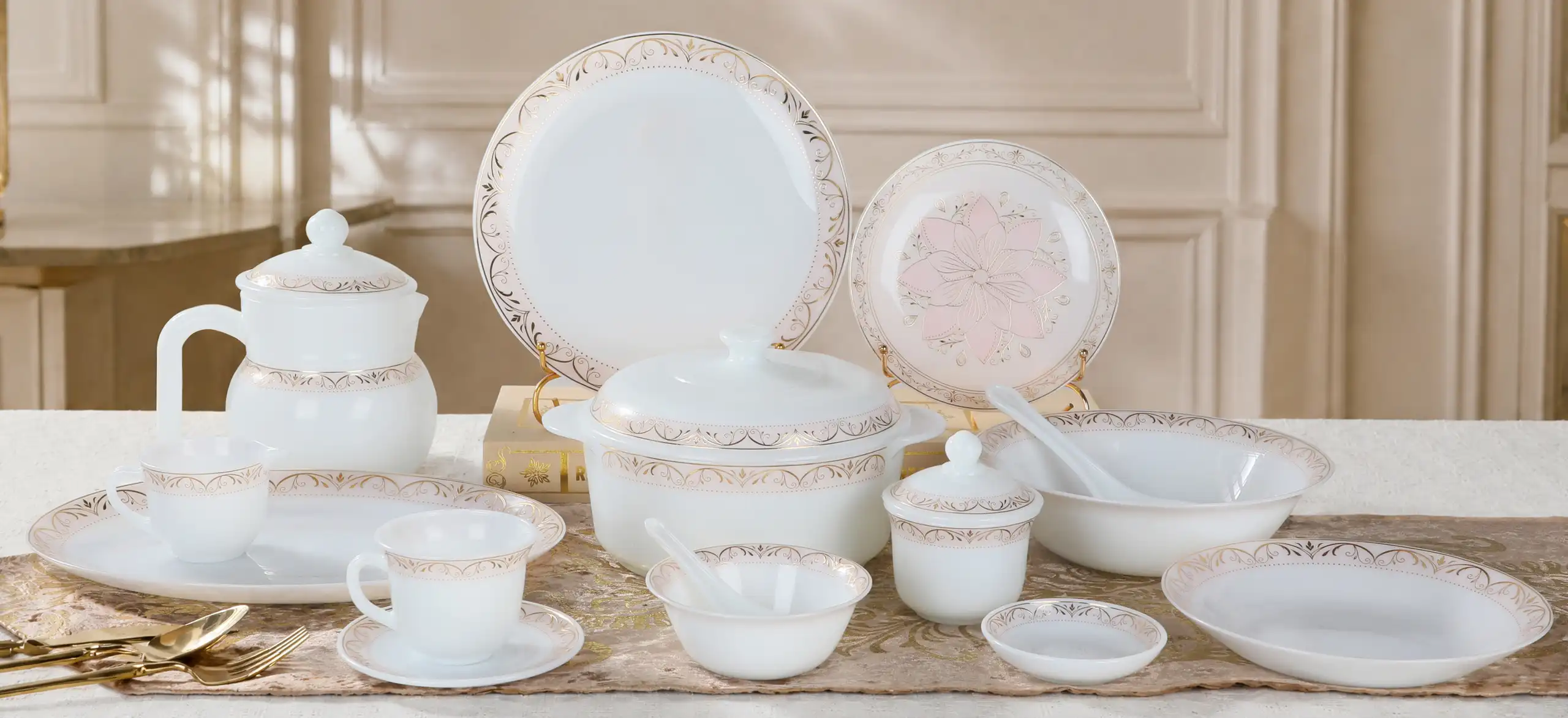
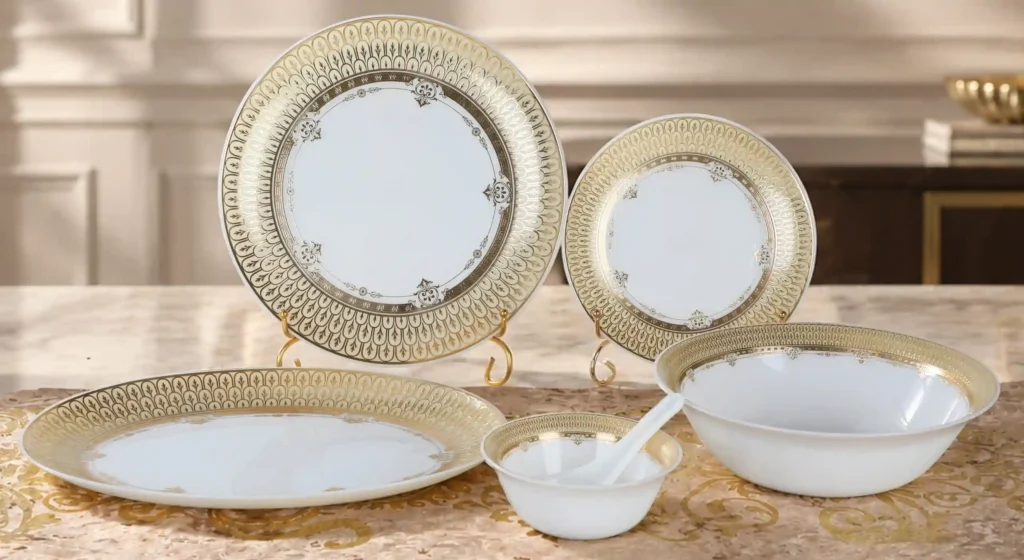
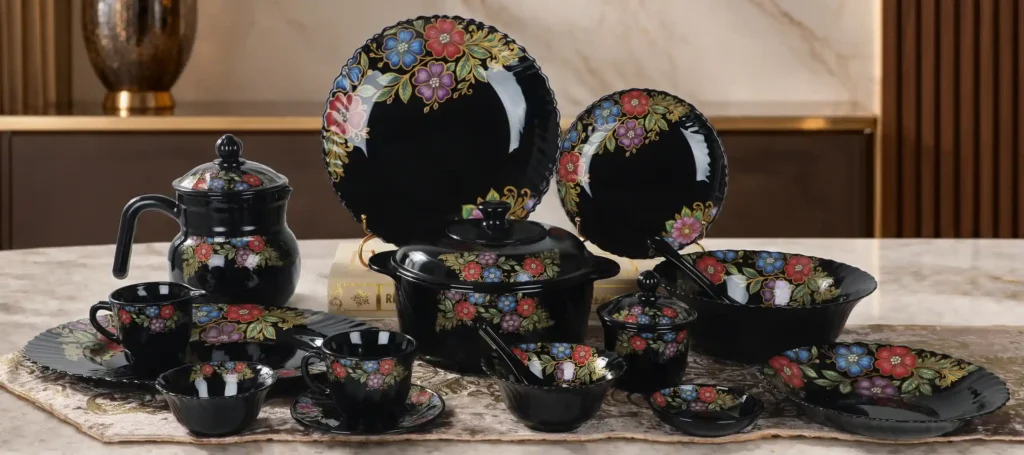
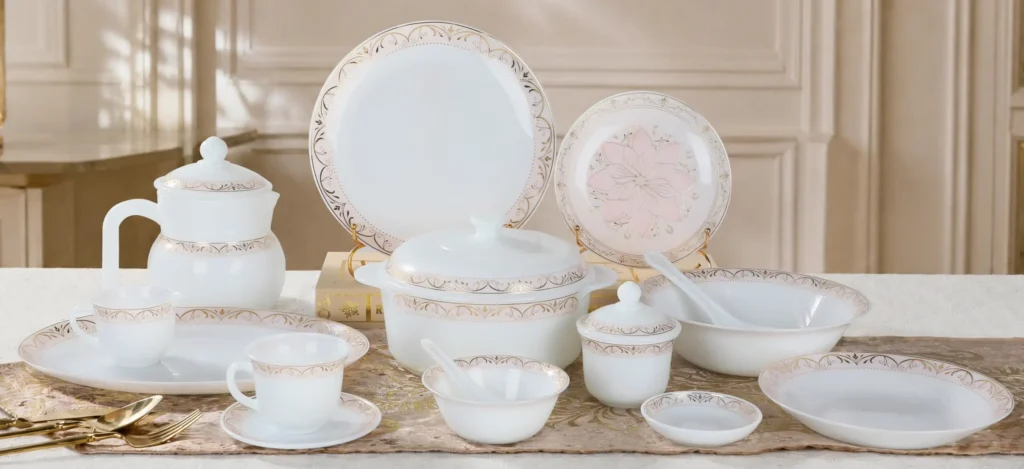
The most common wholesale milk glass dishes fall into four basic groups: plates, bowls, cups and saucers, and trays. Each has a clear place at the table: plates serve main courses, salads, and desserts; bowls cover soups, salads, cereal, and desserts; cups and saucers are used for coffee, tea, and accompanying drinks; and trays support carrying, sharing, and set displays. In the foodservice channel, these pieces can be combined into a set around the menu, while retail buyers care more about whether the collection displays well as a coordinated range.
The four shapes make it easier to build a coordinated collection and reorder later. Buyers who want to develop a set directly can start with opal glass dinnerware sets.
| Shape | Common Uses | Wholesale Pairings |
|---|---|---|
| Plates (Opal Glass Plates) | Main courses, salads, desserts | Combinations of flat plates, deep plates, and dessert plates |
| Bowls (Opal Glass Bowls) | Soups, salads, cereal, desserts | Combinations of soup bowls, salad bowls, and rice bowls |
| Cups and saucers | Coffee, tea, accompanying drinks | Matched cups and saucers |
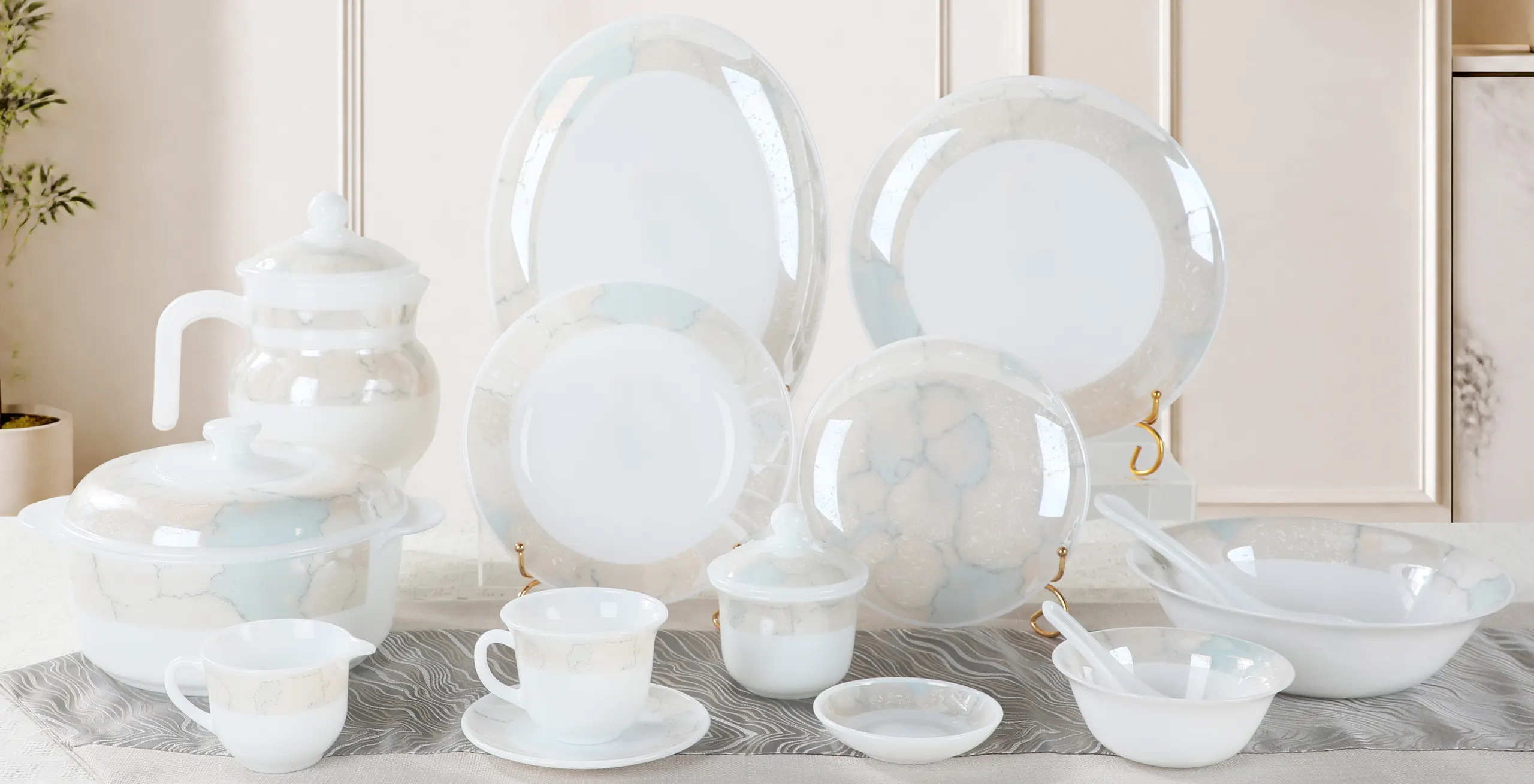
Most milk glass dinnerware is press-formed, so the shape is determined by the mold. The more molds available within one collection, the broader the selection of wholesale milk glass tableware becomes and the easier it is to create a coordinated set. Buyers can review the shape list, product combination photos, and mold numbers, separating shapes available from existing molds from those that require new tooling. Jointion’s existing molds and combination charts help buyers define the product lineup before requesting a quotation.
Common Finishes Include Solid Color, Decals, Rim Lines, Embossing, and Electro-Gold (Finishes)
Solid color, decals, rim lines, embossing, and electro-gold are five common finishes for milk glass dinnerware. All are applied to an opal glass body: the piece is formed first, then the surface is decorated.
- Solid color: A milky white or all-over color with no pattern applied. Glass color is controlled by colorant oxides in the glass batch, which means buyers need to evaluate the glass color itself rather than rely only on a surface color card.
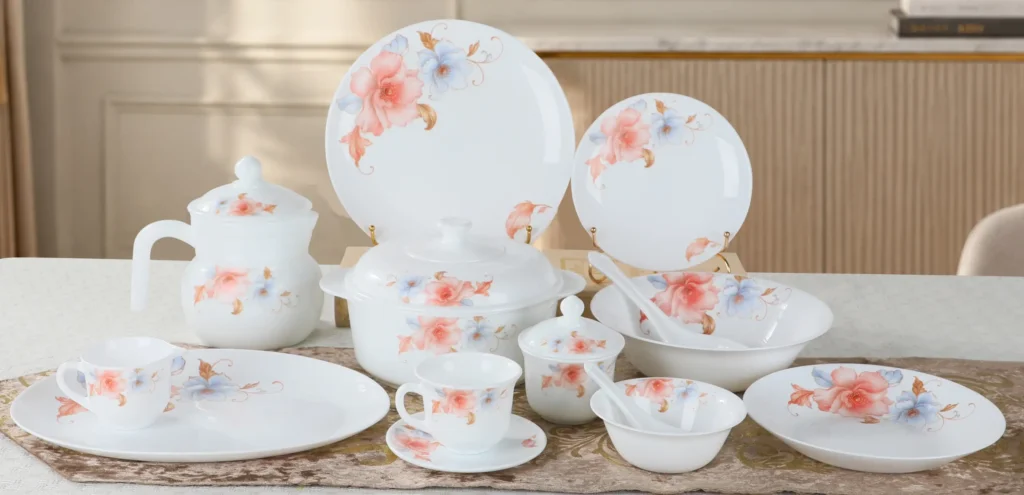
- Decals: A printed decal is transferred to the surface and then fired. This finish suits patterns, themed collections, and brand marks.
- Rim lines: A line decoration applied around the rim of cups and plates. It gives the outline more definition and a cleaner look.
- Embossing: Texture is pressed directly by the mold, making the pattern and shape one piece and giving the surface a more noticeable hand feel.
- Electro-gold: A surface decoration with a metallic luster, part of the gold decoration systems used on glass.
Changing the finish on the same shape changes the positioning of the collection. Solid color works well for year-round core lines, decals for themed lines, rim lines for minimalist collections, embossing for designs that emphasize the mold and hand feel, and electro-gold for stronger decorative expression. When selecting styles, buyers need to compare appearance as well as confirm the process name and sample result. That keeps future quotations and reorders aligned.
What Customization Options Are Available for Wholesale Milk Glass Dinnerware?
The more specific the customization discussion, the easier future reorders become. Decals, logos, color, and packaging should all become confirmed physical samples or files during the sampling stage.
Decal Designs, Logos, Colors, and Packaging Can All Be Customized
Decal designs, logos, glass color, and packaging can all be customized.
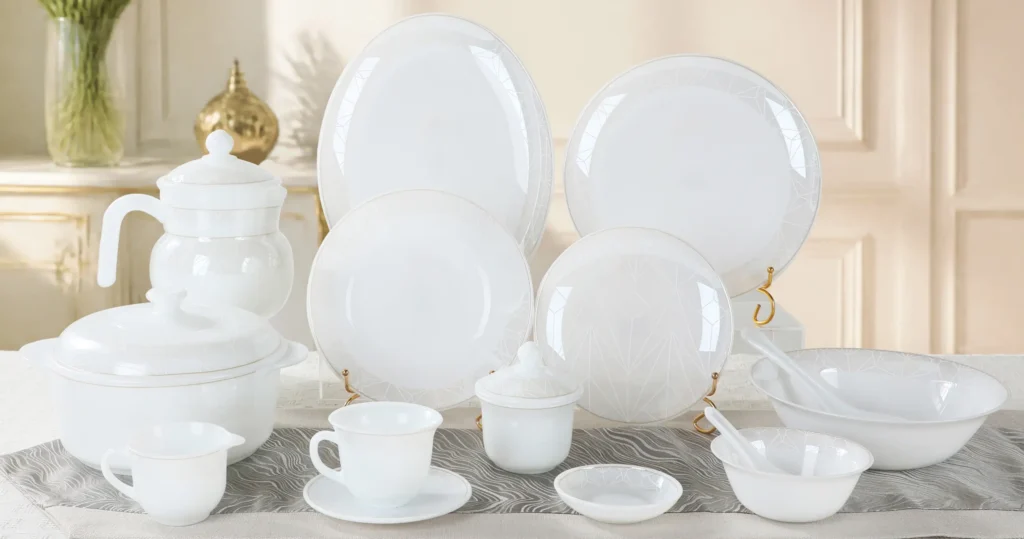
For decals, confirm the artwork, decal size, and color after firing. For logos, confirm placement, size, and clarity. For color, establish whether it refers to the glass batch color or a surface decoration color. For packaging, confirm the printed color box, shipping marks, and packing method. The four options can be combined independently or used together. When customizing a cup-and-saucer set for a brand, logo placement and packaging often need to be reviewed together because both affect how the final set is presented.
Decals, rim lines, embossing, and gold decoration are established routes for glass decoration (Glass and Ceramics: Review of Decoration Methods). Customization can therefore follow a clear sequence: artwork approval, color sample approval, packaging proof approval, and bulk production. Jointion keeps customized artwork, approval samples, and packaging proofs on file, so buyers do not need to explain the same requirements again when they reorder.
What Are the MOQs and Lead Times for Milk Glass Dinnerware?
Samples and bulk orders follow different minimum-order logic. Asking about these two stages separately makes quotations much clearer.
Samples Have No MOQ and Usually Take About 15 Days
Samples have no MOQ and normally take about 15 days.
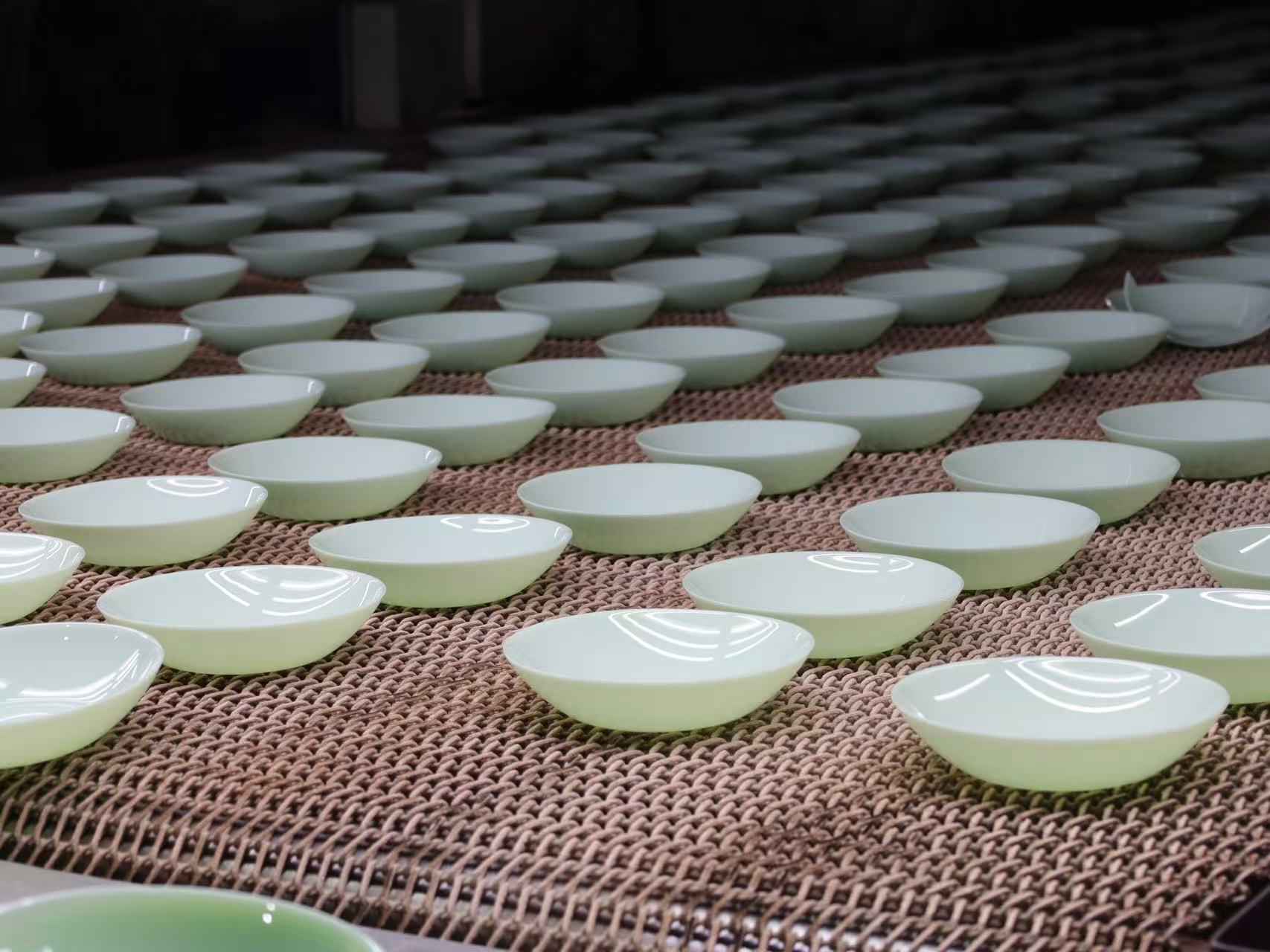
Samples are used to confirm shape, color, finish, and packaging. They are therefore scheduled as sample orders rather than counted against a bulk MOQ. When preparing a new product launch, confirming these points with a sample first makes the bulk stage much smoother. The roughly 15-day timeline mainly covers sample scheduling, forming, decoration, inspection, and sample dispatch. Existing molds and standard decoration can follow this pace; new molds or special decoration are scheduled according to actual production availability.
The more specific the sample approvals, the smoother bulk production will be. Once shape, color, finish, and packaging are all confirmed, both sides have a clearer shared understanding before the order moves into bulk production.
Bulk MOQs Are 200, 500, or 1,000 Sets by Decoration, with About a 50-Day Lead Time
Bulk MOQs need to be reviewed by decoration type. Solid color, decals, rim lines, embossing, and electro-gold each have a different minimum order, and the lead time is about 50 days.
| Decoration | MOQ | Lead Time | Notes |
|---|---|---|---|
| Solid color | 1,000 sets | About 50 days | Requires a longer continuous production run |
| Decals | 500 sets | About 50 days | Involves decal print setup and decoration scheduling |
| Rim lines | 200 sets | About 50 days | Scheduled according to the rim-line decoration process |
| Embossing | 200 sets | About 50 days | Scheduled according to mold and forming requirements |
| Electro-gold | 200 sets | About 50 days | Scheduled according to the gold decoration process |
MOQ differences come from line changeover costs, decoration setup, machine adjustments, and batch losses. Solid color requires a longer continuous production run. Decals require print setup first. Rim lines, embossing, and electro-gold are scheduled according to their individual decoration processes. Using one MOQ to request pricing for every finish usually leads to an inaccurate quotation. The 50-day lead time covers production scheduling, forming, decoration, inspection, and packing. Shipping time is quoted separately according to destination.
Buyers can use this table to estimate order volume, then ask the supplier for a formal quotation based on the actual shape, decoration, and packaging. Once MOQ and lead time are written into the quotation, later communication becomes much easier.
How Does the Factory Maintain the Milky Look and Quality of Milk Glass Tableware?
The milky appearance is not something that can be added at final inspection. It starts with batching, continues through melting, forming, and annealing, and is then locked in through batch acceptance.
The Factory Locks In Raw Material Ratios to Keep Each Batch’s Milky White Base Consistent
Whether the milky white base remains stable starts with the glass batch formula.
Opal glass gets its milky appearance from fluorine additions in a soda-lime glass system and crystalline phases such as NaF, CaF2, and BaF2 (IJAGS: Opal Glass Crystal Research). These crystals scatter light inside the glass, creating a soft, milky visual effect. If the formula changes, the crystal structure and degree of opacity can shift with it. When buyers reorder a collection, one of their biggest concerns is a difference in shade between batches. Formula and weighing records are the starting point for controlling that variation.
The factory therefore needs to lock in the raw material ratio, weighing sequence, and mixing time for the same product and color code. Raw material batch records, weighing records, and formula sheets then demonstrate that the formula has been followed consistently. Glass composition can also be controlled through raw material analysis and daily density and softening point monitoring (GPI: What Is Glass). Formula control has to be applied to every batch before the milky white base can withstand repeat batch reviews.
The Factory Controls Melting and Forming Temperatures to Prevent Color Variation and Flow Lines
Color variation and flow lines remain under control only when melting and forming temperatures are stable.
After the raw materials are weighed individually and mixed, they are melted at 1,300-1,600°C and then sent to forming (Glass Alliance Europe: The World of Glass). Temperature changes alter the viscosity of the molten glass, which in turn changes how it flows during forming. When temperature is unstable, flow lines, localized color variation, or differences in flatness can appear on the surface.
The factory must control more than furnace temperature. Gob temperature and mold temperature matter as well. First-piece approval, parameter records, and in-process inspections help maintain stable temperature across every production shift. Jointion keeps furnace temperature curves, forming parameters, and first-piece comparison photos, so any deviation can be traced back to the point where the parameters changed.
The Factory Controls Cooling to Reduce Cracking and Warping
Cooling speed has to match the shape.
Once opal glass has been formed, internal stress remains in the piece. Annealing research shows that bringing the entire glass piece to the annealing temperature is fundamental, while residual stress depends primarily on the cooling rate in the critical cooling zone (Glass Science and Technology: Annealing and Cooling Research). If the glass cools too quickly, stress cannot relax in time, increasing the risk of cracking and warping.
The factory needs to set the annealing schedule according to wall thickness, dimensions, and loading method, then confirm the result with annealing point and strain point test data and dimensional checks. A thin-walled plate and a thick-walled plate cannot use the same curve. When the load changes, the cooling pace must be adjusted as well.
The Factory Compares Color, Translucency, and Surface Finish Batch by Batch
Batch acceptance checks three things: the milky white base, translucency, and surface finish.
| Inspection Item | What to Check | Purpose |
|---|---|---|
| Milky white base | Compare with the standard color plaque | Prevent batches from becoming too dark or too light |
| Translucency | Compare with the retained sample | Keep the milky appearance consistent |
| Surface finish | Flow lines, inclusions, decoration completeness | Keep visual defects from leaving the factory |
The factory should compare every batch with standard samples and inspection criteria under fixed lighting. The milky white base, translucency, flow lines, inclusions, and decoration result all need to be recorded. If a batch is abnormal, it should be isolated for re-inspection before a decision is made to rework or scrap it.
This step relies on Jointion’s own batch color plaques, retained-sample cabinet, and QC checklist. Once the appearance standard is fixed by retained samples, different shifts have a single standard to follow.
How Can You Tell Whether a Milk Glass Dinnerware Supplier Is Reliable?
A quotation shows only one side of a supplier. Whether the factory, capacity, and communication structure can be explained clearly often says more about whether a long-term partnership will hold up.
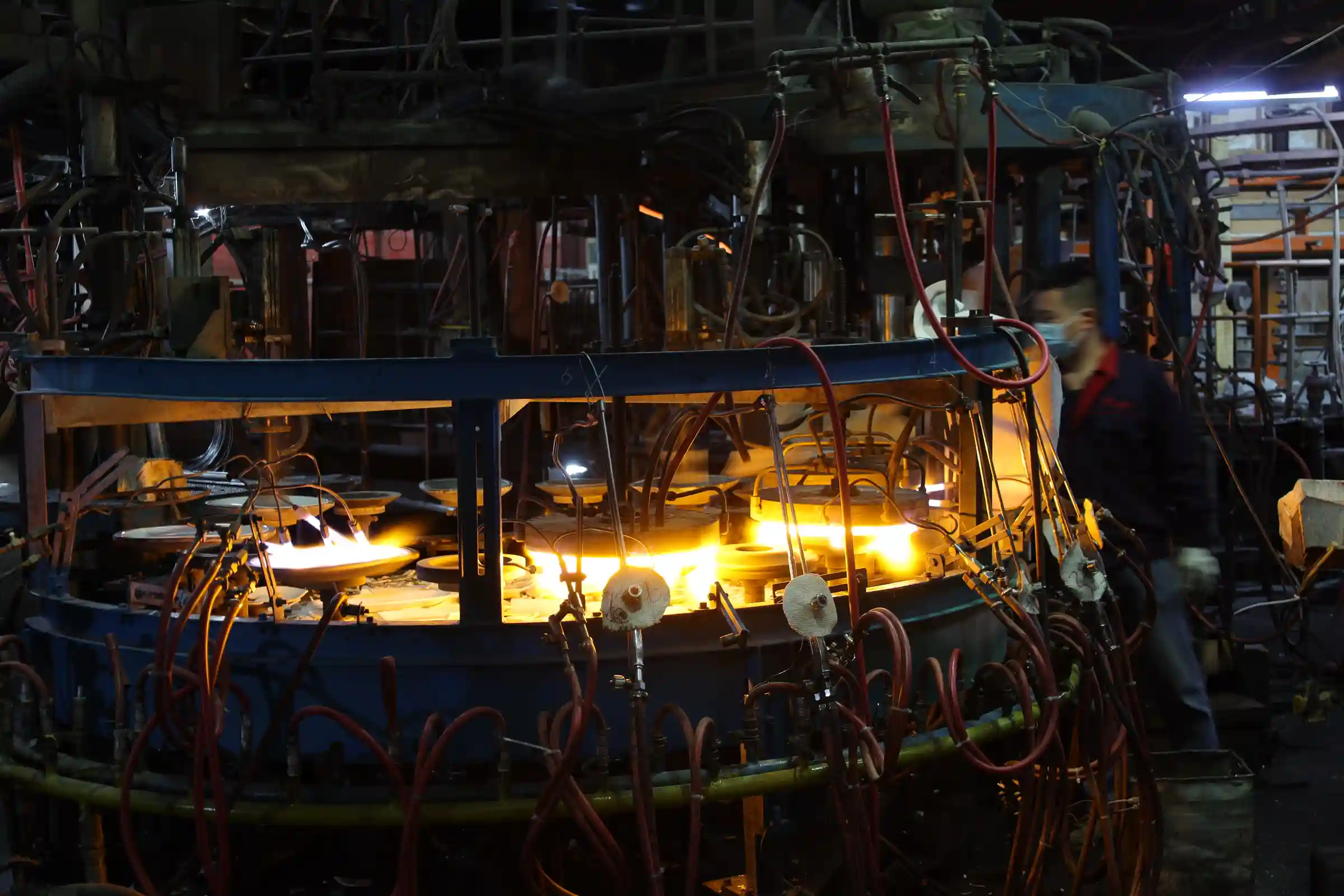
Suppliers Can Explain Their Factory Location, Production Lines, and Daily Capacity
Factory location, production lines, and daily capacity are three hard facts for evaluating production capability.
| Item to Verify | What to Review | What It Shows |
|---|---|---|
| Factory location | Full address, factory photos, or video | Whether a real production site exists |
| Production lines | Furnaces, press forming, decoration, annealing | Whether the production process is complete |
| Daily capacity | Broken down by shape and decoration | Whether the supplier can handle the current order |
Producing opal glass dinnerware involves furnaces, press forming, decoration, and annealing. If a supplier can explain these processes clearly and its capacity figures align with its MOQ and 50-day lead time, buyers have a better basis for judging whether the order can be fulfilled. During a remote factory audit, buyers can follow the same chain to review production scheduling and in-house processes, giving them a more complete picture.
A Fixed Contact Handles Quotations, Sampling, and Order Follow-Up
A fixed contact keeps quotations, sampling, and order follow-up from stalling.
The contact should be able to provide written quotations, sample status, production milestones, and issue-handling records. Specification approvals, sample approvals, and change records should also be kept on file. If packaging needs to change or information needs to be added halfway through an order, these records become the most direct reference. Even if someone else takes over, the project does not have to be explained from the beginning.
Jointion uses a dedicated account contact, an order progress sheet, and an issue-handling form to keep communication traceable. For wholesale buyers, that is far more useful than a promise to “contact us anytime.”
A fixed contact solves the communication side. The factory and product range determine whether the order can move forward. Before requesting a quote, buyers can also review Jointion’s opal glass tableware manufacturing and wholesale information and compare it with the production lines, capacity, and quotation provided by the contact.