
This opal glass sourcing guide cuts through the guesswork of buying commercial opal glass cups and mugs. It covers cup-type differences, accessory pairing, material advantages, breakage prevention, and stocking strategy — everything you need to build a procurement plan that actually works. The goal is simple: get your cup types, accessories, and breakage buffer right on the first order, so you never have to scramble with emergency reorders or watch costs spiral.
Opal Glass Cup Types and Styles
Espresso, Cappuccino, Latte, Tea & General-Purpose Mug — Why Five Cup Types Look So Different
Opal glass cups come in five distinct shapes — and the differences are not decorative. Each beverage has its own requirements for heat loss, liquid-surface height, foam behaviour, and aroma release. The cup shape is built around those requirements. Here is the logic behind each one.
Espresso Cup (2–3 oz) — Thick walls, short body. The thick walls slow heat loss during the very brief drinking window — typically under two minutes. The small capacity keeps a standard shot (about 1 oz) at a decent liquid-surface height, so the crema doesn’t spread too thin and vanish.
Cappuccino Cup (5–6 oz) — Narrow base, wide rim, bowl-shaped. The narrow base holds the coffee liquid low. The wide rim gives milk foam room to spread, making latte art easier for the barista and ensuring each sip picks up both foam and liquid.
Latte Cup (8–12 oz) — The biggest of the five, with a tall, slender body. The large capacity matches the high total volume of milk plus coffee. The height lets milk, coffee, and foam layer vertically into the visual gradient a latte is known for.
Tea Cup (6–8 oz) — Thinner walls, wide opening. Thin walls let the drinker’s lips read the tea temperature more directly. The wide rim increases the surface area for aroma release and shows off the tea’s colour in natural light.
General-Purpose Mug (10–14 oz) — Thick walls, almost always a handle. Opal glass mugs are the most versatile of the five. The thick walls balance heat retention with grip insulation. The large capacity fits Americano, herbal tea, hot chocolate — just about anything. The handle keeps hot surfaces away from the palm. It doesn’t chase perfection for any single drink. Instead, it finds the best compromise across warmth, volume, and everyday ease of use.
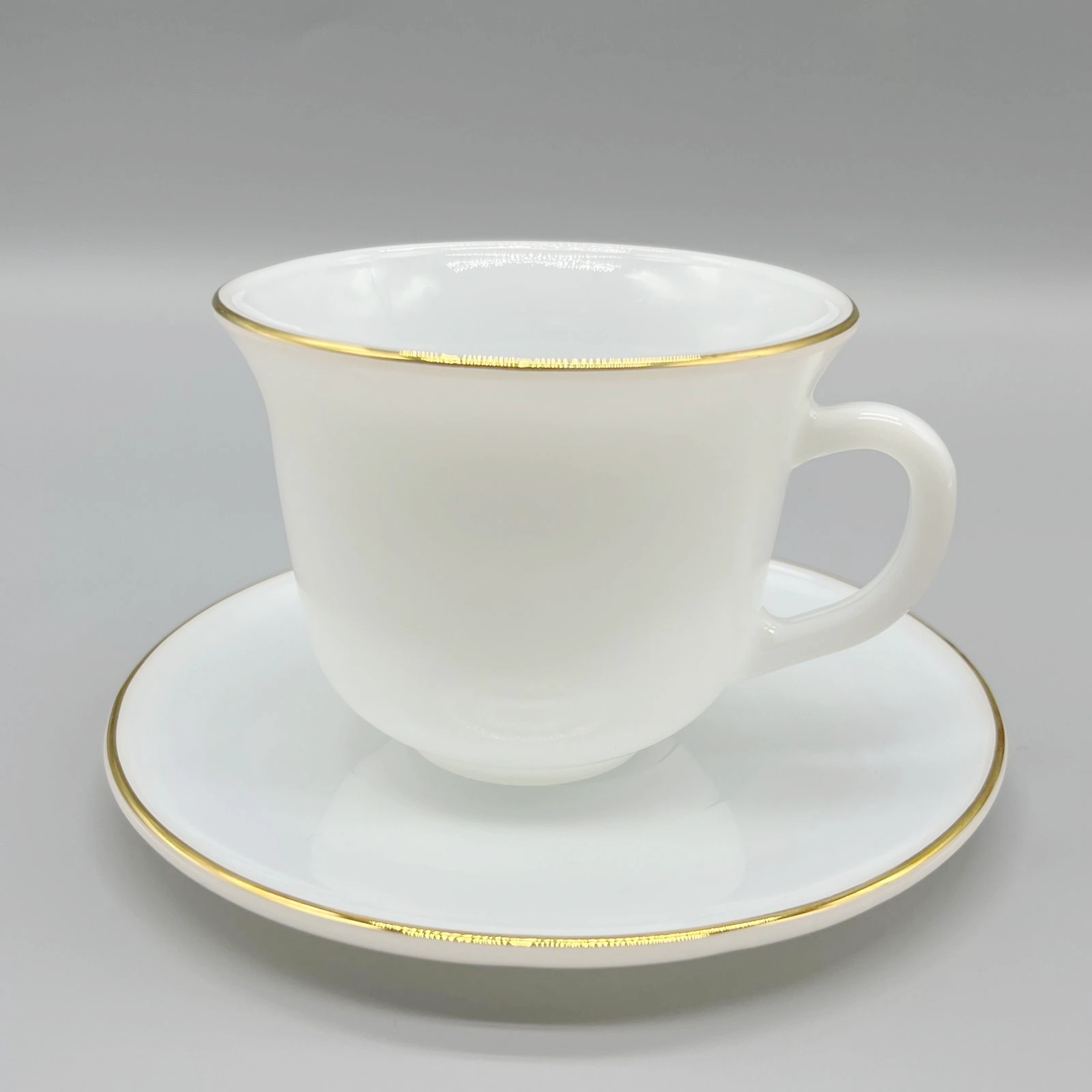
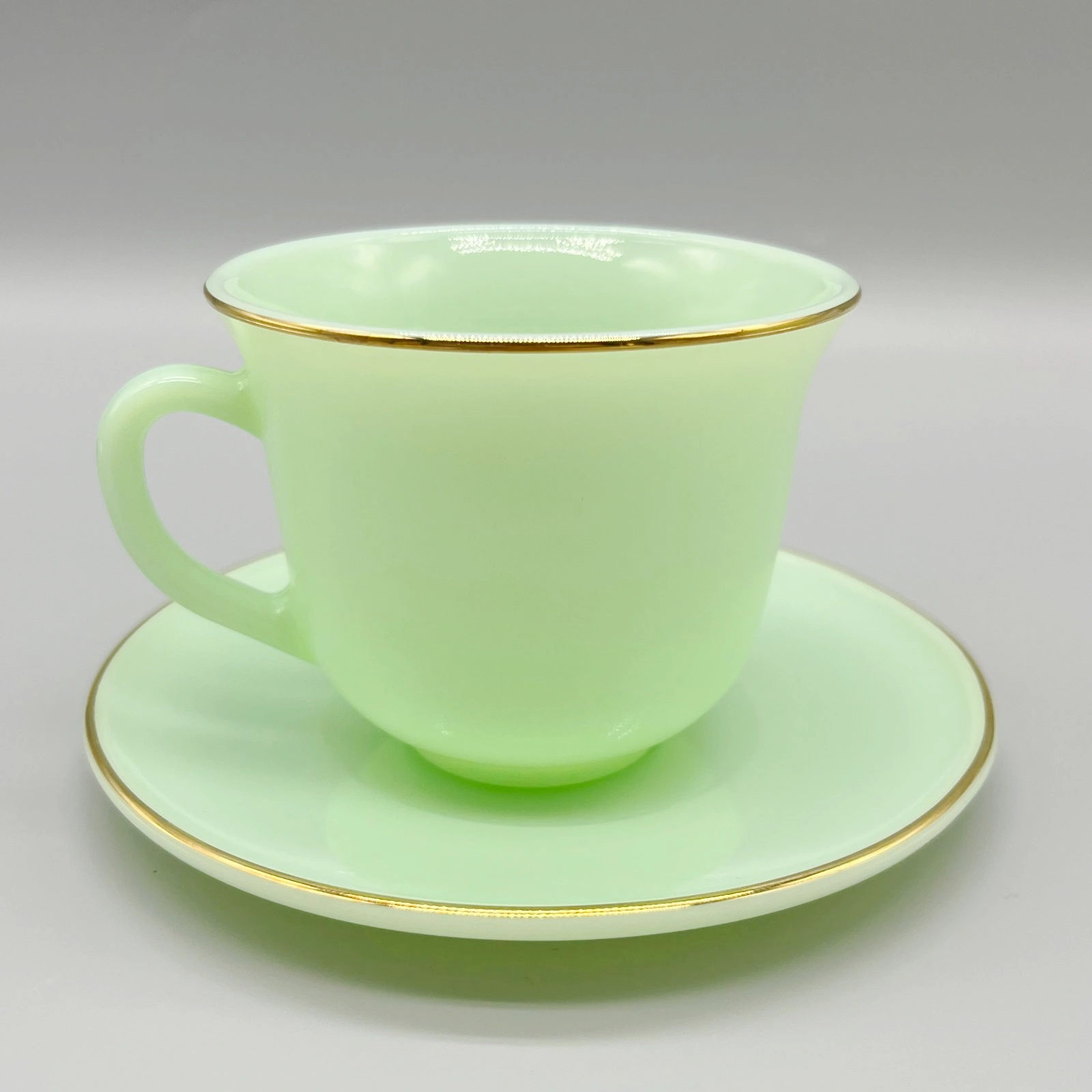
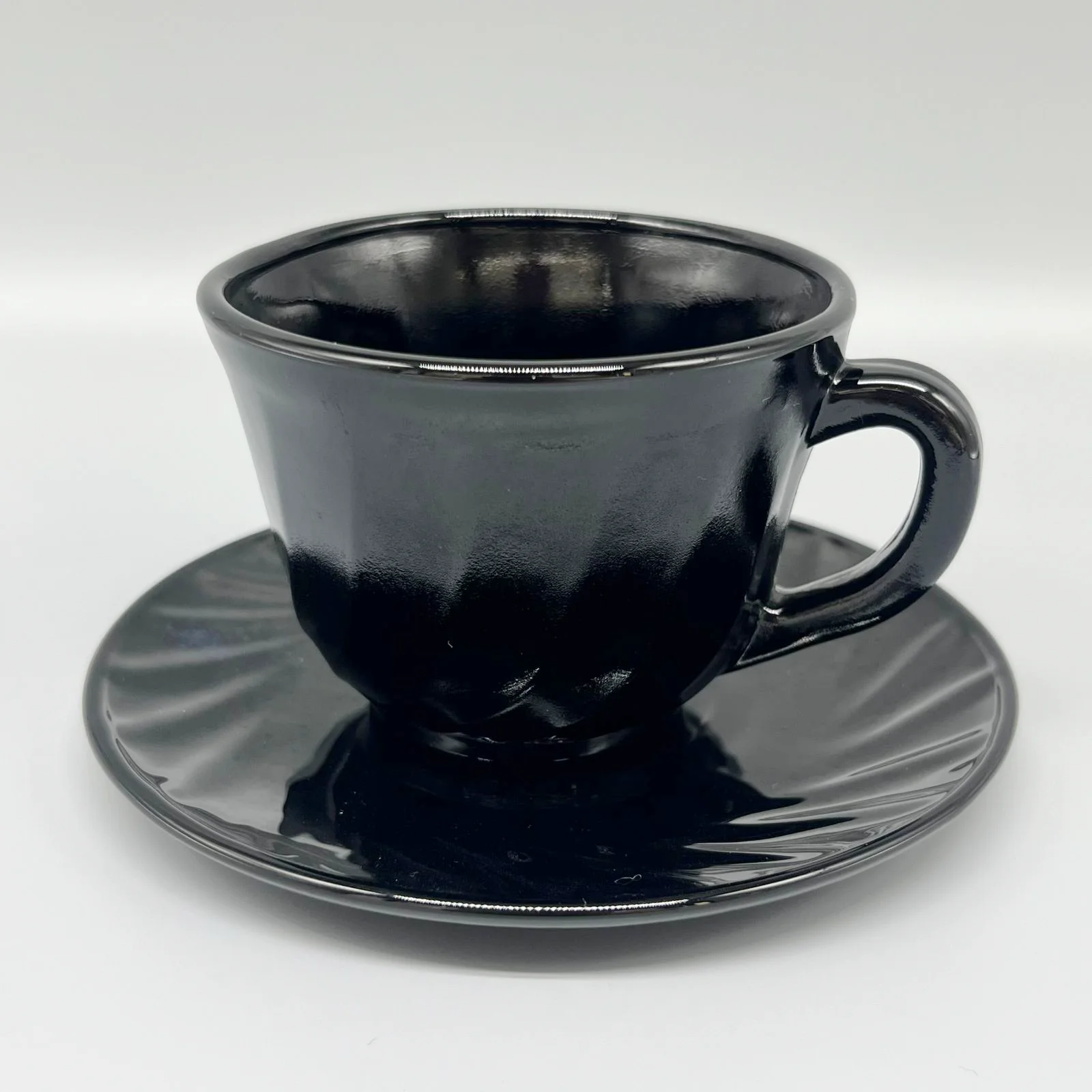
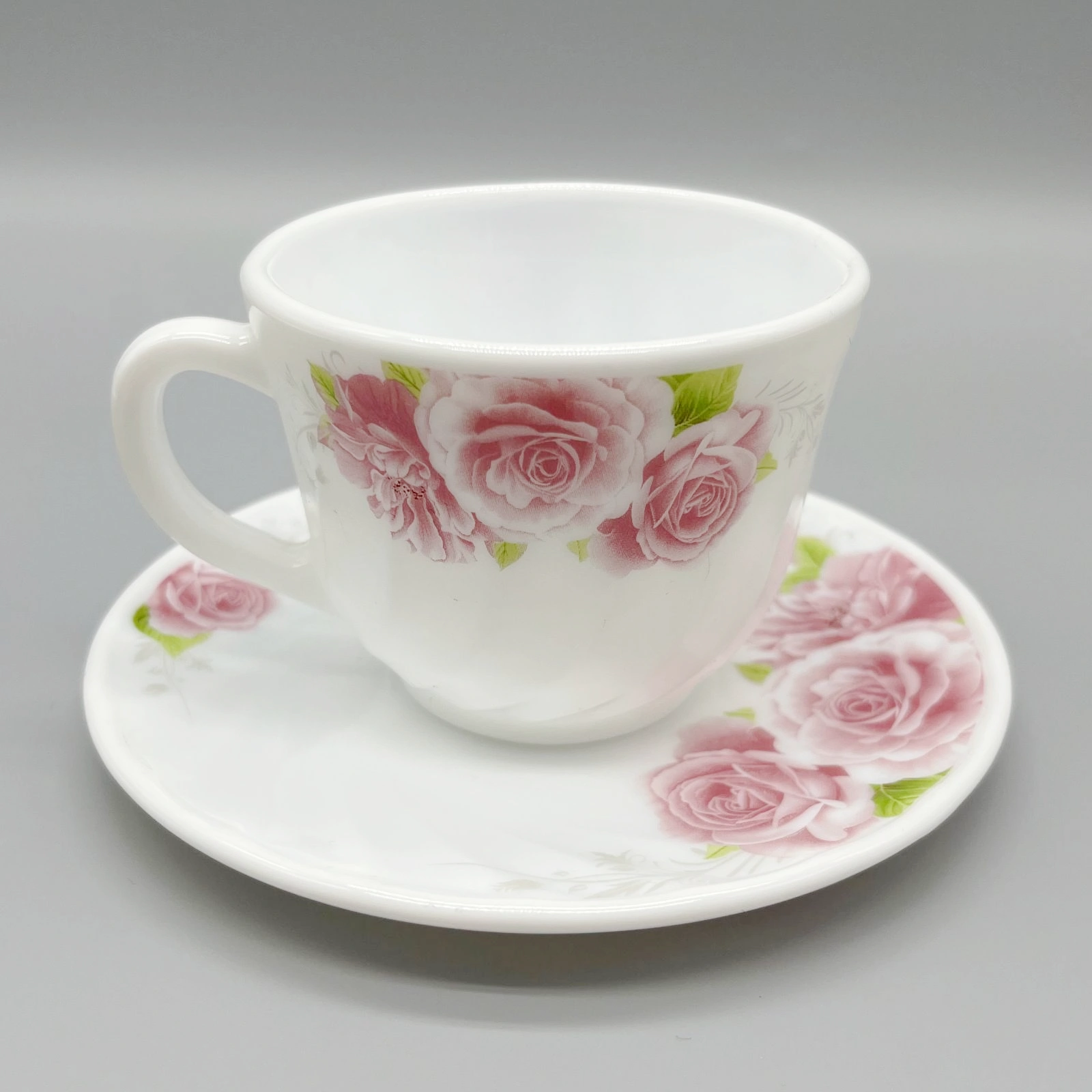
On our Jointion production line, all five types share the same opal glass base material — but the moulds, wall thicknesses, and annealing curves are different for each. So they are not “the same product in different sizes.” They are five separate process paths. This matters at the enquiry stage: quote each cup type and its MOQ independently. Lumping them together often leads to lead-time confusion or cost surprises later.
With or Without a Saucer — The Service Logic Behind This Decision
This decision boils down to one trade-off: service completeness versus operational speed. Many first-time buyers of opal glass cups default to either pairing every cup with a saucer or skipping saucers entirely. A better approach is to weigh what a saucer actually does against what it costs — then decide cup type by cup type.
A real example: at the 2024 Autumn Canton Fair, a chain-hotel procurement manager from the Middle East told us he had originally bought cup-and-saucer sets for every dining zone. Six months in, the self-service breakfast area was breaking saucers at three times the rate of the formal restaurant. Staff also reported that saucers slowed down table clearing during rush hours. His experience lines up perfectly with the framework below — a saucer’s value depends entirely on whether the setting actually needs it.
| Dimension | Functional Value a Saucer Provides | Operational Cost a Saucer Adds |
|---|---|---|
| Liquid management | Catches overflow from the cup rim; keeps the table and tray clean | — |
| Accessory placement | Gives spoons, sugar packets, and biscuits a fixed spot on the table | — |
| Serving stability | Acts as a flat carrying surface so wait staff can serve one-handed | — |
| Purchase volume | — | 1:1 cup-to-saucer matching doubles the order quantity |
| Storage space | — | Saucers need extra stacking racks or cabinet space |
| Dishwashing load | — | Machine cycles double; breakage risk rises with them |
The rule of thumb: if the service is formal and tabletop presentation matters, the saucer earns its keep — go with a cup-and-saucer set. If the service is casual and speed is the priority, the saucer adds cost without enough payoff — buy cups only.
When planning your SKU mix, sort each service zone by formality first. Then decide the cup-to-saucer ratio zone by zone. A blanket “all saucers” or “no saucers” policy across every cup type almost always wastes money somewhere.
What Accessories Pair with Opal Glass Cups
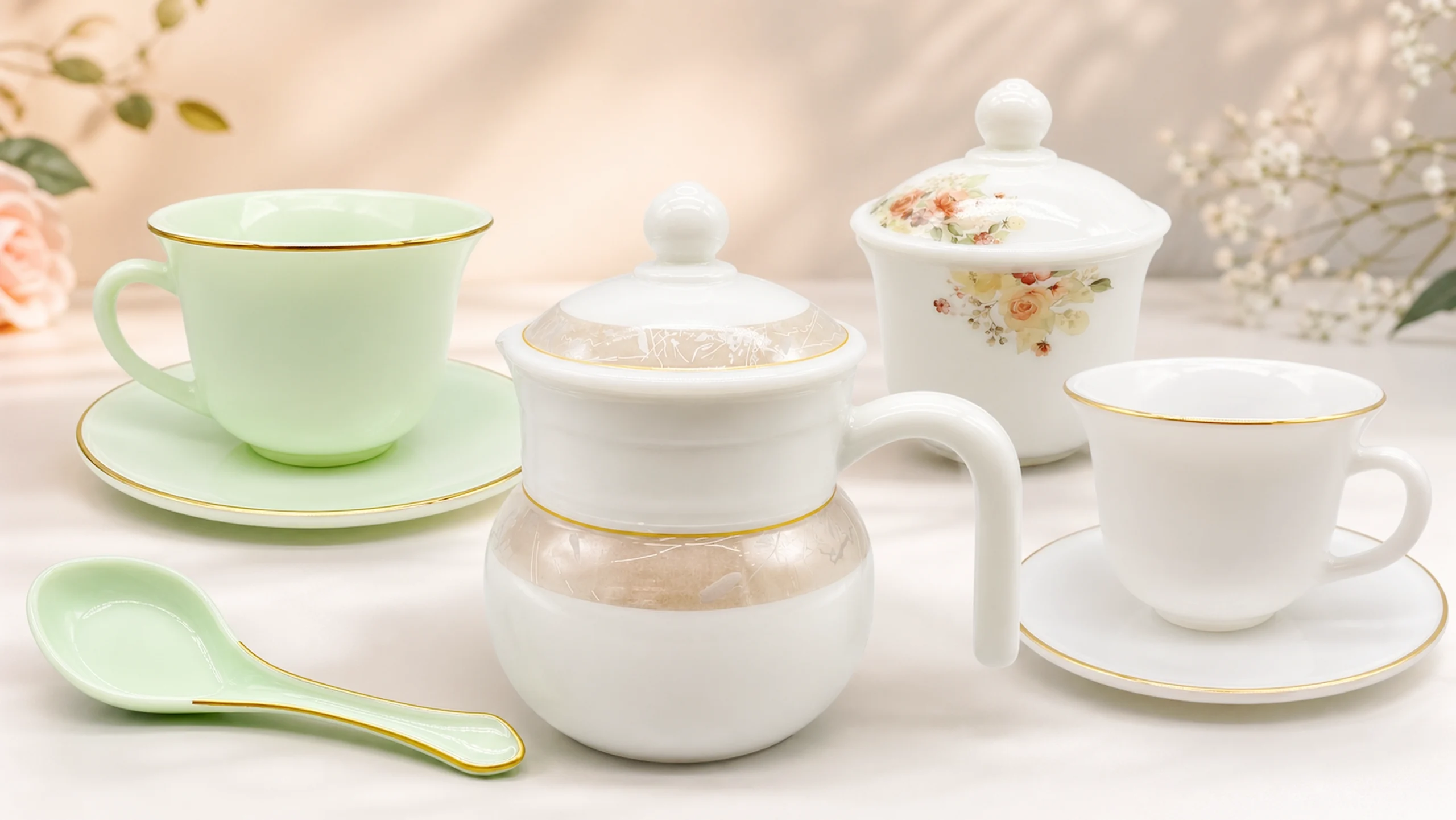
A cup of coffee or a pot of tea does not reach the guest on the strength of the cup alone. In commercial settings, a complete opal glass beverage service set decides whether the flow feels smooth and the table looks professional. Below we break it down from two angles: what goes into a full set, and why the pots in that set are worth buying in opal glass.
What a Complete Beverage Service System Includes
A standard system has six parts. Each one plays a role that is hard to replace.
1. Cup / Mug — The centrepiece. Pick a small espresso cup, a standard tea cup, or a large-handled mug depending on the drink. Capacities typically range from 80 ml to 350 ml. The cup type shapes both grip comfort and the window in which the drink tastes best.
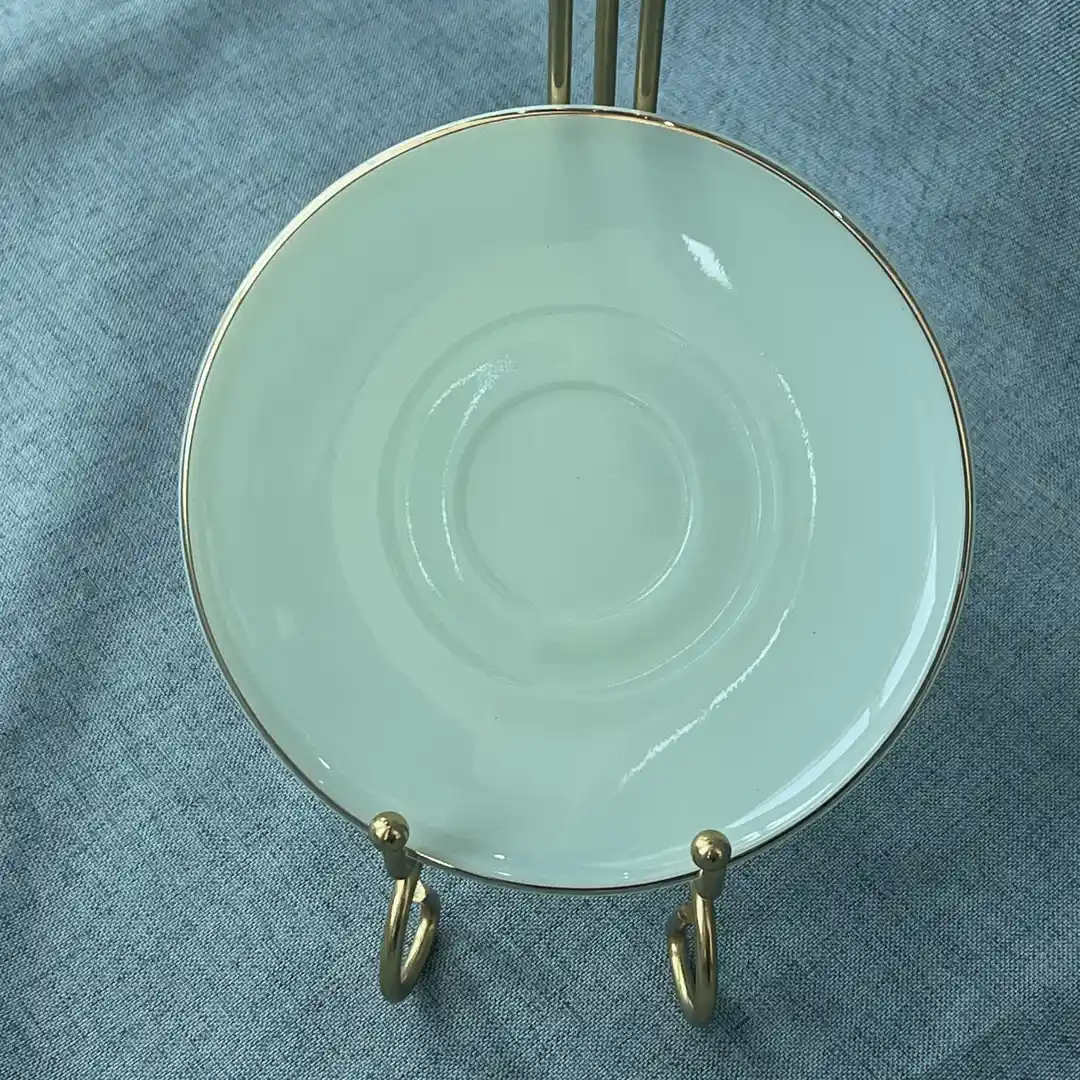
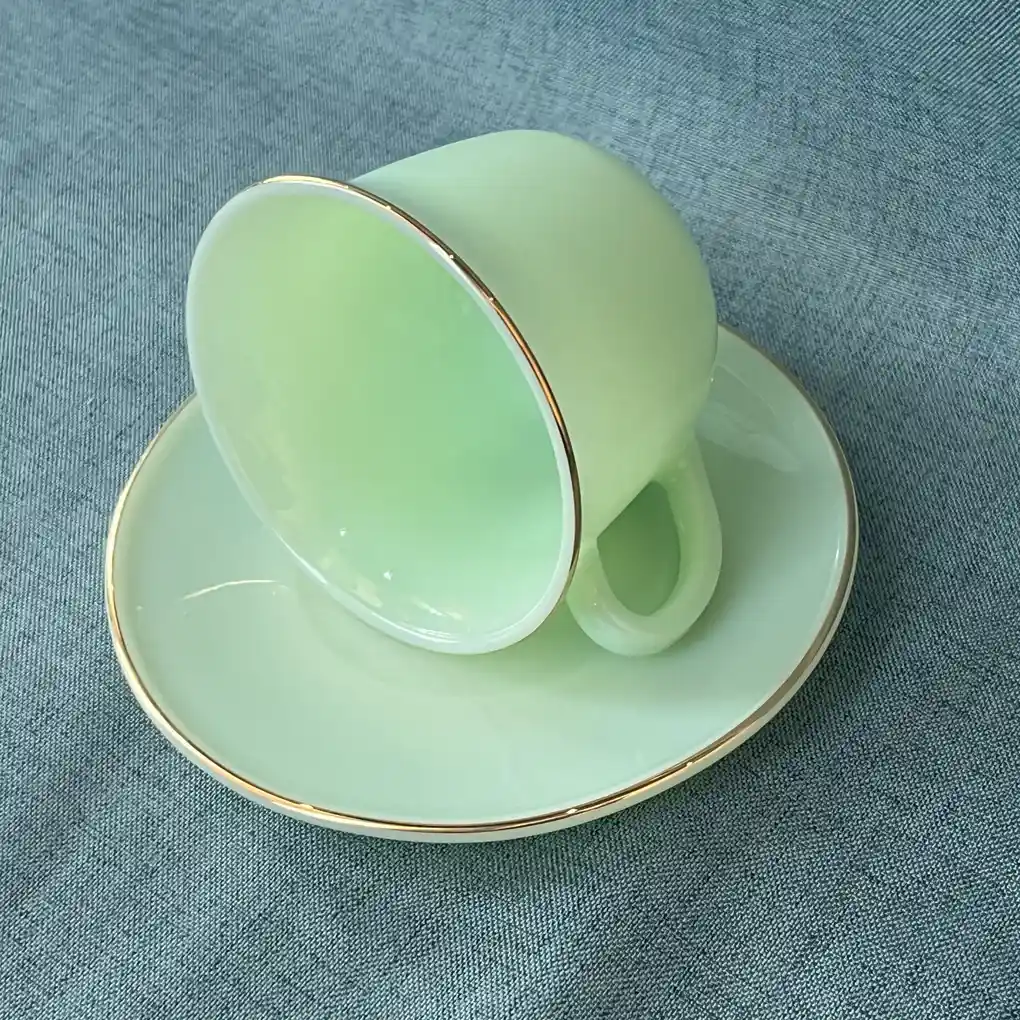
2. Saucer — More than decoration. It catches drips from the cup base, keeps the table clean, and gives the guest somewhere to rest a spoon or sugar packet. In a formal tea break or banquet, a missing saucer makes the whole table look unfinished.
3. Sugar Pot with Lid — Holds cube or loose sugar. The lid keeps moisture and odours out. In humid settings — hotel breakfast rooms, coastal restaurants — loose sugar in an open bowl clumps within half a day. A lidded pot keeps it dry much longer.
4. Creamer — Usually 80–150 ml, with a pouring spout at the lip. That spout lets staff or guests control how much milk comes out, avoiding a messy over-pour. Buyers from Middle Eastern and North African markets pay especially close attention to creamers — their tea-service culture uses them constantly, and they care a lot about how cleanly the spout cuts off the pour.
5. Teapot / Coffee Pot — Sized by “cup servings”: 2-cup (≈ 350 ml), 4-cup (≈ 700 ml), 6-cup (≈ 1 L). Match the size to your table and service style. Small business meetings suit a 2-cup pot — one pot per guest. Large banquet tables need a 6-cup pot so staff aren’t running back and forth to refill.
6. Spoon — Usually stainless steel, but still part of the opal glass set. Length has to match the cup’s rim diameter. Too long and it sticks out awkwardly. Too short and fingers dip into the drink during stirring.
When all six pieces share the same material tone and design curves, the table reads as one cohesive, professional set. Order by matched series — not by mixing and matching singles — to avoid colour gaps and style clashes down the road.
How Opal Glass Pots Differ from Ceramic and Stainless-Steel Pots
The pot is the biggest, most-used, and most breakage-prone piece in the set. Choosing opal glass over ceramic or stainless steel is not about looks. It comes down to two material-level differences that are hard to work around.
Opal glass pots are press-moulded in a single step. The body, spout, and handle form as one piece — no glued joints. Stress spreads evenly, and the risk of a localised crack is removed at the source. Ceramic pots take the opposite approach: spout and handle are shaped separately, then slip-bonded onto the body. Those bond points are where cracks show up first after months of heating, cooling, and everyday bumps. Chipped spouts and snapped handles are the top reason ceramic pots get retired in commercial kitchens.
Against stainless steel, the advantage shifts to thermal behaviour and visibility. Fill a stainless-steel pot with hot water and the outer surface heats up fast — bare-hand contact is out of the question. An opal glass pot warms much more slowly on the outside; you can grip it briefly without discomfort. On top of that, the milky semi-translucent body lets you eyeball the liquid level in the light without lifting the lid. Stainless steel is fully opaque — you have to open it or guess by weight.
| Dimension | Opal Glass Pot | Ceramic Pot | Stainless-Steel Pot |
|---|---|---|---|
| Forming process | Single-piece press moulding; no bonded joints | Spout & handle slip-bonded to the body — weak points at every joint | Welded or stamped as one piece; high structural strength |
| Most common failure | Full drop impact (relatively rare) | Chipped spout or broken handle (stress at joints) | Dents and dings (almost never shatters) |
| Thermal conductivity | Low — outer surface stays mild; brief bare-hand grip OK | Medium — gets warm but usually not scalding | High — outer surface heats fast; bare hand impossible |
| Liquid-level visibility | Semi-translucent; level visible in light without opening the lid | Fully opaque; must lift lid | Fully opaque; must lift lid or judge by weight |
| Aesthetic quality | Warm, porcelain-like finish; matches opal glass cups and saucers | Rich glaze textures, but colour-mismatch risk with opal glass cups | Cool metallic sheen; obvious style gap with opal glass cups |
| Best commercial fit | Hotel tea breaks, banquets, mid-to-high-end dining | Lower-frequency service (spout & handle wear out fast under heavy use) | Back-of-house prep, staff canteens (tough, but lacks front-of-house polish) |
If your cups and saucers are already opal glass, keeping the pots in the same material is the most straightforward way to lock in visual consistency across the table — and the best long-term value.
Advantages of Cups over Plates and Bowls
In the commercial opal glass tableware line-up, plates and bowls tend to be the high-volume workhorses. Cups are the pieces that really put the material to the test. Why? Because a cup is the only item that has to balance three things at once: the feel of the rim against the drinker’s lips, heat management during a long hold, and impact resistance through dozens of pick-ups and put-downs a day. Plates and bowls just carry food. Nobody presses their lips or palms against the wall for minutes at a time.
With a cup, the drinker gets continuous, real-time feedback on temperature and mouthfeel from first sip to last. That constant feedback amplifies every physical property of the wall material — thermal conductivity, thickness tolerance, surface finish. It is also where opal glass pulls furthest ahead of other materials.
If your order covers more than just cups — plates, bowls, the whole range — start with the Opal Glass Tableware Commercial Sourcing Master Guide for the big picture, then come back here for the cup-specific detail.
How Thick-Wall and Thin-Wall Cups Affect the Drinking Experience
Wall thickness is the number-one variable that shapes how a drink feels in the mouth. Thick walls (roughly 3–4 mm) hold heat longer — more material means more thermal mass and a flatter cooling curve. The downside: your lips hit a chunky rim, and that blunts the fine flavour detail of specialty coffee or delicate tea. Thin walls (roughly 1.5–2.5 mm) flip the equation. The slim rim lets liquid slide in almost barrier-free — clean, precise mouthfeel. But heat escapes through the thinner wall faster, the drink cools sooner, and the sweet spot for tasting shrinks.
With ordinary materials, you are stuck choosing one or the other. Standard soda-lime glass and ceramic cannot deliver “thin mouthfeel” and “slow heat loss” at the same time. Go thin, accept faster cooling. Go thick, accept a heavier lip feel. Most buyers end up going back and forth, then pick whichever side hurts less for their main drink.
Opal glass changes the trade-off at the material level. Micro-crystalline phases inside opal glass pull its thermal conductivity well below ordinary glass and most ceramics. A 2 mm opal glass wall can keep the light, precise feel of a thin cup while delivering heat retention close to a thick one.
In our Jointion factory’s side-by-side test, we poured 85 °C water into two cups — both 2 mm walls, one soda-lime glass, one opal glass. Ten minutes later the soda-lime cup’s outer wall had hit roughly 58 °C. The opal glass cup sat at about 46 °C. That 12-degree gap shows up directly in how comfortable the cup is to hold and how long the drink stays warm. In short, opal glass pulls “thin-wall feel” and “thick-wall warmth” — normally a hard either-or — into a range where you can have both.
Handle vs. Handleless — A Universal Decision Framework
This choice is a trade-off between heat safety and structural lifespan plus storage density. A handle keeps the palm completely away from the hot cup wall — great for comfort, especially with very hot drinks. But the handle is also the weakest structural point on the cup. Whether bonded or moulded as one piece, the handle-to-body junction is where stress concentrates. In commercial dishwashers and busy back-of-house environments, handle fracture is the single most common reason cups get thrown out.
A handleless cup wins on durability and stacking. No protruding handle means the same shelf space holds 30 %–40 % more cups, cutting storage and shipping costs. The trade-off: when the drink is above roughly 65 °C, bare-hand contact with the wall becomes uncomfortably hot — a real safety issue in fast-paced service.
Two variables drive the decision: serving temperature and how long the guest stays.
| Dimension | Handled Cup | Handleless Cup |
|---|---|---|
| Heat safety | Excellent — handle isolates all cup-wall heat | Weak — bare hand feels the burn above 65 °C |
| Structural durability | Lower — handle junction is the first thing to crack | High — no protruding weak point; stress spreads evenly |
| Stacking & storage | Low — handle sticks out, hard to pack tightly | High — clean shape; 30 %–40 % more per shelf |
| Dishwasher fit | Needs dedicated racks or wider spacing | Fits standard racks; higher loading density |
| Visual style | Classic, formal | Clean, modern |
| Best-fit scenario | Hot drinks + quick grab-and-go | Moderate temperature, or dine-in where the drink cools before the guest picks it up |
One more thing: opal glass’s low thermal conductivity makes the handleless option even more practical. An opal glass wall passes less heat to the palm than ordinary glass of the same thickness, so the comfortable-grip window is longer. Within the opal glass system, handleless designs cover a wider range of scenarios than they would in traditional materials — giving buyers more room to lean handleless and pocket the stacking and durability gains.
Common Breakage Points for Cups in Commercial Environments
Breakage is an unavoidable line item for every restaurant, hotel, and contract caterer. But opal glass cups break differently from plates and bowls. Plate and bowl damage tends to spread evenly across rims and bases. Cup damage clusters at a few specific spots. Knowing those spots is the first step toward targeted prevention in both purchasing and daily operations.
Handle Breakage — The #1 Cause of Cup Damage and How to Prevent It
Look in the breakage bin of any high-turnover restaurant and you will see a pattern: more than half the retired cups still have an intact body. It is the handle that broke. This is not random. The handle is the only part that sticks outward, so it takes more hits than the body at every stage — dishwasher loading, shelf storage, back-of-house hustling.
With ceramic cups, the handle is typically shaped separately and then glued on. That glue line is a built-in weak point. Opal glass cups are press-moulded in one step, so there is no glue line and the structural integrity is clearly better. But “better” does not mean “bulletproof.” At high enough collision frequency, the handle is still the first part to reach fatigue.
Prevention comes down to reducing how often the handle gets hit. These four measures have been tested over and over in live operations and consistently deliver the biggest impact:
- Point all handles the same way in the dishwasher. One simple rule cuts handle-on-handle collisions dramatically. Many kitchens skip it during rush hour, but once the habit sticks it adds almost zero time.
- Store cups in racks with vertical dividers. Each cup gets its own slot, so handles can’t scrape against neighbours. No dedicated rack? Simple acrylic dividers on existing shelves do the same job.
- Ban the finger-hook carry. Hooking three or four cups through the handles with one hand is the fastest way to snap a handle — and it happens most during peak clearing. The fix: two hands under the cup bases, or a tray for the whole batch.
- Check handle bases monthly for hairline cracks. If you can see a crack, the structure is already failing. Continued use risks a full break — and a potential injury. Pull cracked cups immediately.
These steps are basic by design. Breakage control is the sum of many small habits done consistently. Even a 20 % drop in handle breakage, multiplied across the cup stock of a 200-seat restaurant, adds up to meaningful savings in a year.
Cups and Saucers Break at Different Rates — How to Prepare for This Unique Restocking Challenge
Cup-and-saucer sets create a restocking headache that plates and bowls never do: cups and saucers don’t break at the same speed. In practice, saucers almost always break faster. The reason is simple — during clearing, saucers get stacked with other plates and bowls and take the weight and friction from above. Cups, taller and often handled, get collected on their own.
Six months in, a perfectly matched set often turns into “plenty of cups, not enough saucers.” The mismatch drags down table presentation, and the leftover cups just sit in storage doing nothing.
We hear the same question from nearly every buyer who visits our factory: “Can I reorder saucers by themselves? What’s the minimum?” It came up so often that we started writing breakage-rate guidance and pre-ordering tips directly into our quotations. The table below is built from years of partner feedback and works for most commercial settings.
| Preventive Measure | What to Do | When |
|---|---|---|
| Over-order saucers on day one | Buy 15 %–20 % more saucers than cups | First order |
| Lock in standalone saucer reorder terms | Agree on MOQ, unit price, and lead time for saucer-only orders | Contract signing |
| Keep reference saucers | Set aside at least 2 saucers labelled with the batch number for future colour and size matching | First-shipment inspection |
| Audit the cup-to-saucer ratio regularly | Count both quarterly; reorder when saucer stock drops below 80 % of cups | Every quarter |
These steps cost almost nothing to execute. But they stop the slow drift toward mismatched sets — and all the emergency emails, rush orders, and colour inconsistencies that come with it. Write them into your process early and the rest of the operation gets a lot smoother.
Typical Usage Scenarios for Opal Glass Cups
Quick Navigation by Scenario — Which One Matches Your Beverage Service?
Opal glass cups and mugs show up in more places than most buyers expect. Each setting has very different priorities — ceremony, toughness, branding, visual uniformity — so the right product mix changes every time. Before you start picking items, figure out which scenario below fits your operation, then jump to the detail that matters to you.
1. Hotel Lobby Lounge / Afternoon Tea — Full cup-and-saucer sets plus the complete accessory suite (sugar pot, creamer, teapot, etc.) are standard. Tabletop ceremony is priority number one. Opal glass’s warm, milky finish punches well above its price point in afternoon-tea settings — delivering a high-end look at a fraction of bone-china cost.
2. Hotel Guest Rooms — Mugs, usually without saucers. Brand-logo printing is non-negotiable — the cup doubles as a branding touchpoint. Guest-room cups get replaced more often than dining-area cups, so budget a higher breakage allowance.
3. Chain Coffee Shops / Tea Houses — You need espresso, cappuccino, and latte cups on hand. Rim diameter and capacity directly control how standardised your output looks. Wall thickness also has to balance grip comfort with heat retention.
4. Chinese & Western Banquets / Large Events — Uniform patterning across all cup-and-saucer sets is the baseline. Saucers chip easily during stacking and transport — add extra buffer. Post-event wash throughput should factor into product selection too.
5. Corporate / Institutional Canteens & Contract Catering — Pattern hardly matters. Impact strength and dishwasher durability matter a lot. Opal glass’s tempered construction — 2–3 times tougher than ordinary glass — shines brightest here.
Every scenario has its own selection logic, accessory list, and breakage plan. We recommend jumping straight to the sub-page that matches your setting for a targeted procurement guide, rather than wading through sections that don’t apply.
The Iron Rule of Cup Procurement — Buy All Accessories from the Same Series and Batch in One Order
The biggest difference between buying cups and buying plates or bowls is this: cups are not single items — they are a system. A complete opal glass beverage service set can include cups, saucers, sugar pot, creamer, teapot or coffee pot, spoon rest, and more. If even one piece is missing or its shade of white doesn’t match the rest, the whole table setting looks off.
Opal glass has a distinctive milky, jade-like finish — and that finish shifts slightly from batch to batch. One piece on its own may look fine. Put a new piece next to an older one on the same table and the colour gap jumps out immediately.
This is the trap many buyers fall into on their first order: they buy cups and saucers now, then plan to add sugar pots, creamers, and other small pieces later once volumes settle. Two problems hit at once. First, factories usually set a separate MOQ for small items — a few hundred sugar pots may not be enough to justify a kiln run. Second, even if the factory agrees to produce, the new batch will never be a perfect colour match with the original. The small pieces will always look “just a bit different” on the table.
So no matter the setting — hotel, restaurant, banquet — stick to one rule: put every accessory on the same order, same series, same batch, all at once. Add extra breakage buffer for the small items that chip most. The table below shows the Jointion team’s recommended allowances by category, based on years of shipment data.
| Accessory Category | Common Damage Scenario | Recommended Extra Breakage Allowance |
|---|---|---|
| Cups / Mugs | Daily-use knocks; dishwasher collisions | 10 % |
| Saucers | Rim chipping during stacking and transport (highest rate) | 15–20 % |
| Sugar Bowls | Lid and bowl each break independently; standalone reorder MOQ is high | 15–20 % |
| Creamers | Handle and spout are vulnerable points | 15 % |
| Teapots / Coffee Pots | Pot lid breaks independently at a high rate | Lids: extra 20 %; bodies: 10 % |
| Spoon Rests / Small Dishes | Small size — easy to lose or shatter during washing | 20 % |
Yes, this inflates the first order. But compared to the cost, lead time, and colour-mismatch headaches of chasing individual replacement pieces later, buying everything at once is always cheaper in the end. If your cup types, accessories, and quantities are already locked in, head over to the Opal Glass Cup & Pot Product Catalogue to check specs and customisation options by series — and turn your list into an actual order.