
This guide helps you pick the right opal glass tableware packaging before you place your order — not after the container lands and you’re staring at broken plates. The idea is straightforward: match your packaging type (color box or bulk pack) to your customer, and match your carton strength to your shipping method.
What Are the Common Packaging Types for Opal Glass Tableware, and How Do You Choose?
When it comes to opal glass dinnerware export, how you package the product directly affects two things: how much breaks in transit and how much each piece costs to ship. There are really only two mainstream packaging approaches — individual color box packaging and bulk pack in master cartons. On top of that, different shipping methods put very different demands on carton strength.
Color Box vs. Bulk Pack — Cost and Protection Compared
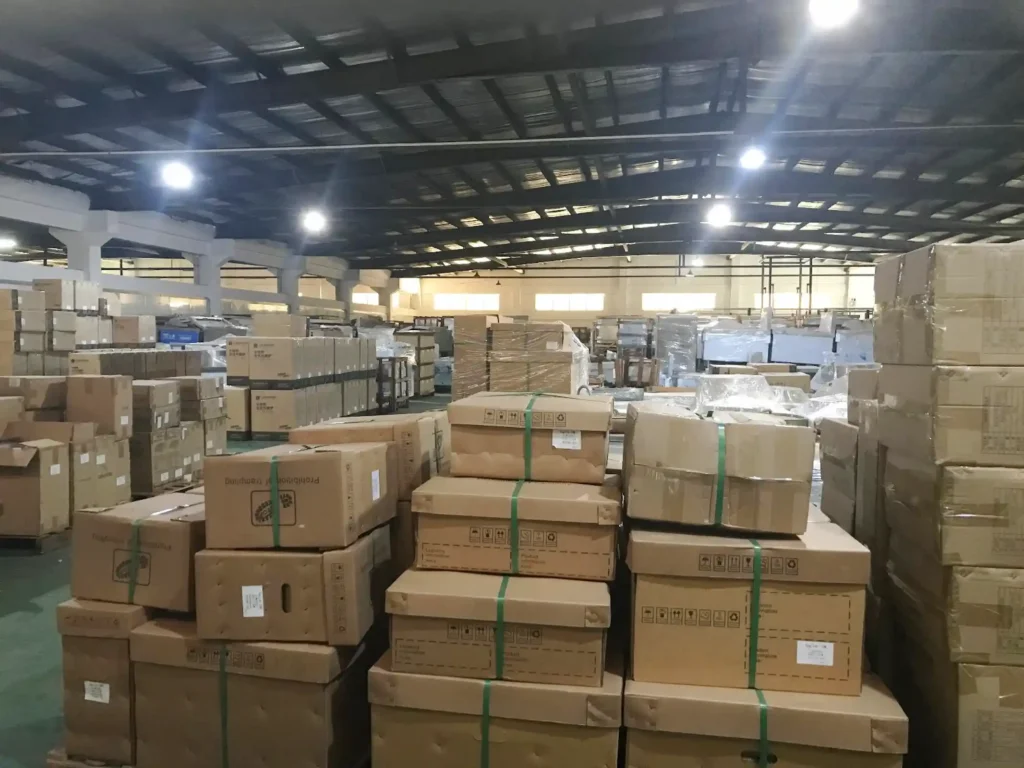
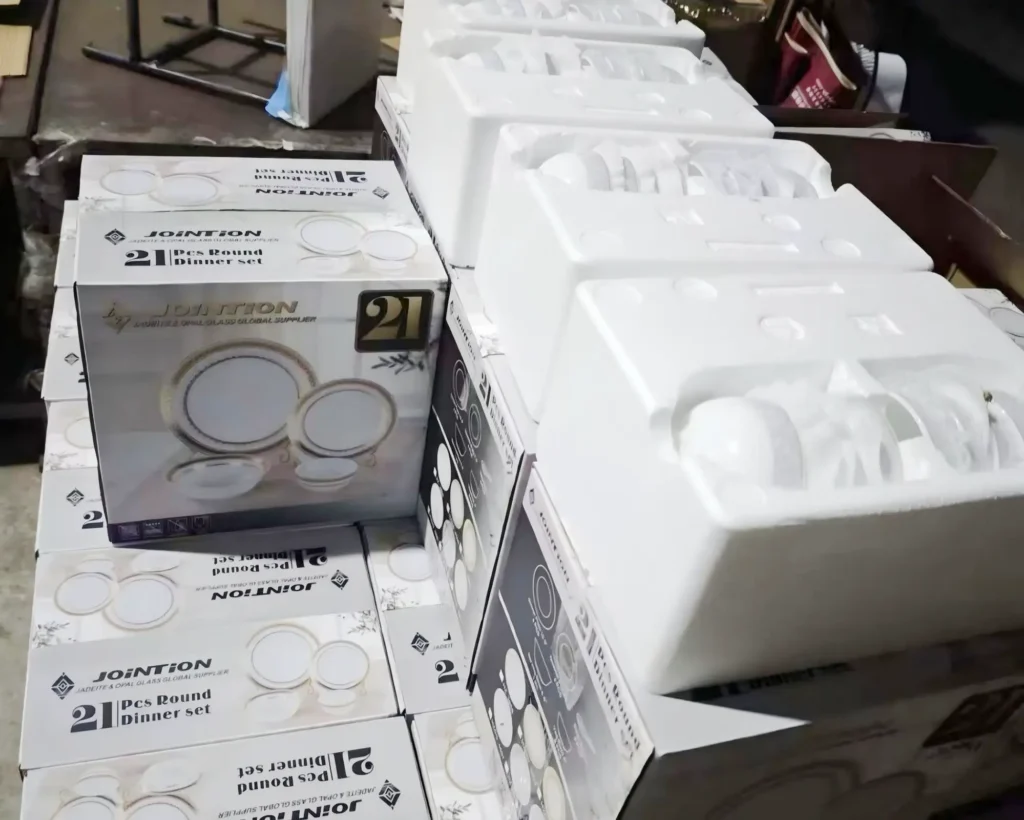
Bulk pack is the go-to budget option for exporting opal glass tableware. You put multiple pieces into one big outer carton and separate them with corrugated dividers inside. No individual box for each piece. Color box packaging is the opposite — every piece gets its own inner box, usually with foam inserts, corrugated positioning cards, or bubble wrap holding it in place.
Both work. But they work for different situations. Pick the wrong one and you’ll either overspend or open a container full of chips and cracks. Here’s what the two options look like side by side in actual production — bulk pack on the left, color box on the right. Both photos are from recent Jointion shipments.
Per-Unit Packaging Cost
Bulk pack is cheaper per piece. You’re just splitting the cost of the outer carton and dividers. Color box adds anywhere from a few cents to over a dollar per piece — that covers the inner box, cushioning, and printing.
Protection Level
Bulk pack depends entirely on those in-box dividers. If the divider material is too thin or the slots don’t fit well, the dividers shift during transit. Products touch each other. On a long ocean voyage with constant vibration, they rub and knock against each other over and over. Edge chips and surface scratches show up at rates much higher than you’d expect.
Color box is like giving each piece its own armor. Products almost never touch each other inside the carton. The jump in protection is significant.
At Jointion, we’ve seen this play out clearly across different markets. One Middle Eastern client reordered three times with bulk pack, then switched entirely to color box on the fourth order. We later found out why: the overall breakage on those bulk-pack shipments wasn’t terrible, but the small edge chips on the plates made his retail customers reject the goods. They called them “defective.”
FCL vs. LCL — Different Carton Strength Requirements
A lot of buyers use the same packaging spec for every order — FCL or LCL, doesn’t matter, same box. That’s a common and costly mistake. It’s also one of the biggest reasons opal glass tableware breakage rates swing from order to order. FCL and LCL put your cargo through completely different physical conditions, and the packaging needs to match.
Here’s a side-by-side look at what each shipping method actually does to your boxes:
| Comparison Dimension | FCL (Full Container Load) | LCL (Less-than-Container Load) |
|---|---|---|
| Shipping Chain | Loaded at the factory → sealed → unloaded at the destination port. Nobody opens it or mixes in other cargo along the way. | Loaded at the origin warehouse → mixed with other shippers’ cargo → split up and sorted at the destination warehouse → delivered. Your boxes get handled multiple times. |
| Primary Breakage Risk | Long stacking time. Bottom cartons carry the weight of everything above them for weeks, which can crush and deform them. | Forklifts moving your cargo repeatedly. Other shippers’ heavy goods pressing on yours. Cartons getting knocked around at each transfer point. |
| Outer Carton Strength | Standard single-wall corrugated (B-flute or C-flute) usually works, as long as edge crush strength is adequate. | Upgrade to double-wall corrugated (BC-flute). Add corner protectors. Crush resistance should be at least one tier above your FCL standard. |
| Internal Cushioning | Dividers in place, products fixed and not rattling — that’s enough. | Add foam layers or bubble wrap on top of dividers. Multiple handling events mean vibration damage adds up. |
| What to Tell Your Supplier | Shipping FCL, number of stacking layers, destination port. | Shipping LCL, any transshipment ports, any inland transport after the destination port. |
We’ve tested this in real shipments. A Southeast Asian client with smaller order volumes shipped LCL every time but used FCL-level packaging on the first two orders. The cartons arrived visibly crushed. When they opened the boxes, plates in the bottom layers were cracked.
We reviewed the full shipping chain with the client and confirmed: his cargo was handled at least twice at the transshipment port, and a batch of hardware had been stacked on top during consolidation. On the third reorder, we upgraded the outer cartons from single-wall to double-wall and added corner protectors on all four sides. Total cost increase? Roughly $0.25 per carton. But the arrival breakage rate dropped from nearly 3% to virtually zero.
So tell your supplier exactly how the goods are shipping — FCL or LCL, whether there’s a transshipment, whether there’s inland transport after the port. Let the factory match the right glass tableware shipping protection level to the actual route. Don’t let every order get the same generic packaging. That small extra cost on cartons is nothing compared to breakage claims, rush replacements, and lost customers.
Which Packaging Details Are Behind High Breakage Rates?
When goods arrive broken, most buyers blame rough handling by the logistics company first. But in reality, most opal glass dinnerware transit breakage starts with the packaging — specifically, with details on the inside and outside of the box. You’ve probably heard the story before: outer carton looks perfect, but the plates inside are shattered. That happens all the time in this industry. Here are the two most overlooked details that make or break your breakage rate.
Inner Dividers Too Thin or Wrong Material — Products Collide Inside the Box
Plenty of breakage cases don’t involve a damaged outer carton at all. You open the box, the carton looks fine, but several plates or bowls inside are broken. The cause? Products weren’t properly separated. Thin, soft dividers let pieces knock into each other the moment there’s any bumping during transit.
Opal glass goes through high-temperature crystallization strengthening. It handles impact much better than regular soda-lime glass. But the edges and rims are still the weak spots — wall thickness there is often just a few millimeters. When two pieces hit each other rim-to-rim, chips and cracks happen fast. And you won’t catch this in a static factory inspection. It only shows up after real-world bumps and vibrations on the road and at sea.
The usual culprit? Suppliers cutting packaging costs by using thin recycled corrugated paper as dividers. The box looks like it has dividers. But the actual thickness is under 2mm, so the cushioning effect is basically zero. In a still warehouse, those thin dividers can just barely keep pieces apart. But the moment a truck hits a pothole or a container rolls through ocean swells, the products shift inside the box way more than those flimsy dividers can absorb.
At multiple Canton Fair sessions, we’ve had buyers from South America and the Middle East walk up with photos of arrival damage, looking for a new supplier. In almost every photo, it’s the same issue — dividers crushed flat like tissue paper, products pressed directly against each other. When you inspect, check this yourself: press a divider with your hand. If it folds right down with barely any pressure and doesn’t bounce back, it’s not going to work.
Different divider materials have very different cushioning performance. Here’s how the common options compare:
EPE (Pearl Cotton) Foam Dividers, Thickness ≥ 5mm
EPE is made of closed-cell foam bubbles. When compressed, the bubbles deform to absorb the hit, then bounce back. That makes it a great fit for opal glass tableware — smooth surfaces, edges that chip easily. Below 5mm, there isn’t enough material to deform and the protection drops off sharply. Best for high-value orders or clients who set strict breakage limits.
B-Flute or E-Flute Double-Layer Corrugated Dividers
Cheaper than EPE. Good for mid-range orders. The two flute layers cross-brace each other, so crush resistance and cushioning are far better than a single layer. B-flute runs about 2.5mm thick, E-flute about 1.5mm. Stack them and you get roughly 4–5mm total — enough for solid baseline protection.
Single-Layer Thin Corrugated Paper (Thickness < 2mm)
This is the divider you’ll find in most high-breakage orders. One thin layer. Under repeated vibration it flattens out fast and stops doing anything useful. It only looks like a divider when the box is first packed. In practice, reject this option outright.
The thickness difference is hard to judge from specs alone. Here’s a close-up of all three divider types we keep as reference samples in our QC room — EPE foam on the left, double-layer corrugated in the middle, single-layer thin paper on the right. You can refer to it.
Outer Carton Corrugation Not Strong Enough — Bottom Layers Crushed Under Stack
Inside a shipping container, cartons are stacked on top of each other. The bottom layer carries the weight of everything above it. And that weight doesn’t sit there for an afternoon — ocean freight takes 20 to 30 days, sometimes over 40 on long routes.
If the carton board isn’t strong enough, time does the rest. Add in the moisture inside the container — condensation from day-to-night temperature swings is extremely common on ocean freight — and the corrugated board soaks up water, losing strength fast. The boxes slowly buckle and collapse. The opal glass tableware inside gets crushed. The bottom two or three layers are almost always the hardest hit.
Opal glass tableware is heavy. A carton with a dozen or twenty pieces weighs at least 7–8 kg. Heavier ones push past 10 kg. Three-ply corrugated (single-wall) can’t handle that. Five-ply (double-wall) is the bare minimum. For LCL — where you can’t control how things get stacked — or for heavier products, go straight to seven-ply.
We learned this firsthand in an internal review. A batch of 10.5-inch large plates going to the Middle East had a single-carton net weight near 12 kg. The client asked for five-ply cartons but didn’t specify board strength beyond that. When the shipment arrived, about 15% of the bottom two layers had visible corner collapse. Breakage in those layers was more than double the upper layers. Since then, for large or heavy products, we proactively recommend upgrading to seven-ply or boosting edge crush strength.
Just telling your supplier “use five-ply” isn’t enough. Two cartons both labeled five-ply can have wildly different actual strength. Here’s a reference table for opal glass tableware shipping — use it to get specific with your supplier:
| Outer Carton Spec | Edge Crush Test (ECT) | Max Stacking Layers | Best For |
|---|---|---|---|
| Three-ply (single-wall) | About 4–5 kN/m | Not recommended for export | Lightweight domestic short-haul only. Not suitable for opal glass ocean freight. |
| Five-ply (double-wall) | ≥ 8 kN/m | Up to 6 layers | Standard-weight orders (single carton ≤ 8 kg). FCL with controlled stacking. |
| Five-ply (reinforced) | ≥ 10 kN/m | Up to 8 layers | Medium-heavy orders (8–12 kg per carton). Long-haul routes over 30 days. |
| Seven-ply (triple-wall) | ≥ 12 kN/m | Up to 10 layers | Heavy orders (over 12 kg per carton). LCL. Uncontrolled stacking. |
Put the minimum edge crush strength number directly in your purchase contract. Include stacking limits. Require clear stacking marks printed on every carton. At inspection, spot-check a few cartons with a simple edge crush test — or at least ask your supplier for a third-party board test report. Confirm the numbers before you load the container. It takes a little extra coordination, but it’s the most reliable way to eliminate breakage caused by weak cartons.
How to Confirm Packaging Standards with Your Supplier Before Ordering
Opal glass tableware is fragile. Whether your breakage rate is high or low comes down less to luck and more to how clearly you define opal glass supplier packaging standards when you order. Across several Canton Fair sessions, we keep hearing the same regret from new buyers: they didn’t realize until after a bad shipment that packaging details need to be locked in before the contract is signed. Once the container is open and the damage is done, it’s too late to hold anyone accountable. Here are the two steps you can’t afford to skip.
Your Contract Packaging Clause Cannot Just Say “Standard Export Packing”
A lot of buyers negotiate everything in detail — except the packaging line. That just gets “standard export packing” and moves on. Those words sound professional. In practice, they mean nothing. Every factory reads “standard” differently. One factory thinks three-ply cartons and a strip of foam is standard. Another delivers five-ply with EPE dividers. You have no way to enforce a standard you never defined.
A Middle Eastern client who visited our factory last year told us what happened with his previous supplier. The contract said “standard export packing.” Arrival breakage hit 8%. When he tried to file a claim, the supplier said “we packed to standard.” He had nothing in writing to argue with.
The fix is simple: quantify everything and put it in the PI or a contract annex. Here’s what to lock down:
| Packaging Element | Recommended Spec | Notes |
|---|---|---|
| Inner cushion material | 5mm EPE (pearl cotton) foam dividers | Every piece individually separated. Non-negotiable. |
| Outer carton structure | Five-ply AA corrugated board | Double-wall for better crush resistance. |
| Edge Crush Test (ECT) | ≥ 8 kN/m | Baseline for export ocean freight. |
| Pieces per carton | ≤ 12 pieces | Single-carton gross weight ≤ 18 kg. |
| Stacking limit | ≤ 6 layers | Stacking marks must be printed. |
| Outer carton markings | Fragile, This Side Up arrows, moisture-proof symbols | Bilingual (Chinese and English). |
| Sealing method | H-seal pattern, BOPP tape ≥ 50mm | Double-reinforced on the bottom. |
Write it out in the annex exactly like this: “Inner cushioning: 5mm EPE foam dividers, each piece separated individually. Outer carton: five-ply AA corrugated board, ECT ≥ 8 kN/m. Max 12 pieces per carton. Stacking limit: 6 layers.” That level of detail gives you something to enforce. And the supplier knows there’s nowhere to cut corners.
Require Pre-Shipment Packaging Verification — Don’t Wait Until Arrival to Find Problems
Don’t find out the packaging wasn’t up to standard when you open the container at the destination port. By then, the ocean freight, customs clearance, and warehousing costs are already spent. Filing a claim takes months. You’re stuck. The smarter move is to verify everything before shipment.
At Jointion, here’s what we typically walk clients through before goods leave the factory:
Get packing-process photos and video from the factory. Have the supplier film the full process — divider placement, each piece going in, sealing the carton. Check that cushion thickness, carton ply count, and sealing method match what the contract says. If you want to be thorough, ask them to open a finished carton on camera and show the cross-section.
Run a drop test and keep the report. Use ISTA 1A or ASTM D5276 as your reference. Drop a fully loaded carton from 60–80 cm — single corner, single edge, single face, one drop each. Open it up and check for breakage and divider shift. Save the video and the report.
Add packaging checks to your third-party inspection. If you’re using SGS, Bureau Veritas, or Intertek, add packaging items to the inspection checklist ahead of time. Have the inspector measure divider thickness, weigh a carton, and confirm all printed markings and stacking symbols are clear.
Match shipping marks to the packing list. This matters most in mixed containers. Outer carton marks, batch numbers, and packing lists need to line up one-to-one. If the labeling is unclear, cargo gets sorted wrong at the destination port — and that extra handling causes breakage.
These steps cost almost nothing to add. But they catch the vast majority of breakage problems before the goods leave the factory. Our internal numbers show that orders completing all four steps consistently land with a breakage rate below 0.5%. Orders that skip verification swing much higher. Getting this right before shipment beats arguing over claims for months after arrival.
Packaging isn’t an add-on cost. It’s a bet you place on your arrival outcome. Pick the right format — color box or bulk. Match your carton strength to your shipping method. Write every spec into the contract. Do those three things and breakage stops being a gamble. Half an hour aligning packaging details with your supplier before ordering saves you three months of claims headaches after.
Common Questions People Ask
Q: My order quantities are small and the product mix is all over the place — bowls, plates, and cups in one container. What should I watch out for on packaging?
The biggest risk in a mixed container isn’t weak packaging on individual items. It’s the weight and size differences between product types making the stack unstable. Heavy cartons (large plates) go on the bottom. Light cartons (cups) go on top. When different-sized boxes are stacked together, fill every gap so the whole load can’t shift in transit. Ask your supplier for a loading plan diagram before you load.
Q: My customer insists I use their designated packaging material supplier, but the factory says they can’t guarantee the breakage rate. What do I do?
This comes up a lot. Start by having the factory make a sample batch with the client’s materials and run a drop test. Show the results to your client. If it fails, have the factory put together a side-by-side comparison report with data. Use the numbers to push for a spec change. The key contract point: whoever picks the packaging material owns the breakage risk. Write that in.