
Table of Contents
Differences in Raw Materials and Manufacturing
The debate around opal glass vs jade glass starts well before either product reaches your table — it begins at the raw material formulation and manufacturing process stage. On the surface, both belong to the category of “white glass” dinnerware, and visually both exhibit a certain warm, opaque quality. However, once you go deeper into the formulation level and production workflow, you will find that the two differ significantly in material logic, technical pathways, and structural principles.
Simply put, from “what raw materials are used” to “how they are made,” every step these two types of glass take is an entirely different path.
① Different Raw Material Bases
Opal Glass uses silica sand (60%–65%), soda ash (12%–15%), and limestone (5%–10%) as its base materials. These three ingredients form a standard soda-lime silicate glass system, with widely available raw materials and a high degree of industrial maturity. Jade Glass, by contrast, additionally incorporates special minerals such as fluorspar, potassium feldspar, and calcite. These components begin serving the final jade-like aesthetic right at the formulation stage — for instance, the K₂O introduced by potassium feldspar directly raises the refractive index, giving the finished product a warm luminosity close to natural jade rather than a simple milky-white opacity.
This distinction becomes especially relevant when evaluating opal glassware vs imitation jade glass: what looks like a subtle color difference on the shelf is actually rooted in a completely different raw material logic. The two raw material systems point toward entirely different material objectives from the very beginning.
② Different Key Additives
The core of achieving Opal Glass’s opacity is the opacifier, which accounts for 5%–10% of the formulation. Common types include fluoride-based opacifiers (calcium fluoride CaF₂, cryolite, etc.) and phosphate-based opacifiers (calcium phosphate Ca₃(PO₄)₂). These opacifiers undergo phase separation during cooling, dispersing uniformly throughout the glass matrix and scattering light to produce a soft milky-white color. The key additive in Jade Glass is instead a mineral combination represented by fluorspar (4%–8%). Its role is not only opacification but, more importantly, providing the chemical conditions necessary for the subsequent precipitation of microcrystalline phases — the fluoride ions in fluorspar are essential participants in the formation of the canasite microcrystalline phase, a function entirely absent from Opal Glass’s opacifier system.
All raw materials for modern high-quality Opal Glass must comply with international food-contact material safety standards such as FDA, LFGB, and GB 4806.5, with explicit requirements for the absence of lead and cadmium. A study published in the Journal of Environmental Science & Engineering by the Central Glass and Ceramic Research Institute of India (PubMed ID: 18472562) confirmed that the food-contact surfaces of opal glass tableware do carry a risk of lead and cadmium leaching when exposed to common edible acids such as acetic acid and citric acid, and that “the release of lead and cadmium is most rapid during the first 2 hours of the leaching period.” This is precisely why leading industry manufacturers eliminate heavy metals entirely at the formulation design stage.
③ Different Melting Temperature Ranges
The melting temperature for Opal Glass is 1500°C–1600°C. At this temperature, opacifiers can fully dissolve and distribute uniformly throughout the glass melt, creating the conditions for phase separation during subsequent cooling. The melting temperature for Jade Glass is slightly lower, at 1400°C–1520°C, but the melting duration is longer — typically 12 to 16 hours — to ensure that special mineral raw materials such as fluorspar and potassium feldspar are thoroughly melted and reach a state of chemical homogeneity.
The temperature difference between the two may appear modest, but it reflects entirely different melting objectives: the former aims to uniformly disperse the opacifier, while the latter aims to uniformly dissolve the microcrystalline precursors, laying a stable glass matrix foundation for the subsequent crystallization heat treatment.
④ Different Forming Process Pathways
After Opal Glass is melted and homogenized, the molten glass proceeds directly to the press-forming process, completing forming under 50–150 tons of pressure in 0.5–1.5 seconds. It is then annealed (470°C–520°C, with heating and cooling rates not exceeding 3°C per minute) to eliminate internal stress. Premium products are also immersed in a potassium nitrate molten salt bath at 400°C for 3–6 hours for chemical tempering, forming a compressive stress layer of 30–50 micrometers on the surface and increasing impact resistance by more than 300%.
After forming, Jade Glass must undergo an additional two-stage crystallization heat treatment: first held at 1000°C–1080°C for 2–4 hours to complete nucleation, then cooled to 800°C–860°C and held for 2–4 hours to complete crystal growth. This process is completely absent from Opal Glass production lines and is the fundamental reason why Jade Glass has a longer manufacturing cycle and higher process control difficulty.
⑤ Fundamentally Different Material Natures
After annealing, Opal Glass retains an amorphous glass microstructure. Its milky-white effect originates from the scattering particle interfaces formed by phase separation — it is, in essence, still glass. After crystallization treatment, Jade Glass has precipitated a lath-shaped microcrystalline phase primarily composed of canasite (Na₄₋₃K₂₋₃Ca₅(Si₁₂O₃₀)F₄) within the glass. Academically, this material belongs to the glass-ceramic category, combining the smoothness of glass with the crystalline strength of ceramics. Its visible light transmittance is approximately 30%–40%, which is the fundamental reason it presents a translucent jade-like quality rather than a pure milky-white color.
Although both appear “white” on the surface, their material natures belong to entirely different substance categories. It is also worth noting that barium carbonate (BaCO₃), which sometimes appears in Jade Glass formulations, primarily acts as a flux and clarifying agent and exists in some early patent formulations. Modern compliant products must equally pass heavy metal leaching tests, and the use of barium is subject to strict quantity controls — there is no fundamental divergence from Opal Glass at the food safety standards level.
For more in-depth guidance tailored to commercial purchasing — from specifications and certifications to bulk procurement considerations — read: Opal Glass Tableware: The Complete Commercial Buyer’s Guide
| Comparison Dimension | Opal Glass | Jade Glass |
|---|---|---|
| Base Material System | Silica sand + soda ash + limestone (soda-lime silicate) | Silica sand + fluorspar + potassium feldspar + calcite, etc. |
| Core Additive | Opacifier (fluoride-based or phosphate-based), 5%–10% | Fluorspar (CaF₂) 4%–8%, serving dual roles of opacification and crystallization |
| Melting Temperature | 1500°C–1600°C | 1400°C–1520°C, melting for 12–16 hours |
| Post-Forming Heat Treatment | Annealing (470°C–520°C) + optional chemical tempering | Mandatory two-stage crystallization (800°C–1080°C) |
| Material Nature | Amorphous opacified glass | Glass-Ceramic |
| Opacity Mechanism | Phase-separation scattering particles | Precipitation of microcrystalline phase (canasite) |
| Visible Light Transmittance | Near 0% (fully opaque milky-white) | ~30%–40% (translucent jade-like quality) |
| Food Safety Standards | FDA / LFGB / GB 4806.5, lead-free and cadmium-free | Equivalent heavy metal leaching test requirements; barium subject to quantity controls |
Differences in Appearance and Light Transmission
When you place a piece of Opal Glass dinnerware and a piece of Jade Glass dinnerware side by side on a dining table, the visual difference is perceptible almost instantly. Yet this difference does not merely reside at the color level — it involves how light behaves within the material, the degree of translucency, and the overall visual impression that results. Understanding the fundamental distinction between these two materials in terms of appearance and light transmission is a prerequisite for making the right choice.
In short, these two types of glass dinnerware have four core differences in appearance and light transmission that you can sense at a glance.
• Color
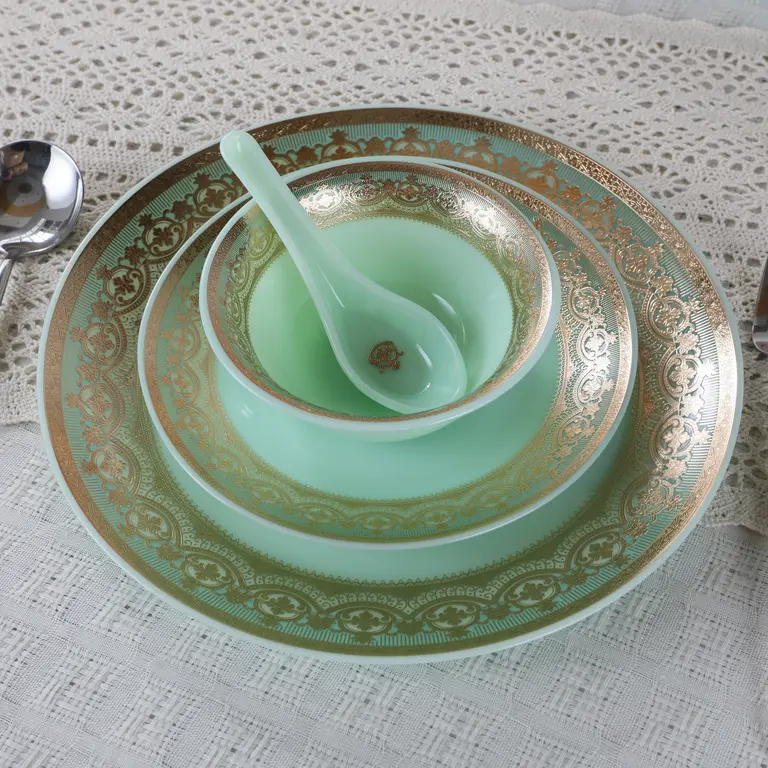
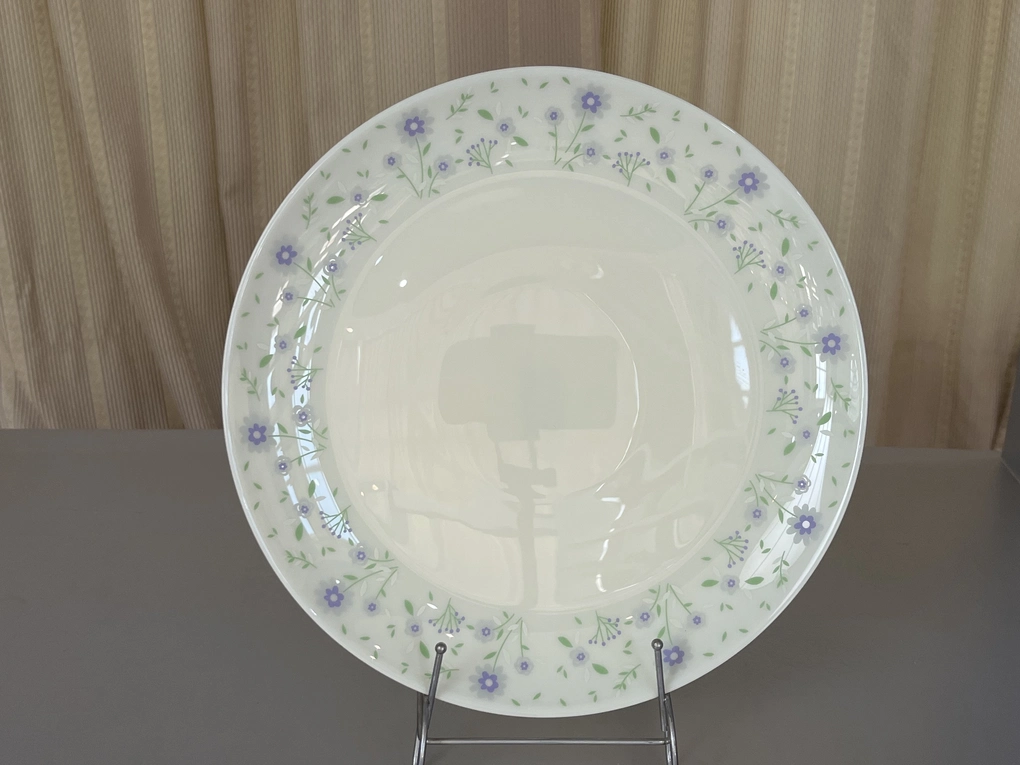
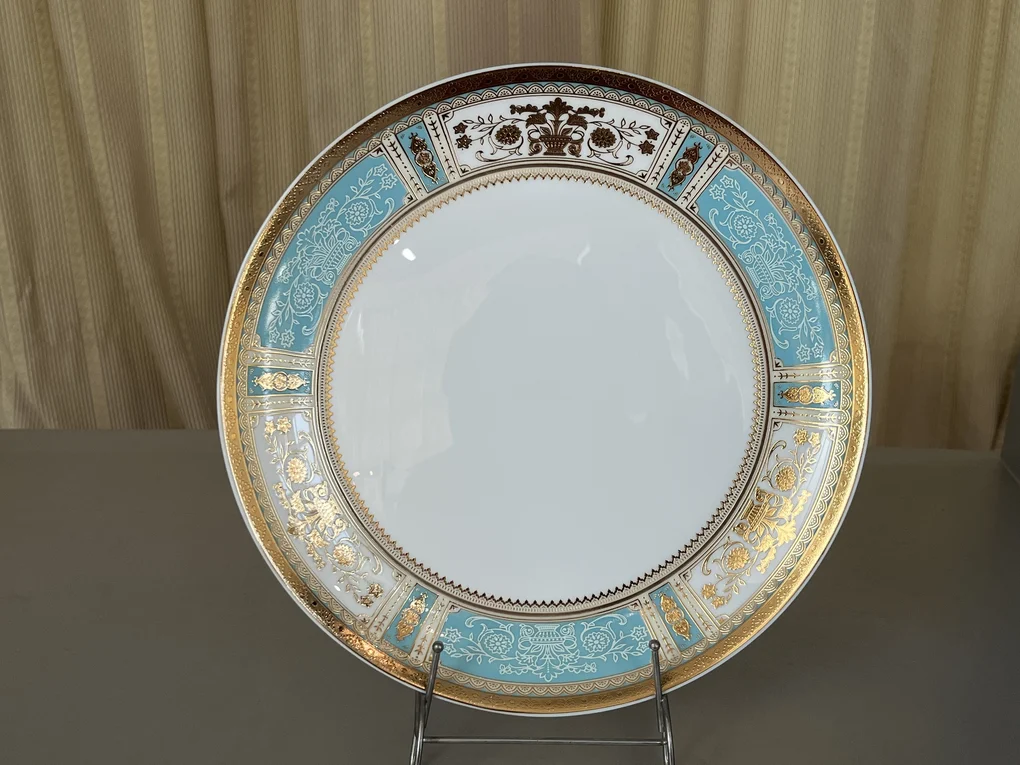
When comparing white porcelain glass vs jade-green glass, the most immediate difference is color tone. Opal Glass presents a uniform milky-white, close to pure white — neutral enough to function as a visual background on any table setting. Jade Glass, by contrast, sits at a low-saturation jade color somewhere between white and light green, carrying a quiet mineral warmth that reads more like ceramic or natural stone than conventional glassware.
This color difference is not incidental — it stems from entirely different material logic. The white of Opal Glass is produced by light scattering off opacifiers such as fluorides and phosphates, resulting in a uniform and stable color. The jade color of Jade Glass arises from the combined effect of metallic colorants such as chromium oxide and copper oxide together with the opacifier, where the former defines the hue and the latter controls translucency. Because the proportion of colorants in the formulation can be adjusted, Jade Glass can range from an extremely pale jade color barely distinguishable from white, all the way to a light green that is clearly identifiable — giving it a naturally broader color range than Opal Glass.
• Translucency
Opal Glass is completely opaque — even when held directly under strong light, no light can penetrate, and it maintains a uniformly opaque white at all times. Jade Glass, on the other hand, possesses a slight translucency: particularly at the rim of bowls or in areas where the cup wall is thinner, a faint light transmission effect can be seen when facing the light, a quality that closely mirrors the visual logic of natural jade — “translucent at the edges, warm and lustrous within.”
The reason for this difference lies in the amount of opacifier used: Opal Glass has a higher opacifier concentration, and the crystal particles scatter light more completely, blocking nearly all transmission; Jade Glass uses a comparatively restrained amount of opacifier, reducing rather than entirely eliminating transparency, thus preserving visible light transmission at thin-walled areas.
• Light Behavior
Opal Glass scatters incoming light uniformly in all directions through its internal opacifier particles. No obvious specular highlights appear on the surface, and the overall visual effect is soft and stable — maintaining a nearly consistent milky-white appearance under both warm and cool lighting, with minimal color shift. Jade Glass transmits light in a manner closer to diffuse transmission: light is partially absorbed and partially softened as it passes through the material before emerging, making it considerably more sensitive to the color temperature of ambient light sources.
Under warm light, the green tone of Jade Glass is softened, giving it a warmer, more mellow appearance; under cool white light, the jade tone becomes more distinct and visually prominent. This means that the same piece of Jade Glass dinnerware can exhibit subtly but perceptibly different color impressions in different rooms or at different times of day.
• Overall Visual Impression
Opal Glass looks clean, neutral, and versatile. Its milky-white color functions essentially as a visual “background” that does not compete with the colors of food — it actually makes the colors of dishes on the plate appear more vibrant. Jade Glass looks warm and layered, closer in feel to ceramic or natural jade, lending the table a quietly distinctive atmosphere.
This contrast is neatly captured in the broader debate around milk glass vs jadeite glass: milk glass prioritizes neutral uniformity, while jadeite glass introduces a tonal personality that makes the dinnerware itself part of the table’s visual story. North American vintage collecting media Vintage Unscripted describes Jadeite Glass as “an opaque milky green glass” (vintageunscripted.com), a phrasing that precisely captures the essence of its visual impression: neither fully transparent nor purely white, but a unique visual presence that combines milky opacity with a distinctive green tone.
| Comparison Dimension | Opal Glass | Jade Glass |
|---|---|---|
| Color | Uniform milky-white, close to pure white | Low-saturation jade color, between white and light green |
| Color Consistency | Highly consistent across batches | Color range varies with formulation adjustments |
| Translucency | Completely opaque | Slightly translucent; light visible at thin-walled areas |
| Light Transmittance | Near 0% (opacifier scatter-based) | ~30%–40%; higher at edges and thin walls |
| Light Scattering Mode | Uniform diffuse scattering; no specular highlights | Diffuse transmission; light softened as it passes through |
| Ambient Light Sensitivity | Low; color stable under both warm and cool light | High; warmer under warm light, jade tone more visible under cool light |
| Overall Visual Impression | Clean, neutral, and versatile | Warm, layered, close to jade-stone quality |
Differences in Performance and Practical Applications
The distinction also matters when evaluating opaque glass vs jadite glass for professional procurement: performance specifications, not just aesthetics, should anchor the final decision. Below is a breakdown of six core performance dimensions that directly determine which material suits which scenario.
• Thermal Shock Resistance
On the dimension of thermal shock resistance, Jade Glass actually holds an advantage over Opal Glass. Jade Glass can withstand a temperature differential of up to 150°C, meaning you can take it directly from the refrigerator (approximately 4°C) and immediately fill it with food fresh off the stove — the vessel will not crack due to the sudden temperature change. Opal Glass has a thermal shock threshold of 130°C, which is perfectly adequate for everyday use, but its margin for error in extreme temperature-swing operations is slightly narrower than that of Jade Glass.
For commercial kitchen environments that require frequent “cold-to-hot switching” operations, Jade Glass holds a clear advantage on this particular metric.
• Impact Resistance and Break Prevention
Opal Glass has opacifier particles (fluorides, phosphates, etc.) uniformly distributed throughout its interior. When subjected to impact, these particles force any developing crack to repeatedly deflect and expend energy rather than propagating in a straight line through the vessel. This mechanism yields an impact resistance approximately three times that of ordinary glass, with stable performance in 1-meter drop tests (ASTM C149). Jade Glass is also strengthened and offers better drop resistance than ordinary glass, but its interior lacks an equivalent density of particle-based buffering structures, so its overall impact absorption capacity falls short of Opal Glass.
To put it simply: both are more durable than ordinary glass, but Opal Glass’s anti-fracture mechanism is more systematic. In high-frequency back-of-house collision scenarios or households with young children, this advantage will become increasingly apparent over time.
• Microwave Compatibility
Both materials can be safely used in a microwave. Jade Glass is essentially an opacified glass with colorants added; its silicate base does not absorb microwave energy, making it microwave-safe to the same degree as Opal Glass. Both are suitable for high-frequency daily reheating without restriction.
One shared precaution for both materials: regardless of type, any vessel with metallic decorative edging (such as gold or silver trim) must not be placed in a microwave. Always confirm the product label reads “Microwave Safe” before use.
• Dishwasher Compatibility
Opal Glass has a dense, smooth, pore-free surface that can withstand the repeated high-temperature water jets and powerful detergents of a dishwasher. High-quality Opal Glass products can pass 500+ cycle tests without surface hazing or fading (ASTM C1499 commercial-grade certification standard). Jade Glass can also be placed in the dishwasher for cleaning; everyday household-use frequency presents no issue.
However, systematic long-term durability test data for Jade Glass in dishwashers is comparatively limited. For high-temperature drying programs in particular, long-term performance is best verified against the specific brand’s product documentation.
• Scratch Resistance
In terms of Mohs hardness, Jade Glass has a surface hardness of approximately 6.5–7, while Opal Glass is approximately 6.5. The values are close, so the degree of physical scratching caused by everyday metal cutlery use is not significantly different between the two. What truly determines “how visible scratches are” is how well the surface color and translucency conceal them.
The opaque milky-white surface of Opal Glass provides a natural visual masking effect for minor scratches, keeping the appearance clean even after long-term use. The translucent light-green surface of Jade Glass offers comparatively weaker concealment — fine surface marks are more likely to become visible under certain lighting conditions, affecting the overall quality of appearance.
• Practical Application Scenarios
Combining the five dimensions above, the appropriate use cases for each material become quite clear. Jade Glass, with its higher single-instance thermal shock threshold (150°C), has a natural advantage in operational scenarios that require frequent cold-to-hot switching. Its warm jade-green tone and vintage aesthetic sensibility also make it naturally suited to home users who value table ambience, as well as light-dining spaces such as cafés and guesthouses pursuing a natural or retro aesthetic.
Opal Glass, with its higher impact resistance, more established long-term dishwasher durability data, and stronger scratch concealment, is better suited to high-intensity, high-frequency usage scenarios: commercial restaurants, hotel banquet halls, or home environments with young children or elderly members where the risk of vessel collision is higher. Neither material is categorically superior — the key lies in your actual usage intensity and scenario requirements.
| Performance Dimension | Opal Glass | Jade Glass |
|---|---|---|
| Thermal Shock Threshold | 130°C | 150°C |
| Impact Resistance | ~3× ordinary glass; internal particles arrest crack propagation | Better than ordinary glass; no equivalent particle-buffering structure |
| Microwave Compatibility | Supported; no restriction on high-frequency daily reheating | Supported; equally unrestricted for high-frequency daily reheating |
| Dishwasher Compatibility | Supported; surface remains stable after 500+ cycle tests | Supported for household use; long-term commercial data limited |
| Scratch Resistance (Concealment) | Strong; opaque milky-white surface naturally conceals scratches | Weaker; translucent light-green surface makes scratches more visible under light |
| Recommended Use Scenarios | Commercial dining, high-frequency household use, families with children or elderly | Home daily use, cafés, guesthouses, and light-dining spaces |
Conclusion
Choosing between opal glass vs jade glass is ultimately not a question of which material is “better” — it is a question of which material is better matched to your specific context. Opal Glass delivers systematic durability, proven dishwasher resilience, and a neutral aesthetic that performs equally well in a hotel banquet hall and a family kitchen. Jade Glass offers superior thermal shock tolerance, a distinctive warm-green visual character, and a crafted, mineral-like quality that elevates more intimate or style-conscious table settings.
If your priority is operational reliability at scale — high-frequency use, commercial washing cycles, or an environment where breakage risk is elevated — Opal Glass is the more defensible choice. If your priority is atmosphere, aesthetic differentiation, and a material that invites conversation at the table, Jade Glass brings a quality that standard white dinnerware simply cannot replicate. Knowing what each material is made of, how it behaves under light, and where it performs best gives you the framework to make that call with confidence.
Ready to see what’s available in both materials? Browse our full opal glass and jade glass dinnerware collections to find the right match for your table or your next bulk order.
FAQ
Q1: I run a café with a strong aesthetic identity — will Jade Glass hold up to daily commercial use, or should I default to Opal Glass for peace of mind?
This is one of the most common tension points for independent hospitality operators. Jade Glass is not fragile — it outperforms Opal Glass on thermal shock resistance (150°C vs 130°C) and handles everyday café use without issue. However, if your service model involves a high volume of dish cycles through a commercial dishwasher, or if you are operating with a lean replacement budget, Opal Glass has a stronger evidence base for long-term commercial dishwasher durability (500+ certified cycles) and a more systematic impact-resistance mechanism. A practical middle path: use Jade Glass for table-facing items such as side plates, dessert bowls, and mugs where visual impact matters most, and reserve Opal Glass for higher-attrition items like main course plates that cycle through the wash more frequently.
Q2: I’ve seen products marketed as both “milk glass” and “jadeite glass” — are these the same thing, and does the label affect what I’m actually buying?
The terminology can be genuinely confusing, and the short answer is: they are related but not interchangeable. In the context of milk glass vs jadeite glass, milk glass refers broadly to any opaque or near-opaque white glass — it is a category, not a specific formulation. Jadeite glass is a specific sub-type within that category: opaque milk glass that has been tinted green, historically through metallic colorants such as chromium or uranium oxides. When a modern manufacturer labels a product “jade glass” or “jadeite glass,” it typically means a jade-toned opaque glass — but without full formulation disclosure, you cannot automatically assume it uses the glass-ceramic microcrystallization process described in this article. Always ask for the specific material certification (FDA, LFGB, or equivalent) and a heavy metal leaching test report, regardless of how the product is labeled.