Multiple industry reports published throughout 2024-2025 identify opal glass dinnerware as an emerging competitive alternative to traditional ceramic and porcelain tableware, with analysts from MarkWide Research highlighting its growth as a “threat from substitutes” to established porcelain markets. This competitive dynamic raises a critical procurement question for foodservice operators: when both materials claim durability, safety, and cost-efficiency, which delivers verifiable performance advantages in high-volume commercial settings? The stakes extend beyond initial purchase price. Rising labor costs pressure operators to minimize breakage-related replacement cycles, while tightening FDA oversight of food-contact materials demands transparent safety compliance documentation. For restaurant chains expanding locations or hotels refreshing tableware inventories, the choice between opal glass and porcelain represents a strategic decision affecting five-year total cost of ownership, staff handling efficiency, and regulatory compliance confidence. This comprehensive comparison examines both materials through evidence-based analysis of material composition, standardized durability testing data, FDA certification requirements, and documented commercial kitchen performance to provide procurement managers with decision-making frameworks aligned with operational realities and budget constraints.
Table of Contents
- Understanding the Fundamentals: What Are Opal Glass and Porcelain?
- Opal Glass vs Porcelain: Durability and Strength Comparison
- Safety and Health Considerations: Opal Glass Dishes vs Porcelain
- Practical Performance Comparison: Opal Glass Dinnerware vs Porcelain in Daily Use
- Making the Right Choice: Is Opal Glass Better Than Porcelain for Your Needs?
- Frequently Asked Questions
Understanding the Fundamentals: What Are Opal Glass and Porcelain?
Understanding the material composition and manufacturing processes of dinnerware is essential for making informed procurement decisions. Opal Glass vs. Porcelain represents two fundamentally different material systems, each with distinct production methods and resulting properties that affect their commercial viability.
Material Composition and Production Process
Opal glass, also known as milk glass or tempered glass dinnerware, is manufactured from natural minerals with silica sand comprising 70% of raw materials. The production process involves melting materials at temperatures exceeding 1400°C, followed by automated forming equipment for one-piece molding. This results in a product with zero heavy metal content and complete opacity achieved through opacifying agents.
The modern opal glass manufacturing process includes four critical stages: raw material preparation and mixing with precise measurements, high-temperature melting at approximately 1500°C with uniform dispersion of opacifiers, forming through mechanical pressing or blowing techniques, and finally tempering treatment at around 620°C followed by rapid cooling with high-pressure air streams. This tempering process creates surface compressive stress layers that increase strength by 4-5 times compared to untreated glass.
Porcelain production follows a different methodology. Composed primarily of kaolin clay (40-50%), feldspar (20-30%), and quartz (20-30%), porcelain undergoes firing at temperatures between 1200-1400°C. The manufacturing involves multiple stages including material processing through grinding and screening, forming via various methods such as slip casting or pressing, drying to remove moisture, bisque firing at 900-1000°C, glazing application, and final high-temperature firing where feldspar melts to form a glassy phase and kaolin decomposes to create mullite crystals.
| Characteristic | Opal Glass | Porcelain |
|---|---|---|
| Material Composition | Silicate glass with opacifiers (70% silica sand, sodium carbonate, limestone) | Kaolin clay with feldspar and quartz mineral additives |
| Production Temperature | Melting: 1500°C, Tempering: 620°C | Firing: 1200-1400°C |
| Manufacturing Complexity | Automated one-piece molding, 4 main stages | Multi-step process, 6 main stages requiring technical expertise |
| Microstructure | Amorphous non-crystalline with dispersed opacifier crystals | Composite structure with glassy phase, mullite crystals, residual quartz |
Physical Properties and Performance Characteristics
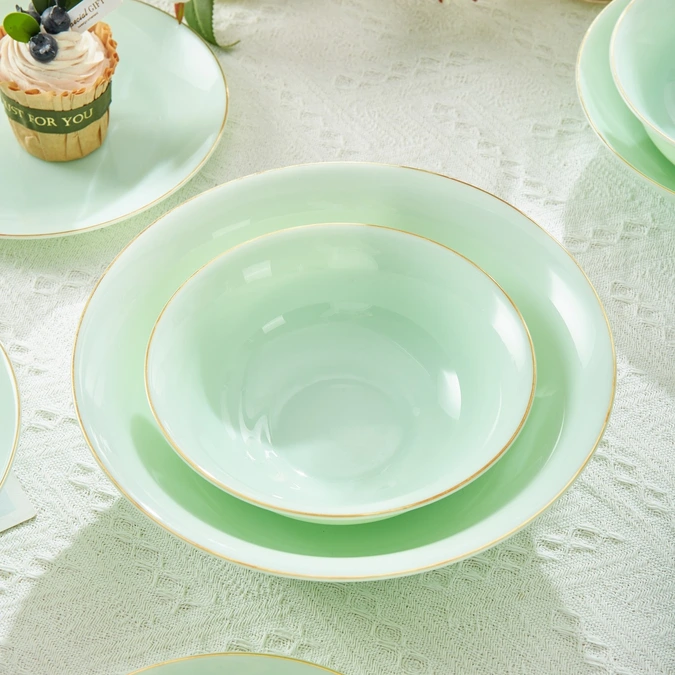
Opal glass exhibits several distinctive physical characteristics: a milky white appearance with slight translucency, surface smoothness comparable to mirror finish, weight reduction of 30-40% compared to equivalent porcelain products, non-porous surface preventing bacterial growth, and temperature tolerance of approximately 130°C differential suitable for microwave and dishwasher use.
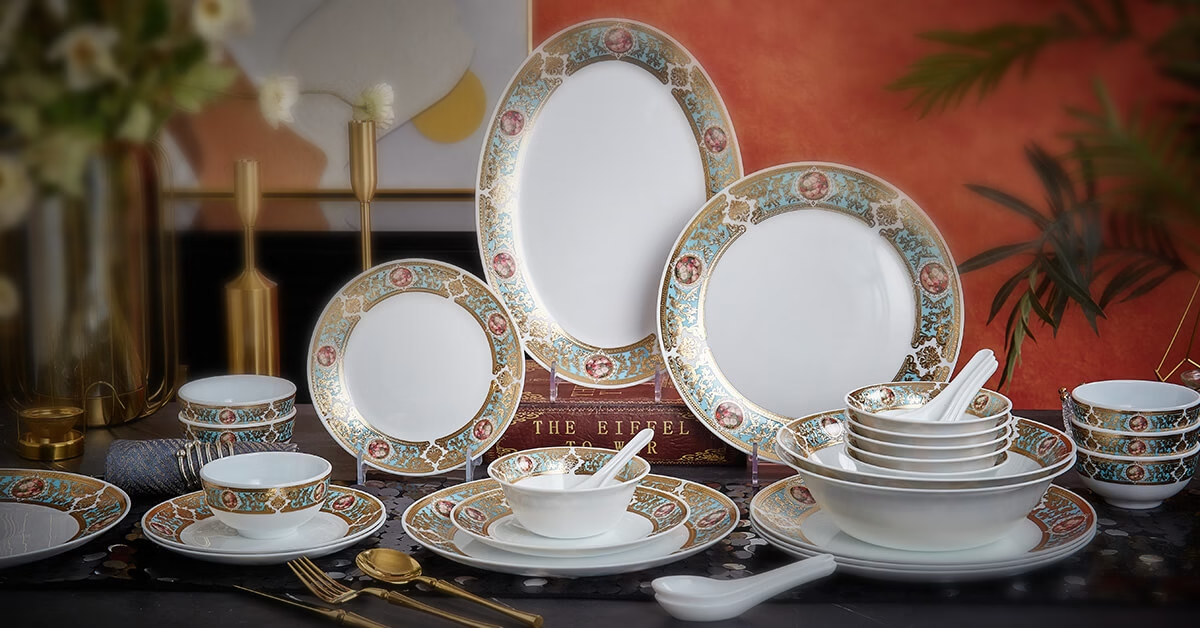
Porcelain displays different properties: completely opaque appearance with refined surface texture, higher material density resulting in greater weight, water absorption rate below 0.5% for quality porcelain, translucency in thin-walled pieces indicating quality, and safe operating temperatures typically between 160-260°C with broader applicability for oven use.
Opal Glass vs Porcelain: Durability and Strength Comparison
When evaluating porcelain vs glass dinnerware durability, commercial buyers must consider multiple strength factors including impact resistance, edge durability, surface hardness, and thermal stability. These metrics directly correlate with product lifespan, replacement frequency, and total cost of ownership.
Impact Resistance Performance
Tempered opal glass demonstrates superior impact resistance due to its unique stress distribution. The tempering process creates an outer layer under compressive stress (typically 69-138 MPa) balanced by internal tensile stress. When impacted, the compressive layer absorbs and disperses impact energy effectively. Testing shows that properly tempered opal glass can sustain daily use for an average of 5.3 years before showing significant wear, compared to 3.7 years for standard ceramic alternatives.
Standardized drop tests reveal that opal glass exhibits breakage rates of 15-25% when dropped from standard height (80-100 cm) onto hard surfaces, with particularly strong performance in edge and base regions. Even when breakage occurs, the material fragments into small, blunt particles significantly reducing injury risk. Pass rates in ball drop testing typically range from 85-95%, with edge impact resistance approximately 30-40% higher than traditional ceramics.
Porcelain’s impact performance varies with type and firing temperature. Its composite structure of glassy phase, mullite crystals, and residual quartz exhibits brittle fracture characteristics under impact. Breakage probability from equivalent drop heights ranges from 35-50%, notably higher than tempered opal glass. Edge areas and protruding elements like handles are particularly vulnerable to chipping. According to ASTM C648 standards, quality porcelain dinnerware demonstrates breaking strength typically between 250-400 pounds-force, with testing conducted using three-point loading at the center.
Commercial Impact Data: In high-volume foodservice environments, opal glass shows 1-2% breakage rates in commercial dishwashers compared to porcelain’s 3-5% breakage rate.Over a five-year operational cycle, total cost efficiency of opal glass typically exceeds porcelain by 20-30% when factoring replacement costs. For detailed product specifications and testing data, browse our complete dinnerware catalog.
Edge Durability and Chip Resistance
Edge integrity represents a critical durability factor as edges constitute the most vulnerable dinnerware component. Opal glass edges benefit from uniform compressive stress distribution achieved through tempering, with surface compressive stress layers typically 0.1-0.2mm thick. This structure effectively prevents microcrack initiation and propagation. Standard edge chip testing shows damage occurrence rates 70-80% lower than ordinary glass and approximately 40-50% better than ceramic edges.
Porcelain edges represent structural weak points, typically only 1-3mm thick where glassy phase continuity is easily compromised. Manufacturing processes may introduce microscopic defects in edge regions, creating stress concentration points. Statistics indicate approximately 60-70% of porcelain dinnerware damage originates from edge chipping, often starting from minor defects that gradually expand. Dishwasher operations and stacking storage contribute significantly to edge damage.
Surface Hardness and Scratch Resistance
Opal glass registers approximately 5.5-6.5 on the Mohs hardness scale, comparable to ordinary glass and slightly below quartz (hardness 7). While tempering doesn’t alter inherent material hardness, it enhances surface compressive capability. This hardness level resists most daily scratching, with normal stainless steel utensil contact leaving no visible marks. Surface finish maintains quality after thousands of washing cycles, with scratch resistance approximately 20-30% superior to glazed ceramics.
Porcelain surface hardness depends primarily on glaze quality, with high-quality glazes achieving Mohs hardness of 6-7, superior to glass. However, frequent metal utensil use can leave metal marks on glazes, accumulating into gray trace networks. Once glaze damage occurs, exposed porcelain body may absorb stains, and scratches are essentially irreparable without costly refinishing or replacement.
| Performance Metric | Opal Glass | Porcelain |
|---|---|---|
| Impact Resistance | 4-5x stronger than untreated glass, 15-25% breakage rate from standard drop | Brittle fracture characteristics, 35-50% breakage rate from equivalent drop |
| Edge Chip Resistance | 40-50% better than ceramic edges, maintains integrity 3-5 years | Vulnerable edges, 60-70% of damage originates from edge chipping |
| Surface Hardness | 5.5-6.5 Mohs, maintains finish after thousands of cycles | 6-7 Mohs (glaze), susceptible to metal marking and staining when damaged |
| Thermal Shock Resistance | ΔT 120-130°C, excellent for rapid temperature changes | ΔT 80-100°C, sensitive to sudden temperature variations |
| Commercial Dishwasher Cycles | 1000+ cycles, 1-2% breakage rate | 1000+ cycles when quality manufactured, 3-5% breakage rate |
Thermal Stability and Temperature Differential Tolerance
Opal glass demonstrates exceptional thermal stability with heat resistance up to 130°C temperature differential, enabling direct transition from frozen storage to oven use. This capability stems from uniform stress distribution and low thermal expansion coefficient (3-5×10⁻⁶/°C). Safe operating temperature range spans -20°C to 200°C, making it ideal for microwave-to-table service. Repeated thermal cycling tests show breakage rates remaining below 5% after 1000 heat-cool cycles.
Porcelain tolerates high temperatures with safe operating ranges typically 160-260°C, but exhibits greater sensitivity to rapid temperature changes with recommended safe differential of 80-100°C. Its thermal expansion coefficient (4-8×10⁻⁶/°C) exceeds opal glass, meaning greater dimensional changes during temperature fluctuations. Differences between glaze and body expansion coefficients may cause crazing. Quality porcelain withstands multiple thermal cycles but typically shows microcracking after 500-800 cycles.
Safety and Health Considerations: Opal Glass Dishes vs Porcelain
Food contact safety represents a non-negotiable priority for commercial dinnerware procurement. Understanding opal glass dishes safety alongside porcelain safety standards ensures compliance with health regulations and protects brand reputation. Both materials offer food-safe options when properly manufactured, but their safety profiles differ significantly.
Material Purity and Chemical Safety
Modern opal glass products are manufactured from natural minerals with zero heavy metal content, meeting the strictest international standards. The production process utilizes silica sand (70% of raw materials) melted at 1400°C+ with modern opacifiers primarily consisting of titanium dioxide (also used in sunscreen) and tin oxide (recognized as safe). Critically, contemporary opal glass contains no lead, no cadmium, and no BPA, with one-piece molding technology eliminating risks from decorative additions.
The glass material itself is completely inert, never reacting chemically with food regardless of acidity, alkalinity, or fat content. Opal glass is 100% food-safe and does not leach any chemicals into food. This chemical stability persists throughout the product’s lifespan without performance degradation, eliminating safety concerns related to aging.
Historical context requires attention: vintage milk glass, particularly pieces used for hot, acidic, or fatty foods, may leach harmful substances as past formulations used bone ash and lead or cadmium-based compounds. However, modern manufacturing has completely eliminated these dangerous components. Commercial buyers should explicitly require supplier certification of contemporary production methods and avoid old stock or antique pieces for food contact applications.
Porcelain Safety Standards and Glaze Considerations
Porcelain body material itself is inherently safe, composed of natural minerals including kaolin clay, feldspar, and quartz. High-temperature firing (1200-1400°C) ensures complete material fusion and stabilization. Unglazed porcelain and stoneware are safe for use without glazing.
Safety concerns primarily relate to glaze formulations. Traditional glazes may contain lead as a flux to lower firing temperatures and increase luster. Since implementation of regulations limiting lead in glazes across many countries, ensuring selected ceramic dinnerware is lead-free and complies with modern safety standards remains crucial. Reputable modern manufacturers utilize lead-free glaze formulations.
Decorative elements introduce additional risks. Glazes for vibrant colors like red, orange, and yellow historically contained lead or cadmium. Bright colors or glossy surfaces are particularly likely to contain lead or cadmium. Gold or silver rim decorations may utilize materials containing heavy metals. Hand-painted decorations, if not properly fired, may release harmful substances during use.
The FDA has issued Compliance Policy Guides outlining acceptable leaching levels for cadmium and lead with established testing methodologies. Major brands including Lenox, Mikasa, and Villeroy & Boch commit to lead-free glazes. Modern porcelain complying with FDA and Prop 65 regulations should be lead-free, with premium products typically certified by third-party laboratories.
| Safety Aspect | Opal Glass | Porcelain |
|---|---|---|
| Heavy Metal Content | Zero heavy metals, lead-free, cadmium-free modern formulations | Quality products lead-free, but market variations exist; vintage pieces may contain lead/cadmium |
| Chemical Inertness | 100% inert, no reaction with acidic, alkaline, or fatty foods | Properly glazed porcelain inert; damaged glaze may leach substances |
| Microwave Safety | Completely safe, no hotspots, no chemical release | Generally safe (verify no metallic accents); heating accelerates potential leaching |
| Surface Porosity | 100% non-porous, prevents microbial harboring | Vitrified porcelain non-porous when glaze intact; damage increases porosity |
| Regulatory Compliance | FDA, EU 1935/2004, China GB 4806, California Prop 65 | FDA, Prop 65 when quality manufactured; verification essential |
Hygienic Performance and Antimicrobial Properties
Opal glass manufactured from non-porous material provides hygienic and food-safe properties, storing no microorganisms that cause bacterial infections. The tightly packed glass molecular structure contains no visible or microscopic pores, preventing bacterial or mold attachment and internal penetration. Food residues remain only on surfaces without material absorption. Opal glass is 100% non-porous glass material, retaining no microorganisms potentially causing bacterial contamination, nor unpleasant odors.
Standard microbiological testing confirms near-zero bacterial survival rates on opal glass surfaces, with post-cleaning bacterial counts far below porous materials. No special antimicrobial treatment is required as the material inherently possesses antimicrobial characteristics, meeting strict hygiene standards for commercial kitchens and medical institutions.
Opal glass proves extremely hygienic and easy to clean, readily hand-washed or machine-washed with rapid drying. Oil, pigments, and other contaminants cannot penetrate, requiring only rinsing for removal. It absorbs no odors even after holding strongly scented foods. High-temperature dishwasher cleaning doesn’t damage material while enhancing hygiene assurance. Cleaning agent usage can decrease, reducing chemical residue risks.
Quality porcelain vitrification provides similar non-porous properties where bacteria, food particles, and stains cannot penetrate surfaces, making dinnerware essentially more hygienic than porous alternatives. However, porcelain hygiene performance highly depends on glaze integrity. Once glaze develops cracks, chips, or wear exposing porous porcelain body underneath, moisture and food particle absorption occurs. Microscopic crazing, though invisible, diminishes hygiene performance. Surface damage or cracking may allow harmful substance leaching posing health risks if ingested. For a comprehensive analysis of opal glass safety standards and testing protocols, see our detailed guide: Is Opal Glass Safe to Use?
Practical Performance Comparison: Opal Glass Dinnerware vs Porcelain in Daily Use
Beyond material properties, real-world performance determines operational success. This section examines opal glass dinnerware pros and cons alongside porcelain performance in actual commercial settings, considering factors that directly impact daily operations, staff efficiency, and customer satisfaction.
Temperature Adaptability in Service Scenarios
Opal glass exhibits high thermal shock resistance, withstanding temperature transitions from refrigeration to microwave heating. This capability proves particularly valuable in fast-casual and takeout operations. Food can be stored in opal glass containers under refrigeration, then heated directly in microwaves without container changes, significantly simplifying workflow and reducing dishwashing requirements.
The material safely handles temperature differentials up to 120-130°C, enabling frozen-to-heated transitions without cracking risk. However, traditional oven high-temperature applications have limitations. Operations requiring baking or broiling may find this constraining, though microwave suitability covers most reheating needs in contemporary foodservice.
Porcelain better tolerates conventional oven high temperatures with broader thermal application ranges. This makes porcelain advantageous for operations employing diverse cooking methods including baking, braising, and roasting. Ceramic material’s gradual thermal conductivity provides superior heat retention, ideal for maintaining food temperatures during extended service periods.
However, porcelain demonstrates sensitivity to rapid temperature changes. Sudden thermal variations may cause thermal shock cracking. Operational protocols must avoid placing hot dishes directly into cold water for cleaning, requiring staff awareness and proper handling procedures. Recommended safe temperature differential typically ranges 80-100°C, more restrictive than opal glass.
Cleaning Efficiency and Maintenance Requirements
Opal glass’s smooth, non-porous surface prevents stain adhesion, maintaining like-new luster even after thousands of uses. This non-porous characteristic means food residues, oils, and pigments cannot penetrate material structure. Most soiling requires only warm water rinsing for removal, sometimes enabling direct flow-through cleaning that minimizes detergent usage—an environmental benefit.
Dishwasher performance proves exceptional with opal glass. Surface non-adhesion means standard dishwasher cycles achieve excellent results without extra soaking or manual scrubbing steps. Back-of-house staff can focus more energy on food preparation rather than dinnerware cleaning. Rapid drying speeds further enhance turnover efficiency, allowing equivalent dinnerware quantities to support higher table turn rates.
Porcelain maintains similar non-porous surfaces but may accumulate slight scratches or stains over time, particularly in lower-quality products. Uneven glaze application creates stain retention prone areas compromising aesthetics and hygiene. Stubborn stains require paste mixtures of baking soda and water applied with gentle rubbing—a time-consuming process potentially affecting dinnerware turnover during peak periods.
High-end porcelain featuring hand-painted decorations requires manual washing to protect surface patterns from abrasion, further increasing maintenance labor costs. While necessary quality assurance for premium establishments, this becomes an efficiency bottleneck in high-volume, fast-paced operations.
Appearance Retention and Replacement Cycles
Surface finish longevity affects long-term aesthetics and replacement timing. Opal glass maintains transparency and milky white luster essentially unchanged for 3-5 years under normal use conditions. The material doesn’t develop the fine scratch networks common in glazed ceramics. This sustained appearance reduces premature replacement driven by aesthetic degradation rather than structural failure.
Quality porcelain maintains finishes longer, typically 5-7 years, when properly cared for. Premium products can serve indefinitely under optimal conditions, representing genuine long-term investments. However, this assumes careful handling and protective maintenance. Commercial reality often involves frequent metal utensil contact, aggressive cleaning, and occasional mishandling that accelerate appearance deterioration.
Replacement cost analysis must consider both unit prices and replacement frequency. While porcelain unit costs average 20-30% higher, extended lifespan under ideal conditions may offset this premium. Conversely, opal glass’s lower breakage and chip rates in demanding environments often result in superior total cost of ownership over typical 3-5 year evaluation periods.
Making the Right Choice: Is Opal Glass Better Than Porcelain for Your Needs?
The question “is opal glass better than porcelain” lacks a universal answer—optimal choice depends entirely on your specific operational context, brand positioning, and business objectives. Contact our procurement specialists for customized recommendations based on your operation. This section provides a decision framework integrating all previously discussed factors to guide your procurement strategy.
Budget Structure and Lifecycle Cost Planning
Dinnerware investment shouldn’t focus solely on initial purchase prices but requires lifecycle cost-benefit analysis. For budget-constrained businesses requiring rapid large-volume equipment or expanding chains, opal dinnerware typically costs less than porcelain, representing budget-friendly choices. Assume a mid-sized restaurant needs 200 place settings—opal glass initial investment might range from several hundred to several thousand dollars depending on styles and suppliers, while equivalent high-quality porcelain could require several times that budget.
Price differentials magnify during bulk procurement. Basic opal glass typically maintains stock availability, allowing customers to mix multiple designs and sizes within single containers, benefiting both small retail buyers and large wholesale importers. This flexibility provides businesses greater capital allocation capacity, enabling saved budgets to flow into other critical operational areas.
Extending perspective to 3-5+ years shifts cost consideration focal points. Consumer reviews indicate properly tempered opal glass dinnerware averages 5.3 years continuous use before significant wear appears, versus 3.7 years average lifespan for standard ceramic alternatives. This data reveals important reality: even if porcelain initial costs exceed opal glass, significantly higher breakage rates may erode or exceed initial price differentials through long-term replacement procurement costs. For high-frequency commercial scenarios, opal glass proves both affordable and practical, with durability exceeding most ceramic dinnerware sets, making it advantageous choices.
Of course, quality porcelain under proper care can last lifetimes, representing true long-term investments. For high-end venues with stable traffic, standardized operations, and traditional value emphasis, porcelain’s “lifetime value” merits consideration. The key lies in evaluating actual breakage rates and replacement frequencies for more precise cost accounting.
Comprehensive Decision Matrix
Synthesizing all factors, here’s when each material optimally serves:
Choose Opal Glass When:
- Operating high-volume, fast-paced service models with elevated dinnerware turnover frequencies
- Emphasizing operational efficiency and cost control, seeking reduced long-term replacement expenses
- Requiring lightweight, easy-handling dinnerware to reduce staff physical burden
- Pursuing modern, minimalist brand imagery emphasizing hygiene and cleanliness perception
- Offering varied-temperature dishes or takeout services requiring dinnerware temperature adaptability
- Facing limited storage capacity necessitating space utilization optimization
- Operating chains or requiring frequent logistics distribution, prioritizing transportation costs
- Serving populations including children, elderly, or environments where breakage safety is paramount
Choose Porcelain When:
- Positioning as premium establishments emphasizing traditional elegance and cultural refinement
- Managing stable, controllable traffic with standardized operations prioritizing detail quality
- Needing dinnerware to convey brand prestige and ceremonial significance
- Serving dishes requiring extended heat retention, prioritizing food presentation effects
- Desiring unique visual styles through rich pattern and color selections
- Willing to invest in long-term brand value without prioritizing short-term costs
- Maintaining professional dinnerware management teams with standardized operational protocols
- Operating venues where storytelling and emotional connection through dinnerware are valued
Hybrid Strategy: Strategic Material Combination
This isn’t a binary choice. You can mix opal glass and ceramic in your kitchen for diversified appearances, ensuring they visually complement each other forming consistent styles. Many successful foodservice operations employ “tiered configuration” strategies: deploying opal glass for high-frequency basic dinnerware (daily set service plates and bowls) while using porcelain as accents in specific premium sets or banquet services. This controls overall costs while ensuring quality presentation at critical moments.
Hybrid strategy success hinges on maintaining overall style coordination, avoiding customer perceptions of “inconsistent quality levels” creating confusion. Through careful style selection and pairing design, different material dinnerware can harmoniously coexist on single tables, each playing to strengths.
Jointion offers both material options with industry-leading warranties: 2 years for opal glass dinnerware, 3 years for porcelain dinnerware sets, providing procurement confidence and post-sale support assurance.
Frequently Asked Questions
What are the main cost differences between opal glass and porcelain for bulk commercial orders?
For bulk commercial procurement, opal glass typically costs 20-40% less than equivalent quality porcelain for initial purchase. However, lifecycle cost analysis reveals more nuanced economics. Opal glass demonstrates 1-2% commercial dishwasher breakage rates versus porcelain’s 3-5%, with average service life of 5.3 years compared to porcelain’s 3.7 years under high-frequency use. When calculating total cost of ownership over 5-year operational cycles including replacement costs, opal glass frequently delivers 20-30% better cost efficiency in high-turnover environments. For operations prioritizing upfront budget optimization or rapid equipment scaling, opal glass provides superior value. Premium porcelain investments may prove worthwhile for establishments with controlled usage, standardized handling protocols, and brand positioning requiring traditional elegance where long-term appearance retention justifies higher initial investment.
How do opal glass dishes compare to porcelain for food safety certifications and regulatory compliance?
Modern opal glass offers exceptional food safety with zero heavy metal content, manufactured from natural minerals (70% silica sand) meeting FDA, EU 1935/2004, China GB 4806, and California Prop 65 standards. The material is 100% inert, never leaching chemicals into food regardless of content acidity, temperature, or contact duration. Quality porcelain from reputable manufacturers similarly achieves food safety compliance when using lead-free glazes, though market variations exist. Critical distinction: opal glass safety remains consistent throughout product lifespan as glass itself comprises the food contact surface. Porcelain safety depends on glaze integrity—damage exposing porous ceramic body increases contamination risks. For procurement, both materials offer compliant options, but opal glass provides simpler safety verification and more consistent long-term performance. Always request third-party laboratory testing documentation and contemporary manufacturing process certification regardless of material choice.
Which material better suits high-volume commercial dishwasher operations?
Opal glass demonstrates superior performance in commercial dishwasher environments based on multiple factors. Testing shows 1-2% breakage rates over 1000+ cycles compared to porcelain’s 3-5% rate. Temperature differential tolerance of 120-130°C versus porcelain’s 80-100°C means reduced thermal shock failure risk during rapid heating-cooling cycles. The non-porous surface enables faster drying, shortening cycle times and supporting higher turnover with equivalent dinnerware quantities. Noise reduction of 3-5 dB creates quieter kitchen environments reducing staff auditory fatigue. Lightweight design (15-20% lighter) simplifies handling during loading-unloading, minimizing drop damage risk. Porcelain performs adequately in commercial dishwashers when quality-manufactured but requires more careful handling, gentler detergents for decorated pieces, and acceptance of slightly higher breakage rates. For operations prioritizing maximum dishwasher efficiency, minimal breakage, and lowest maintenance demands, opal glass provides measurable advantages.
Can opal glass dinnerware match porcelain’s premium presentation quality for upscale dining?
This depends on specific brand positioning and presentation priorities. Opal glass offers smooth, glossy surfaces with semi-translucent milky white appearance closely mimicking fine porcelain, suitable for modern, minimalist upscale concepts emphasizing clean aesthetics and contemporary design. The material’s refined finish and consistent quality appeal to establishments pursuing sophistication without traditional formality. However, porcelain maintains advantages for venues requiring intricate decorative patterns, diverse color options, and cultural heritage storytelling. Porcelain’s decorative versatility, historical associations, and tactile presence provide unmatched capability for conveying traditional luxury and ceremonial significance. Successful upscale operations often employ hybrid strategies: opal glass for everyday service with porcelain reserved for signature dishes or special occasions, balancing operational efficiency with peak presentation moments. Modern opal glass quality has evolved substantially—it’s no longer merely “economy alternative” but legitimate choice for upscale operations with contemporary design philosophies. Assessment should align with specific brand narrative and target market expectations rather than assuming porcelain automatically signifies premium positioning.
What warranty and replacement considerations should inform procurement decisions between these materials?
Warranty coverage and replacement logistics significantly impact long-term procurement strategy. Jointion provides industry-leading protection: 2-year warranties for opal glass dinnerware and 3-year warranties for porcelain dinnerware sets, covering manufacturing defects and premature failure under normal commercial use. Beyond warranty periods, consider replacement availability. Opal glass typically maintains broader stock availability with ability to mix designs and sizes within container orders, facilitating rapid restocking without large minimum orders. Standardized production enables consistent replacement piece matching even years after initial purchase. Porcelain replacement complexity varies by customization level—stock patterns reorder easily while custom decorated pieces may require minimum quantities or face discontinued pattern challenges. For multi-location operations, opal glass’s lighter weight (15-20% reduction) decreases inter-location transfer costs and inventory redistribution expenses. Breakage rate differentials mean opal glass requires approximately 30-40% less replacement budget allocation over equivalent service periods in high-frequency environments. Decision framework should evaluate total replacement cycle costs including procurement, shipping, and inventory management rather than focusing exclusively on unit pricing or warranty length.