
This article compares the main characteristics of Opal Glass, porcelain, bone china, and melamine tableware, explains which hotel settings suit each material, and offers more targeted selection guidance based on the actual workflows of hotel restaurants, banquet halls, buffets, and room service. It also helps purchasing teams evaluate impact resistance, resistance to temperature changes, and performance through repeated dishwasher cycles instead of making decisions based only on appearance or a single test.
What Types of Durable Hotel Tableware Are Commonly Available?
No single material used in commercial tableware leads in every area that matters to a hotel. Appearance, weight, impact resistance, heat resistance, and purchasing cost all involve trade-offs that depend on the setting. Purchasing decisions become clearer when the defining characteristics of each material are established before samples are tested.
| Tableware Material | Main Characteristics | What to Check Before Purchasing |
|---|---|---|
| Opal Glass tableware | Similar in appearance to white porcelain, with good resistance to routine impacts when properly strengthened | Check rim strength, thermal shock resistance, and surface changes after machine washing |
| Porcelain | Heat resistant and available in many shapes, making it suitable for hot dishes and everyday dining | Heat resistance is not the same as resistance to sudden temperature changes, and rims can still chip |
| Bone china | Thin, lightweight, and refined, with a strong presentation for formal table settings | Compare the actual composition, wall strength, and long-term replacement cost |
| Melamine tableware | Lightweight and less likely than ceramic to shatter during routine drops | Follow the manufacturer’s limits for temperature, dishwashing, and heating |
Opal Glass Tableware Combines an Attractive Appearance with Impact Resistance
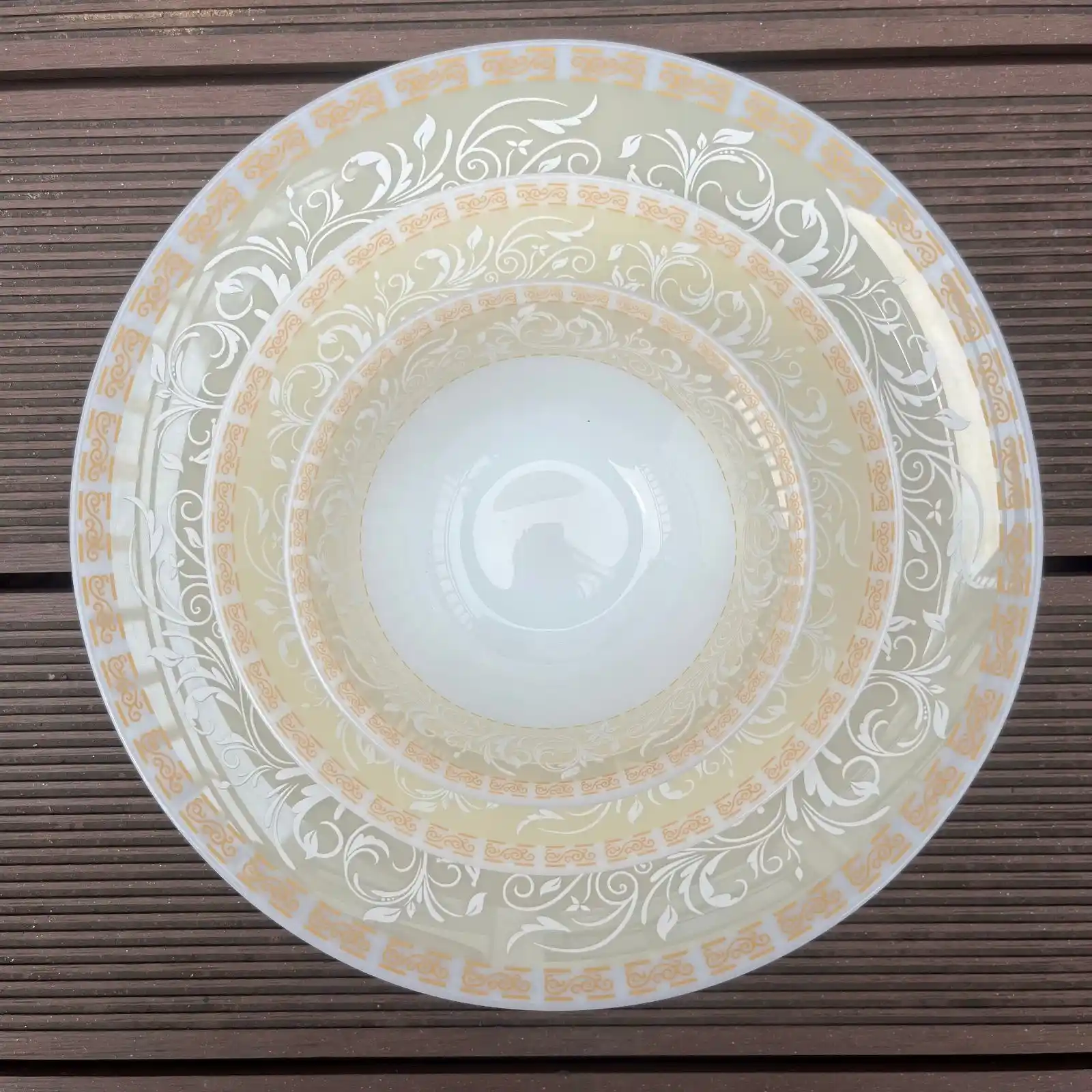
Opal Glass tableware is made from opaque glass. Its smooth white surface resembles ceramic, giving hotel tables the clean, consistent appearance they require without noticeably interfering with the colors of the food. Compared with clear glass, it fits more naturally into Chinese dining, Western dining, and banquet table settings. Compared with standard plastic tableware, its hard surface and sheen also look more appropriate for formal foodservice.
Porcelain Is Best Known for Its Heat Resistance
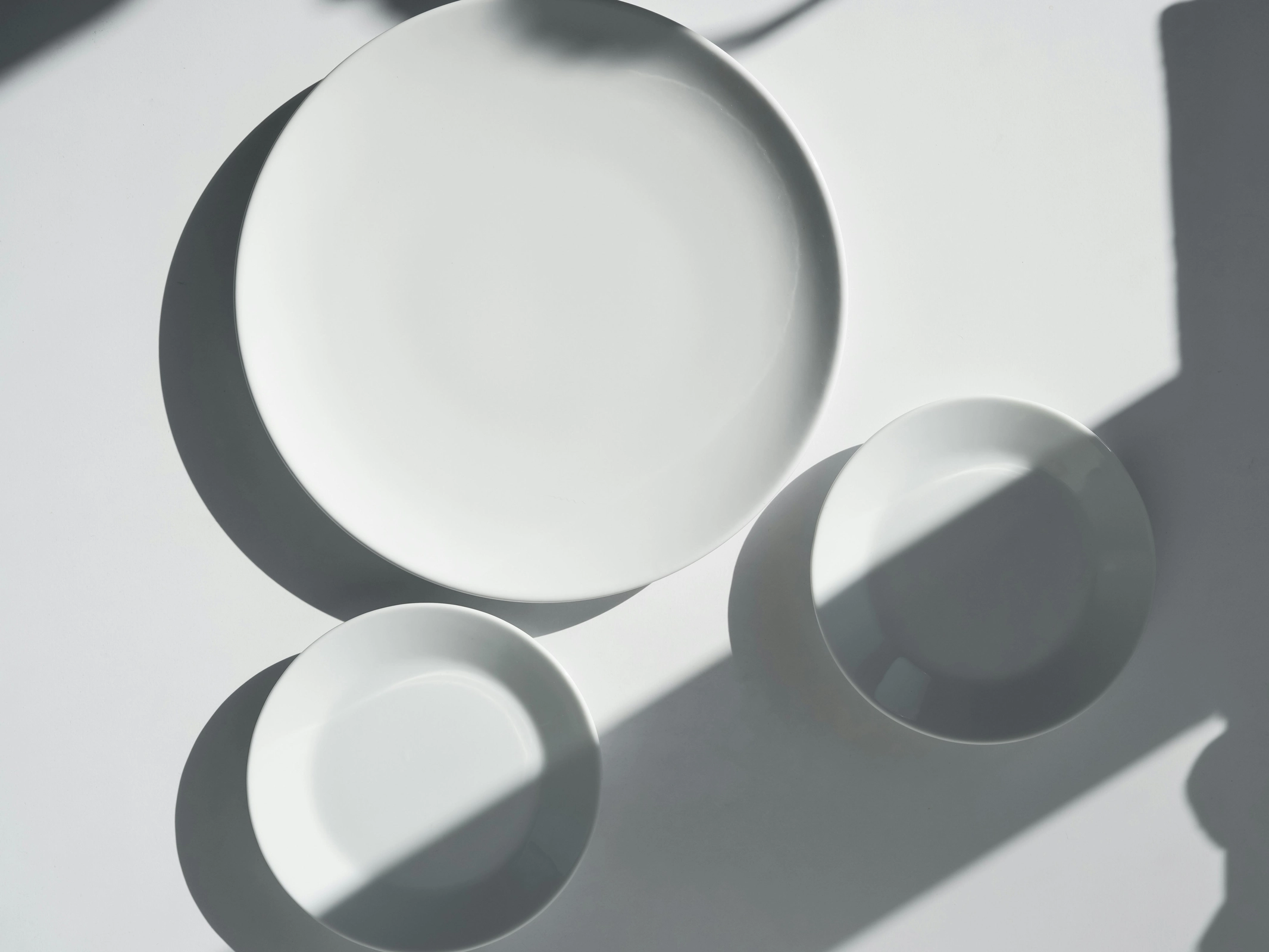
Porcelain is fired at high temperatures, giving its body and glaze good stability under normal foodservice conditions. Properly specified porcelain can hold hot soups, hot dishes, freshly baked foods, and sauces that have just been heated. This is a major reason porcelain plates, bowls, and cups have long formed the core of hotel crockery collections.
Bone China Is Lightweight, Thin, and Refined
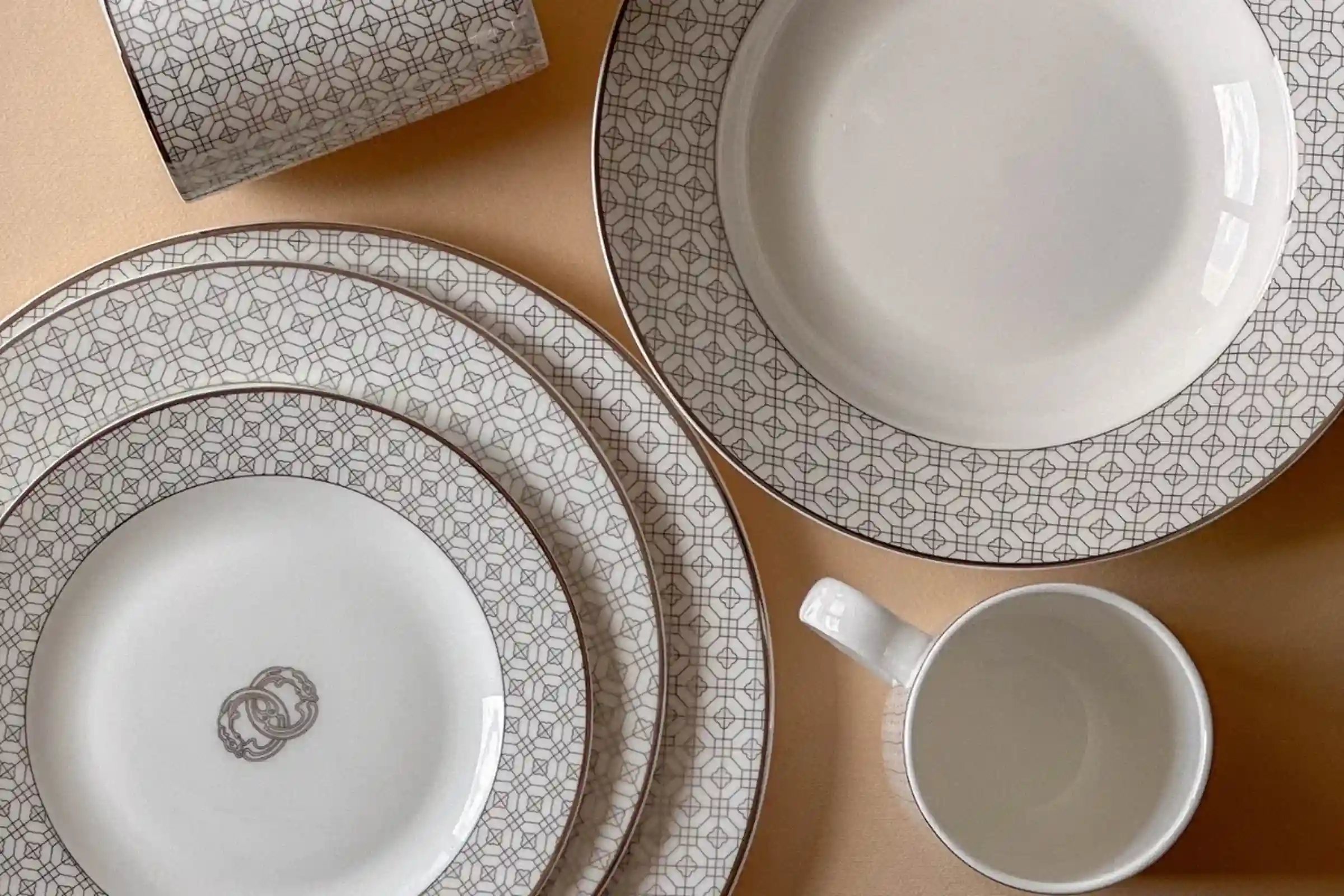
The main advantages of bone china are apparent in its feel and tabletop presentation. Its walls are usually thin, its weight is relatively low, and its surface is refined, with a degree of translucency under suitable lighting. In a formal table setting, plates, bowls, and cups can create a more consistent and sophisticated overall appearance.
Melamine Tableware Is Lightweight and Resistant to Breakage
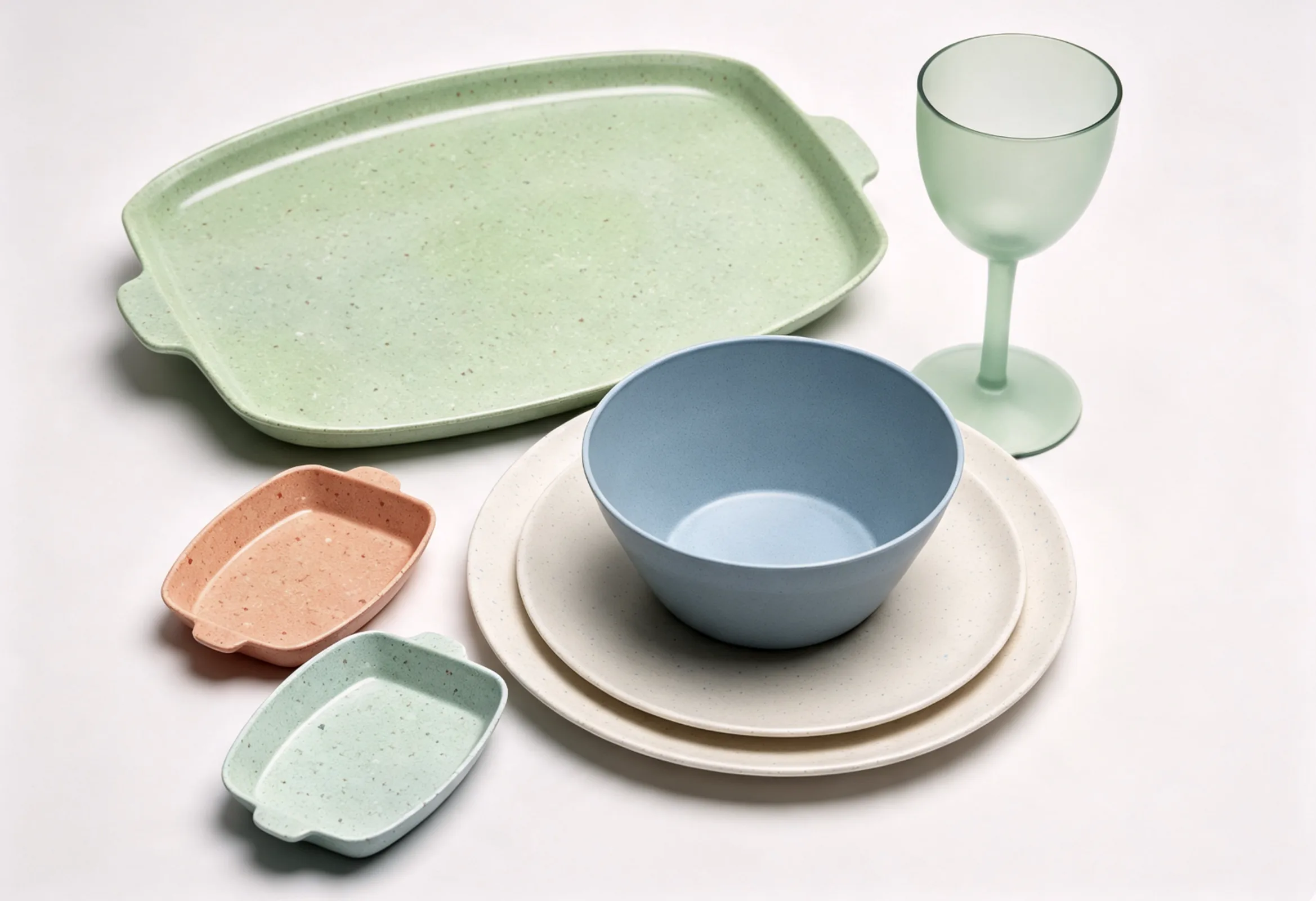
Melamine tableware is lightweight. When staff replenish a buffet, clear many tables at once, or transport tableware for outdoor catering, a load of melamine pieces generally weighs less than the same number of similarly sized ceramic pieces. Under routine impacts or an accidental drop from a low height, it is also less likely than ceramic to break into numerous fragments. This makes it practical for fast-turnover service areas with heavy guest and staff traffic.
Which Settings Are Best Suited to Each Hotel Tableware Material?
Material selection needs to be considered within the actual service process. A piece of tableware that performs reliably in a quiet formal restaurant may reveal problems with weight or impact resistance when moved into an area with frequent guest handling and rapid table clearing. The following sections explain the most typical settings for each material.
Opal Glass Tableware Is Suitable for Beverages, Cold Dishes, and Display Settings
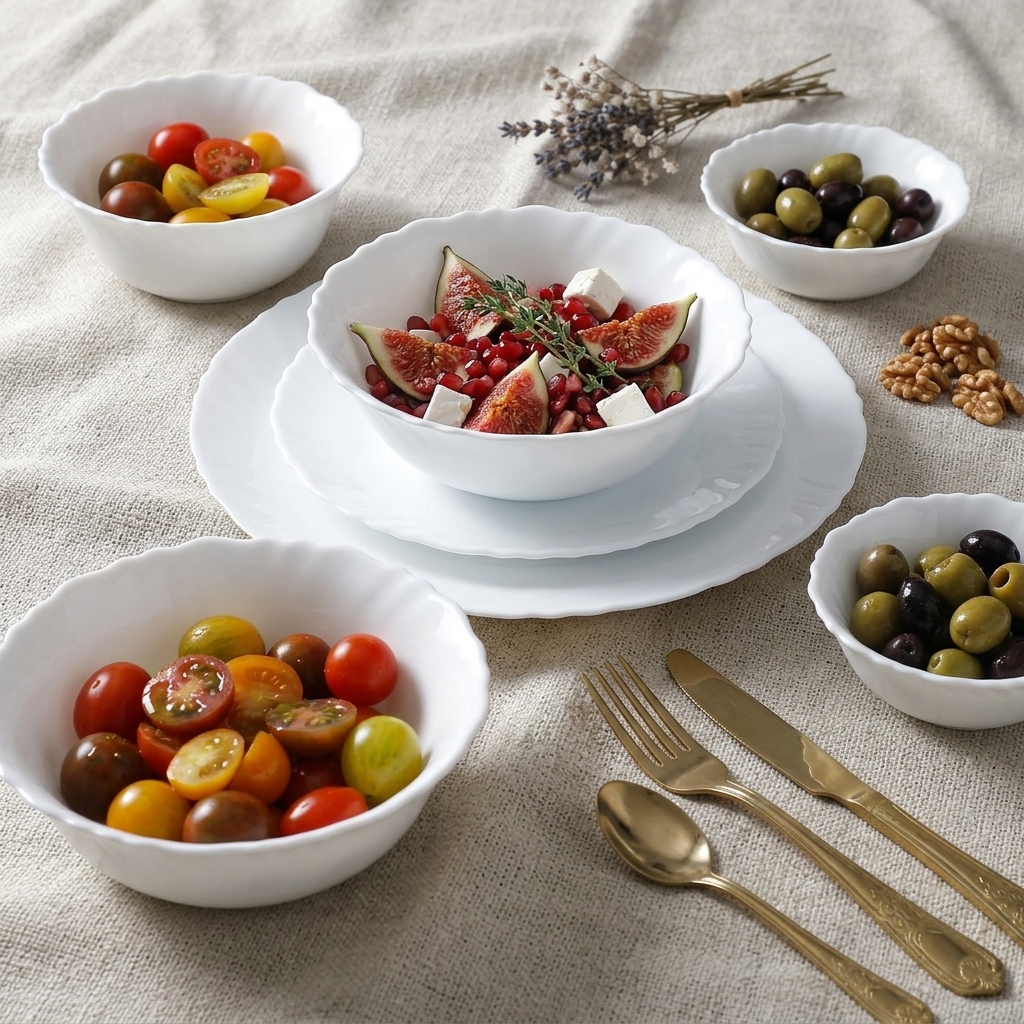
Beverage service, cold dishes, and display settings all depend heavily on color presentation. White Opal Glass provides a clean background for juice, desserts, salads, and cold platters. When the shapes are consistent, pieces also look orderly when arranged in a row. Because the surface is opaque, the color of the tablecloth or buffet counter does not show through beneath the food, giving it an appearance closer to the white porcelain commonly used in hotels.
These areas also involve frequent handling. Cold-dish plates are arranged in large quantities before service, beverage cups and small bowls are continually replenished, and everything must later be collected and washed in batches. Properly strengthened Opal Glass can reduce the risk of rim chipping caused by routine contact, so it is not limited to display use and can also support the demands of regular service turnover.
These three settings are where its advantages are particularly easy to see, but they do not mean that Opal Glass can only be used for cold food. Products that meet the relevant heat-resistance and food-contact requirements can also be used for many hot dishes, staple foods, and everyday dining applications traditionally served in ceramic tableware. Hotels should still base their decision on the heat-use instructions, test documents, and on-site trial results for the specific product.
Porcelain Is Suitable for Chinese Dining, Western Dining, and Everyday Meal Service
Chinese dining requires plates, bowls, soup tureens, and condiment dishes, while Western dining uses main-course plates, soup plates, and dessert plates in several sizes. Porcelain is available in a broad range of shapes, glaze colors, and decorative finishes, making it easier to build a complete collection around the menu. This breadth is practical for hotels that operate both Chinese and Western dining services.
Porcelain can also handle most everyday hot-food applications. Its glazed surface is relatively easy to clean, and menu changes do not require frequent changes to the tableware because of material limitations. Purchasing teams should therefore check whether a chosen collection covers the menu, fits existing dishwasher racks, stacks securely, and will remain available in matching specifications for future replenishment.
For these reasons, hotel restaurants with complex menus, a wide range of required shapes, and relatively stable service routines can generally use porcelain as a core choice. When table turnover is fast and table clearing involves frequent impacts, reinforced porcelain or Opal Glass should also be compared rather than relying on porcelain’s heat resistance alone.
Bone China Is Suitable for Upscale Dining and Formal Banquets
Upscale dining and formal banquets require more than tableware that simply holds food. The feel when a piece is lifted, the proportions of the plate, its color under banquet lighting, and the coordination of the entire table setting all matter. Bone china is thin and lightweight with a refined surface, helping it create a more polished formal dining atmosphere alongside premium linens, glassware, and flatware.
Bone china is particularly suitable when the following needs apply:
- The average check is high, and the tableware must match the quality of the food presentation and service;
- The number of banquet tables is manageable, allowing staff to follow a consistent clearing and sorting process;
- The hotel values a lightweight feel, a refined glazed surface, and the effect of a coordinated table setting;
- The purchasing budget can cover both the initial investment and future replenishment of the same collection.
When banquet turnover is very fast and tableware must be stacked high in large quantities, bone china’s presentation benefits need to be weighed against breakage risk and replacement cost. It suits formal settings because it improves the look and handling experience of the table. Universal durability under every type of impact is not its main advantage.
Melamine Tableware Is Suitable for Buffets and Outdoor Catering
At a buffet, guests collect their own tableware, so pieces are handled frequently and continually move between the buffet counter, return cart, and dishwashing area. Melamine is lightweight, making full stacks easier to replenish. An accidental drop is also less likely to create the same cleanup problem as shattered ceramic, making it suitable for busy serving stations with heavy foot traffic.
Outdoor catering also involves cart transport, uneven ground, and temporary storage. In these conditions, low weight and resistance to routine drops offer direct practical value. Service teams can reduce the total transport load and are less likely to stop service to clear away broken tableware.
However, high outdoor temperatures do not necessarily mean the tableware itself must hold very hot food, and the fact that a dish is served at a buffet does not make melamine suitable for every menu item. Hot soup, hot oil, and foods that must be kept warm should be evaluated separately according to the product instructions. Melamine is best suited to frequent handling and transport. Other heat-resistant tableware may still be required for specific menu items.
How Should Hotels Choose Tableware for Restaurants, Banquet Halls, Buffets, and Room Service?
Purchasing hotel dinnerware by service area is more practical than using one material throughout the entire property. Hotels can maintain a consistent color and style while selecting different materials according to impact frequency, table-setting requirements, and delivery distance in each area.
| Hotel Area | Main Requirements | More Suitable Choice | Reason for Choosing It |
|---|---|---|---|
| Hotel restaurant | Food presentation, coordinated shapes, and formal dining | Porcelain or bone china | Complete collections can match the restaurant’s positioning and menu |
| Banquet hall | Large-scale table setting, rapid clearing, and frequent stacking | Impact-resistant Opal Glass | Balances an orderly appearance with resistance to routine impacts |
| Buffet restaurant | Frequent guest handling, continuous replenishment, and collection | Melamine or thick-walled glass | They respectively prioritize lightweight break resistance and transparent presentation |
| Room service | Cart transport, compatibility with plate covers, and limited space | Securely stackable porcelain or Opal Glass | Must balance hot-food service, transport impacts, and cart dimensions |
Room service requires dimensional testing in particular. Plates must fit service carts, plate covers, and guest-room tables, while cups and saucers need to remain stable as the cart turns corners and crosses thresholds. The complete loaded setup should be tested before selection rather than reviewing the appearance of each piece in isolation.
Hotel Restaurants Should Prioritize Porcelain or Bone China
The central requirement in a hotel restaurant is consistent menu presentation. Plates need enough usable surface for plating, bowls and cups must suit the intended portion sizes, and the complete tableware collection should match the restaurant’s price positioning. Porcelain and bone china are supported by mature ranges of shapes, making it easier to coordinate everything from main courses and desserts to tea service and soups.
The choice between them can be based on four factors:
- Restaurant positioning: Everyday all-day dining restaurants usually place more emphasis on practicality and easy replenishment, while upscale restaurants value a lightweight feel and refined table settings.
- Menu type: When a menu includes many hot dishes and soups and requires complex shapes, porcelain generally offers a wider selection.
- Frequency of use: High-turnover restaurants should pay close attention to the condition of rims, stacks, and surfaces after machine washing rather than judging only new samples.
- Purchasing budget: Bone china usually has a higher initial cost and creates more pressure to maintain matching replacement stock, both of which should be included in long-term budgeting.
Porcelain is therefore better suited to broad, stable everyday service, while bone china is more appropriate for restaurants that emphasize status and a sense of occasion. If a hotel restaurant is also dealing with a high breakage rate, it can include Opal Glass as a comparison sample during trials, but menu compatibility and table-setting style should not be overlooked.
Banquet Halls Should Choose Impact-Resistant Opal Glass Tableware
In banquet halls, the greatest risk of breakage often occurs before and after the meal rather than while guests are dining. Before an event, hundreds of plates must be unpacked, set on tables, and transported in batches. Afterward, staff must clear tables, stack pieces, load racks, and wash everything quickly. Plate rims come into contact with one another far more often than they do in a typical restaurant.
Opal Glass retains the orderly appearance of white tableware. Properly strengthened products generally offer an advantage over standard ceramic when it comes to rim impacts and high-volume turnover, making them suitable for banquet service with many tables and short changeover times. Their practical value comes from providing additional tolerance for unavoidable routine contact. Staff still need to follow proper handling procedures.
Before purchasing, hotels should recreate the full workflow of a banquet: stack the actual quantities required, transport them on existing carts, load them into existing dishwasher racks, and complete repeated washing cycles. If the shape causes unstable stacks or the dimensions do not fit the racks, even a single sample that performs well in isolation should not move directly into large-volume purchasing.
Buffet Restaurants Are Well Suited to Melamine and Thick-Walled Glass Tableware
A buffet has both a guest-facing side and a service side. Guests want tableware that is easy to pick up and stable when set down, while employees must continually replenish, collect, and wash it. Melamine and thick-walled glass solve different problems and work best when assigned to specific buffet stations.
| Area of Use | Recommended Material | Main Reason |
|---|---|---|
| Frequently accessed staple-food, salad, or children’s stations | Melamine | Lightweight and less likely to create many fragments after a routine drop |
| Dessert, cold-dish, and display areas where food color should remain visible | Thick-walled glass | Transparent, with enough weight to remain relatively stable |
| Areas near hot soup, hot oil, or warming equipment | Select separately according to heat-use instructions | Safety requires more than supplier claims of drop resistance or thick walls |
Thick-walled glass offers stability and display value, but it can still break under severe impact or thermal shock. Melamine is lightweight, but its temperature and cleaning restrictions must be followed. Hotels should assign materials according to food-station temperature, guest age, handling frequency, and the collection route rather than equipping the entire buffet with a single type of tableware.
What Should Hotels Check When Evaluating Tableware Durability?
Durability is not a single specification. What hotels actually need is commercial dinnerware that remains stable throughout their established service process: fewer chipped rims, no cracking under normal temperature changes, and an appearance and structure that remain serviceable after repeated machine washing. The following three areas should be tested separately before a bulk purchase.
Check Whether the Tableware Has Strong Impact Resistance
The most common forces applied to hotel tableware come from rims striking one another, carts turning corners, contact with dishwasher racks, and pressure from stacking. Impact resistance cannot be judged by tapping only the center of a plate or checking whether it survives a single drop. The rim, body, and base experience force differently and should be inspected separately.
- Define the test conditions. Record the number of samples, drop height, landing surface, impact location, and number of test cycles so different materials can be compared under the same conditions.
- Inspect the critical areas. Check the rim for chips, the body for visible cracks, and the foot ring for damage.
- Include repeated service cycles. Inspect the pieces again after stacking, rack loading, transport, and washing rather than treating one test result as proof of long-term performance.
- Set rejection criteria. Define in advance whether chipped rims, cracks, loose sections, deformation, or notches that affect cleaning require a piece to be removed from service.
Hotels that need to assess a supplier’s inspection capabilities can review Jointion’s explanation of its Opal Glass tableware quality-control process and ask the supplier to provide the sample quantity, test conditions, and acceptance criteria for the actual product model. Results can only be meaningfully compared when the test process is transparent.
Check Whether the Tableware Can Withstand Heat and Temperature Changes
Hotel tableware moves between hot dishes, chilled foods, wash water, and room-temperature counters. A material that retains its shape at a particular high temperature is not necessarily able to withstand a rapid temperature change. When the temperature difference is too great, the inner and outer surfaces expand or contract at different rates, making existing chips and hidden cracks more likely to spread.
This risk is not limited to laboratory testing. Channel NewsAsia reported on IKEA’s recall of certain plates, bowls, and mugs, stating that the products could break while holding hot food or beverages and create a burn hazard. In the corresponding official recall notice, the U.S. Consumer Product Safety Commission wrote: “123 reports of breakage worldwide, including four reports of injuries.”
The recall applied to specific products made from PLA and should not be used to suggest that Opal Glass, porcelain, bone china, or melamine has the same problem. What it does show is that a durability claim cannot replace testing under hot-food and temperature-change conditions, and that breakage can create secondary risks such as burns.
Hotels should complete high-temperature holding and hot-to-cold transition tests under the conditions specified by the supplier, inspecting for cracks, deformation, and changes to the glaze or surface after each cycle. If the actual workflow includes placing hot food on a cold plate or moving tableware from a high-temperature dishwasher directly onto a cooler counter, those transitions should also be simulated under controlled conditions. The goal is to confirm that the tableware suits the hotel’s own temperature pathway rather than focusing on an isolated maximum-temperature figure.
Check Whether the Tableware Can Withstand Dishwashers and High-Temperature Sanitizing
If a sample looks normal after one machine-washing cycle, that only shows that it passed one wash. Hotel tableware may enter a commercial dishwasher several times a day and face repeated exposure to high-temperature water jets, detergent, rinse aid, and sanitizing programs. The changes that accumulate under these conditions are what determine the useful service life.
Repeated-wash testing should record:
- Whether the surface loses gloss, becomes cloudy, or develops visible scratches;
- Whether colors, decorations, or markings fade or peel;
- Whether rims and bases develop chips, cracks, or rough spots;
- Whether cup handles, joined sections, or thin-walled areas become loose or deformed;
- Whether pieces remain stable in the dishwasher rack or strike one another under water pressure.
Hotels should also check the wash temperature, rinse temperature, program duration, and detergent type used by their existing equipment. A supplier’s dishwasher-safe label may not cover every commercial program. Running a small batch of samples through multiple washing cycles and then inspecting their appearance and structure turns a one-time sample review into a more useful assessment of service-life performance.
Ultimately, the name of the material alone does not determine whether tableware is durable enough for a hotel. Opal Glass offers a balance of ceramic-like appearance, resistance to routine impacts, and cost. Porcelain suits restaurants that need a broad selection of shapes and reliable hot-food service. Bone china prioritizes formal presentation and a lightweight, refined feel. Melamine is better suited to lightweight applications with frequent handling. By testing each material through actual table-setting, transport, washing, and replacement workflows, hotels can select tableware that fits their service positioning and remains reliable through long-term use.