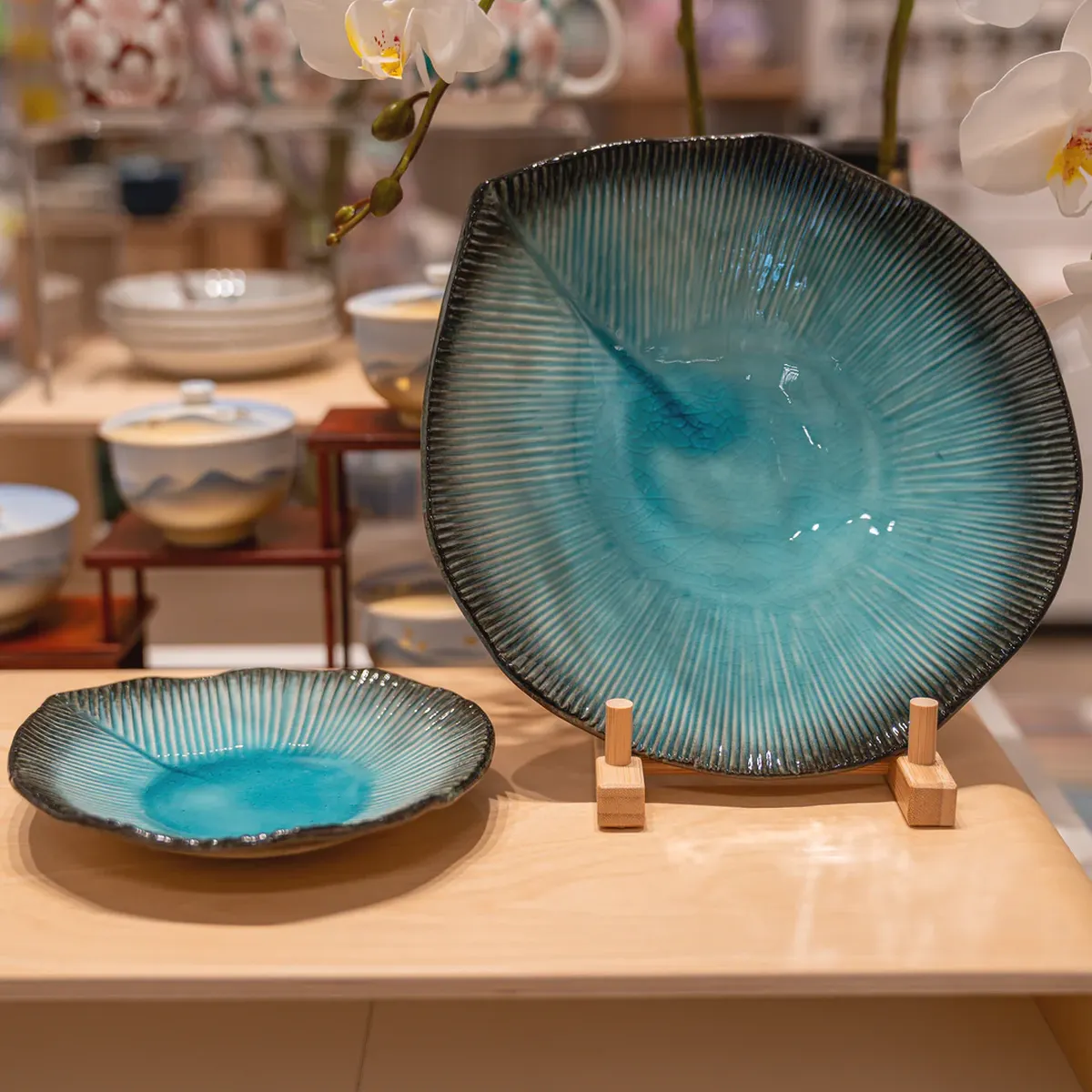
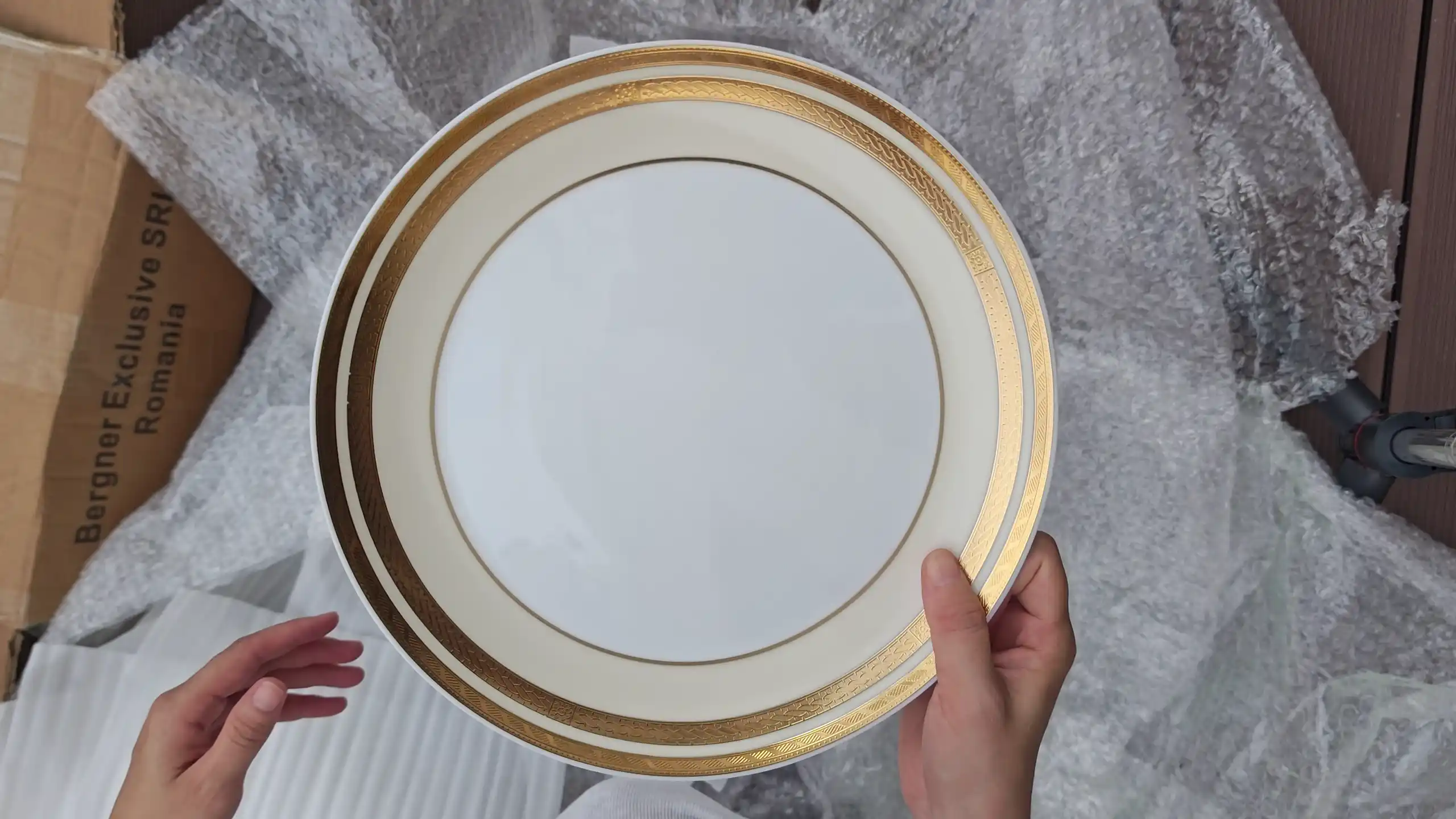
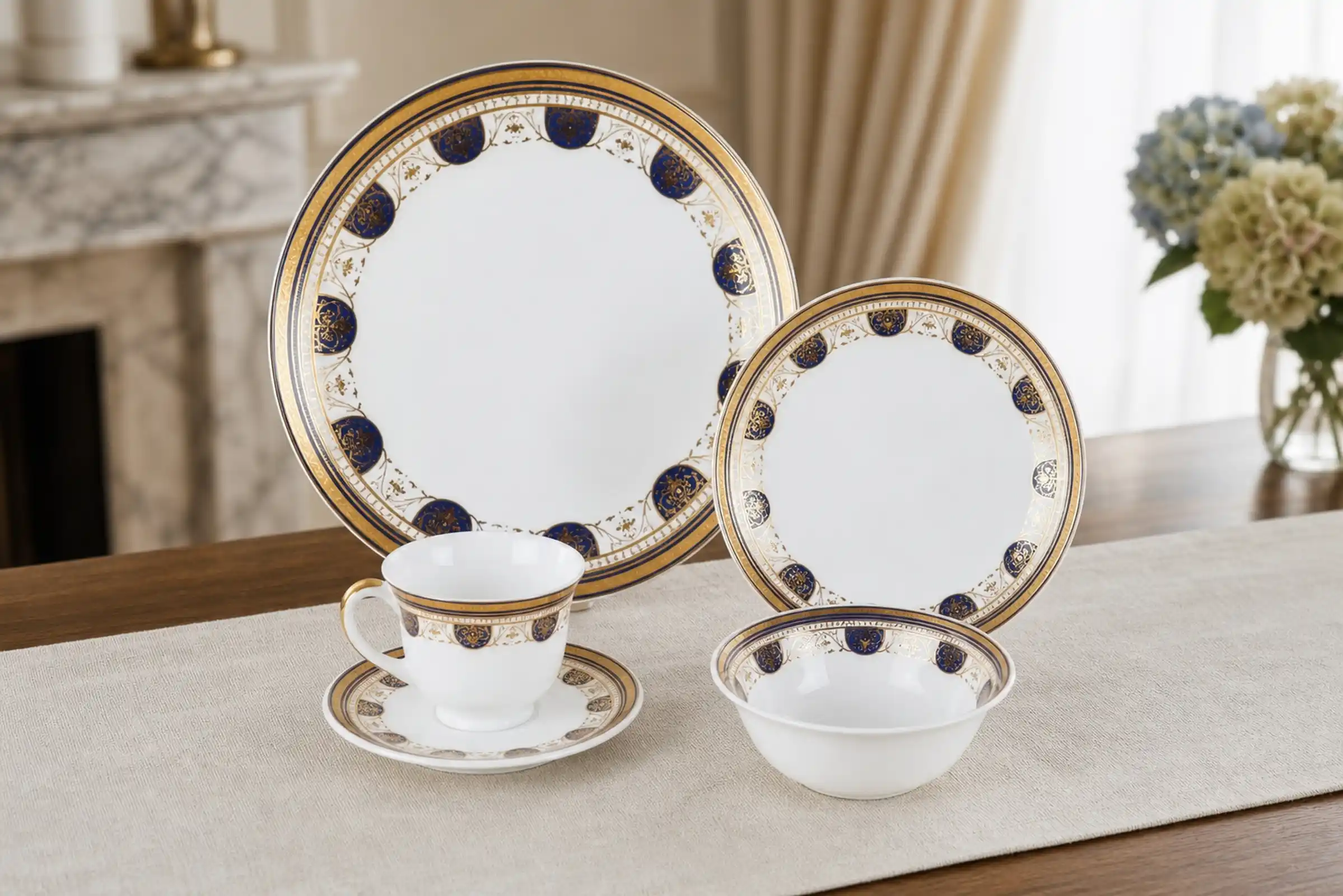
⚡Short note: Colored ceramic glazes carry hidden food-contact risks; opal glass avoids these entirely thanks to its one-piece construction.
- Surface glaze dependency: Colored ceramics rely on an outer glaze for both color and sealing — a layer that gradually wears down with extended use.
- Substance migration: An unstable ceramic glaze can allow trace amounts of heavy metals to leach into food during normal, everyday use.
- One-piece construction: Opal glass is formed as a single, uniform material with no added glaze layer, making it inherently stable for food contact.
- Consistent condition: Opal glass retains its original properties through frequent daily washing and regular use over time.
The Hidden Risk in Your Colored Ceramic Dishes
The real, often overlooked risk with colored ceramic tableware has nothing to do with whether something is “ceramic” — it comes down to whether the surface glaze is structurally stable and whether it holds up over time. This is why some colored tableware remains perfectly fine for years while other pieces start raising red flags after a while: the difference isn’t the color itself, but whether the surface layer that carries that color is reliable.
In conversations about food-contact safety, the focus typically falls on whatever surface is actually touching the food. The U.S. Food and Drug Administration (FDA) explicitly states that “Lead may be present in the glazes or decorations covering the surface of some traditional pottery.” (relevant regulatory statement) The point isn’t to cause alarm — it’s a reminder that when evaluating risk, what matters is the glaze and decorative layer, not simply whether something is labeled “ceramic.”
To be direct about it, the hidden risks of colored ceramic tableware unfold across four progressive levels:
- Color stays on tableware surfaces because of a glaze or decorative layer — there’s no other way to put it there.
- Once the risk is concentrated in that surface layer, safety is no longer just a “material question” — it becomes a question of whether that layer remains stable.
- If manufacturing falls short, substances that should be locked within the glaze can migrate into food during normal use.
- Even a product that passes safety standards at the factory doesn’t stay in factory-fresh condition forever — wear, aging, and surface changes over time make these risks increasingly hard to assess by eye.
The first level explains why colored ceramics get flagged for “hidden risks” in the first place: color doesn’t just appear on its own — it has to be bonded to the surface somehow. For colored ceramics, that means glazes or surface decorations handle the color, the sheen, and the decorative effect all at once. In other words, what people use every day isn’t just a “colored bowl” — it’s a layered structure that handles color, surface protection, and food contact simultaneously. When that layer is stable, it’s simply part of the appearance. When its stability is in question, it stops being decorative and becomes the most critical variable in everyday safety.

The second level matters more than the first because it shifts the conversation from “material safety” to “structural safety.” Many people instinctively assume that ceramic, being a high-temperature fired material, must be inherently stable — and that’s partially true. But what makes repeated contact with food is not just the inner body; it’s the outermost surface layer that gets used, cleaned, heated, and filled day after day. If the risk is concentrated there, the standard of judgment has to shift: the question is no longer “is it ceramic?” but “can this surface layer stay stable under real-world conditions?” This is why some colored ceramic products hold up fine for years, while others raise concerns — whether due to unclear sourcing, inconsistent craftsmanship, or visible changes in surface condition.
The third level gets to the heart of what users actually want to know: why does “manufacturing quality” directly determine risk level? The same FDA statement makes the logic clear: “If the pottery is not manufactured properly, this lead can leach into food and drink.” This is a critical point. It’s not that having a glaze layer is automatically a problem — it’s that if the manufacturing process doesn’t produce a sufficiently stable surface structure, the substances that should stay locked in that layer can be released when it contacts food. In other words, the real dividing line isn’t “glazed or unglazed” — it’s “stable or unstable.”
The fourth level is the most overlooked, yet it’s the closest to everyday reality: even a product that passes standards at the time of purchase doesn’t stay that way. Tableware gets washed repeatedly, scraped, and filled with all kinds of food over its lifetime. Subtle surface changes often don’t show up as cracks or obvious damage — which is exactly what makes them easy to miss. The color might still look vivid, the surface might still feel smooth, and everything might appear fine — but what’s genuinely hard to assess is whether the surface structure underneath that intact-looking exterior is still as stable as it once was. The most insidious aspect of this risk isn’t that it happens suddenly — it’s that it may quietly become harder to evaluate as use continues, without any visible warning signs. If you’re already thinking about materials that sidestep glaze-stability concerns entirely, the Opal glass tableware guide offers a thorough look at opalware’s structural properties, practical applications, and what to look for when sourcing it.
This is also why certain colors come up repeatedly in safety advisories. The FDA specifically calls out products “brightly decorated in orange, red, or yellow color” (from the same regulatory statement). The point isn’t that those colors are inherently dangerous — it’s that the more a product leans on vibrant surface decoration and eye-catching color effects, the more reason there is to scrutinize its surface structure rather than taking its “ceramic” label at face value. The more striking the color, the more naturally consumers focus on the aesthetics — but from a practical standpoint, that’s exactly when it’s worth asking: is the surface layer holding those colors together actually stable?
It’s Not the Bowl — It’s the Glaze
The reason colored ceramic tableware raises safety concerns isn’t the ceramic body itself — it’s the colored glaze layer on the surface.
After high-temperature firing, the ceramic body primarily provides structural support: it holds the shape, bears weight, and handles basic heat resistance. What actually determines the food-contact experience is the outermost layer. The colors people see, the smoothness they feel, and the surface that touches their food — nearly all of that comes from the glaze, not the ceramic body underneath. Because of this, any honest discussion of colored ceramic tableware safety can’t stop at “is it ceramic?” — it has to go further and ask “is the glaze on that ceramic stable?”
To put it plainly: the concern with colored ceramic tableware isn’t the bowl — it’s the colored glaze that handles both color and surface isolation.
- The ceramic body itself is generally quite stable and isn’t the main source of risk.
- Color effects come from the glaze, which means the glaze is what’s actually in sustained contact with food.
- When glaze formulation, firing conditions, or structural integrity fall short, problems originate in that layer first.
- So when evaluating whether colored ceramic tableware is a concern, the question isn’t about the bowl body — it’s about whether the glaze can hold up over time.
Start with the first point: the ceramic body is generally stable and isn’t the primary risk factor.
This matters because it clears up the most common misconception. When people hear “colored ceramic tableware carries risks,” many instinctively blame the word “ceramic” — as if the material itself is the problem. It isn’t. Once fired at high temperatures, the ceramic body has a relatively stable structure; its job is to provide shape and strength, not to determine surface contact safety. The thing worth scrutinizing isn’t the hard inner core — it’s the layer that sits on top of it. Once that’s clear, the rest of the analysis stays on track.
The second point narrows the focus from there: since the color effect comes from the glaze, the glaze is what actually contacts food over time.
Given that the ceramic body isn’t the concern, the logical next question is: what is the food actually touching every day? Not the body — the glaze. The blues, greens, reds, and blacks on colored ceramic tableware aren’t natural properties of the ceramic material; they’re the result of a surface glaze designed to produce those color effects. When someone serves soup, fruit, or a hot dish, that food is in direct contact with this layer. From the standpoint of “what actually touches food,” the glaze is the real object of scrutiny. Practically speaking, people aren’t using bare ceramic — they’re using ceramic wrapped in glaze.

The third point explains why the glaze is also the most likely starting point for problems when things go wrong.
This isn’t just repeating “the glaze matters” — it’s explaining why the glaze is more failure-prone. A glaze layer doesn’t just carry color; it also handles surface sheen, moisture resistance, and isolation functions. That’s a lot of responsibility, and it raises the bar for manufacturing precision. If the formulation isn’t dialed in, or if firing temperature, duration, or uniformity aren’t ideal, the resulting glaze surface may not be as fully stable as it needs to be. When the product is new, this often isn’t visible — it may look glossy, flat, and perfectly sellable. But repeated thermal cycling, contact with acidic foods, utensil friction, and frequent cleaning will continuously stress that surface layer. The first signs of trouble tend to appear there, not in the ceramic body — through glaze aging, wear, or gradual structural breakdown.
The fourth point is the logical conclusion that follows from the first three: when judging whether colored ceramic tableware is a concern, focus on whether the glaze can maintain stability through long-term use.
Strip out the ceramic body, identify the food-contact layer, understand why that layer is more susceptibility to change — and the evaluation standard becomes clear: what users should actually pay attention to is whether the colored glaze holds up through sustained use. A piece of tableware looking fine in the short term doesn’t guarantee it’ll look — or perform — the same way indefinitely. What really counts is whether the glaze layer maintains a complete, uniform, stable surface after repeated use. Only when that’s true do the concerns around colored ceramic tableware genuinely go away.
The logic throughout this section is straightforward: first separate “ceramic body” from “surface glaze,” then work through who actually contacts food and which layer is more prone to change — and the conclusion follows naturally. The concern with colored ceramic tableware isn’t the bowl. It’s the glaze.
Technical Comparison: Colored Ceramic vs. Opal (Milk) Glass Tableware
| Key Technical Aspect | Colored Ceramic Tableware | Opal (Milk) Glass Tableware |
|---|---|---|
| Surface Structure | Relies on an additional glaze/decoration layer on the ceramic body; the glaze is responsible for color presentation and surface isolation | Integral structure without additional glaze layer; color and texture come from the homogeneous material itself |
| Primary Risk Source | Instability of the surface glaze layer (potential migration of substances if manufactured improperly or worn out after long-term use) | No glaze-related risks; structural stability is derived from the inherent properties of the monolithic glass material |
| Long-Term Stability | Prone to subtle wear, aging and structural loosening of the glaze layer after repeated use, leading to uncertain safety risks | Consistent performance after long-term use; no gradual degradation of surface protective layers due to integral material structure |
| Cleaning Characteristic | May require extra cleaning steps for heavy oil/stain foods; visual residual marks may remain on the glaze surface after cleaning | Easy to clean for heavy oil/stain foods; smooth integral surface reduces residual marks and simplifies cleaning process |
| Material Integration | Separate structure (ceramic body + glaze layer); performance depends on the bonding stability of the two layers | Monolithic material structure; performance is determined by the uniform physical and chemical properties of opal glass |
Why Opal Glassware Has No Glaze to Worry About
As more consumers move away from colored ceramic tableware, the hesitation they face usually isn’t about changing how their table looks — it’s a more practical question: can the surface glaze on ceramic tableware really be trusted over the long haul? Colored ceramics invite this concern because their color, sheen, and surface protection all depend on the glaze layer. Once users start thinking about stability through repeated use, frequent washing, and high-volume contact, the glaze stops being “just part of the craftsmanship” and becomes the central factor in the purchasing decision.
Opal glass offers reassurance for a completely different reason — not because it has a thicker or more robust surface coating, but because it doesn’t rely on a glaze layer at all. Rather than forming a substrate and then applying a surface treatment to achieve the desired effect, opal glass integrates its characteristic appearance, dense surface, and durability requirements directly into the material as it’s formed. The result is that the concern users have about glaze stability simply has nowhere to take root.

This also means that when friction, washing, or heavy use occurs, there’s no pathway for “surface degradation affecting safety.” If you’re more interested in the food-contact safety profile of this material in actual use — rather than just the structural point about having no glaze — Is opal glass safe to use covers that in depth.
The reason opal glass has no glaze layer to worry about isn’t that it skips a manufacturing step — it’s that the material structure never creates a risk layer that requires ongoing monitoring in the first place.
- There’s no extra protective coating on the surface — the entire piece is a stable, unified structure.
This changes the basis of evaluation entirely. With ceramic tableware, trustworthiness often hinges on a question: “Is the surface layer still intact, still stable, still the same as when it was new?” With opal glass, safety doesn’t depend on a separate outer layer, because there isn’t one to monitor independently.
At a deeper level, this distinction affects not just the name of a manufacturing process, but the nature of long-term trust. Any product whose key performance relies on a coating will naturally invite concern about how that coating holds up over time. When a product is instead formed as a unified material system, the question shifts from “how long will the surface layer last?” to “what is the overall structure — and will it stay that way?” This is why opal glass tends to feel more straightforwardly reassuring: what it reduces isn’t surface decoration, it’s the ongoing uncertainty of having to assess a separate surface layer. - Its appearance isn’t applied after the fact — so risk doesn’t compound with surface changes.
Many people, when they hear “no glaze layer,” interpret it simply as “one fewer surface treatment.” But the more significant point is this: when a product’s color, sheen, or integrity depends on its outer layer, then what users find visually appealing and what users worry about safety-wise are coming from the same place. The more prominent that surface layer is, the more unsettling it becomes when that surface starts to change.
Opal glass doesn’t work this way. Its characteristic milky appearance comes from how the material itself is formed — not from a finish applied on top. This makes its logic fundamentally more stable than colored ceramics: it isn’t a substrate that gets modified by an outer layer to achieve the desired look — the inside and outside of the material are consistent throughout. Because of that consistency, users see the product maintaining its inherent condition after extended use, rather than watching an outer coating gradually diverge from what’s underneath. - There’s no chain reaction of “surface ages first, then doubts follow.”
For many users, what’s genuinely unsettling isn’t obvious damage — it’s the invisible but unavoidable changes that accumulate over time: subtle wear from repeated scrubbing, gradual loss of sheen after years of use, small changes around the edges. These things tend to feel concerning precisely because they happen at the surface first, and the surface is the most critical component of a ceramic glaze layer.
Opal glass doesn’t have this chain. Because there’s no outer layer that needs to be monitored for changes, daily use doesn’t naturally evolve into a habit of “check the surface first, then question everything else.” With colored ceramics, the concern often isn’t a single incident — it’s a gradually accumulating sense of uncertainty. Opal glass cuts that accumulation off at the source. Since its appearance isn’t carried by an outer layer, there’s no mechanism for “surface changes first, then rising doubt” to play out. - As a result, long-term and high-frequency use tends to build sustained confidence rather than erode it.
This is why opal glass gets particular attention from household users, foodservice buyers, and hotel procurement teams. High-volume use environments don’t just test whether a product looks good when new — they test consistent performance through repeated washing, stacking, handling, and sustained food contact. Any product that requires users to periodically check whether a surface layer is still holding up adds a quiet psychological cost to every use cycle.
Opal glass eliminates that cost upfront. Users don’t need to track whether the surface has entered a new phase, or periodically reassess whether their initial confidence is still warranted. The progression through the points above all leads here: unified structure with no dependence on a separate outer layer; appearance that isn’t applied after the fact; no mechanism for surface-first degradation leading to broader doubt; and, in practice, a foundation for stable long-term trust. This isn’t just a claim about “having no glaze” — it’s an explanation of why the absence of a glaze layer genuinely reduces concern in use.
Most people who switch from colored ceramics to opal glass aren’t doing so because they’ve lost interest in color — they’re doing it because they’ve come to care more about something more fundamental: whether a dish’s sense of safety comes from a surface treatment or from the material itself. When it’s the former, use comes with ongoing second-guessing. When it’s the latter, the choice feels natural.
What It’s Actually Like Using Milk Glass Dinnerware Every Day
Using milk glass dinnerware every day doesn’t just mean “the table looks whiter” — over time, you start to notice something more specific: it quietly eliminates the small, easy-to-overlook friction points that tend to accumulate with everyday dining.
The day-to-day experience of milk glass tableware moves through distinct stages — from “it looks cleaner” to “it’s easier to use” to “it stays that way.”
- The first thing you notice: every meal looks cleaner.
The most immediate impression, especially in the beginning, is visual tidiness. Milk glass tableware has a stable, neutral color that doesn’t compete with or distort the appearance of food the way colored ceramics sometimes do — through background color, surface patterns, or glaze reflections. Whether it’s a simple breakfast, a home-cooked dinner, or a dish with deep, rich colors, the overall table presentation tends to feel more composed.
But this isn’t purely an aesthetic point. It also means the tableware isn’t interfering with how the food looks — what you’re seeing is the actual color and condition of the dish, not a visual impression shaped by the tableware around it. Over time, this consistency creates an intuitive baseline: this set always looks clean, and the dining table tends to feel more put-together as a result. - The second shift: cleaning becomes noticeably easier.
Once visual cleanliness becomes the norm, the next thing that stands out is how much easier cleanup has gotten. With many colored ceramic pieces, heavy or deeply pigmented foods — tomato sauce, curry, oily dishes — tend to prompt a second pass, or at least a lingering sense that the plate isn’t quite clean even after washing. Sometimes there’s a visual dullness that makes the piece look worn even when it isn’t dirty.
With milk glass, that burden drops considerably. The surface is more uniform, which makes rinsing and scrubbing after saucy or greasy meals noticeably more straightforward. The real value here isn’t the few seconds saved — it’s the elimination of uncertainty from the process. There’s no need to keep checking whether a residue is still there, or wondering whether the plate is going to look dull again tomorrow despite being clean today. Cleaning stops being something to second-guess and becomes something you just do. - The third change, which takes longer to appreciate: it holds up consistently over time.
Looking good and being easy to clean would be compelling on their own — but neither is enough to sustain a genuine switch if the quality degrades quickly. What actually makes people stay with milk glass is that it doesn’t.
This is the most underrated aspect of daily use: the advantage isn’t that it’s remarkable on day one — it’s that pulling it out three months or six months later, it still has that same clean, uniform, composed look. A common problem with tableware isn’t how it performs when new; it’s what happens after sustained use — surfaces that start looking increasingly worn, uneven condition across a matching set, a creeping sense that old and new pieces no longer belong together.
Milk glass minimizes that drift. The visual consistency and easy cleanup from the earlier stages don’t fade — they extend into long-term stability. Gradually, it becomes clear that the experience isn’t just good for one meal; it’s good for many meals in a row, with no new problems emerging in between. - The end result: genuine peace of mind with daily use.
When tableware is visually consistent, easy to clean, and holds up well over time without noticeable decline, what eventually develops isn’t just “convenience” — it’s a quiet, practical confidence.
That confidence isn’t abstract. It comes from accumulated daily confirmation: you don’t have to inspect it when you take it out of the cabinet; you don’t have to wonder whether cleaning actually worked; you don’t run into that creeping uncertainty of “something about the surface has changed, but I can’t quite say what.” The reassurance is built through repetition — being fine once doesn’t mean much, but being consistently fine over a long stretch of time does.
All the earlier stages feed into this one: looking cleaner makes cleaning easier; easier cleaning extends into long-term consistency; long-term consistency becomes the everyday confidence that’s hard to put into words until you’ve had it for a while.
So what daily use of milk glass dinnerware actually involves isn’t a single material advantage — it’s a compounding improvement in everyday experience. It doesn’t rely on one strong selling point; it systematically reduces the most common friction points in tableware use: the visual, the functional, and the long-term.
This is also why many people who started with colored ceramics don’t just view the switch to milk glass as an aesthetic upgrade. They experience it as a shift in daily habits — because the problems it solves aren’t isolated incidents. They’re things that would have come up again, and again, and again.
Key Feature Highlight
This set of opal glass dinnerware belongs to the tempered opal glass category, and it is a type of lead-free glass tableware that fits daily dining scenes. The smooth texture and uniform structure of milk glass dishes match the stable performance of the material system.
Frequently Asked Questions (FAQ)
1. Is lead the only harmful substance that may leach from colored ceramic tableware glazes?
No, lead isn’t the only potential concern. Depending on the glaze formulation and manufacturing process, other heavy metals such as cadmium may also be present in the glaze layer. If that layer is unstable — due to improper firing or wear over extended use — these heavy metals can potentially migrate into food or beverages. That said, it’s worth noting that compliant colored ceramic tableware produced to standard manufacturing specifications has minimal migration of such substances and meets established food-contact safety requirements.
2. Does opal glass tableware have any limitations compared to colored ceramic tableware in practical use?
Yes, there are some trade-offs worth knowing about. On the aesthetic side, opal glass can’t replicate the rich decorative variety of colored ceramics — intricate patterns and vibrant color gradients, for instance — because its appearance is determined by the material’s inherent properties rather than surface glaze decoration. It’s also worth noting that opal glass tends to be heavier than some lightweight ceramic options, which may matter for users who prefer lighter pieces. That said, in terms of long-term stability and ease of cleaning, opal glass holds a clear advantage.