
Opal glass dinnerware is everywhere now — restaurants, hotels, family kitchens. But most people picking up a milky-white plate aren’t thinking “nice design.” They’re thinking: “What makes it white? Is it actually safe to eat off?”
This article tackles one question: is opal glass food safe for everyday use? We’ll go through it step by step — where the white color comes from, what happens with hot and acidic food, whether it contains harmful substances, what safety standards actually mean, and how to tell a good product from a bad one.
Will Harmful Substances Leach from Opal Glass into Food?
This is the core opal glass food safety question. To answer it, we need to start with where the white color comes from — and whether those ingredients could migrate into your food.
The White Color Isn’t Dye — It’s Light Scattering
Opal glass starts with the same base as regular glass: silica, soda ash, and limestone. The difference? A small amount of opacifier — usually calcium fluoride or phosphate compounds — is added during production.
At melting temperatures above 1500°C, these opacifiers fuse completely with the glass, forming tiny crystalline particles distributed evenly throughout. When light hits these particles, it scatters — and that’s what creates the soft, milky-white look.
The white is a physical effect, not a chemical one. No pigment. No coating. No surface paint.
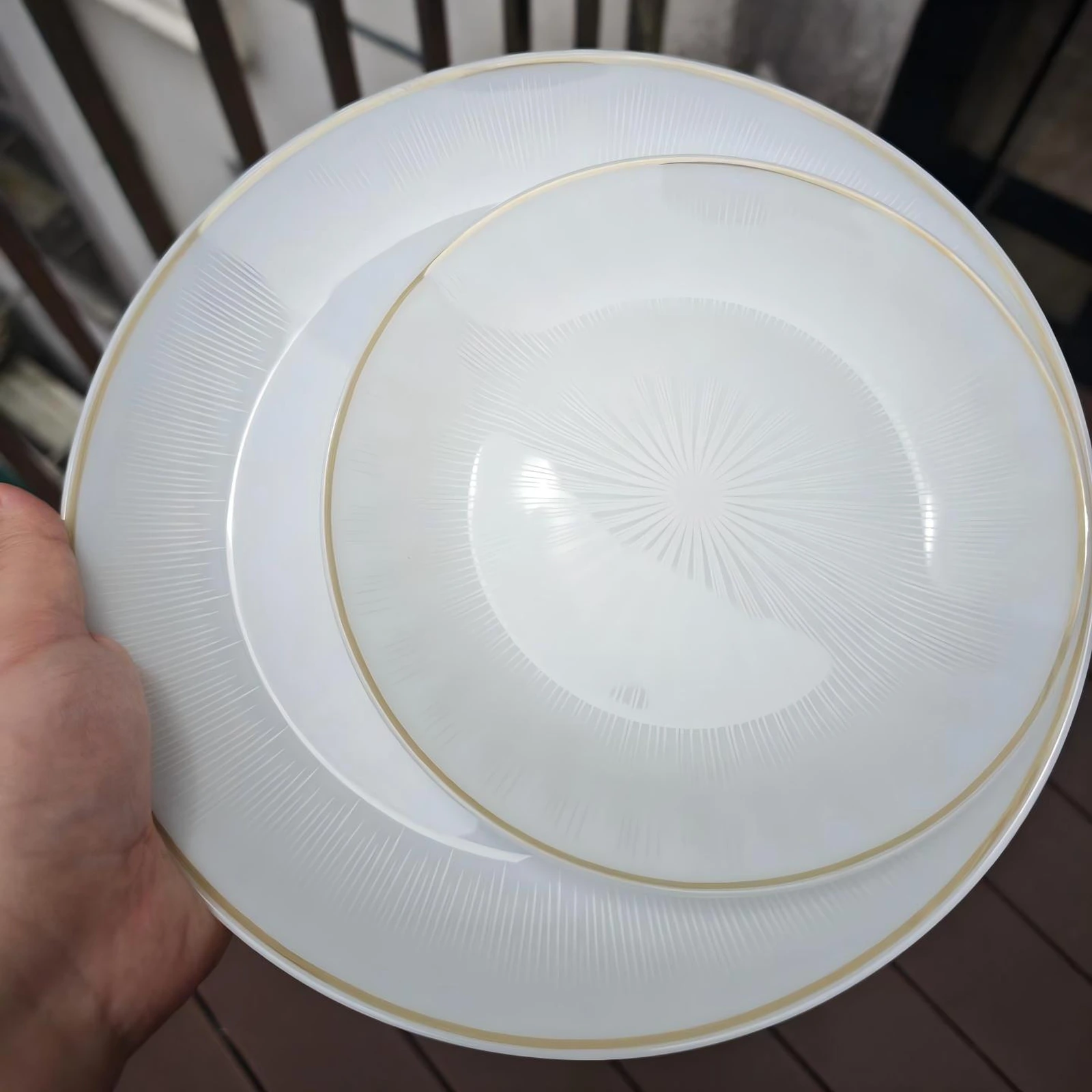
Some traditional ceramic glazes use metal oxides like lead, cadmium, or cobalt to get their colors. Opal glass works differently. The white comes from the material’s internal structure, and no heavy metals are needed in the process. So the color itself isn’t a food safety concern at all.
For a broader look at how opal glass holds up as everyday dinnerware, see this guide: is opal glass good for dinnerware.
No Glaze Means No Peeling, No Leaching
OK, so the white color is safe. But opacifiers are still in there. Over time, could they slowly seep into food?
Short answer: no.
At 1500°C+, calcium fluoride and phosphates react with silica and form stable covalent bonds. They become permanently locked into the glass network. This isn’t mixing — it’s molecular-level fusion. The resulting compounds won’t break apart under normal conditions.
Structurally, opal glass is one solid piece from surface to core. No coating. No glaze. Ceramic dinnerware, by comparison, uses a “body + glaze” structure. If that glaze cracks or wears down, the body underneath can become exposed to food. Opal glass doesn’t have this problem — there’s no second layer to crack or peel.
This single-layer, inert structure is a key reason the FDA classifies glass as “GRAS” (Generally Recognized as Safe). The European Container Glass Federation (FEVE) has noted that glass is the only widely used food packaging material with FDA GRAS status. So when people ask is opal glass toxic — based on this structure, the answer is no.
Is Opal Glass Safe for Hot Soup and Acidic Food?
The material checks out. But daily life gets more specific. Hot soup straight from the stove — will it cause anything to leach? Tomato sauce sitting in a bowl for hours — will it eat into the surface?
One question is about heat. The other is about acid. Let’s take them separately.
Hot Food Won’t Affect Opal Glass Safety
Lab tests show opal glass stays chemically stable below 300°C. No breakdown, no gas, no substance migration. That makes opal glass safe for hot food — and not just barely safe.
Here’s what everyday food temperatures actually look like:
| Scenario | Typical Temperature |
|---|---|
| Hot soup (just served) | 80–95°C |
| Freshly cooked stir-fry | 70–90°C |
| Food after microwave reheating | 60–85°C |
| Hot coffee or tea | 65–80°C |
The hottest item on that list is 95°C. The stability threshold is 300°C. That’s a gap of over 200 degrees — not tight, but massive.
In short, normal hot food doesn’t come close to the temperature range where opal glass would undergo any chemical change.
Vinegar, Lemon Juice, Tomato Sauce — Also Not a Problem
Heat is settled. But acid is where people worry more — and honestly, it’s a fair concern. Vinegar, lemon juice, tomato sauce, pickle brine. These touch dinnerware daily.
A widely cited PubMed study (Sinha, 2007) exposed glass dinnerware to five common food acids, including acetic acid and citric acid, then measured lead and cadmium migration. Trace amounts were detected.
But context matters. First, the test included old-style glassware with lead in the formula — not modern opal glass. Second, the soaking conditions (acid concentration and duration) went far beyond real-world use. Nobody pours undiluted vinegar on a plate and leaves it for dozens of hours. (Full study data: PubMed — Sinha, 2007.)
For modern opal glass with no lead or cadmium in the formula, migration under everyday acid exposure stays well below international safety limits.
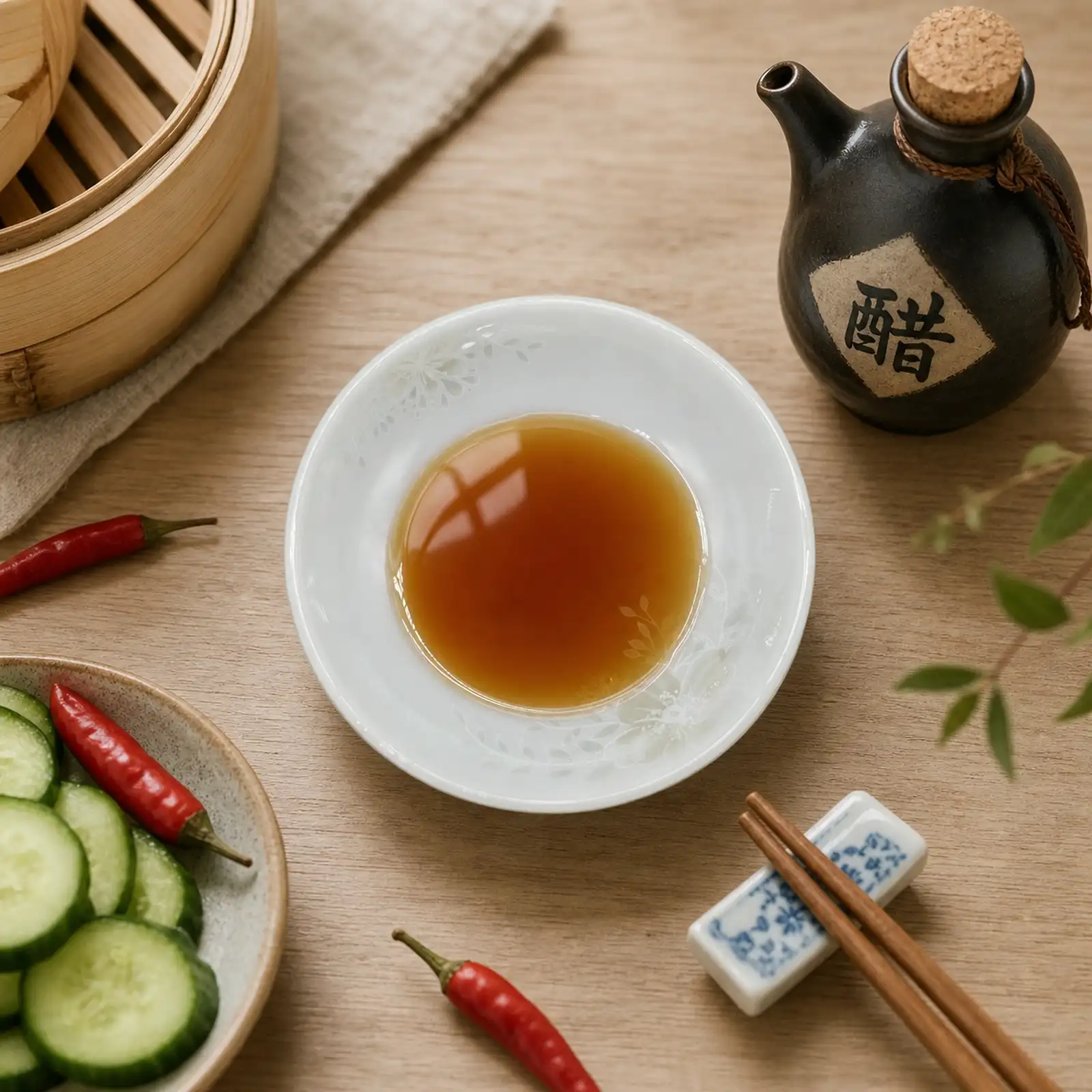
There’s a structural point here too. Some ceramic dinnerware with heavy-metal glazes has a documented risk: acid slowly erodes the glaze, accelerating metal leaching. Opal glass has no glaze. Food touches the glass body directly. The pathway of “acid eats through a coating to reach something harmful” doesn’t exist.
We have a client running a fast-casual chain who’s been serving vinaigrette salads and pickled sides in opal glass bowls for over two years. No discoloration, no surface roughness, no lingering odors. One case isn’t lab data, but it shows how compliant opal glass holds up in acidic conditions during real daily use.
Does Opal Glass Contain Lead, Cadmium, or BPA?
These three come up constantly in food safety searches. Let’s go through each.
Lead and cadmium: Standard opal glass formulas don’t use either. The white comes from calcium fluoride or phosphate scattering — no heavy metals involved. At the formula level, opal glass is lead free and cadmium-free.
BPA: BPA (bisphenol A) belongs to the world of plastics — polycarbonate, epoxy resin linings, that kind of thing. Glass is inorganic. BPA simply isn’t part of the process, making opal glass BPA free by default.
But here’s a detail many people miss: the glass body being clean doesn’t guarantee the finished product is.
Surface decorations — printed patterns, gold trim, colored designs — can introduce lead or cadmium through their pigments and adhesives. Low-temperature fired decals (below 680°C) are the biggest concern. The pigment doesn’t fully bond to the glass surface, so over time it can peel or migrate.
Bottom line: judging whether a piece of opal glass dinnerware is truly “lead-free, cadmium-free” requires looking beyond the material to the decoration process. That connects directly to the standards discussion below.
How to Tell If Opal Glass Meets Food Safety Standards
Safe material and safe finished product are two different things. There are several opal glass dinnerware safety labels in the market, but most buyers don’t know what each one actually tests — and some labels create more confusion than confidence.
FDA, EU, Prop 65 — What Each One Really Checks
| Standard | What It Tests | What It Means for You |
|---|---|---|
| FDA GRAS | Material-level safety | Glass as a category is recognized as safe for food contact |
| EU 1935/2004 | Finished product migration | Measures whether substances actually transfer from dinnerware to food |
| California Prop 65 | Chemical disclosure | Requires a warning when products contain chemicals on California’s list |
FDA GRAS is a material-level endorsement. It tells you glass as a class of material is generally recognized as safe for food contact.
EU 1935/2004 goes further. It tests the actual finished product — placing it in simulated food conditions (set temperature, acidity, and time) to measure whether anything migrates from the dish into the food, and whether the amount stays under safe limits. This is the framework closest to real-world use.
Prop 65 works on a completely different logic and is the most misunderstood. It’s California-specific, and its warning threshold is extremely low — roughly 1,000 times stricter than FDA daily intake guidance, according to AGT Labs. That means many products fully compliant with FDA standards still require a Prop 65 warning label.
Seeing a Prop 65 warning doesn’t mean the product is unsafe. It’s an aggressive disclosure mechanism, not a fail stamp. On opal glass dinnerware, it usually triggers because of trace amounts in a decorative layer — not a problem with the glass itself.
More on the GRAS classification of glass: European Container Glass Federation (FEVE) — Health & Safety.
No Certification Mark Doesn’t Automatically Mean Unsafe
This is a common misunderstanding worth clearing up.
Certification is done per order, per target market. A factory can follow FDA or EU production standards for every batch, but if the buyer doesn’t request formal testing, the product won’t carry the mark. The reverse also applies — a certification covers the tested batch, not the factory forever.
So instead of asking “does it have a label?”, focus on what the production side can actually deliver:
- Are raw materials traceable? Proper factories keep supplier records and composition test data for every batch, traceable to the source. Clean raw materials are the first gate for finished product safety.
- What decoration process is used? High-temperature fired decals (above 680°C) fuse pigment into the glass surface for a stable bond. Low-temperature printed decorations have weak adhesion and carry migration risk over time.
- Will the factory cooperate with third-party testing? Factories that produce to international standards can usually work with SGS, Intertek, or other agencies at the buyer’s request. A factory that won’t even entertain the idea of independent testing is a red flag on its own.
Labels are the output. Production capability is what matters.
How to Quickly Judge Food Safety When Buying
Material, scenarios, harmful substances, standards — all covered. Now the practical part: you’re holding a piece of opal glass dinnerware. How do you size it up quickly?
- Check the decoration. If there are patterns, figure out whether they’re high-temperature fired or low-temperature printed. High-temp decals are flush with the surface — run your fingernail across and you won’t feel a ridge. Low-temp prints have obvious edges, and hard rubbing may even transfer color.
- Read the labeling. Look for “lead-free” and “cadmium-free.” These correspond to specific test items, not marketing fluff.
- Ask for test reports. A credible supplier can provide food contact material reports from SGS, Intertek, Bureau Veritas, or similar agencies, with specific migration test results and numbers. “Our products are safe” without documentation is not enough.
- When in doubt, go plain white. Undecorated pieces have the lowest risk — the only thing touching your food is the glass body itself. No decorative layer, no extra variable.
Opal glass has built-in structural advantages for food safety — no glaze, no pores, chemically inert. But between “safe material” and “safe product,” there’s still raw material control, production process, and decoration treatment. Picking the right material is step one. Checking the craftsmanship of the finished product is what completes the picture.
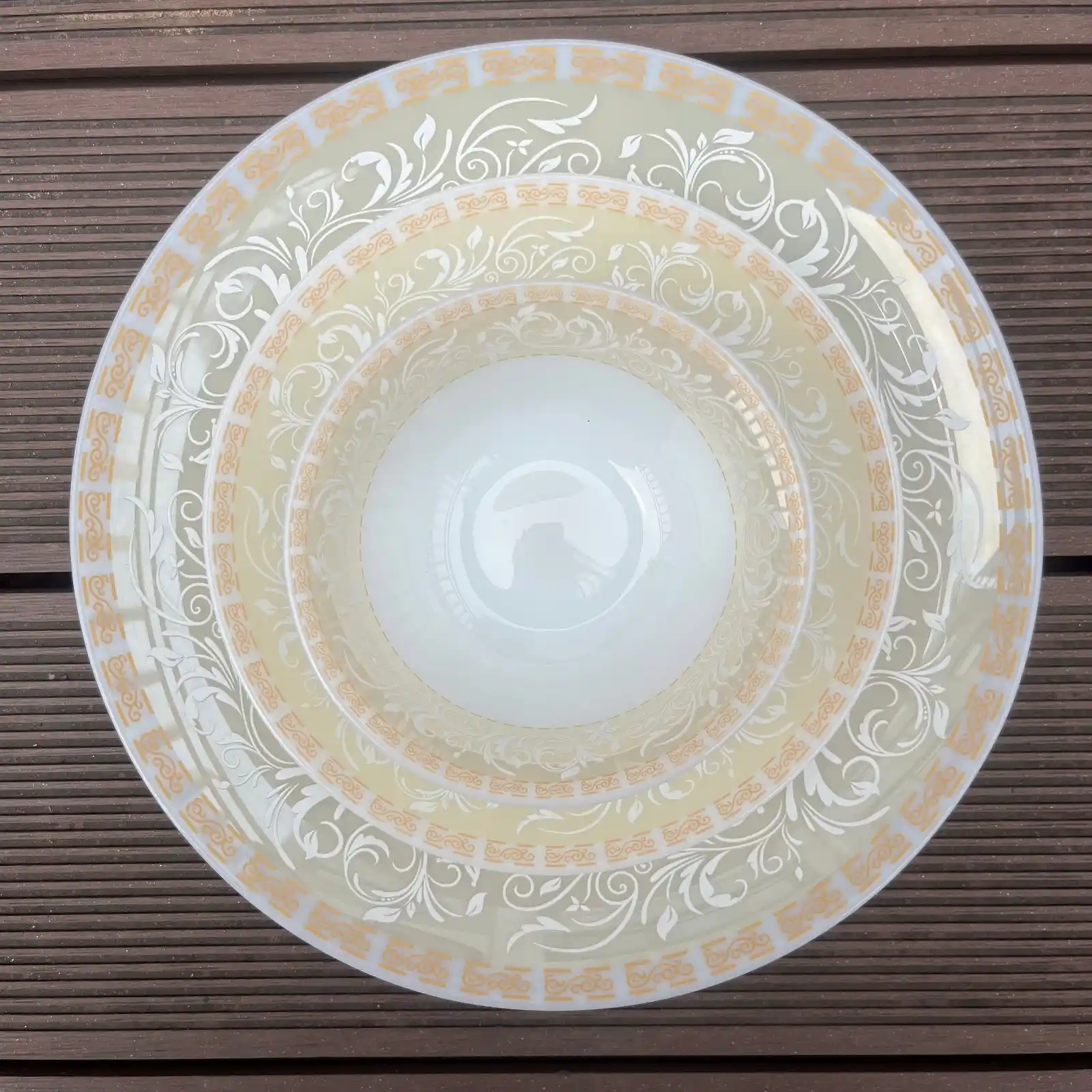
People sometimes search “is opalware food safe” — the answer is the same. “Opalware” is just a brand-style term for opal glass products. Same material, same standards.
Another common question: is tempered opal glass food safe? Tempering is a physical process — the glass is heated and rapidly cooled to boost impact resistance. It doesn’t change the chemical makeup. A tempered opal glass plate is just as food safe as a non-tempered one, with better durability.
If you know what to look for, you can browse the JOINTION opal glass dinnerware catalog for specifications and process details.
Common Questions People Ask
Q1: Buying opal glass in bulk for a restaurant — what food safety documents should I ask the supplier for?
Three things: a raw material composition sheet (confirming no lead or cadmium in the formula), a decoration process spec (confirming decal firing temperature reaches 680°C or above), and a third-party migration test report matching your target market — for example, an SGS-issued EU 1935/2004 or FDA 21 CFR report. Complete paperwork doesn’t guarantee perfection, but a supplier that can’t produce these documents probably shouldn’t be on your shortlist.
Q2: Is opal glass safe for baby food?
From a material standpoint, yes — no BPA, no phthalates, which gives it a chemical safety edge over plastic. For infant use, though, two extra checks are worth making. Choose plain, undecorated pieces to remove any decorative-layer risk entirely. And confirm the product has passed stricter migration tests for sensitive users, such as LFGB requirements for infant food contact materials.
Q3: After years of dishwasher use, does opal glass become less food safe?
No. Opal glass is non-porous, unglazed, and one solid body. Dishwasher detergent and hot water won’t break down the glass structure or cause leaching. You may see minor surface scratches after extended use — that’s physical wear, not chemical change. Food safety doesn’t decline with age, as long as the glass hasn’t cracked or chipped.